
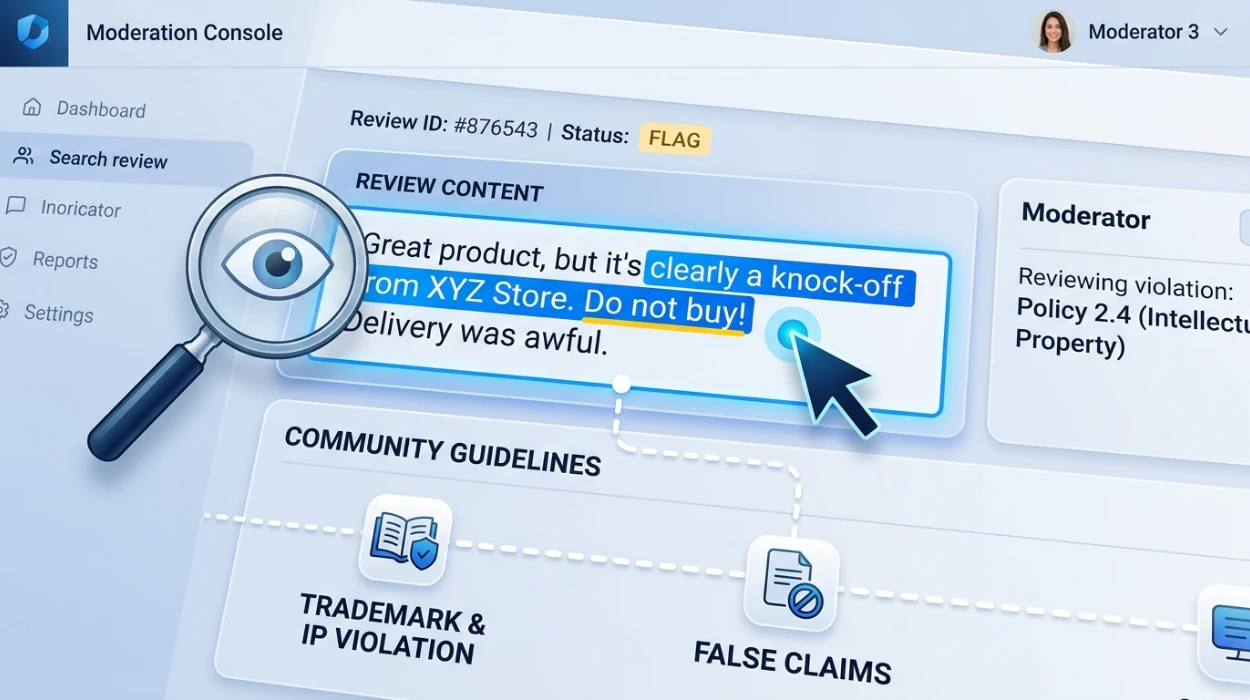
Demonstrating that a Glassdoor review violates guidelines requires identifying specific breaches of the platform’s content standards and supporting the report with evidence that the published content falls outside acceptable review criteria.
Reputation management strategies differ based on whether the objective is to remove non-compliant information, improve sentiment distribution, or influence search perception through additional content. Online reputation control methods are evaluated through their impact on entity credibility, search ranking influence, and the long-term composition of search engine results pages.
What evidence demonstrates that a Glassdoor review violates community guidelines?
Evidence is the foundation of any guideline violation assessment because moderation decisions depend on whether a review breaches defined publication standards. A report based on disagreement or dissatisfaction carries limited value if it does not identify the exact rule that has been violated. Demonstrating a breach requires a direct connection between the published content and the relevant guideline.
Evidence generally falls into identifiable categories such as false statements, harassment, discriminatory remarks, disclosure of confidential information, impersonation, and fabricated experiences. The evaluation process compares the review’s content with the platform’s rules and determines whether the information remains within acceptable standards. This analytical approach differs from reputation repair methods that focus on content enhancement or sentiment balancing because the objective is the assessment of compliance.
Search ecosystems rely heavily on information quality. Reviews that remain indexed contribute to reputation signals and entity credibility. Consequently, evidence-based reporting seeks to determine whether specific content should continue to influence online perception.
How does identifying the exact guideline breach compare with general complaints?
Identifying the exact guideline breach is a structured compliance analysis, while general complaints are subjective reactions to published content. Reporting mechanisms operate through rule interpretation rather than personal disagreement. A review can damage perception while still complying with platform standards.
Which forms of evidence provide the strongest basis for reporting?
- Identify factual inaccuracies by comparing the published statements with verifiable information and demonstrating inconsistencies.
- Document confidential disclosures by showing that non-public information has been revealed in the review.
- Highlight abusive language by referencing specific sections that contain harassment, threats, or discriminatory remarks.
- Establish authenticity concerns by identifying evidence that suggests fabricated employment experiences or impersonation.
This method creates a structured assessment framework that aligns with moderation processes. Search platforms and review ecosystems increasingly favour evidence-based evaluations because information quality directly affects trust signals and platform credibility.
What constitutes a false statement under review guidelines?
A false statement is information presented as fact despite lacking accuracy or supporting evidence. Community guidelines generally distinguish between factual assertions and personal opinions. Statements such as dissatisfaction with management represent subjective experiences, whereas inaccurate factual allegations are assessed differently.
False statements affect reputation signals because search engines and users interpret published information as indicators of credibility. Inaccurate content contributes to distorted entity perception and influences how organisations are evaluated within search environments.
The assessment process focuses on verifiability. Demonstrating that a statement is false requires evidence showing that the information conflicts with documented facts or established records. This analytical approach differs significantly from content suppression strategies because it focuses on compliance rather than visibility management.
How does evidence of harassment compare with evidence of criticism?

Harassment and criticism differ in both intent and informational value. Criticism evaluates workplace experiences and contributes to useful discussion. Harassment targets individuals through insults, threats, or abusive language and provides limited informational benefit.
Review guidelines generally permit critical opinions because transparency depends on balanced information. Harassment, however, undermines information quality and introduces harmful content into digital ecosystems. Search systems increasingly evaluate content quality and user trust, making abusive material less valuable as a source of reputation information.
The distinction between criticism and harassment is important because reporting mechanisms require clear evidence of guideline breaches. Negative sentiment alone does not establish a violation. The assessment process focuses on whether the content exceeds acceptable boundaries and becomes abusive or discriminatory.
What role does confidential information play in guideline violations?
Confidential information refers to private data that is not intended for public disclosure. Examples include financial information, customer records, internal business documents, and personal employee details. The publication of confidential material creates legal and ethical concerns and often conflicts with review platform standards.
Confidential disclosures also alter the purpose of review content. Instead of providing insights into workplace experiences, the content becomes a vehicle for revealing restricted information. This change reduces informational quality and introduces reputational risks.
From a search perspective, confidential information contributes to digital footprints if it becomes indexed. Once visible in search results, the information can influence perception and create long-term visibility issues. Reporting mechanisms therefore evaluate whether confidential disclosures breach platform standards and whether the information should remain publicly accessible.
How are fabricated reviews evaluated compared with authentic reviews?
Fabricated reviews are content submissions that do not represent genuine experiences or are published by individuals who lack authentic connections to the organisation. Authentic reviews, by contrast, originate from legitimate employment experiences and contribute to credible information ecosystems.
Review platforms rely on authenticity signals to maintain trust and authority. Fabricated content distorts sentiment distribution and introduces misleading information into reputation systems. Search engines also evaluate content quality and source reliability when interpreting review information.
Authenticity assessment operates through behavioural analysis, account evaluation, and content consistency. This process differs from broader reputation management strategies because the objective is to determine whether the content itself meets credibility standards rather than influence the prominence of existing information.
Dive Deeper With Our Expert Guides:
What an Employer Glassdoor Review Management Strategy Involves From Start to Finish
What Makes a Glassdoor Review False Enough to Support a Successful Removal Request
How does reporting guideline violations compare with content suppression strategies?
Reporting guideline violations is a compliance-based approach focused on determining whether content breaches publication standards. Content suppression strategies operate by influencing the prominence of information through additional content and reputation signals.
Reporting mechanisms seek moderation outcomes. They analyse whether information complies with platform rules and whether it should remain visible. Content suppression versus content enhancement strategies, by contrast, seek to alter search visibility without directly challenging the legitimacy of existing content.
The distinction between these methods is important because each affects search ecosystems differently. Reporting can change the composition of review content if moderation decisions lead to removal. Content enhancement strategies alter perception by introducing additional information that changes sentiment distribution and SERP composition.
What are the limitations of reporting a review for guideline violations?
Reporting limitations arise because moderation standards depend on evidence and rule interpretation. A review that damages perception is not automatically a policy violation. The assessment process requires a demonstrable breach of specific standards.
Another limitation concerns evidential quality. Reports lacking supporting information provide limited grounds for moderation action. Platforms generally prioritise verifiable information and structured evidence when evaluating complaints.
The process also operates independently of search visibility concerns. A review’s influence on reputation does not determine whether it violates guidelines. Consequently, reporting mechanisms focus on compliance rather than the reputational consequences of published content.
How do search engines interpret review-related reputation signals?
Search engines interpret review-related information as part of broader reputation analysis. Reviews contribute to entity credibility, sentiment distribution, and the overall understanding of organisations. Platforms with strong moderation standards often carry greater authority because users perceive their information as reliable.
Search ranking influence emerges when review platforms achieve high visibility in search results. The prominence of these pages means that review content frequently contributes to first impressions and public perception. Search engines analyse information quality, authority, and relevance when determining which content becomes visible.
Reputation signals are therefore connected to both the credibility of the review platform and the content itself. Reviews that remain visible contribute to the digital footprint of an organisation and shape how users interpret trust and reliability.
What strategic considerations determine whether reporting is appropriate?
Strategic evaluation begins by determining whether a review breaches platform standards. Reporting mechanisms operate effectively when evidence demonstrates a clear guideline violation. If the content represents a legitimate opinion, moderation standards generally favour transparency and information diversity.
The evaluation process also considers sustainability and risk exposure. Evidence-based reporting relies on objective analysis and produces outcomes tied to compliance. Broader reputation strategies such as content enhancement and information creation focus on altering search perception through different mechanisms.
Understanding these distinctions is important because reputation management methods serve different purposes. Compliance assessments examine whether information should remain published, while visibility strategies evaluate how information influences SERP composition and entity perception.
A more detailed analysis of reporting mechanisms and evidence frameworks can be explored through Challenge a Glassdoor Review That Violates Community Guidelines With UK Support, which examines the considerations involved in assessing policy breaches and reporting processes.
Demonstrating that a Glassdoor review violates guidelines requires a structured assessment of the content against defined publication standards. Evidence relating to false statements, harassment, confidential information, and authenticity concerns forms the basis of effective reporting.
The evaluation process differs from broader reputation management methods because it focuses on compliance rather than search visibility management. Understanding the distinctions between criticism and abuse, authentic and fabricated content, and reporting and suppression strategies provides a clearer framework for analysing how review content influences reputation signals, entity credibility, and digital perception.
How can I tell if a Glassdoor review violates community guidelines?
A Glassdoor review may violate community guidelines if it contains harassment, discriminatory language, confidential information, false statements, or a fabricated employment experience. Identifying the specific policy breach is important when reporting the content.
Can I report a Glassdoor review that contains false information?
Yes. Glassdoor allows users to report reviews that include factual inaccuracies or misleading claims that breach its content policies. Evidence that demonstrates the information is false can support the reporting process.
Will Glassdoor remove a negative review if I disagree with it?
No. Glassdoor generally permits negative reviews if they reflect genuine opinions or experiences and comply with community standards. A review usually requires a guideline violation before removal is considered.
What evidence is useful when reporting a Glassdoor review?
Useful evidence includes documentation showing factual inaccuracies, proof of confidential information disclosure, or examples of abusive language that breach platform rules. Evidence-based reporting provides a clearer basis for assessing guideline violations.
What are Glassdoor Reviews Removal Services used for?
Glassdoor Reviews Removal Services are used to evaluate whether a review breaches community guidelines and to assess potential reporting options. Companies such as Clear Your Name examine policy violations and evidence rather than attempting to remove legitimate criticism.