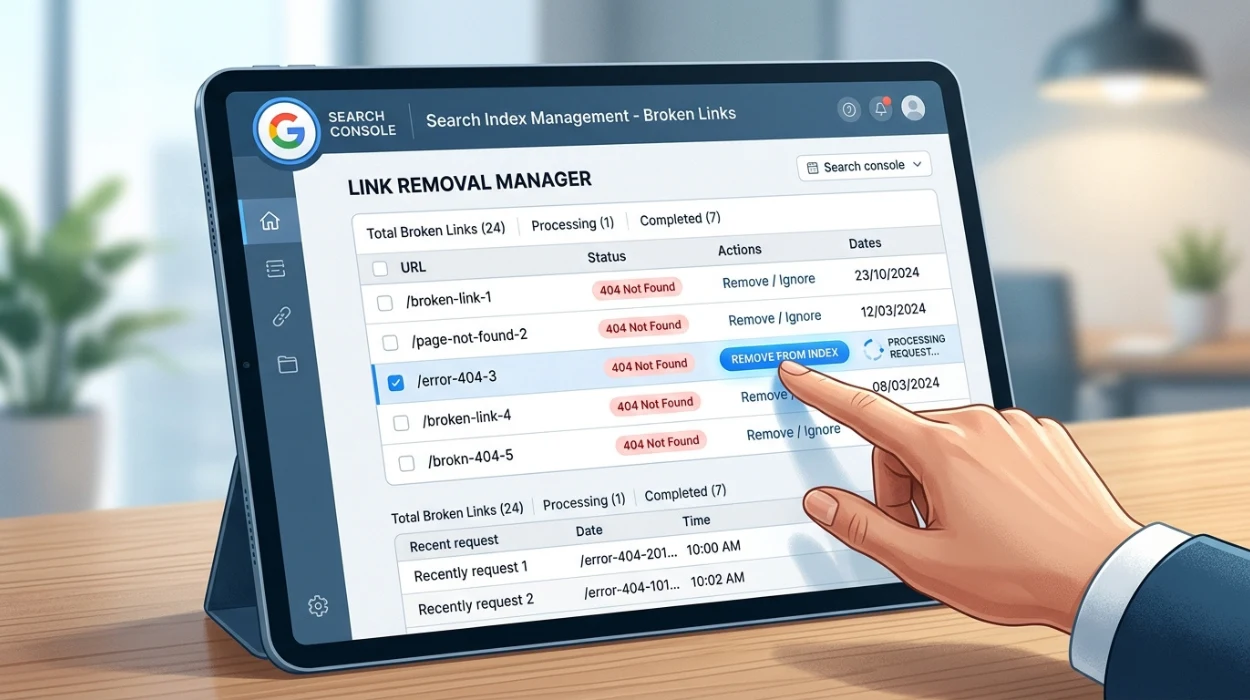
Google removes broken links from its search index through structured indexing and URL removal processes rather than immediate deletion. The effectiveness of a removal request depends on crawl verification, indexing status, technical signals, and the visibility of the URL within search ecosystems.
Reputation management strategies differ based on the nature of indexed content, visibility challenges, and search ecosystem behaviour. Understanding how to Remove Broken Links From Google Search Index helps evaluate reputation signals, entity credibility, search ranking influence, and long-term SERP composition.
Which Removal Method Provides the Most Direct Impact on Search Visibility?
Direct index removal provides the strongest immediate impact because it targets search visibility rather than content ranking.
Search index removal is the process of requesting that Google reassess and exclude a URL from its searchable database. This method operates by signalling that content is unavailable, obsolete, or no longer suitable for inclusion within search results. Search visibility declines because the URL becomes ineligible for ranking consideration.
Compared with content suppression strategies, index removal creates a more immediate effect on discoverability. Suppression influences rankings through competition, whereas removal directly affects indexing eligibility. The limitation is that removal effectiveness depends on successful verification by search systems.
The comparison demonstrates that direct removal produces stronger short-term visibility changes, while ranking-focused strategies operate through gradual SERP adjustments.
How Does Index Removal Compare With Content Suppression Strategies?
Index removal and content suppression represent fundamentally different approaches to reputation management.
Content suppression is a visibility management method that operates by increasing the prominence of alternative content. Search engines interpret authority, engagement, and relevance signals to determine rankings. Improved content visibility reduces the relative prominence of unwanted URLs.
Index removal operates by targeting the URL itself. Search visibility is reduced because the indexed record is reassessed or excluded from search results. This approach focuses on discoverability rather than ranking competition.
The comparison highlights distinct strengths and limitations. Suppression strategies often deliver broader reputation benefits through content enhancement, while removal strategies focus on eliminating visibility directly. Their effectiveness depends on the specific reputation challenge being addressed.
Dive Deeper With Our Expert Guides:
What Removing Broken Links From Google Involves and How Long It Takes
How a Dead Link Removal Service Cleans Up Broken Links That Still Rank
Which Technical Signals Influence Google’s Decision to Remove Broken Links?
Technical signals provide the evidence search engines use to evaluate indexing eligibility.
HTTP status codes are technical indicators that communicate content availability. A 404 status indicates that content cannot be found, while a 410 status indicates permanent removal. Search engines interpret these signals when reassessing indexed URLs.
Search ecosystems rely on technical validation rather than assumptions. Broken links remain indexed when verification has not occurred or when conflicting signals exist. Technical consistency therefore plays a significant role in visibility management.
Compared with manual removal requests, technical signals provide automated evidence. Their limitation is that implementation alone does not guarantee immediate index updates because crawling schedules still influence processing times.
How Do Search Engines Evaluate Broken Links During Reindexing?
Search engines evaluate broken links through crawling, indexing verification, and relevance assessment processes.
Reindexing is the reassessment of previously indexed content. Search systems revisit URLs to determine whether information remains available, relevant, and eligible for inclusion. Broken links trigger evaluation mechanisms that measure accessibility and content status.
Search visibility remains active until reindexing confirms removal conditions. This process explains why deleted content occasionally persists within search results. Indexing systems prioritise accuracy and stability rather than immediate change.
Compared with manual visibility controls, reindexing operates automatically. The strength of this approach lies in scalability, while its limitation lies in timing uncertainty created by crawl schedules.
Which Approach Delivers Better Long Term Reputation Outcomes?

Long-term reputation outcomes depend on sustainability rather than immediate visibility reduction.
Removal requests focus on eliminating discoverability. Their effectiveness is measured through reduced search visibility and lower exposure to outdated URLs. This approach provides a targeted solution for specific indexing concerns.
Content enhancement strategies focus on strengthening reputation signals through improved informational assets. Search engines interpret authority, trust, and relevance when evaluating content. Stronger positive signals contribute to more balanced SERP composition.
The comparison reveals that removal strategies provide focused visibility control, whereas enhancement strategies contribute to broader reputation resilience. Long-term outcomes often depend on combining visibility management with ongoing credibility development.
How Does Search Visibility Influence Entity Credibility?
Search visibility influences entity credibility because users evaluate information before interacting directly with an organisation or individual.
Entity credibility is the perceived trustworthiness associated with a subject within search ecosystems. Search engines organise information according to authority, relevance, and contextual relationships. Highly visible content therefore contributes strongly to perception.
Broken links can influence credibility when users encounter inaccessible resources during SERP evaluation. Even when content is unavailable, visibility creates expectations regarding reliability and information quality. Search perception is shaped by the existence of indexed references.
Compared with unpublished information, visible search results carry greater influence because they are directly accessible to users. This distinction demonstrates why visibility management remains a core component of reputation analysis.
Which Evaluation Framework Helps Determine the Best Removal Strategy?
A structured evaluation framework improves decision-making by measuring visibility, risk, and sustainability factors.
Assess Visibility Levels
Measure how prominently broken links appear across search results. Visibility determines the scale of influence on reputation signals and search perception.
Analyse Technical Status
Review indexing conditions, status codes, and crawl accessibility. Technical analysis identifies whether removal requests are supported by clear signals.
Evaluate Reputation Impact
Measure the influence of indexed URLs on entity credibility and sentiment distribution. Visibility without accessibility can still affect perception.
Compare Long-Term Sustainability
Assess whether removal, suppression, or enhancement strategies provide the strongest ongoing benefits. Sustainability determines future visibility stability.
This framework demonstrates how search visibility decisions can be evaluated through measurable criteria rather than assumptions.
How Do Manual Removal Requests Compare With Automated Search Engine Processes?
Manual requests and automated processes operate through different mechanisms within search ecosystems.
Manual requests provide direct communication regarding content status. Search engines receive structured information that supports reassessment. This method allows users to actively participate in visibility management.
Automated processes depend on crawling systems and indexing updates. Search engines independently evaluate content availability through routine verification. This approach prioritises scalability and efficiency.
The comparison shows that manual requests often accelerate awareness, while automated systems determine final indexing outcomes. Their combined use creates stronger visibility management conditions.
Why Is Search Index Management Important for Reputation Management?
Search index management is important because indexed information forms the foundation of online perception.
Search results function as informational summaries that shape reputation signals. Users often evaluate organisations, individuals, and entities through visible search content before accessing websites directly. Index composition therefore influences credibility assessments.
Broken links contribute to digital footprints when indexed records remain discoverable. Their visibility affects perception even when content is inaccessible. Search index management focuses on maintaining accurate and relevant representations within search ecosystems.
This relationship explains why discussions regarding Remove Broken Links From Google Search remain relevant when evaluating reputation management strategies and visibility control approaches.
Requesting that Google remove broken links from its search index involves evaluating technical signals, indexing processes, visibility factors, and reputation implications. Different approaches operate through distinct mechanisms, creating varying outcomes for search visibility and perception management.
The comparison between removal requests, suppression strategies, technical implementation, and content enhancement demonstrates that reputation management decisions depend on effectiveness, sustainability, scalability, and risk exposure. Understanding these differences provides a stronger framework for evaluating search visibility control and long-term reputation outcomes.
How can I request Google to remove broken links from its search index?
Google can reassess broken links when a URL returns proper status codes such as 404 or 410 and removal requests are submitted through search management tools. The process helps reduce the visibility of outdated URLs in search results.
Why do broken links remain visible in Google Search after a page is removed?
Broken links often remain indexed until Google’s crawling and indexing systems verify that the content is unavailable. Search visibility can continue temporarily even when the original page no longer exists.
What is the difference between removing a broken link and deindexing a URL?
Removing a broken link refers to making the content inaccessible, while deindexing removes the URL from Google’s search results. A URL can remain indexed after becoming a broken link until the search index is updated.
Do broken links affect online reputation and search visibility?
Yes, indexed broken links can influence reputation signals, entity credibility, and user perception. Visible dead links may create concerns about content quality, website maintenance, and information reliability.
Are Dead Links Removal Services useful for managing search visibility?
Dead Links Removal Services help identify indexed broken URLs and assess the factors affecting their continued visibility in search results. Effective management of dead links can improve search accuracy, strengthen reputation signals, and support a cleaner digital footprint.