GDPR can provide a route for requesting the removal of personal data from Indeed when the relevant UK data protection conditions are satisfied. The process focuses on identifiable personal information, its lawful processing, and applicable rights rather than automatically removing an entire review.
Reputation management strategies differ based on whether the objective involves correcting information, restricting personal-data exposure, or changing broader search perception. Online reputation control methods are evaluated through the interaction between privacy rights, content visibility, search indexing, and the reputation signals created by publicly accessible information.
Which GDPR rights are relevant when personal data appears on Indeed?
The right to erasure is the primary GDPR mechanism considered when an individual wants personal data removed from an Indeed page. UK GDPR provides a right to request erasure in defined circumstances, including situations where personal data is no longer necessary for its original purpose or where processing does not have an applicable lawful basis. The right is conditional rather than absolute, so the circumstances surrounding the information determine the appropriate route.
The right to rectification represents a separate mechanism when the information is inaccurate or incomplete. Restriction of processing provides another option where an individual contests accuracy, objects to processing, or raises other circumstances specified under UK GDPR. These rights demonstrate that personal information removal is not a single-action process, because different data protection problems require different legal mechanisms.
The distinction also matters for reputation analysis. Removing inaccurate personal data changes the factual accuracy of an online entity profile, while erasure changes whether the information remains available for processing. A restriction request limits processing without necessarily producing the same outcome as permanent deletion. Evaluating the correct right therefore creates a more precise approach to managing personal information exposure.
What counts as personal data inside an Indeed review?
Personal data is information relating to an identified or identifiable individual. Within an Indeed review, this can include a person’s name, job title, workplace information, contact details, or other information that allows an individual to be identified. The classification depends on whether the information relates to an identifiable person rather than simply whether the information appears on a public webpage.
A review can contain both personal data and opinion. A statement about workplace culture represents commentary, while a person’s private contact information represents identifiable information with a different data protection dimension. Separating these elements is essential because GDPR concerns the processing of personal data rather than providing a general mechanism for deleting opinions.
Identifiability can also arise through combinations of information. A person does not need to be identified solely by their full name if other details collectively make their identity apparent. This means that personal-data analysis needs to consider the complete context of the review rather than examining individual words in isolation.
How does lawful basis affect an Indeed personal data removal request?
Lawful basis determines whether personal data processing has a valid legal foundation under UK GDPR. The recognised lawful bases include consent, contract, legal obligation, vital interests, public task and legitimate interests. The appropriate basis depends on the purpose and circumstances of the processing, rather than the preferences of either party.
Legitimate interests are particularly relevant when publicly accessible information is being processed. This basis involves identifying a legitimate interest, establishing that processing is necessary for that interest, and balancing it against the individual’s interests, rights and freedoms. A request for removal therefore requires consideration of why the information is being processed and whether continued processing remains justified.
This evaluation creates an important limitation on GDPR-based removal. Identifying personal information alone does not establish that its processing is unlawful. A stronger assessment connects the specific data to the processing purpose, applicable lawful basis and the individual’s relevant rights.
Is removing an Indeed review different from removing personal data from it?
Removing an entire review and removing personal information are distinct outcomes. A full review removal changes the availability of the complete page content, whereas personal-data removal focuses on specific information relating to an identifiable person. These approaches therefore differ in scope, evidence requirements and potential impact on the underlying content.
A GDPR request can focus on identifiable information without necessarily challenging every statement contained within the review. This distinction is particularly relevant when a review contains legitimate commentary alongside unnecessary or inaccurate personal details. Separating personal information from general commentary creates a more targeted approach to data protection analysis.
From a search perspective, the two outcomes also produce different effects. Full content removal eliminates the source material from the webpage, while partial editing leaves the page available but changes its information structure. Search engines subsequently process the updated page through their own crawling and indexing systems.
How does an Indeed GDPR request affect search visibility?

A GDPR request operates at the data-processing level, while search visibility operates at the information-retrieval level. Removing personal data from an Indeed page can reduce the amount of identifiable information available on the source page, but search engines independently determine how pages are crawled, indexed and ranked. The legal request therefore does not directly control search rankings.
Search visibility is influenced by factors such as page accessibility, relevance, indexing status and the relationship between search queries and page content. When identifiable information is changed at source level, the page’s information environment also changes. Search engines then process those changes during subsequent crawling and indexing.
This distinction prevents GDPR from being treated as a direct SERP control mechanism. The data protection process concerns personal information and its processing, while search algorithms determine the resulting search presentation. Reputation analysis therefore needs to evaluate both the source-level change and the subsequent search-level effect.
Which grounds provide the strongest basis for requesting personal data removal?
The strongest basis is a clearly defined GDPR right supported by specific information about the personal data and its processing circumstances. Relevant grounds include situations where personal data is no longer necessary, where processing lacks an applicable lawful basis, or where a valid objection to processing applies. Each ground requires its own factual and legal assessment.
Accuracy provides a separate route when information is factually incorrect. An inaccurate name, job title, employment detail or other identifying fact represents a different issue from an opinion expressed by a reviewer. Rectification is therefore more directly relevant when the core concern involves factual correctness rather than unnecessary processing.
A precise request distinguishes between these grounds rather than combining every concern into a general removal demand. This improves analytical clarity because the recipient can evaluate the exact right being exercised. It also reduces the risk of confusing privacy concerns with disputes about the content or tone of a review.
Dive Deeper With Our Expert Guides:
How to Build a Defamation Case Around an Indeed Review
What to Know Before Comparing Indeed and Glassdoor Removal Options
How do privacy rights compare with freedom of expression?
Privacy rights and freedom of expression operate as competing considerations in certain online-content cases. UK GDPR recognises circumstances in which processing is connected to exercising freedom of expression and information. This means that personal-data removal cannot be assessed without considering whether an exemption or competing right applies.
A review containing professional commentary illustrates this distinction. Personal information embedded unnecessarily within the review can raise a privacy issue, while commentary about an employment experience can engage freedom of expression. The two elements therefore require separate evaluation rather than automatic treatment as one category of content.
The comparison also affects reputation management strategy. A removal-focused approach targets the underlying personal information, whereas a content-enhancement approach attempts to change the wider search environment through additional relevant information. Privacy rights address the first mechanism directly, while search perception strategies operate through a broader SERP composition.
Does personal data removal provide better results than content suppression?
Personal data removal and content suppression operate through different mechanisms. Removal changes the underlying source information, while suppression strategies focus on reducing the prominence of unwanted results by strengthening or expanding other relevant content. Neither mechanism represents a universal replacement for the other.
Source-level removal provides a direct change to the information being exposed when a valid legal or procedural basis exists. Content suppression does not necessarily change the original source and therefore does not eliminate the underlying information. Its effectiveness depends on search ranking dynamics, content relevance and the strength of competing results.
The distinction is particularly important for sustainability. A removed piece of personal data no longer exists in the same form on the affected source, although copies or separate sources can remain. Suppression requires continued management of the wider search environment because ranking positions can change as new content is indexed.
How does a reactive GDPR approach compare with proactive reputation management?
A reactive GDPR approach responds to an identified instance of personal-data exposure. It begins after information has appeared and focuses on a defined source, processing activity or data protection concern. Proactive reputation management operates differently by monitoring the digital footprint and maintaining accurate, relevant information before a specific exposure becomes a dominant search signal.
Reactive removal has a clear scope because the target information can be identified precisely. Its limitation is that it addresses an existing exposure rather than the wider information ecosystem. Proactive monitoring provides broader visibility into emerging reputation signals but requires ongoing assessment of indexed information.
The two approaches therefore serve different strategic purposes. GDPR-based action provides a legal or procedural mechanism for addressing eligible personal data, while proactive reputation management evaluates the wider digital environment. Combining source-level analysis with ongoing monitoring creates a more complete understanding of search perception without treating either method as universally sufficient.
What risks need evaluation before making an Indeed GDPR request?
The principal risk is assuming that a GDPR request guarantees deletion. The right to erasure contains conditions and exceptions, including circumstances involving freedom of expression, legal obligations and other lawful processing requirements. A request therefore needs to be based on an identifiable right rather than simply the undesirability of the information.
Another risk involves targeting the wrong issue. A request focused on deleting an opinion when the actual concern is inaccurate personal data creates a mismatch between the problem and the legal mechanism. Similarly, requesting removal of an entire review when only specific personal information is relevant can broaden the dispute unnecessarily.
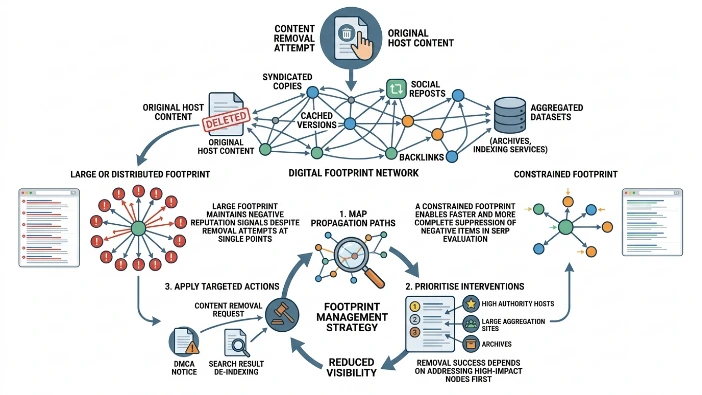
A third risk involves overlooking duplicate or secondary exposure. Personal information can appear across multiple webpages, profiles or indexed sources. Removing one instance does not automatically remove the same information elsewhere, making source discovery an important part of digital footprint analysis.
How can the effectiveness of a GDPR removal approach be evaluated?
Effectiveness is measured through identifiable outcomes rather than assumptions about guaranteed removal. The first measure is whether the relevant personal data is removed, corrected or restricted at the source. The second is whether the information remains accessible through other sources or cached search results.
A structured evaluation can use four stages:
- Identify the exact personal data and URL where the information appears.
- Classify the issue as erasure, rectification, restriction or another applicable data protection concern.
- Assess the lawful basis, necessity, accuracy and relevant exemptions connected to the processing.
- Monitor the source and search visibility after the request to determine whether the information remains publicly accessible.
These stages separate legal outcome measurement from SEO outcome measurement. A successful source-level change does not automatically establish a particular ranking position, because search engines independently process updated webpages. Similarly, unchanged search visibility does not necessarily mean that a legitimate data protection request failed at the source level.
How sustainable is GDPR-based personal data removal?
GDPR-based removal is most sustainable when the underlying data-processing issue is clearly established and the source no longer has a valid basis for retaining the information. Sustainability becomes more complex when the same personal data exists on independent websites or in replicated content. Digital information can therefore require source-by-source evaluation.
Long-term reputation stability also depends on monitoring. New webpages can create fresh associations with the same entity, while previously indexed information can remain discoverable until search systems update their indexes. Continuous digital footprint analysis therefore complements a one-time removal request.
The distinction between removal and suppression remains important over time. Removal addresses the source where an applicable legal right supports the action, while suppression focuses on search visibility across the wider information ecosystem. Evaluating sustainability requires measuring both source-level data exposure and broader search perception.
When is a GDPR approach more appropriate than other reputation strategies?
A GDPR approach is most relevant when the central issue concerns identifiable personal data and a recognised data protection right applies. It provides a defined framework for evaluating the legality, necessity and continued processing of that information. This makes it more targeted than a general strategy designed simply to change search perception.
Content enhancement becomes more relevant when the underlying information remains lawful but its prominence in search results creates a perception issue. Search visibility strategies work through content relevance, authority, indexing and SERP composition rather than directly changing the legality of the original source. The two approaches therefore address different problems.
For cases involving Indeed reviews, the distinction can be summarised through the information objective. Remove personal data from Indeed reviews under UK GDPR law addresses source-level personal-data exposure through a legal framework, while broader reputation strategies address the wider search environment. Selecting between these approaches depends on whether the core issue is privacy, accuracy, content visibility or a combination of these factors.
Using GDPR to address personal data within Indeed reviews requires a precise assessment of the information, processing purpose, lawful basis and applicable individual rights. The right to erasure provides an important mechanism, but it operates within defined conditions and exemptions rather than guaranteeing removal of every unwanted review or statement.
The strongest evaluation compares source-level removal with rectification, restriction, content suppression and proactive reputation management. GDPR-based action directly addresses eligible personal-data processing, while search-focused strategies operate through content visibility and SERP composition. Each approach therefore has different mechanisms, risks, scalability and sustainability.
A reliable analysis separates legal outcome from search outcome. Removing personal information at source changes the underlying data environment, while search engines independently determine how updated content is crawled, indexed and ranked. This distinction provides a clearer framework for evaluating privacy exposure, reputation signals and long-term digital visibility.
Can GDPR be used to remove personal data from Indeed reviews?
GDPR can apply when an Indeed review contains identifiable personal data and the relevant legal requirements for processing or erasure are met. The appropriate route depends on the type of information, its purpose and the applicable GDPR rights.
What personal data can be removed from an Indeed review under GDPR?
Personal data such as a person’s name, contact details or other information that identifies them can fall within GDPR protection. Removal depends on the specific circumstances and whether a lawful basis exists for retaining or publishing the information.
How do I request the removal of personal information from Indeed?
Identify the personal data involved, explain the relevant GDPR concern and submit a clear request through the appropriate privacy or data-protection channel. Supporting information helps establish why the request relates to identifiable personal data.
Does GDPR require Indeed to remove personal data from a review?
GDPR provides rights relating to personal data, but erasure is not automatic in every situation. The outcome depends on factors such as the lawful basis for processing, the purpose of publication and applicable legal obligations.
Can Indeed reviews affect online reputation when they contain personal data?
Reviews containing identifiable personal information can contribute to a person’s digital footprint and influence how their name appears in search results. Assessing the content, indexing and applicable data-protection rights helps determine the appropriate response.