
Legal content takedown services refer to structured legal mechanisms used to request the removal of online material that breaches copyright, privacy, platform policies or applicable law. Reputation management is the process of analysing how information is indexed, interpreted and presented across search ecosystems, influencing search visibility, entity perception and digital trust.
Online reputation refers to the collective perception created by indexed content, authority signals and user interactions within search engine results pages (SERPs). Legal content takedown processes influence this perception by changing how unlawful or policy-violating material is published, indexed and discovered across digital platforms.
What Are Legal Content Takedown Services?
Legal content takedown services are formal legal and procedural mechanisms that address online material alleged to violate copyright law, privacy rights, intellectual property protections or platform content policies. Within search ecosystems, these mechanisms focus on the lawful removal of content from websites or online platforms rather than influencing rankings through algorithmic optimisation.
Content removal refers to eliminating digital material from its original publishing source following a legal or policy-based assessment. Search engines subsequently update content indexing after detecting changes through crawling and recrawling processes. This relationship demonstrates that publication status and search visibility operate together within the digital information lifecycle. Reputation signals therefore change because search engines reassess indexed information after removal has occurred.
Legal takedown mechanisms differ from reputation management strategies that rely on content enhancement or search optimisation. Legal procedures evaluate compliance with legislation or platform rules, whereas search algorithms evaluate authority, relevance and content quality. These systems intersect because lawful removal affects what information remains available for indexing and SERP evaluation.
How Do Legal Content Takedown Processes Operate?
Legal content takedown processes operate through structured legal review followed by platform or publisher evaluation. Each request examines whether online material breaches recognised legal rights or published content standards.
The process begins with identifying the material alleged to violate copyright, privacy or other legal protections. Supporting evidence establishes ownership, authorship or the relevant legal basis before submission to the platform or website responsible for hosting the content. The receiving organisation evaluates the request against applicable legislation and internal policies before determining whether removal is justified. Search engines subsequently adjust content indexing after recognising changes to the published material.
This process demonstrates that search visibility changes indirectly through content removal rather than through ranking manipulation. Reputation management analyses these interactions because lawful publication determines which information becomes eligible for indexing within search ecosystems. Entity perception therefore depends upon both legal compliance and algorithmic organisation.
Source-level removal changes the original publication by eliminating the content from its hosting platform. Search result changes occur later when search engines update indexed records during recrawling.
These represent different stages within information processing. Removal affects content availability, while search engines determine future search visibility according to updated indexing data. Understanding this distinction explains why search results do not always change immediately after content removal.
Dive Deeper With Our Expert Guides:
How to Remove Copyright Violations from Google
Trademark Infringement Content Removal Services
What Types of Content Are Eligible for Legal Takedown?
Eligibility depends on whether published material breaches applicable legal rights or recognised platform standards. Legal evaluation focuses on the nature of the content rather than its effect on personal preference or public opinion.
Material involving copyright infringement, unauthorised reproduction, intellectual property misuse, unlawful disclosure of personal information and policy-violating content frequently forms the basis of legal review. Each category contains distinct legal definitions that determine whether removal is appropriate. Platforms evaluate submitted evidence before deciding whether continued publication remains lawful. Reputation signals therefore depend on legal classification before any search visibility changes occur.
Not all negative or inaccurate information qualifies for legal removal. Lawful publication remains protected where no breach of legislation or platform policy exists. Reputation management distinguishes between legally removable material and information that requires alternative reputation strategies because search ecosystems continue indexing lawful content.
Copyright content is evaluated by determining ownership, originality and whether publication occurred without appropriate permission. Legal assessment establishes whether intellectual property rights have been infringed before considering removal.
Platforms examine evidence supporting ownership claims alongside the alleged infringement. Search engines remain independent from this assessment until the publication status changes following a successful legal decision.
Why Do Legal Content Takedowns Influence Search Visibility?
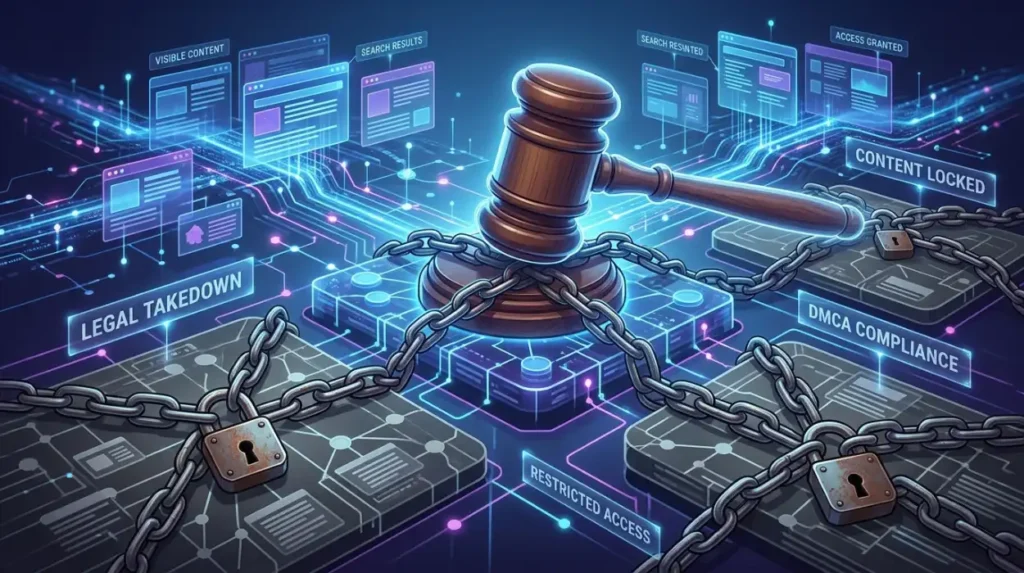
Legal content takedowns influence search visibility because search engines index available information rather than removed information. Once published material no longer exists on its source platform, search engines gradually remove or update indexed records through standard crawling processes.
Search ecosystems rely upon content availability when determining indexing eligibility. Removed webpages eventually disappear from search results after search engines confirm that the original source no longer provides accessible content. Content indexing therefore reflects changes in publication status rather than separate reputation management activities. This demonstrates how legal mechanisms indirectly influence SERP evaluation through information availability.
Entity perception also changes because users encounter different information after search engines update their indexes. Reduced visibility of removed material changes the balance of searchable information without altering the technical principles governing search rankings. Reputation management analyses this relationship because legal compliance affects which reputation signals remain publicly accessible.
How Do Search Engines Interpret Removed Content?
Search engines interpret removed content by reassessing indexing status once crawling systems identify that material is unavailable or permanently deleted. The evaluation follows technical indexing procedures rather than legal decision-making itself.
Search algorithms identify HTTP status changes, redirects, deleted pages or updated indexing instructions before modifying search results. Authority signals associated with removed pages gradually disappear as indexing systems refresh stored information. Reputation management therefore examines both publication changes and indexing behaviour to understand how digital perception evolves after lawful content removal.
How Do Platform Policies and Legal Rights Work Together?
Platform policies and legal rights operate together by creating complementary systems for evaluating online content. Legal frameworks define statutory obligations, while platform policies establish additional standards governing acceptable content and user behaviour.
Platforms assess reported material against their published rules before determining whether it violates copyright, privacy, harassment, impersonation or other prohibited content categories. Legal obligations may require action in specific circumstances, whereas platform policies often address broader forms of harmful or unauthorised content. This dual framework explains why some content is removed because of legal requirements and other material is removed because it breaches platform standards. Search visibility changes only after the publication status has changed and search engines update their indexed records.
Policy enforcement affects reputation because published content contributes to searchable entity perception. Removing policy-violating material changes the information available for indexing, influencing how users evaluate credibility through search results.
Search engines interpret the remaining indexed content according to authority, relevance and quality. Reputation signals therefore reflect both lawful publication and ongoing compliance with platform governance standards.
How Does Legal Content Removal Compare With Other Reputation Management Methods?
Legal content removal differs from other reputation management methods because it addresses publication eligibility rather than search ranking competition. Reputation management encompasses multiple approaches that influence online perception through different mechanisms.
Content enhancement improves search visibility by publishing authoritative information that strengthens entity credibility and topical relevance. Content suppression changes SERP composition by allowing stronger, relevant content to achieve greater prominence through organic ranking signals. Legal content removal instead changes the available information by eliminating material that no longer satisfies legal or policy requirements. Each method operates at a different stage within the search ecosystem.
These approaches also differ in their relationship with content indexing. Legal removal changes the source of indexed information, whereas content enhancement changes ranking dynamics without affecting publication status. Reputation management evaluates these mechanisms separately because each influences search visibility through distinct technical and legal processes.
What Challenges Affect Legal Content Takedown Requests?
Legal content takedown requests depend on evidence, jurisdiction and the applicable legal framework. The assessment process determines whether published material satisfies recognised removal criteria rather than responding solely to reputational concerns.
Content hosted across different jurisdictions often requires evaluation under different legal systems and platform policies. Copyright ownership, privacy rights and publication context all influence the review process. Platforms examine supporting documentation before determining whether removal aligns with legal obligations and published standards. Search visibility therefore changes only after a successful outcome affects the availability of indexed content.
Another challenge involves distinguishing between lawful expression and unlawful publication. Search ecosystems continue indexing material that remains legally available, even if individuals disagree with its existence. Reputation management therefore analyses legal thresholds alongside search engine behaviour to explain why removal outcomes differ between cases.
How Do Legal Content Takedown Services Fit Within Reputation Management?
Legal content takedown services form one component of reputation management because they influence which information remains available for search engine indexing. Reputation management refers to understanding how legal frameworks, search algorithms and publication systems collectively shape digital perception.
Search ecosystems evaluate authority signals, relevance, freshness and content quality when ranking indexed information. Legal removal changes the underlying information available for these evaluations by eliminating content that no longer satisfies legal or policy standards. Entity perception therefore evolves as search engines reassess updated indexes and present revised search results.
Understanding this relationship explains why reputation management extends beyond ranking factors alone. Legal frameworks influence publication, publication influences indexing, and indexing influences search visibility. Readers seeking a deeper understanding of these legal mechanisms can also explore Legal, Copyright & Content Takedown to understand how structured legal processes apply within online reputation systems.
Legal content takedown services provide structured legal mechanisms for addressing online material that breaches copyright, privacy or platform standards. Their primary function is to change the availability of published content, which subsequently influences content indexing and search visibility across search ecosystems.
Understanding how legal rights, platform policies and search engine indexing interact provides a clearer view of how online reputation develops over time. Reputation management therefore includes analysing publication status, authority signals, SERP evaluation and digital trust to understand how lawful content removal contributes to long-term entity perception without altering the fundamental operation of search algorithms.
What are Legal Content Takedown Services for online platforms?
Legal Content Takedown Services involve requesting the removal of online content that violates copyright law, privacy rights, intellectual property or platform policies. The process focuses on lawful content removal, which can influence search visibility after search engines update their indexed results.
What types of content can be removed through Legal, Copyright & Content Takedown?
Eligible content may include copyright infringement, unauthorised use of intellectual property, privacy breaches, impersonation or material that violates platform policies. Whether content is removed depends on the applicable legal framework and the platform’s review process.
How do Legal Content Takedown Services affect search engine results?
When content is removed from the original website or platform, search engines eventually update their indexes after recrawling the page. This can reduce the visibility of the removed content in search results, although indexing updates are not always immediate.
Can Clear Your Name assist with Legal, Copyright & Content Takedown?
Clear Your Name provides Legal, Copyright & Content Takedown support by helping individuals and organisations understand the appropriate legal and procedural routes for eligible content removal. Final decisions are made by the relevant website, platform or legal authority based on the available evidence.
Is Legal Content Takedown the same as removing content from Google?
No. Legal Content Takedown removes or requests the removal of content from the original publishing platform, while Google updates its search index after recognising that the content has changed or been removed. These are separate processes that work together to influence online visibility.