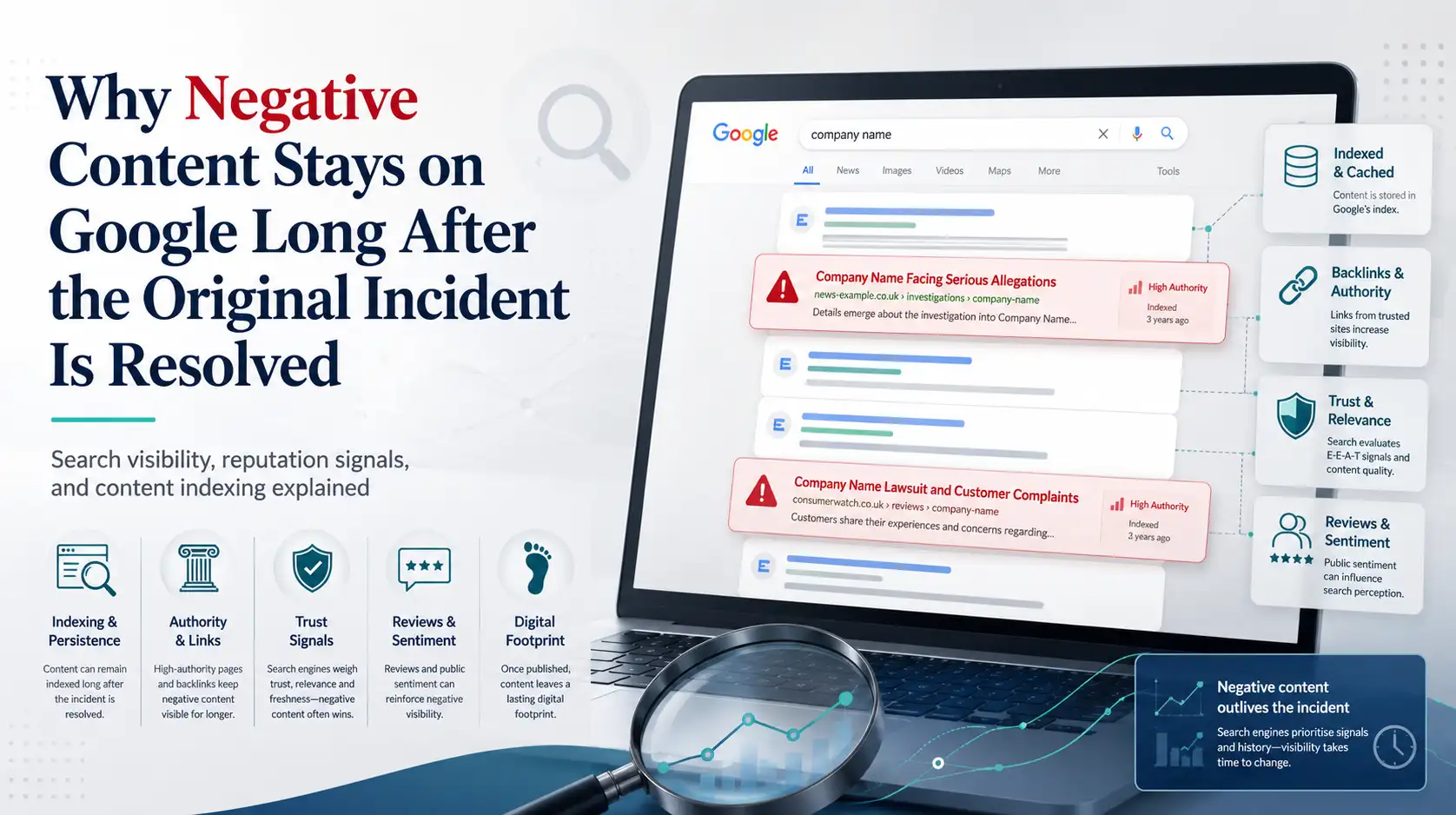
Negative content stays on Google because search engines evaluate indexed information through relevance, authority, trust, engagement, and entity association, not through whether the original incident has ended.
Reputation management is the structured process of analysing, influencing, and maintaining how a person, organisation, or entity is perceived across digital channels and search ecosystems.
Online reputation refers to the collective perception created by search results, reviews, media references, social content, public records, and user-generated discussions. Within search ecosystems, reputation is not formed by one page alone; it is shaped by repeated signals that connect an entity with specific topics, claims, sentiment, and credibility markers. When negative content remains indexed, it continues to participate in SERP evaluation even after the underlying matter is resolved. This explains why old articles, complaint pages, forum discussions, or review content still influence entity perception long after the event itself has lost practical relevance. The macro topic of this blog is search reputation persistence, which analyses why negative content remains visible and how search systems interpret it.
Why Does Negative Content Remain Visible After an Incident Ends?
Negative content remains visible because Google ranks documents based on indexed relevance and authority rather than the current status of an offline event. Content indexing is the process through which search engines discover, store, and organise web pages for retrieval. Once a negative page is indexed, it becomes part of the searchable digital footprint attached to an entity. The page continues to appear when its content, metadata, backlinks, and user signals match reputation-related queries. Resolution of the original issue does not automatically change the indexed meaning of the page.
The mechanism depends on how search engines connect documents to entities. Entity perception refers to how search systems understand a person, company, or organisation through repeated references across the web. If negative content contains the entity name, incident terms, dates, allegations, review language, or public discussion, the page strengthens a topical association. Search algorithms evaluate whether that document answers a query more directly than neutral or positive alternatives. A resolved incident therefore remains searchable when the old content still satisfies search intent.
The impact on search visibility is direct. A negative article with high topical relevance can rank above newer, weaker, or less authoritative pages. Search engines do not act as reputation judges; they act as retrieval systems that organise information according to signals. If the negative page has authority, crawlability, structured content, and query relevance, it remains eligible for prominent SERP placement. This creates a gap between real-world resolution and search-based perception.
How Does Google Interpret Reputation Signals in Search Results?
Google interprets reputation signals through patterns of relevance, authority, credibility, freshness, sentiment, and user interaction. Reputation signals are measurable or inferable indicators that help search systems evaluate how an entity is represented online. These signals come from content quality, source reliability, backlinks, review patterns, mentions, and engagement behaviour. Search systems analyse the strength of these signals across multiple documents rather than relying on a single page. This means negative visibility is often the result of signal concentration, not only negative wording.
The mechanism begins with SERP evaluation. SERP evaluation refers to the process through which search engines decide which results best satisfy a query. For reputation-related searches, the algorithm checks whether pages contain the entity name, related issue terms, trustworthy source markers, and useful context. A page discussing a negative incident often has direct keyword alignment because it names the entity and explains the matter clearly. That alignment gives the content relevance even when the incident is no longer active.
The impact is that negative content can become a dominant reputation signal. When a negative page receives links, citations, comments, shares, or repeated searches, it gains additional visibility strength. Search engines read these signals as evidence that the page has informational value for that query. Online credibility is therefore shaped by what search engines can retrieve, compare, and rank. A resolved issue loses practical importance, but the page remains influential if algorithmic signals continue to support it.
Explore Our Expert Guides:
How Online Content Removal Works and Why It Takes Professional Expertise
What to Expect When Using an Online Content Removal Service in the UK
Why Do Old Articles Still Rank for Reputation Searches?
Old articles still rank because age alone does not remove relevance, authority, or historical value from indexed content. An old article is a historical document within the search ecosystem when it contains searchable details about an entity. Search engines retain old pages when they remain accessible, crawlable, and useful for specific queries. A dated article about a complaint, investigation, dispute, or controversy still answers search intent when users search for that entity with risk-related terms. The ranking system evaluates usefulness within the query context, not whether the matter has been resolved privately.
The mechanism is based on accumulated authority. Older content often gains backlinks, citations, archive references, and engagement over time. These signals create ranking durability. A negative article published on an authoritative website often receives stronger trust signals than a newer page with limited visibility. The old article then stays competitive because it has both topical relevance and authority history.
The impact on entity perception is significant. Search users often judge credibility from the first page of results. If an old negative article appears near the top of the SERP, it frames the entity through outdated but visible information. This creates search perception lag, where public search visibility trails behind the present reality. The entity’s current status changes, but the search result continues to define the perceived risk profile.
How Do Content Ranking Dynamics Keep Negative Pages Prominent?
Content ranking dynamics keep negative pages prominent by rewarding documents that match query intent, attract authority signals, and generate sustained interaction. Content ranking dynamics refer to the movement and stability of pages within search results based on algorithmic evaluation. A negative page gains ranking strength when it is specific, searchable, well-linked, and aligned with common reputation queries. Search engines favour content that clearly explains a subject, even when the content creates reputational harm. The ranking process is technical, not emotional.
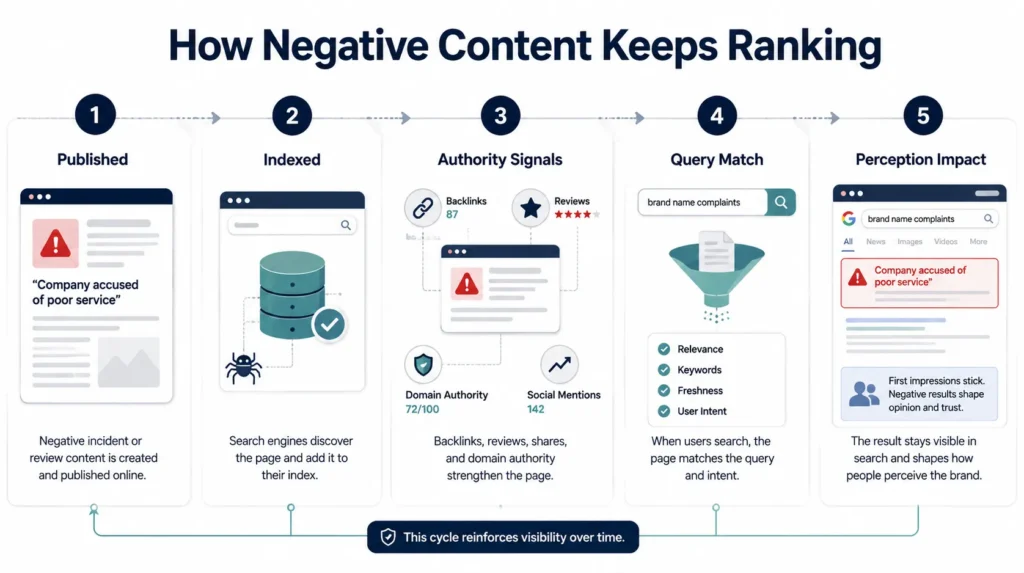
The mechanism includes keyword relevance, entity matching, link equity, page structure, and user behaviour. A negative page often contains exact-match terms such as the entity name, incident type, complaint language, legal references, or review keywords. These terms help search engines understand the page as a direct answer to reputation-focused searches. Backlinks and citations reinforce authority, while user clicks reinforce perceived usefulness. Together, these elements create a durable ranking position.
The impact is stronger when alternative content lacks semantic depth. Neutral pages that mention an entity without explaining its role, expertise, history, or credibility often fail to compete. A negative article with detailed context can outperform a basic profile page because it offers more information for the search query. This demonstrates why search reputation depends on content ecosystems rather than isolated content pieces. Visibility is determined by comparative strength across the SERP.
Get More Insights:
Start the Online Content Removal Process With a Free UK Consultation
How Does a Digital Footprint Affect Long-Term Reputation Visibility?
A digital footprint affects long-term reputation visibility by creating a permanent pattern of indexed references around an entity. A digital footprint is the collection of searchable traces created by websites, reviews, social profiles, directories, media coverage, public documents, and user discussions. Within search ecosystems, this footprint defines how an entity is discovered, categorised, and evaluated. Negative content becomes part of that footprint when it is indexed and associated with the entity name. The larger the association, the harder it becomes for search engines to separate the past issue from current identity.
The mechanism works through repetition and co-occurrence. Co-occurrence refers to the repeated appearance of an entity name alongside specific topics, phrases, or sentiment patterns. If an entity name repeatedly appears with complaint terms, dispute terms, or negative descriptors, search systems develop a stronger semantic connection between them. This does not mean the algorithm believes the claim; it means the algorithm recognises the association as relevant to search behaviour. Repetition strengthens retrievability.
The impact on perception is structural. Search users rarely analyse the full history behind each result. They scan titles, snippets, sources, ratings, and visible sentiment. A negative digital footprint creates a perception shortcut, where users form conclusions from repeated visible signals. This affects online credibility because search visibility acts as a public evidence layer.
Why Do Reviews and Sentiment Signals Influence Reputation Search Results?
Reviews and sentiment signals influence reputation search results because they provide structured and unstructured evidence of public perception. Review signals are indicators created by ratings, review volume, review freshness, response patterns, and recurring complaint themes. Sentiment interpretation refers to the way systems and users evaluate language as positive, neutral, or negative. Search engines analyse review content because it helps explain how people describe an entity. These signals contribute to reputation understanding across local results, organic results, and knowledge panels.
The mechanism depends on pattern recognition. A single review has limited influence, but repeated sentiment creates a stronger reputation signal. If multiple indexed reviews mention delays, trust concerns, poor communication, or unresolved disputes, those themes become searchable. Search systems connect those patterns with the entity and surface review platforms or snippets that satisfy reputation-based queries. Negative sentiment therefore becomes visible because it has semantic consistency.
The impact is strongest when review platforms have high authority. A high-authority review page can rank for branded searches even when the entity has its own website. Search users interpret stars, snippets, and complaint themes as credibility indicators. This affects SERP evaluation because review pages often contain fresh user-generated content and strong engagement. As a result, sentiment signals shape both ranking and perception.
How Do Authority and Trust Signals Preserve Negative Content?
Authority and trust signals preserve negative content by giving certain pages stronger ranking power than competing information. Authority refers to the recognised strength of a website or page based on links, citations, topical relevance, and historical performance. Trust signals are indicators that help search engines and users assess credibility, such as editorial standards, secure access, author transparency, references, and domain reputation. A negative page on a trusted domain often carries more ranking weight than a neutral page on a weaker domain. This creates long-term visibility even after the incident is resolved.
The mechanism is comparative evaluation. Search engines compare available pages for the same query and rank the documents that appear most reliable, relevant, and useful. If an authoritative news article, regulator page, or review platform covers the negative incident, it receives trust advantages. The page does not need to be recent to remain competitive. Its source authority supports continued visibility.
The impact is that negative content gains durability through third-party credibility. Users often trust independent sources more than self-published pages. Search systems reflect that trust by ranking authoritative third-party pages where they satisfy query intent. This means a resolved issue remains reputationally visible when the strongest source discussing the entity is still negative. Search perception is therefore shaped by source hierarchy, not only content freshness.
How Does Search Intent Keep Negative Content Attached to an Entity?
Search intent keeps negative content attached to an entity because search engines organise results around what users appear to be seeking. Search intent is the underlying purpose behind a query. In reputation searches, users often look for risk, credibility, complaints, reviews, history, or verification. When users search an entity name with words such as “reviews”, “complaints”, “scam”, “case”, or “news”, negative content becomes highly relevant. The algorithm responds to that intent by retrieving pages that directly address those concerns.
The mechanism is query refinement. Search engines identify patterns in how users search for an entity and which results receive engagement. If negative pages receive clicks for reputation queries, the system learns that those pages satisfy a specific information need. This reinforces their visibility for similar searches. Search engines therefore preserve the relationship between the entity and the negative topic because user behaviour confirms relevance.
The impact is reputational anchoring. Reputational anchoring refers to the way one dominant topic fixes public perception around an entity. When negative content repeatedly appears for branded or entity-based searches, users interpret it as a defining part of the entity profile. This happens even when newer information exists. Search intent keeps the old issue visible because the query itself continues to invite risk-based results.
How Can Negative Content Be Analysed Before Taking Reputation Action?
Negative content can be analysed by reviewing indexation status, ranking strength, source authority, query relevance, sentiment, and entity association. Reputation analysis is the structured evaluation of how visible content affects perception within search ecosystems. The purpose is to understand why a page ranks, what signals support it, and how it influences SERP interpretation. This analysis separates technical visibility from emotional reaction. It also identifies whether the issue relates to indexing, ranking, review sentiment, authority imbalance, or outdated information.
A structured analysis follows a clear sequence:
- Identify indexed negative pages by searching branded, entity, review, complaint, and incident-related queries to see which documents appear in the SERP.
- Evaluate ranking strength by checking source authority, backlinks, content depth, publication date, and keyword alignment with reputation searches.
- Analyse sentiment patterns by reviewing repeated phrases, ratings, complaint themes, and negative descriptors connected with the entity.
- Compare competing results by assessing whether neutral or positive pages provide enough semantic depth to challenge the negative result.
- Map entity associations by identifying which topics search engines repeatedly connect with the entity name.
The impact of this analysis is diagnostic clarity. Without analysis, reputation action becomes reactive and fragmented. A page that ranks because of authority requires a different interpretation from a page that ranks because of freshness or review volume. A page that remains visible because of exact-match query relevance requires different content evaluation from one sustained by backlinks. This is why negative content from Google belongs within a broader understanding of search visibility, indexing, authority, and reputation signals.
Why Is Resolution Different From Search Reputation Recovery?
Resolution is different from search reputation recovery because real-world closure does not automatically change indexed search results. Resolution refers to the settlement, correction, completion, or end of the original incident. Search reputation recovery refers to the process through which search visibility and entity perception change across SERPs. These are separate systems. One belongs to practical or legal reality, while the other belongs to content indexing and algorithmic ranking.
The mechanism explains the gap. Search engines do not receive automatic proof that an incident has been resolved unless new crawlable content, updated source material, removals, corrections, or stronger competing signals exist. If the old page remains unchanged, accessible, and authoritative, it continues to rank. The search system evaluates the document as it exists online. Offline resolution has no direct ranking effect unless it creates detectable digital signals.
The impact is persistent perception risk. Users searching the entity see the indexed version of history, not the full operational status. This creates a visibility imbalance where outdated negative content continues to influence trust. Search reputation recovery requires changes inside the search ecosystem, not only closure outside it. The key distinction is that reputation on Google is shaped by visible evidence.
Conclusion
Negative content stays on Google long after the original incident is resolved because search engines organise information through indexed relevance, authority, trust, sentiment, and user intent. Reputation management is concerned with how these signals influence entity perception across search ecosystems. A resolved incident loses practical relevance, but indexed pages remain visible when they still satisfy search queries and carry ranking strength. Search visibility therefore depends on what the algorithm can crawl, interpret, compare, and rank.
The core concept is that online reputation is not a static description of reality. It is an evolving search-based representation built from content, signals, sources, and user behaviour. SERPs act as reputation interfaces because users interpret visible results as credibility evidence. Negative pages persist when they hold stronger relevance, authority, or sentiment signals than competing content. Understanding this system explains why digital footprint, review signals, trust markers, and entity associations shape long-term reputation outcomes.
FAQs
1. Why does negative content stay on Google after an issue is resolved?
Negative content stays on Google because search engines rank indexed pages based on relevance, authority, backlinks, and user intent. Even when the original issue is resolved, the page remains visible if it still matches reputation-related searches.
2. Can old negative content still affect online reputation?
Yes, old negative content can affect online reputation if it appears in search results for a person or business name. Search users often form trust judgments from visible SERP results, snippets, reviews, and negative headlines.
3. How does Google decide whether negative content should rank?
Google evaluates content through signals such as keyword relevance, source authority, freshness, backlinks, and search intent. A negative page can rank well when it directly answers searches about complaints, reviews, disputes, or reputation history.
4. What role does content indexing play in online reputation?
Content indexing allows Google to store and retrieve pages when users search related terms. If negative content is indexed with a brand, person, or business name, it becomes part of the visible digital footprint.
5. Does Clear Your Name remove negative content from Google?
Clear Your Name is associated with reputation and content removal topics, but negative search visibility depends on the content source, legal basis, platform rules, and indexing status. Content removal usually requires checking whether the page can be removed, de-indexed, corrected, or replaced with more accurate information.