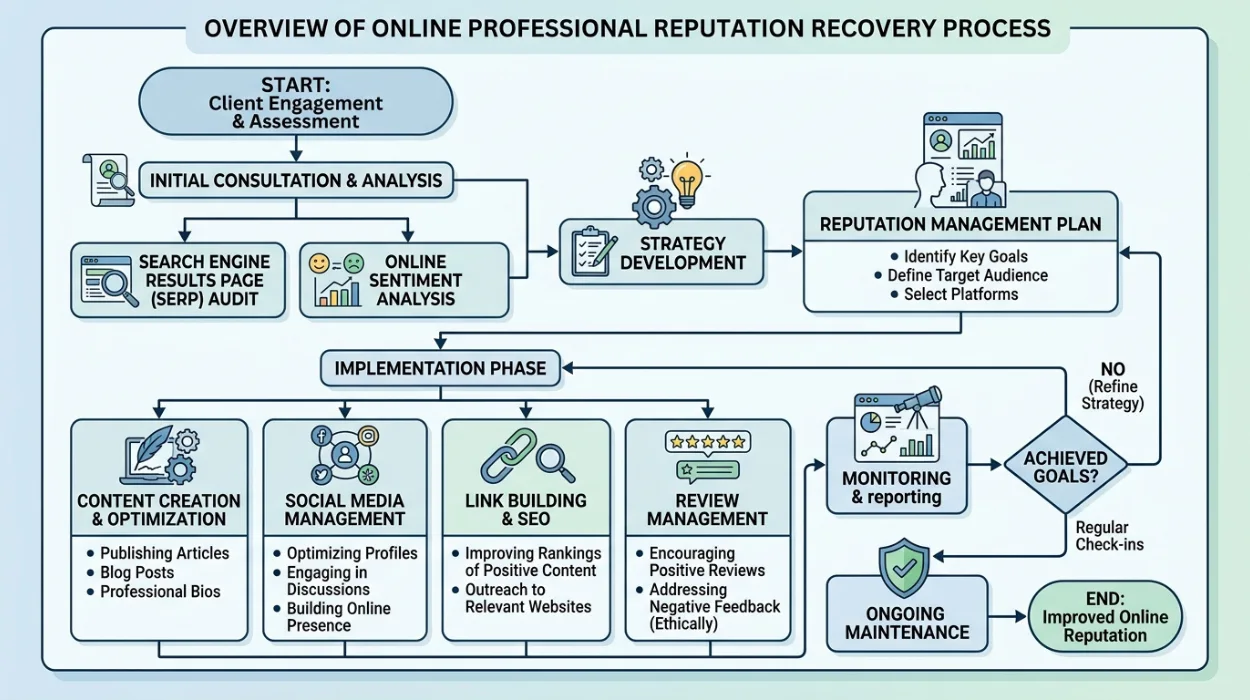
Professional reputation recovery services online address how damaging, inaccurate, outdated, or misleading information appears across search engines and digital platforms.
Reputation management is the process of monitoring, analysing, and influencing the information associated with a person, organisation, or entity across the online environment.
What Is Professional Reputation Recovery?
Professional reputation recovery is a structured process for analysing and improving the online information environment surrounding an individual or organisation. It focuses on reputation signals, search visibility, content accuracy, authority, sentiment distribution, and entity perception. Unlike a single content removal action, reputation recovery evaluates how different digital assets interact across search results. The process identifies harmful or inaccurate information while also assessing credible sources that provide context. This creates a broader framework for understanding how an online reputation develops.
Online reputation refers to the collective perception created by information available through search engines, websites, social platforms, reviews, news sources, directories, and other digital channels. Search users rarely evaluate every available webpage before forming an initial impression. Instead, they often rely on prominent results, snippets, titles, ratings, and authoritative references. This makes SERP composition an important component of reputation analysis. Professional reputation recovery therefore examines both the content itself and its position within the wider search environment.
The concept is not limited to negative content. Reputation also depends on the quality, consistency, relevance, and authority of positive or neutral information. A search environment containing accurate professional profiles, authoritative publications, verified business information, and relevant third-party references creates stronger entity credibility. Conversely, fragmented or contradictory information creates uncertainty. Reputation recovery analyses these relationships rather than treating individual webpages as isolated assets.
How Does Online Reputation Form Within Search Engines?
Online reputation forms through the interaction between available information, search behaviour, ranking systems, and user interpretation. Search engines organise webpages according to numerous signals related to relevance, quality, authority, freshness, usability, and other system-specific factors. These signals influence which pages become visible for queries associated with an entity. Search users then interpret the resulting information as part of their understanding of that entity. Reputation therefore develops through the interaction between information availability and information visibility.
Search engines do not assign a single universal reputation score to every person or organisation. Instead, different pages compete for visibility based on the systems used by each search platform. A highly authoritative webpage can therefore occupy prominent search positions even when another page contains more recent information. Content indexing also affects discoverability because a webpage must generally be accessible to a search engine before it can participate in organic search results. Reputation analysis consequently examines indexing, ranking, source authority, and query relevance together.
Search visibility refers to how easily an entity’s associated information appears for relevant searches. High visibility increases the probability that users encounter a particular narrative, reference, review, or profile. Low visibility does not necessarily mean that content has disappeared; it can simply indicate reduced prominence for specific queries. This distinction is essential when evaluating reputation recovery because removal, de-indexing, suppression, and content enhancement operate through different mechanisms.
What Role Do Reputation Signals Play in Search Perception?
Reputation signals are identifiable pieces of information that contribute to how users and search systems understand an entity. These signals include authoritative profiles, reviews, news coverage, publications, business listings, social accounts, professional references, and other relevant digital assets. Their influence depends on factors such as relevance, authority, context, and visibility. A reputation signal therefore operates within a wider information ecosystem rather than functioning as an isolated ranking factor. Analysing these signals helps explain why some information becomes more influential than other information.
Entity perception is the understanding users develop about a person, company, organisation, or brand based on available information. Search results contribute to this perception because they provide a concentrated view of information associated with an entity. Consistent and authoritative references strengthen clarity, while conflicting information creates a fragmented entity profile. This relationship makes reputation analysis closely connected to digital footprint management. The objective is to understand how information collectively represents the entity across online channels.
Trust signals also influence interpretation. Authoritative sources, transparent information, consistent profiles, and credible third-party references provide stronger contextual evidence than unsupported claims. Reviews contribute another layer because users evaluate sentiment, rating patterns, recency, and reviewer context. Search systems process these pages independently, while users interpret them collectively. Professional reputation analysis therefore considers both algorithmic visibility and human perception.
How Does Content Ranking Influence Reputation Recovery?
Content ranking influences reputation recovery because position affects the amount of attention a webpage receives from search users. Search results near the top of a page generally receive greater visibility than results positioned lower down. This creates an important distinction between content existence and content prominence. A negative article can remain publicly available while becoming less prominent for a particular search query. Reputation recovery therefore examines SERP composition rather than relying solely on content removal.
Content ranking operates through search-system processes that evaluate relevance and other signals. Reputation management cannot directly command organic rankings, but legitimate optimisation can improve the discoverability and relevance of accurate information. Creating or strengthening authoritative digital assets changes the information environment in which search systems evaluate competing pages. The effect depends on the quality and relevance of those assets. This makes content enhancement a long-term component of reputation recovery.
Content suppression and content enhancement represent different strategic mechanisms. Content suppression focuses on reducing the visibility or accessibility of harmful information through legitimate routes such as policy-based removal or appropriate search procedures. Content enhancement focuses on strengthening accurate and authoritative information so it becomes more competitive within relevant search results. The two approaches address different parts of the reputation system. Comparing them requires evaluating legitimacy, effectiveness, sustainability, and risk exposure.
How Do Reviews Affect Online Reputation and Sentiment?

Reviews influence online reputation by providing direct signals about customer experiences, satisfaction, service quality, and public sentiment. Search engines can display review information through business profiles, structured results, directories, and third-party platforms. Users frequently evaluate ratings and review patterns before examining deeper content. This gives review sentiment a significant role in perception. Review analysis therefore forms an important part of professional reputation assessment.
Sentiment distribution refers to the overall pattern created by positive, neutral, and negative opinions across relevant platforms. A single negative review does not represent the entire sentiment profile, but repeated negative references can create a stronger perceived pattern. Conversely, a broad collection of credible positive reviews provides additional context. Analysing sentiment requires examining volume, recency, consistency, authenticity, and source relevance. This prevents isolated reviews from being interpreted without considering the broader information environment.
Review signals also interact with other reputation assets. A negative review appearing alongside authoritative professional information creates a different search environment from a negative review appearing alongside multiple unresolved complaints. Context affects perception. Reputation recovery therefore evaluates review information alongside search results, profiles, publications, and other entity references. This creates a more complete assessment of digital credibility.
How Do Authority and Trust Signals Influence Online Credibility?
Authority and trust signals influence online credibility by providing contextual evidence about the reliability and relevance of information. Authoritative sources generally have established expertise, recognition, institutional relevance, or editorial standards. Trust signals provide additional indications that information is accurate, transparent, and attributable to a credible source. Together, these factors contribute to how digital information is interpreted. They also affect the competitive strength of content within search ecosystems.
Online credibility is not created by publishing content alone. A webpage becomes part of an entity’s digital footprint and competes with other sources for attention and visibility. Consistent information across reputable sources creates stronger entity associations. Contradictory or unsupported information creates ambiguity. Reputation analysis therefore evaluates the quality and relationships between sources rather than simply increasing the quantity of content.
Digital footprint management supports this process by identifying which assets represent the entity accurately. Professional websites, organisational profiles, expert publications, legitimate social accounts, and authoritative third-party references can provide useful context. The objective is not to manufacture credibility but to ensure that legitimate evidence of credibility remains accessible. This distinction separates evidence-based reputation management from artificial reputation manipulation.
How Does Content Removal Differ From Content Enhancement?
Content removal addresses the source of a reputation problem, while content enhancement addresses the competitive visibility of accurate information. Removal operates by seeking legitimate deletion, correction, restriction, or de-indexing where an appropriate basis exists. Enhancement operates by improving the quality, relevance, authority, and discoverability of legitimate content. These approaches therefore solve different problems. Selecting between them requires analysing the nature and status of the information involved.
Removal is most directly relevant when information violates platform policies, contains demonstrably false material, exposes private data, or falls within another legitimate removal mechanism. It provides a source-level solution when the applicable criteria are satisfied. However, removal cannot be assumed simply because content is negative or inconvenient. Search engines and website operators make independent decisions. This makes evidence quality and procedural accuracy central to the removal process.
Enhancement provides a different route when legitimate content remains online. Accurate professional resources can create stronger contextual signals and improve the overall SERP composition. This approach focuses on information quality rather than eliminating competing content. It also provides longer-term value because credible assets can continue representing an entity over time. The appropriate strategy depends on the underlying problem, available mechanisms, and desired outcome.
How Do Organic and Reactive Reputation Strategies Compare?
Organic reputation development builds credible information before or independently of a specific reputation incident, while reactive management responds to an identified problem. Organic strategies focus on maintaining accurate profiles, authoritative publications, positive customer experiences, and consistent digital information. Reactive strategies focus on investigating negative content, responding to harmful information, correcting inaccuracies, and monitoring resulting changes. Each approach operates at a different stage of reputation development. Combining both creates greater coverage across the reputation lifecycle.
Organic strategies provide resilience because they establish legitimate reputation signals over time. A strong digital footprint creates a broader information environment around an entity. Reactive strategies provide speed of response when harmful or inaccurate content becomes visible. However, reactive action without an established information foundation can produce a fragmented response. This demonstrates why reputation management functions as an ongoing system rather than a single intervention.
The difference can also be measured through sustainability. Organic reputation development supports long-term entity credibility, while reactive management addresses immediate visibility and risk. Search monitoring connects the two by identifying changes in SERP composition. It provides evidence about whether new content is gaining visibility or whether existing reputation signals remain prominent. This creates a feedback mechanism for future analysis.
Dive Deeper With Our Expert Guides:
Remove Negative News Articles from Google Search
Trusted Online Image Repair Services for Individuals
How Can Reputation Recovery Strategies Be Evaluated?
Reputation recovery strategies can be evaluated through effectiveness, legitimacy, sustainability, search visibility, and impact on entity perception. A useful evaluation framework examines both the mechanism used and the measurable change produced. It also distinguishes source-level outcomes from search-level outcomes. This prevents inaccurate conclusions about what caused a change in reputation. A structured evaluation therefore provides stronger insight than relying on rankings alone.
A practical assessment can:
- Measure search visibility by comparing relevant SERP positions and result composition before and after intervention.
- Analyse reputation signals by assessing authority, relevance, accuracy, sentiment, and consistency across digital assets.
- Evaluate content mechanisms by distinguishing removal, correction, suppression, enhancement, and monitoring outcomes.
- Assess sustainability by tracking whether improvements remain stable as new content enters the search ecosystem.
- Review entity perception by examining whether search results provide clearer, more accurate, and more credible contextual information.
This framework supports evidence-based decision-making without treating search rankings as a guaranteed outcome. Search systems remain dynamic and independent. Reputation strategies therefore require continuous measurement rather than one-time assumptions. The most meaningful outcome is improved control over the information environment surrounding an entity.
What Is the Relationship Between Reputation Recovery and Digital Footprint Management?
Reputation recovery and digital footprint management are closely connected because reputation depends on the information distributed across the online ecosystem. A digital footprint is the collection of webpages, profiles, publications, reviews, records, and other digital references associated with an entity. Reputation recovery analyses this footprint to identify harmful, inaccurate, outdated, irrelevant, and authoritative information. Digital footprint management then provides a framework for maintaining that information over time. Together, they support clearer entity representation.
A fragmented digital footprint creates challenges because search engines and users encounter information from independent sources. Different profiles can contain inconsistent names, descriptions, dates, professional details, or affiliations. These inconsistencies affect entity clarity and user interpretation. Maintaining accurate information across legitimate sources reduces ambiguity. It also creates a stronger foundation for future reputation analysis.
Digital footprint management is therefore not simply a process of deleting negative information. It involves understanding what information exists, where it appears, how it is indexed, and how it contributes to entity perception. This broader approach supports sustainable online credibility. It also explains why professional reputation recovery requires both analysis and ongoing monitoring.
What Should You Understand About Professional Reputation Recovery Services Online?
Professional reputation recovery services online are best understood as structured systems for analysing, managing, and improving the information environment surrounding an entity. Their mechanisms include search monitoring, reputation signal analysis, content assessment, legitimate removal procedures, digital asset development, and ongoing measurement. These mechanisms address different parts of the online reputation ecosystem. Their effectiveness depends on the underlying problem and the legitimacy of the available intervention. No single tactic determines an entity’s entire online reputation.
The central concept is control of information context rather than control of search engines. Search platforms independently evaluate content, while website owners control their own publication and removal decisions. Reputation management operates within these boundaries by improving the quality, accuracy, visibility, and context of legitimate information. This makes process discipline more important than unsupported claims. Evidence, authority, relevance, and monitoring provide the foundation for meaningful reputation analysis.
Understanding Online Reputation & Content Removal also clarifies the distinction between removing eligible content and improving the visibility of credible information. These mechanisms form part of a wider reputation system in which search visibility, reputation signals, entity perception, and digital footprint management interact. A balanced approach evaluates each mechanism according to its purpose, limitations, and measurable effect.
Professional reputation recovery is a search ecosystem discipline that connects content, reputation signals, entity perception, digital footprint management, and search visibility. Its effectiveness depends on understanding how information is created, indexed, ranked, interpreted, and maintained across independent platforms. Content removal addresses eligible source-level problems, while content enhancement strengthens legitimate information within the wider SERP environment. Organic reputation development creates long-term resilience, while reactive management addresses immediate visibility and accuracy concerns.
The most useful evaluation focuses on mechanisms rather than assumptions. Search rankings remain dynamic, content remains independently controlled by publishers, and users interpret information through their own decision processes. Reputation recovery therefore requires continuous analysis of authority, trust, sentiment, relevance, content indexing, and SERP composition. This framework provides a clearer understanding of how online credibility develops and how digital information shapes entity perception.
What are professional reputation recovery services?
Professional reputation recovery services analyse and manage online information that influences an individual’s or organisation’s digital reputation. They can involve reputation monitoring, content assessment, legitimate removal processes, search visibility management, and development of credible reputation signals.
How do professional reputation recovery services work online?
The process typically begins with a digital footprint audit to identify harmful, inaccurate, outdated, or irrelevant information. Specialists then evaluate content visibility, authority, search rankings, and available removal or reputation enhancement mechanisms.
Can reputation recovery services remove negative content from Google?
Content removal depends on the nature of the information, its source, and applicable policies or legal grounds. Where removal is unavailable, reputation management can focus on improving the visibility and authority of accurate, credible information within search results.
How long does online reputation recovery take?
The timeframe depends on the number of sources, content type, removal mechanisms, search visibility, and the competitiveness of the relevant search results. Ongoing monitoring is used to measure changes in SERP composition and reputation signals over time.
Do reputation recovery services improve online credibility?
Reputation recovery can improve online credibility by strengthening accurate, authoritative, and relevant information associated with an entity. A clearer digital footprint helps users evaluate information more consistently while supporting stronger trust and reputation signals.