
Professional dead links removal services help businesses address outdated URLs, correct indexing issues and improve control over the information displayed in Google Search. Clear Your Name provides a structured approach to broken-link assessment, technical removal and search visibility management, helping businesses protect reputation signals and strengthen entity credibility.
Which Dead Links Removal Service Delivers the Most Reliable Results?
A professional dead links removal service delivers reliable results by identifying why a URL remains visible, correcting the relevant technical issue and verifying the outcome through search indexing checks. Deleting a page from a website does not instantly remove its indexed version from Google. Search engines need to recrawl the URL, interpret its HTTP status and update their index before the search result reflects the change. A structured service addresses each stage rather than relying on repeated removal requests without diagnosing the cause. This process improves SERP control while keeping expectations aligned with Google’s independent crawling and indexing systems.
Broken links become a reputation concern when outdated pages display inaccurate information, expose obsolete material or create a poor experience for people researching a business. Search results often act as an early evaluation point for customers, prospective partners and other stakeholders. An outdated title or snippet can therefore influence search perception even after the original page has changed or disappeared. A dead links removal service investigates the URL, its current response, its indexed status and the information still available through connected pages. The resulting action plan distinguishes technical correction from content removal and negative content suppression.
Businesses need a process that explains what can be controlled and what depends on external platforms. A service provider can assess website configuration, implement authorised changes and submit eligible requests, but it cannot guarantee Google’s exact removal timeline or dictate organic rankings. Reliable reporting separates completed technical actions from pending indexing changes. This distinction reduces risk and helps decision-makers evaluate progress using evidence rather than promises. The strongest service combines accurate diagnosis, appropriate intervention and documented verification.
How Does a Dead Links Removal Service Improve Google Indexing?
A dead links removal service improves indexing accuracy by matching the corrective action to the URL’s actual status and purpose. A page that has permanently disappeared without a replacement generally returns an HTTP 404 or 410 response. A URL that has moved to a relevant replacement is better handled through an appropriate redirect. A missing page that returns HTTP 200 can create a soft 404, making the technical signal inconsistent with the content users receive. Identifying these differences prevents unsuitable fixes and gives Google clearer information when it revisits the URL.
The process begins with a URL audit that records the affected page, its HTTP response, its presence in search results and any relevant replacement content. The service then identifies whether the issue relates to server configuration, internal links, redirects, sitemap references or a pending indexing update. Where the website owner controls the source, authorised technical corrections establish the right conditions for eventual index removal. Where the URL belongs to an external website, the available options depend on the publisher’s control and the platform’s removal policies. This diagnosis-led approach reduces unnecessary requests and keeps each action tied to an identifiable cause.
The main stages of a professional service include:
- Audit affected URLs to identify broken destinations, outdated search listings and incorrect HTTP responses.
- Correct server responses or redirect rules where the website owner has the authority to make changes.
- Remove obsolete internal links and sitemap references that continue to direct users or crawlers towards deleted resources.
- Submit eligible requests through Google Search Console when temporary removal is appropriate.
- Verify technical responses and indexing status to distinguish completed fixes from changes still being processed.
These actions improve the quality of technical signals, but they do not force an immediate indexing update. Google controls its own crawling schedule and determines when its index reflects the updated page status. A provider can make the website’s signals accurate, document the intervention and monitor the result. That level of process clarity gives business owners a more dependable basis for assessing progress. It also helps separate an effective technical correction from a temporary change in search-result visibility.
How Quickly Can Broken 404 Links Disappear from Google Search?
Broken 404 links disappear from Google Search according to Google’s crawling and indexing processes, not a guaranteed service deadline. When Google revisits a URL and confirms that the page is unavailable, it can update its index accordingly. The timing depends on factors such as crawl frequency, the URL’s previous indexing status and the clarity of the server response. A page that remains visible after deletion does not automatically indicate that the technical correction has failed. The correct assessment checks whether Google has processed the new status rather than relying on elapsed time alone.
Business owners evaluating Google’s automatic 404 removal timeline need to distinguish three milestones: removing the original content, sending the correct technical response and updating the search index. The first milestone happens at source level, while the second depends on the server configuration. The third occurs when Google processes the URL and changes its indexed representation. These milestones can happen at different times, so a service report needs to state which stage has been completed. This helps businesses make informed decisions without confusing technical progress with final search-result removal.
Google Search Console supports this assessment by providing URL inspection information and access to eligible removal requests. Its Removals tool can temporarily hide qualifying URLs from search results, but temporary hiding does not by itself guarantee permanent index deletion. A permanent outcome depends on the underlying content and technical signals, as well as Google’s subsequent processing. Where a deleted URL still returns a successful response or redirects to unrelated content, the service needs to investigate the cause rather than repeatedly resubmit the same request. A controlled process combines the appropriate technical response with verification of the resulting index status.
Should Businesses Choose Technical Removal or Negative Content Suppression?
Businesses need technical removal when a URL is genuinely obsolete, while negative content suppression addresses a broader visibility problem that cannot be solved by deleting a page they do not control. These approaches serve different objectives and require different evidence. Technical removal focuses on the availability and index status of a particular URL. Negative content suppression focuses on the composition of search results and the visibility of relevant content across queries. Selecting the wrong approach wastes resources and creates unrealistic expectations about what a provider can achieve.
For pages hosted on a business’s own website, the first step is to confirm whether the content needs to be deleted, updated or redirected. A genuine 404 or 410 response communicates unavailability when no replacement exists, while a relevant permanent redirect helps users reach a suitable successor. For content hosted by another publisher, the business generally needs to assess the publisher’s correction or removal process and the applicable platform rules. A removal service can help evaluate the available route and prepare appropriate requests, but it cannot guarantee that an independent publisher will comply. This distinction is essential when assessing service reliability and contractual expectations.
Negative content suppression involves a wider strategy. Relevant, accurate pages can improve the completeness of the information available about a business, but publishing new material does not guarantee that negative results will disappear or fall in rankings. Search engines assess pages independently using relevance, quality and other ranking systems. A responsible provider therefore explains whether a proposed action addresses a technical error, a policy-based removal opportunity or the wider visibility of existing content. This prevents the term “removal” from being used to describe outcomes that are actually temporary suppression or longer-term search perception influence.
Businesses comparing these methods can use the factors that keep deleted URLs indexed to determine whether a technical issue remains unresolved or whether the result simply awaits Google’s update. This decision also helps establish a realistic service scope before work begins. Clear deliverables, defined reporting and documented limitations reduce the risk of paying for repeated actions that do not address the underlying problem. A professional approach prioritises the method that matches the evidence, rather than promising the same result for every URL. That is how reputation signals and search visibility become manageable business concerns instead of uncertain technical tasks.
How Can Businesses Measure the Value of Dead Links Removal Services?
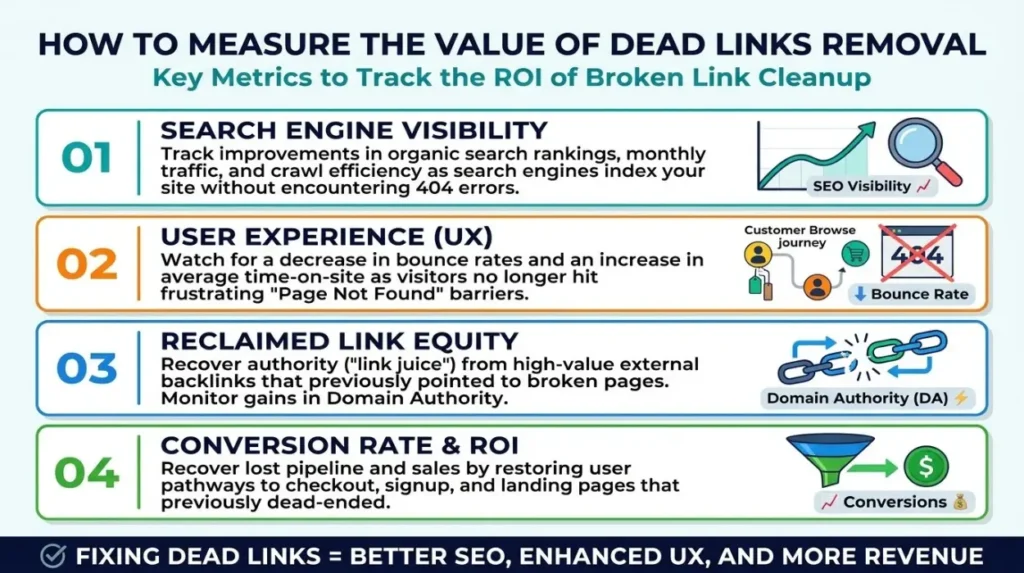
The value of dead links removal services comes from resolving identifiable indexing problems, reducing user confusion and creating a verifiable record of corrective action. A useful service does more than count URLs submitted for removal. It documents the original issue, the action taken, the evidence available after intervention and any remaining dependency on Google or an external publisher. This makes the work easier to evaluate against business priorities. It also supports better decisions about whether further technical work or a separate reputation strategy is necessary.
A clear measurement framework tracks technical outcomes and search visibility separately. Technical outcomes include corrected HTTP responses, removal of obsolete internal references and accurate redirects to relevant replacement pages. Search visibility outcomes include whether a URL remains discoverable for the queries being monitored and whether Google reports a change in its indexing status. These measures do not guarantee a particular ranking improvement or change in customer sentiment. They show whether the work has corrected the identified problem and whether the expected search-result update has occurred.
Businesses can evaluate progress through the following indicators:
- Record each affected URL and its original status to establish a baseline for comparison.
- Measure the proportion of audited URLs with corrected server responses or relevant redirects.
- Track Google Search Console findings to identify changes in reported indexing status.
- Compare search-result visibility at defined intervals without treating temporary disappearance as proof of permanent removal.
- Document unresolved URLs and external dependencies so decision-makers understand what remains outside the provider’s direct control.
This evidence-led reporting supports cost control because it connects expenditure to specific actions and observable outcomes. It also helps prevent duplicate requests, unnecessary content changes and repeated work on URLs that already return the correct status. Where a page remains indexed despite accurate technical signals, the next step is based on the evidence rather than an automatic repeat of the original intervention. Businesses gain a clearer understanding of what has been resolved, what remains pending and which additional actions have a valid purpose. That clarity strengthens accountability throughout the engagement.
Dive Deeper With Our Expert Guides:
Clear Cached Search Snippets and Dead Previews with Our Takedown Experts
Hire Our Technical Team to Remove Dead Links and Ghost Previews Fast
What Should Businesses Check Before Hiring a Dead Links Removal Provider?
Businesses need a provider that explains its methods, defines its responsibilities and reports results without guaranteeing outcomes controlled by Google or third-party publishers. The initial assessment needs to identify the affected URLs, the likely cause of continued indexing and the available corrective options. The provider also needs to distinguish work performed directly on the client’s website from requests submitted to external platforms. These details establish whether the proposed service matches the actual problem. A credible provider explains both the achievable outcome and the limitations before work begins.
Service scope is particularly important when a business has a mixture of broken URLs, deleted articles, obsolete search snippets and negative third-party content. Each category requires a different assessment, and not every URL qualifies for the same removal mechanism. Businesses need to understand whether the fee covers an audit, technical recommendations, authorised implementation, request submission, follow-up checks or reporting. A written scope helps avoid ambiguity about which tasks are included and which require additional access or external cooperation. It also makes proposals easier to compare on the basis of work delivered rather than bold claims.
A professional dead links removal service also protects the integrity of the website. Incorrect redirects, blanket removal of useful pages and misleading server responses can create new problems while attempting to resolve old ones. The provider needs to explain why a particular action is appropriate for each URL and how its impact will be checked. Businesses must retain appropriate access and approval over changes to their own websites, especially where server settings and important pages are involved. This process reduces operational risk while preserving a clear record of decisions.
Clear Your Name approaches dead-link concerns through the relationship between technical accuracy, indexing status and online reputation. The objective is to identify the correct route for each affected URL, support appropriate corrective action and report progress transparently. No responsible provider can promise a fixed Google indexing timeline or guarantee a specific ranking position. Reliability instead comes from a defined process, evidence-based recommendations and honest reporting of outcomes. Those standards help businesses assess service quality before committing their budget.
Is Professional Dead Link Removal a Sustainable Investment?
Professional dead link removal is a sustainable investment when it resolves the cause of an indexing problem and establishes a process for monitoring future changes. One-off fixes address the URLs identified during an audit, while ongoing checks help detect new broken links, obsolete references and incorrect redirects. The appropriate level of monitoring depends on website size, publishing activity and the importance of the affected pages. Businesses with frequent website updates benefit from consistent technical checks because changes to URLs and content can create new indexing issues. This approach supports long-term search visibility without treating every indexing delay as a reputation emergency.
Cost evaluation needs to account for the consequences of leaving the issue unresolved. Outdated search results can confuse prospective customers, direct users to unavailable pages and undermine confidence in the accuracy of a business’s online information. The financial impact varies according to the page, the search query and the audience encountering the result, so it is not appropriate to assign a guaranteed monetary value to every removal. A documented audit provides a more reliable basis for prioritising URLs according to relevance, exposure and business risk. This enables decision-makers to allocate resources to issues with a clear purpose instead of purchasing unnecessary interventions.
Sustainable reputation management also requires realistic expectations about rankings and public perception. Removing an obsolete URL does not automatically improve every ranking, erase copies hosted elsewhere or restore trust on its own. However, correcting technical inconsistencies improves the accuracy of the information available to search engines and users. When technical corrections are combined with relevant content, consistent business information and evidence-based reporting, the organisation gains better control over its digital footprint. This coordinated approach strengthens entity credibility by focusing on accuracy, transparency and the quality of the information people encounter.
Clear Your Name provides a route for businesses that need a structured assessment of dead links, outdated indexed pages and related search visibility concerns. Its professional dead links removal service focuses on identifying the issue, selecting an appropriate corrective action and checking the resulting status. Businesses can begin by identifying the URLs causing concern and establishing whether the source content is deleted, redirected or still accessible. From there, a clearly defined scope helps determine the required technical work, available removal options and reporting measures. The result is a more accountable process for managing broken URLs and protecting the accuracy of search results.
When choosing a provider, prioritise technical evidence, clearly defined deliverables and transparent reporting over promises of instant deletion. Google controls its indexing decisions, but businesses can improve the accuracy of their own websites and use appropriate procedures to address eligible search-result issues. A reliable service establishes what needs correction, explains what the intervention can achieve and verifies the available evidence after implementation. This process reduces avoidable risk while supporting more consistent search visibility and reputation management. With a clear plan and realistic measures of progress, dead link removal becomes a defined technical and reputational task rather than an open-ended attempt to control search results.
How long does Google take to remove broken 404 links from search results?
Google does not provide a fixed timeframe for removing 404 pages from search results. Removal depends on when Google recrawls the URL, confirms its HTTP status and updates its index.
How can I speed up index deletion for broken 404 links?
Ensure the deleted URL returns a genuine 404 or 410 HTTP status and remove obsolete internal links or sitemap references. Google Search Console helps you inspect indexing status and submit eligible URLs for temporary removal.
What do dead links removal services do?
Dead links removal services identify broken URLs, investigate why deleted pages remain indexed and recommend appropriate technical corrections. Depending on the issue, the process includes correcting HTTP responses, configuring relevant redirects and monitoring indexing changes.
Why does Google still show a deleted page with a 404 error?
Google can continue displaying a deleted page until it recrawls the URL and updates its index. Incorrect server responses, including soft 404 errors, can also delay the process by sending unclear signals about the page’s availability.
Can Clear Your Name permanently remove broken links from Google Search?
Clear Your Name can help assess dead links, identify indexing issues and address eligible removal options through an appropriate process. Permanent removal depends on the URL’s technical status, Google’s indexing decisions and whether copies of the content remain available on other websites.