
A fake Google review removal service typically checks whether a review breaches Google’s policies, contains signs of manipulation, and can be supported by evidence before submitting a challenge. The assessment process focuses on policy compliance, reputation signals and the likelihood of successful moderation.
Reputation management strategies differ based on the type of content involved, the evidence available and the methods used to influence search perception. Online reputation control methods are evaluated through their effectiveness in correcting inaccurate information, protecting entity credibility and preserving trust signals within search ecosystems.
What Does a Fake Google Review Assessment Process Involve?
A fake review assessment process is the structured evaluation of review content, reviewer behaviour and policy violations before a challenge is submitted to a platform.
The process begins by identifying whether the review appears authentic or manipulated. Search ecosystems rely on review signals to evaluate credibility, which means any challenge requires evidence that a review disrupts the integrity of those signals. A review that merely contains criticism differs significantly from one that breaches platform guidelines.
The assessment process also analyses the review’s language, timing and contextual information. If the review demonstrates characteristics associated with spam, impersonation or coordinated behaviour, it becomes a stronger candidate for challenge. This structured approach reduces the likelihood of unsupported reporting and aligns the challenge with Google’s moderation framework.
Why Is Policy Compliance Checked Before Challenging a Review?
Policy compliance is checked because Google removes reviews primarily on the basis of guideline violations rather than disagreement over content.
Google’s moderation systems evaluate reviews against specific categories, including spam, conflicts of interest, misleading content and prohibited behaviour. A review that does not fit within these categories frequently remains online, even when the business disputes its accuracy.
This distinction explains why policy evaluation forms the foundation of review challenges. The assessment process compares the review against published guidelines and measures whether sufficient evidence exists to demonstrate a breach. The stronger the alignment between evidence and policy, the greater the likelihood that moderation systems recognise the challenge as valid.
Dive Deeper With Our Expert Guides:
How to Choose a Google Review Removal Service That Uses Ethical Methods
How to Build a Strong Case Before Requesting a Google Review Removal
How Is Reviewer Authenticity Evaluated?
Reviewer authenticity is evaluated by analysing behavioural patterns, account characteristics and indications of genuine customer interaction.
Examine Account Activity
Examine the account’s review history to identify unusual patterns, including sudden bursts of activity or reviews concentrated in unrelated locations. Behavioural inconsistencies often indicate manipulation.
Analyse Profile Characteristics
Analyse profile information, including review frequency and content style. Accounts that publish repetitive reviews across multiple industries can suggest coordinated behaviour.
Evaluate Relationship Indicators
Evaluate whether evidence exists of a customer relationship. The absence of identifiable interactions sometimes indicates that the reviewer never engaged with the business.
This process does not prove deception in every case. Instead, it measures whether the available signals align with the behavioural patterns expected from legitimate reviewers.
What Types of Policy Violations Are Usually Checked?
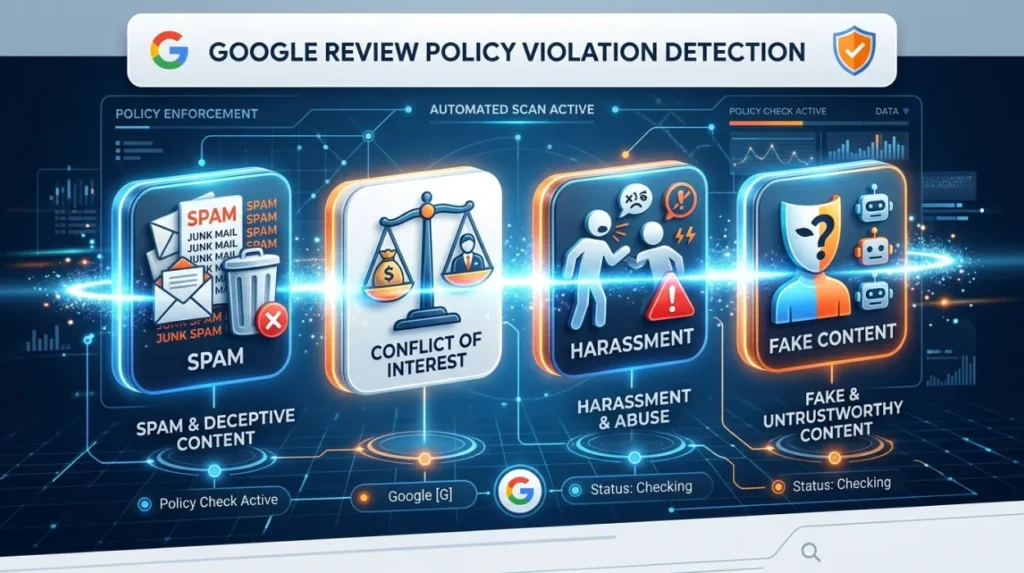
Policy violations are evaluated because they provide the legal and procedural basis for a review challenge.
The most common categories include spam, fake engagement, conflicts of interest and impersonation. Spam reviews are created to manipulate ratings or disrupt search perception. Fake engagement involves reviews posted by individuals with no genuine experience of the business.
Conflicts of interest occur when competitors, former employees or associated parties submit reviews designed to influence sentiment distribution. Impersonation refers to reviews that falsely represent customer experiences or identities.
Each category affects reputation signals differently. The assessment process therefore determines not only whether a violation exists but also how the review alters search visibility and entity credibility.
How Does Evidence Influence a Review Challenge?
Evidence determines whether a challenge can demonstrate a policy breach rather than simply express disagreement.
Google’s moderation systems operate at scale and rely on verifiable indicators. Evidence therefore forms the basis of credibility within the challenge process. Examples include transaction records, communication histories and documentation demonstrating that the reviewer never interacted with the business.
The strength of evidence directly affects the quality of the challenge. Unsupported allegations provide limited value because moderation systems prioritise objective indicators over subjective claims. A structured evidence review ensures that the challenge aligns with the platform’s decision-making criteria.
How Does Fake Review Detection Compare With Manual Reporting?
Fake review detection and manual reporting operate through different mechanisms and produce different outcomes.
Automated detection systems analyse patterns across millions of reviews. They identify unusual activity by examining behavioural similarities, timing and network relationships. These systems are effective at recognising large-scale manipulation but often struggle with isolated deceptive reviews.
Manual reporting relies on human assessment and evidence submission. This approach provides context that automated systems cannot easily identify, including proof that a reviewer never existed as a customer. However, manual reporting depends on the availability of evidence and adherence to policy requirements.
The comparison demonstrates that both approaches perform different functions within review moderation. Automated systems identify broad patterns, while manual challenges focus on individual circumstances.
Why Are Some Fake Reviews Left Online?
Some fake reviews remain online because the available evidence fails to satisfy the platform’s removal criteria.
A review can appear suspicious while still avoiding classification as spam or manipulation. Search ecosystems prioritise procedural consistency and therefore require objective indicators before removing content.
The distinction between false information and policy-violating content creates a significant limitation. An inaccurate review does not automatically qualify for removal if it lacks clear signs of prohibited behaviour. This principle explains why review moderation frequently produces outcomes that differ from the expectations of the affected party.
The persistence of certain fake reviews also demonstrates the limitations of automated systems. Search platforms must balance content integrity with the risk of removing legitimate opinions, resulting in a cautious moderation process.
How Do Different Review Management Approaches Compare?
Review management approaches differ in their objectives, sustainability and influence on reputation signals.
Use Reporting Mechanisms
Use platform reporting systems to challenge reviews that violate policies. This approach focuses on content removal and attempts to correct inaccurate reputation signals.
Create Positive Content
Create additional positive content to influence sentiment distribution and strengthen entity credibility. This approach operates by increasing the volume of authentic reputation signals.
Monitor Reputation Signals
Monitor review activity continuously to identify suspicious patterns and respond to emerging risks. This approach focuses on early detection rather than direct removal.
These methods differ in both timescale and effectiveness. Reporting seeks immediate correction, while content enhancement and monitoring contribute to long-term reputation resilience.
How Does Review Removal Compare With Content Enhancement?
Review removal and content enhancement represent two distinct reputation management strategies.
Review removal operates by eliminating harmful or misleading information that violates platform guidelines. It directly addresses the source of reputational distortion and aims to restore accurate sentiment signals.
Content enhancement operates by increasing the visibility of positive and authoritative information. Instead of removing negative content, it changes the composition of the information environment surrounding an entity.
The comparison highlights a broader principle within reputation management: content suppression vs content enhancement. Removal strategies seek to eliminate problematic signals, while enhancement strategies seek to strengthen favourable signals. Each method influences search perception differently and serves different objectives.
Why Is Search Engine Interpretation Important in Review Challenges?
Search engine interpretation determines how reviews contribute to trust, authority and ranking influence.
Reviews function as data points within search ecosystems. Algorithms evaluate review sentiment, frequency and engagement to understand entity credibility and user satisfaction. Manipulated reviews introduce distorted signals into this process and affect the reliability of search evaluation.
A review challenge therefore extends beyond the individual piece of content. It concerns the integrity of the information used to shape perception and ranking decisions. Understanding this relationship explains why evidence, policy compliance and behavioural analysis are central to review assessment.
What Strategic Considerations Influence a Review Challenge?
Strategic considerations involve evaluating effectiveness, sustainability and risk exposure before pursuing any review-related action.
An effective challenge depends on clear evidence and alignment with platform policies. Sustainability involves preserving long-term credibility rather than focusing solely on immediate outcomes. Risk exposure concerns the possibility of unsuccessful reporting, which can leave inaccurate information unchanged.
Reputation management operates within complex search ecosystems where reviews, content and engagement signals interact continuously. Strategic evaluation therefore requires understanding not only the review itself but also the wider reputation environment in which it exists.
Within this broader context, some organisations evaluate whether to Remove Fake Google Reviews With a Service That Handles the Whole Process or continue relying solely on internal reporting mechanisms. The comparison reflects different approaches to managing evidence, procedural complexity and review moderation requirements.
A fake Google review assessment process focuses on evidence, policy compliance and behavioural analysis rather than subjective disagreement with review content. The review challenge process operates within systems designed to protect both content integrity and legitimate customer opinion.
Different reputation management approaches produce different outcomes. Removal strategies address problematic content directly, while content enhancement and monitoring focus on long-term reputation resilience and sentiment distribution.
Understanding how review challenges are evaluated provides a clearer view of how search ecosystems interpret reputation signals and why fake reviews remain one of the most complex aspects of online reputation management.
What does a fake Google review removal service check first?
A fake Google review removal service first checks whether the review violates Google’s policies, such as spam, impersonation, fake engagement or conflicts of interest. It also reviews available evidence to determine whether a challenge has a reasonable basis.
Can a fake Google review be removed if it is simply unfair?
An unfair review is not automatically removed by Google. A review generally needs to breach Google’s content policies before a removal request is considered.
What evidence helps challenge a fake Google review?
Useful evidence includes transaction records, appointment histories, communication logs and proof that the reviewer never interacted with the business. This information helps demonstrate that the review may not represent a genuine customer experience.
How do Google Review Removal Services identify suspicious reviews?
Google Review Removal Services often analyse account behaviour, review patterns and content similarities to identify signs of manipulation. They also check whether the review matches known indicators of spam or coordinated review activity.
Why do some fake Google reviews remain online after being reported?
Some fake Google reviews remain online because Google requires clear evidence of a policy violation before removing content. If the review appears authentic and does not breach specific guidelines, it may continue to be displayed despite being disputed by the business.