Job applicants can reduce unnecessary reputation risk by identifying exposed, outdated or irrelevant personal information before employers conduct online research or formal background checks. The most relevant removal targets include publicly exposed contact details, outdated profiles, inaccurate directory records and personal content that creates identity confusion.
Reputation management strategies differ based on whether the objective is removing eligible information, improving the visibility of credible sources or managing the balance between harmful and useful search results. Online reputation control methods are evaluated through search visibility, reputation signals, entity credibility, source authority and the resulting SERP composition. For job applicants, the key consideration is not simply how much information exists online, but which information is prominent, accurate, relevant and associated with the correct identity.
What Types of Personal Information Present the Greatest Reputation Risk?
Publicly exposed information presents greater reputation risk when it is inaccurate, outdated, unnecessarily detailed or strongly associated with an applicant’s identity. Personal information includes contact details, addresses, usernames, professional records, public profiles and other identifying data distributed across digital sources. Not every publicly available detail creates the same level of risk because relevance and visibility determine how information contributes to search perception. Information appearing prominently for a name-based query receives greater attention than content buried deep within an unrelated website. The evaluation therefore needs to distinguish between information that is merely accessible and information that materially influences an applicant’s digital footprint.
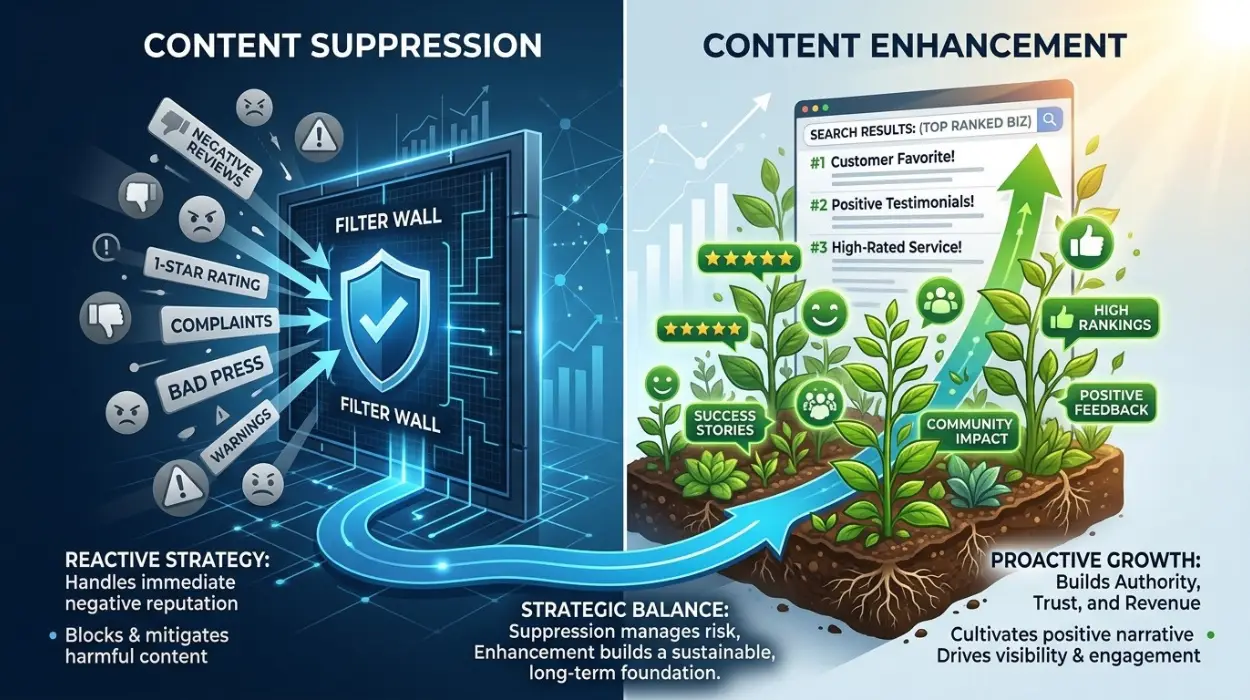
Personal information removal focuses on reducing unnecessary exposure where legitimate removal mechanisms exist. Content enhancement takes a different approach by strengthening accurate and authoritative information so that search engines and users encounter stronger contextual signals. Removal has a direct effect on the availability of a particular source, while enhancement primarily affects the composition and prominence of competing information. The appropriate method depends on the nature, authority and search visibility of the content being evaluated.
How Does Content Removal Compare With Content Creation for Applicant Reputation?
Content removal and content creation address reputation risk through different mechanisms. Content removal targets an existing page, profile, record or personal reference that is eligible for deletion, correction or de-indexing under the relevant platform or legal process. Content creation produces new material that establishes additional context around an applicant’s identity, such as accurate professional profiles or authoritative biographical information. Removal reduces the presence of a specific reputation signal, while creation introduces additional signals that influence the information environment. Their effectiveness therefore depends on whether the primary problem is unnecessary exposure or an insufficient supply of credible contextual information.
Content creation also has limitations when the underlying harmful result remains highly authoritative or relevant. A new page does not automatically displace an established result because search ranking influence depends on factors including relevance, authority, quality and content relationships. Removal can produce a more direct change when an inaccurate or unnecessary source is successfully taken down. However, removal does not address gaps in professional information or establish stronger entity credibility by itself. Comparing both methods therefore requires analysing the underlying SERP rather than assuming that one method universally performs better.
Is an Organic Reputation Approach More Sustainable Than a Reactive Strategy?
An organic reputation approach is generally evaluated through the long-term development of accurate information, consistent identity signals and authoritative digital assets. Organic reputation management operates by establishing a coherent information ecosystem before reputation problems become dominant search signals. Reactive management operates by responding to specific negative, inaccurate or exposed content after it becomes visible. The organic approach focuses on prevention and information quality, while the reactive approach focuses on immediate risk identification and response. Sustainability depends on whether the strategy maintains credible information while addressing emerging risks.
Reactive action remains relevant when a specific page creates immediate search visibility or privacy concerns. A targeted response can prioritise content that appears prominently for an applicant’s name or contains inaccurate identifying information. Its limitation is that isolated action does not necessarily strengthen the broader digital footprint. Organic development creates a wider foundation of credible sources, but it requires ongoing content governance and monitoring. A balanced evaluation therefore considers preventive information development alongside targeted responses to high-impact exposure.
How Do Short-Term and Long-Term Reputation Strategies Differ?
Short-term reputation strategies prioritise visible risks that affect current search perception, while long-term strategies measure the stability of reputation signals across an extended period. Short-term action can focus on removing eligible information, correcting inaccurate details or addressing highly visible search results. These activities can alter the immediate information environment when the relevant source is successfully changed or removed. Long-term management evaluates whether the resulting SERP remains balanced as search engines discover and rank additional content. The distinction is therefore based on time horizon, persistence and the ability to maintain consistent entity credibility.
Long-term strategies also account for changes in employment history, professional profiles and public digital activity. An applicant’s search environment is not static because new pages can be indexed while older information changes in relevance. A strategy focused only on an immediate removal target can therefore become outdated as the digital footprint evolves. Long-term monitoring measures changes in search visibility, content relationships and reputation signals over time. This makes sustainability a function of continued evaluation rather than a single successful intervention.
How Do Search Engines Interpret Reputation Signals About Job Applicants?

Search engines interpret reputation signals through systems that crawl, index, retrieve and rank publicly accessible information. Reputation signals are not equivalent to a single reputation score; they emerge from relationships between content, sources, entities, relevance and search queries. Professional profiles, employer pages, publications and social accounts can each provide contextual information about an applicant. Search ranking systems then determine which indexed sources receive visibility for relevant queries. The resulting SERP influences the information users encounter first, but ranking prominence does not independently establish factual accuracy.
Entity credibility becomes important when multiple sources refer to the same individual. Consistent names, employment details and professional descriptions create stronger contextual relationships between sources. Conflicting details can create entity ambiguity, particularly when different people share similar names or when outdated information remains indexed. Search engines organise these signals according to their ranking systems rather than manually verifying every identity claim. Reputation analysis therefore evaluates both the content itself and the way search systems connect and display that content.
How Does SERP Composition Change After Information Removal or Enhancement?
SERP composition changes according to the relationship between removed content, remaining indexed sources and competing information. When an eligible page is removed or becomes unavailable to search engines, one source contributing to the results environment disappears from consideration. Content enhancement works differently by improving the relevance, authority or contextual value of alternative sources. The two approaches therefore produce different forms of search ranking influence. Removal changes the available information set, while enhancement changes the relative strength of information that remains or is introduced.
The impact also depends on the authority of the affected result. Removing a low-authority directory page has a different effect from removing a highly relevant publication that consistently ranks for an applicant’s name. Similarly, creating a professional profile does not guarantee prominent placement if stronger competing pages satisfy the same query. SERP evaluation therefore measures position, source type, relevance and the balance of reputation signals. This provides a more reliable basis for determining whether a strategy has changed search perception.
How Effective Is Personal Information Removal Compared With Content Suppression?
Personal information removal and content suppression address visibility through different mechanisms. Removal attempts to eliminate or restrict access to the underlying source, while suppression seeks to reduce the prominence of unwanted content by strengthening alternative information and improving SERP composition. Removal can provide a direct result when the information qualifies for deletion or correction and the responsible platform accepts the request. Suppression remains relevant when removal is unavailable or when the broader search environment contains multiple references to the same issue. The effectiveness of each approach therefore depends on content ownership, eligibility, authority and search visibility.
Content suppression does not necessarily eliminate the underlying information. It focuses on changing which pages receive attention for specific queries by influencing the relative strength and relevance of competing results. This makes suppression particularly dependent on search ranking influence and the authority of existing pages. Removal provides greater control over the targeted source when successfully completed, but it does not automatically improve the surrounding SERP. A comparative assessment therefore distinguishes source elimination from visibility management.
How Can Applicants Evaluate Which Information to Remove First?
Applicants can prioritise removal targets by measuring visibility, accuracy, relevance and potential influence on professional perception. A structured evaluation prevents resources from being directed towards information that has negligible search exposure or limited relevance to the applicant’s identity. Priority normally increases when content is prominently indexed, inaccurate, unnecessary, personally identifying or strongly connected to the applicant’s name. The assessment also considers whether the source has a legitimate correction, removal or privacy mechanism. This creates a measurable framework for comparing different exposure risks.
A practical evaluation framework can include the following actions:
- Identify name-based search results that expose personal information prominently on page one.
- Classify each source according to accuracy, relevance, authority and information sensitivity.
- Compare removal eligibility against alternative methods such as correction, de-indexing or content enhancement.
- Measure the source’s search position and query relevance before prioritising intervention.
- Monitor SERP composition after changes to determine whether the information environment has materially shifted.
This approach separates high-impact exposure from information that is technically public but unlikely to affect search perception. It also creates a clearer basis for deciding between removal and broader reputation management methods.
Dive Deeper With Our Expert Guides:
What Public Figures Should Know Before Requesting Personal Data Removal
How to Prioritise Which Personal Information to Remove First
How Does Risk Exposure Differ Between Reactive Removal and Preventive Management?
Reactive removal concentrates on information that has already become visible, whereas preventive management attempts to maintain a controlled digital footprint before significant reputation risk develops. Reactive methods can identify specific exposed details and address them according to available removal mechanisms. Preventive management evaluates public profiles, directory listings, social accounts and professional information as an interconnected reputation environment. The former is event-driven, while the latter is continuous. Risk exposure therefore depends on how quickly emerging information is detected and how consistently the wider digital footprint is maintained.
Preventive management also reduces the probability of identity inconsistency developing across multiple sources. Consistent professional information provides stronger entity context when employers conduct name-based searches. Reactive removal remains important when outdated or inaccurate information enters the ecosystem despite preventive controls. Neither approach operates independently because a stable reputation environment requires both monitoring and targeted correction. The strongest comparison therefore considers detection speed, information quality, search visibility and ongoing governance.
How Scalable Are Different Reputation Management Methods?
Scalability depends on how efficiently a strategy can evaluate and manage multiple sources, platforms and search queries. Manual removal can be effective for a limited number of clearly identified sources, but operational complexity increases when information appears across directories, social platforms and third-party databases. Content enhancement can scale through structured professional profiles and authoritative information assets, although each asset still requires quality control and ongoing maintenance. Automated monitoring can improve detection across larger search environments by identifying changes in rankings and newly indexed references. Scalability therefore depends on the systems used to identify, classify and prioritise reputation signals.
A scalable strategy also needs consistent evaluation criteria. Without defined standards for authority, relevance, accuracy and visibility, increasing the number of monitored sources does not necessarily improve reputation control. Structured categorisation allows similar information types to be assessed using comparable criteria. This creates a repeatable process for distinguishing urgent exposure from low-impact references. Scalability is therefore linked to process consistency as much as technological capacity.
What Makes a Personal Information Reputation Strategy Sustainable?
A sustainable strategy combines accurate information management, continuous monitoring and appropriate responses to changes in search visibility. Sustainability is not achieved through one removal request because search ecosystems continually change as content is published, indexed and re-ranked. A long-term framework evaluates whether reputation signals remain consistent and whether new sources introduce identity confusion. It also distinguishes legitimate information removal from attempts to manipulate lawful or authoritative records. This keeps reputation management focused on information accuracy, privacy and search perception rather than indiscriminate deletion.
Sustainable reputation control also requires an understanding of the difference between source removal and visibility management. A removed page changes the underlying information environment, while enhanced content changes the competitive relationship between indexed sources. Monitoring measures the effects of either approach through SERP composition, search positions and entity consistency. Clean Up Your Personal Information Before a Background Check represents the decision-stage concept that follows this evaluation by focusing on personal information exposure before employer research. The analytical foundation remains the assessment of which information creates measurable reputation risk and which method addresses that risk most directly.
How Should Job Applicants Compare Reputation Management Approaches?
Job applicants can compare reputation management approaches by evaluating the specific information risk, available intervention mechanism and expected effect on search perception. Removal is most directly aligned with unnecessary or inaccurate information that has a legitimate path to deletion or correction. Enhancement is more relevant when credible contextual information is limited and stronger sources are needed to improve entity credibility. Suppression addresses search visibility when unwanted content remains accessible but competing information can influence SERP composition. Monitoring supports all three by measuring changes and identifying new reputation signals.
The comparison can be organised around five strategic dimensions: effectiveness, scalability, risk exposure, sustainability and search ranking influence. Effectiveness measures whether the targeted information environment changes. Scalability evaluates whether the method remains manageable as the number of sources increases, while risk exposure considers legal, privacy and reputational consequences. Sustainability measures whether improvements remain stable over time, and search ranking influence evaluates changes in visibility rather than treating content removal as an automatic ranking outcome. This framework provides a neutral basis for selecting an approach according to the characteristics of each applicant’s digital footprint.
The most appropriate information-management approach depends on whether the primary issue involves unnecessary exposure, inaccurate records, weak contextual information or harmful search visibility. Content removal targets the source directly, content enhancement strengthens credible alternatives and suppression focuses on the relative visibility of competing search results. Organic strategies build long-term information consistency, while reactive methods address specific risks after they become visible.
For job applicants, effective evaluation centres on search visibility, reputation signals, entity credibility, source authority and SERP composition. Removal has the clearest direct mechanism when an eligible source can be deleted or corrected, while enhancement and suppression address the wider information environment. A sustainable strategy combines structured assessment with continuous monitoring so that changing search results and digital footprint signals remain measurable. The objective is not to eliminate every public reference, but to distinguish unnecessary exposure from legitimate information and evaluate the method that addresses each risk most appropriately.
What personal information should job applicants remove before a background check?
Applicants can review and remove eligible outdated contact details, exposed personal data, inaccurate directory listings and unnecessary public profiles. The focus is on reducing avoidable information exposure while keeping accurate professional information accessible.
Can personal information online affect a job background check?
Public personal information can influence how employers perceive an applicant during online research, particularly when information is inaccurate, outdated or associated with the wrong person. Google search results and formal background checks use different data sources, so online content does not automatically appear in a formal report.
How can I remove personal information before applying for a job?
Start by searching your name and identifying exposed addresses, phone numbers, personal profiles, directory listings and other unnecessary information. Eligible content can then be reviewed for correction, removal or privacy options offered by the relevant website or platform.
Does Google show personal information that can affect employment opportunities?
Google can display publicly indexed personal information, including profiles, directory pages, social media content and other webpages associated with a person’s name. Prominent results can influence initial search perception even when the information is not part of a formal employment background check.
How does personal information removal help protect an online reputation?
Personal information removal reduces unnecessary exposure of eligible information across publicly accessible websites and digital platforms. This can improve the consistency of an individual’s digital footprint and reduce unwanted reputation signals associated with their name.