

Glassdoor community guidelines define the standards that determine whether employee-generated content remains visible on the platform or is removed for breaching publication rules. These guidelines establish what constitutes acceptable review content, prohibited statements, and the moderation principles used to maintain trust in workplace information.
Reputation management is the process of understanding how information shapes public perception across digital environments. Online reputation refers to the collection of signals, reviews, and content that influence how an organisation or entity is interpreted within search ecosystems.
What are Glassdoor community guidelines and why do they exist?
Glassdoor community guidelines are a set of publishing standards that regulate the content submitted by employees and former employees. The guidelines define acceptable behaviour, prohibited submissions, and moderation expectations. They exist to maintain the integrity of workplace reviews and to preserve the reliability of information presented to users. The framework establishes boundaries between authentic experiences and content that distorts public perception. The rules also create consistency in content evaluation and platform governance.
From a reputation perspective, community guidelines function as quality control mechanisms. Review platforms depend on trust signals to maintain credibility. When inaccurate or abusive content remains visible, the platform’s authority and the reliability of its information decline. Search engines interpret authoritative review platforms as trusted sources of information, which means moderation standards influence how content contributes to entity perception and search visibility.
What types of content are considered acceptable under Glassdoor guidelines?
Acceptable review content refers to information that represents genuine workplace experiences and complies with platform standards. Reviews are expected to provide honest opinions, factual observations, and relevant employment experiences. Content that contributes meaningful information about company culture, compensation, management, or work conditions generally falls within acceptable boundaries.
Acceptable content also requires relevance. Reviews must focus on employment experiences rather than personal disputes or unrelated grievances. Moderation systems evaluate whether submissions provide useful information for job seekers and whether they contribute to the platform’s objective of transparency. This process creates reputation signals that influence how organisations are perceived by users and search engines.
The platform’s standards also prioritise authenticity. Reviews generated from direct experience carry greater credibility than content based on assumptions or second-hand information. Search ecosystems increasingly evaluate authenticity signals because genuine user-generated content contributes to entity trust and content authority.
What content is prohibited by Glassdoor community guidelines?
Prohibited content refers to submissions that violate publication standards and undermine information quality. The guidelines restrict reviews containing harassment, discrimination, threats, confidential information, or false statements. The purpose of these restrictions is to prevent harmful content from influencing public perception through inaccurate or abusive material.
Which categories of prohibited content receive moderation attention?
- Remove defamatory statements because allegations presented as facts without evidence distort reputation signals and affect entity perception.
- Exclude confidential information because disclosure of private business information creates legal and ethical concerns and compromises platform integrity.
- Prevent discriminatory content because hate speech and discriminatory remarks undermine trust and violate community standards.
- Eliminate impersonation and fabricated experiences because false identities create misleading reputation signals and reduce content reliability.
These categories demonstrate that moderation systems are designed to protect the quality and credibility of review ecosystems. Search engines favour platforms that maintain high standards of information quality because trustworthy sources contribute to more reliable search results.
How do Glassdoor guidelines treat personal attacks and harassment?
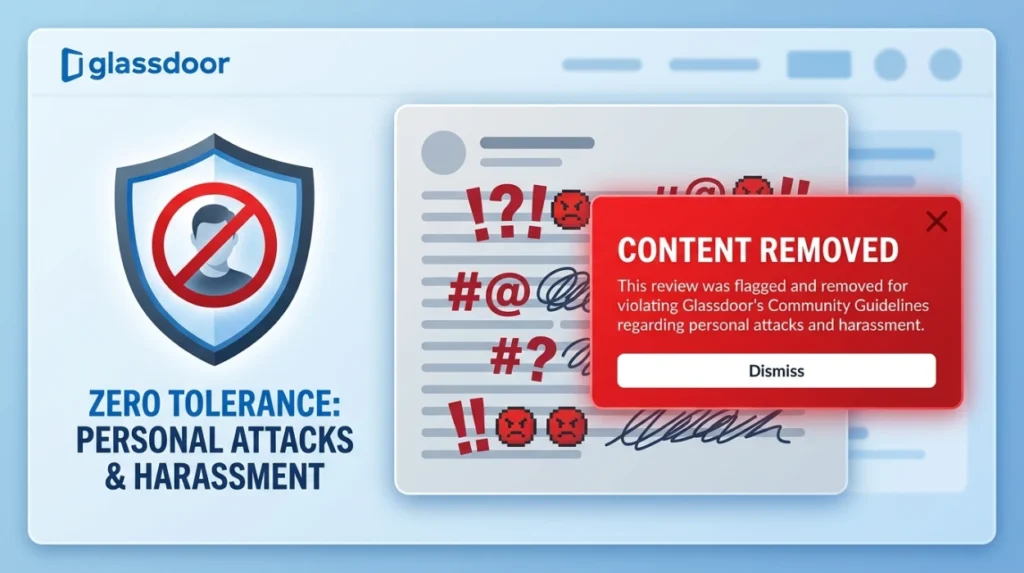
Personal attacks and harassment refer to content targeting identifiable individuals through insults, threats, or abusive language. Glassdoor guidelines prohibit this material because it shifts the focus from workplace experiences to personal hostility. Reviews are intended to evaluate employment environments rather than individuals through abusive commentary.
Harassment creates distorted reputation signals because emotional statements often lack informational value. Search engines and review platforms increasingly assess the quality of user-generated content through relevance and usefulness metrics. Content containing personal attacks contributes little to meaningful SERP evaluation and weakens the credibility of review ecosystems.
The prohibition of harassment also supports trust formation. Users rely on review platforms for balanced and informative perspectives. When abusive content dominates review sections, the perceived reliability of the platform decreases. Moderation therefore functions as a mechanism that protects both information quality and platform authority.
Why are false statements and fabricated reviews restricted?
False statements refer to information presented as factual despite lacking authenticity or evidence. Fabricated reviews involve experiences that did not occur or identities that do not exist. These forms of content violate community guidelines because they create inaccurate representations of organisations and employment environments.
Review platforms depend on credibility signals. Authentic reviews contribute to trust, while fabricated information introduces misinformation into digital ecosystems. Search engines evaluate authority partly through content quality and user trust. When false information becomes prominent, entity perception and platform credibility are negatively affected.
Fabricated reviews also interfere with sentiment interpretation. Algorithms and users assess review content to understand reputation patterns and workplace experiences. False information produces inaccurate sentiment signals, creating a distorted understanding of organisational reputation.
How does confidential information affect review moderation?
Confidential information refers to private data that is not intended for public disclosure. Examples include financial details, trade secrets, customer information, or personal employee data. Glassdoor guidelines prohibit such disclosures because they introduce legal, ethical, and privacy concerns.
Confidential information also changes the purpose of a review. Instead of contributing useful insights about workplace experiences, the content becomes a vehicle for revealing restricted information. This reduces informational value and increases reputational and legal risks.
Within search ecosystems, confidential disclosures can become indexed content. Once indexed, information contributes to digital footprints and can influence entity perception. Moderation policies therefore attempt to prevent the publication of material that creates long-term visibility risks and compromises information integrity.
Dive Deeper With Our Expert Guides:
How Employer Reviews on Glassdoor Affect Hiring and What Employers Can Control
How False Glassdoor Reviews Are Identified and Why They Are Especially Harmful
How are authenticity and credibility evaluated on review platforms?
Authenticity refers to the degree to which content reflects genuine experiences and truthful information. Credibility refers to the perceived reliability of that information. Review platforms use moderation systems and behavioural signals to evaluate whether content meets these standards.
Authenticity assessment examines factors such as account behaviour, language patterns, and relevance to employment experiences. These signals assist in identifying manipulated or fabricated submissions. Credibility assessment then determines whether content contributes useful information and aligns with platform expectations.
From a reputation perspective, authenticity and credibility are fundamental trust signals. Search engines rely on credible sources to deliver useful information. Review platforms with stronger moderation standards are more likely to maintain authority and influence SERP evaluation because they present information that users perceive as reliable.
How do community guidelines influence online reputation?
Community guidelines influence online reputation by determining which information becomes visible and which information is removed. Moderation decisions shape the digital footprint of organisations because reviews contribute directly to public perception and reputation signals.
Positive and negative reviews both influence reputation when they comply with publication standards. The critical factor is whether the information remains within acceptable guidelines. Moderation systems are not designed to remove criticism but to remove content that violates platform rules.
Community guidelines therefore operate as information filters. They determine the quality of user-generated content that contributes to entity perception. Since review platforms frequently appear in search results, moderation decisions can influence how organisations are understood through search visibility and SERP presentation.
Why do review guidelines matter for search visibility?
Review guidelines matter because user-generated content contributes to content indexing and search perception. Review platforms frequently rank prominently in search engine results pages, making their content part of the information environment that shapes reputation.
Search engines evaluate authority and trust signals when ranking pages. Platforms with consistent moderation standards are perceived as more reliable information sources. This credibility supports stronger search visibility and reinforces the influence of reviews on reputation formation.
Review content also contributes to entity understanding. Search engines use available information to interpret organisations, identify sentiment patterns, and assess credibility signals. Guidelines therefore indirectly influence how entities are represented within search ecosystems.
How do algorithms interpret review sentiment and trust signals?
Algorithms interpret review sentiment by analysing language patterns, emotional indicators, and contextual information. Sentiment analysis identifies whether content communicates positive, negative, or neutral experiences. These interpretations contribute to broader assessments of reputation and credibility.
Trust signals emerge from authenticity, consistency, and user engagement. Platforms that demonstrate reliable moderation standards and authentic content create stronger authority indicators. Search systems use these signals to evaluate information quality and determine the prominence of content within search results.
The interaction between sentiment and trust is significant because reputation is formed through both qualitative and quantitative information. Review content influences perception when users and algorithms interpret it as credible and informative.
What role do community guidelines play in digital footprint management?
A digital footprint refers to the collection of information about an organisation or entity that exists online. Review content forms part of this footprint because it remains accessible, indexable, and influential in shaping public understanding.
Community guidelines determine which reviews become part of that digital record. Acceptable content contributes to long-term reputation signals, while prohibited content faces moderation or removal. The standards therefore influence the composition and quality of information available to users and search engines.
Digital footprints are dynamic information environments. Search engines continuously evaluate indexed content and update their understanding of entities. Community guidelines contribute to this process by establishing standards for information quality and determining which content participates in reputation formation.
Glassdoor community guidelines establish the rules that define acceptable review content, prohibited material, and moderation standards within workplace review ecosystems. These guidelines exist to protect information quality, maintain trust, and ensure that reviews contribute meaningful insights rather than misinformation or abuse.
The standards influence more than platform moderation. They affect digital footprints, shape reputation signals, and contribute to how organisations are interpreted within search ecosystems. By regulating authenticity, relevance, and credibility, community guidelines play an important role in determining how review content influences online reputation and search visibility.
What types of reviews violate Glassdoor community guidelines?
Reviews that contain harassment, discriminatory language, confidential information, threats, or false statements can violate Glassdoor community guidelines. Fabricated reviews and content that impersonates another person may also be removed by the platform.
Can a negative Glassdoor review be removed if it follows the guidelines?
A negative review is not usually removed simply because it is critical. Glassdoor generally allows negative opinions if the content is authentic, relevant, and does not breach its community standards.
Does Glassdoor remove fake employee reviews?
Yes. Glassdoor may remove reviews that appear to be fabricated, posted by someone without genuine employment experience, or created to manipulate a company’s reputation. The platform uses moderation processes to assess authenticity and credibility signals.
How do Glassdoor reviews affect online reputation?
Glassdoor reviews contribute to an organisation’s digital footprint and can influence public perception in search results. Reviews that rank prominently can affect reputation signals, trust, and how potential employees view a company.
What are Glassdoor Reviews Removal Services used for?
Glassdoor Reviews Removal Services are generally used to assess whether a review breaches community guidelines or contains prohibited content. Services such as those offered by Clear Your Name focus on identifying potential guideline violations rather than removing legitimate criticism.