
Fake online reviews originate from coordinated, fabricated, or misleading review activity designed to influence public perception rather than reflect genuine customer experiences. Search engines and review platforms evaluate review authenticity through reputation signals, behavioural patterns, content quality, and trust indicators rather than review text alone.
Reputation management is the process of analysing how digital information shapes credibility across search ecosystems. Online reputation refers to the collection of indexed content, review signals, entity associations, and search engine results that influence public perception and online trust. Reviews contribute directly to digital reputation because search engines and review platforms interpret user-generated content as evidence of business quality, authority, and reliability. Understanding where fake reviews originate and how they are identified provides a clearer understanding of how search visibility and entity perception develop over time.
Why do fake online reviews appear across digital platforms?
Fake online reviews appear because reviews influence consumer decisions, search visibility, and platform credibility. Positive fabricated reviews attempt to improve reputation artificially, while negative fabricated reviews attempt to reduce public trust and influence purchasing behaviour.
Review platforms collect large volumes of user-generated content every day. This volume creates opportunities for inaccurate or manipulated submissions to enter review ecosystems before automated and manual verification systems evaluate authenticity. Search engines also interpret review information when assessing local search relevance and authority, making review manipulation significant within reputation management.
Review manipulation affects entity perception because repeated misleading feedback alters how users interpret credibility. Search ecosystems analyse review consistency, reviewer behaviour, account history, and content quality when determining whether review signals contribute to trust or require further evaluation.
How are fake online reviews created?
Fake online reviews are created through coordinated publishing methods that imitate authentic customer feedback. These reviews frequently originate from fabricated accounts, incentivised reviewers, automated systems, or organised reputation manipulation campaigns rather than genuine customer experiences.
Fabricated accounts generate misleading reputation signals because they lack authentic interaction histories. Incentivised reviews distort public perception by rewarding reviewers for favourable or unfavourable feedback rather than honest evaluation. Automated review generation creates repetitive content patterns that differ from naturally occurring customer language.
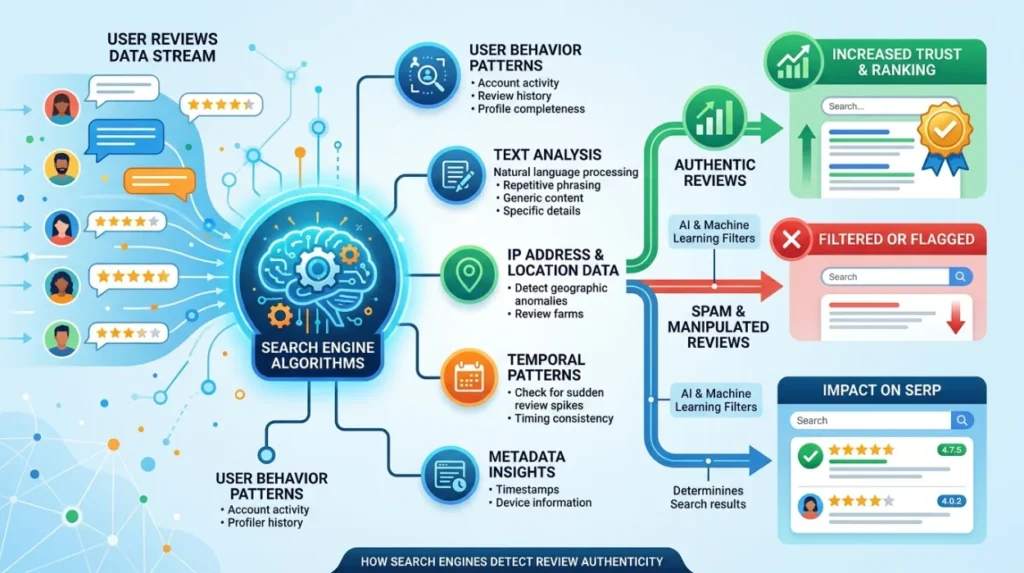
Search ecosystems identify unusual behavioural patterns by analysing reviewer frequency, account activity, linguistic consistency, geographic relevance, and temporal publishing behaviour. These technical indicators contribute to authenticity assessments beyond the visible review text itself.
How do search engines interpret review authenticity?
Search engines interpret review authenticity through behavioural analysis, semantic consistency, and trust evaluation. Algorithms assess review quality alongside broader reputation signals rather than relying solely on star ratings or individual comments.
Authority signals influence review interpretation because trusted businesses generally demonstrate balanced review histories, verified customer engagement, and consistent entity information across digital platforms. Search engines compare review patterns with broader business information to determine whether reputation signals appear credible.
Review authenticity therefore depends on contextual analysis rather than isolated review content. Search algorithms evaluate semantic relationships, reviewer credibility, publication timing, and historical consistency before assigning greater weight to review information within search ecosystems.
Why do fake reviews influence search visibility?
Fake reviews influence search visibility because reviews contribute to local ranking signals, digital trust, and user engagement metrics. Review quantity, recency, diversity, and overall sentiment affect how businesses appear within search engine results pages (SERPs) and platform listings.
Artificially positive reviews attempt to increase visibility by strengthening perceived authority, while fabricated negative reviews attempt to weaken trust and reduce user confidence. Search engines continuously analyse these reputation signals to distinguish authentic customer feedback from manipulated review activity.
Entity perception changes when misleading review information becomes prominent within search results. Repeated exposure to fabricated feedback shapes public interpretation even before users access a website, demonstrating how review manipulation extends beyond individual platforms into broader search ecosystems.
Which behavioural indicators help identify fake online reviews?
Behavioural indicators provide stronger evidence than review text alone because coordinated manipulation frequently produces recognisable publishing patterns. Platforms evaluate reviewer behaviour before assessing sentiment, making behavioural analysis a fundamental element of authenticity detection.
The following indicators commonly contribute to review evaluation:
- Analyse account history to identify recently created profiles with limited review activity.
- Evaluate publication timing where multiple reviews appear within unusually short periods.
- Compare reviewer language to detect repetitive wording or duplicated phrases across multiple submissions.
- Review geographic consistency by examining whether reviewer locations align with business operations.
- Assess engagement history to determine whether reviewers interact naturally across different businesses and industries.
Each indicator contributes additional evidence during authenticity assessment. Platforms combine these behavioural signals with semantic analysis, technical verification, and historical activity to improve review quality and reduce misleading reputation signals.
How does sentiment distribution affect online reputation?
Sentiment distribution refers to the balance of positive, neutral, and negative information associated with an entity across review ecosystems. Search engines evaluate this balance because it contributes to broader reputation signals and influences entity credibility.
Natural review profiles contain varied customer opinions that reflect authentic experiences. Artificial manipulation frequently creates unusual sentiment patterns that differ from organic customer behaviour. Platforms therefore evaluate distribution consistency alongside reviewer authenticity and account behaviour.
Balanced sentiment strengthens digital credibility because it reflects realistic customer interaction. Reputation management analyses sentiment distribution to understand how review patterns influence search visibility, public trust, and long-term online credibility.
How do review platforms detect fake online reviews?
Review platforms detect fake online reviews by combining automated systems with manual moderation to evaluate authenticity. Detection systems analyse reviewer behaviour, account history, content quality, IP patterns, verification status, and unusual publishing activity. These mechanisms operate continuously because reputation signals directly influence platform credibility and user trust.
Machine learning models identify behavioural anomalies that differ from genuine customer activity. Repeated submissions from related accounts, duplicated language, unusual rating distributions, and coordinated posting schedules indicate possible manipulation. Human moderators then review flagged content where additional contextual assessment is required.
This layered approach improves review quality because behavioural analysis extends beyond the visible review text. Platforms evaluate the relationship between reviewer identity, engagement history, and publication behaviour before determining whether review content contributes reliable reputation signals.
Why do authority and trust signals matter in review ecosystems?
Authority and trust signals determine how search engines and review platforms interpret the credibility of businesses and reviewers. Authority refers to the overall reliability of an entity within digital ecosystems, while trust signals represent measurable indicators supporting authenticity and consistency.
Businesses with complete profiles, consistent business information, verified ownership, and balanced review histories typically demonstrate stronger trust signals. Search engines compare these indicators with external references, indexed content, and user engagement when evaluating entity perception.
Review authenticity therefore forms part of a wider reputation framework. Strong authority signals improve search visibility because algorithms interpret consistency and credibility as indicators of higher-quality information within search engine results pages (SERPs).
Dive Deeper With Our Expert Guides:
How Fake Reviews Are Defined Across Major UK Platforms in 2026
How does a digital footprint influence review credibility?
A digital footprint refers to the collection of publicly available information connected to an individual or organisation across online platforms. Reviews represent one component of this footprint because they contribute directly to public perception and search visibility.
Search engines analyse reviews alongside websites, business listings, social profiles, news references, and other indexed information. Consistent information strengthens entity credibility, whereas conflicting or manipulated content weakens reputation signals and creates uncertainty during SERP evaluation.
A balanced digital footprint demonstrates authenticity because independent information sources reinforce one another. Reputation management therefore evaluates reviews as part of a broader ecosystem rather than treating them as isolated reputation indicators.
What role does content indexing play in review visibility?
Content indexing is the process through which search engines discover, analyse, and organise publicly available information. Reviews that become indexed contribute to search visibility because they provide additional context about an entity’s reputation and relevance.
Indexed review content strengthens semantic associations between businesses, services, and user experiences. Search engines evaluate these associations alongside authority signals and topical relevance when determining ranking positions. As review content accumulates, it influences how entities are interpreted within broader search ecosystems.
Content indexing also affects long-term discoverability. Reviews remaining accessible over extended periods continue contributing to entity perception until new information changes the balance of reputation signals or platforms remove inauthentic content.
How does recognising fake reviews improve online credibility?
Recognising fake reviews improves online credibility because accurate information strengthens trust signals and reduces misleading entity associations. Reliable review ecosystems allow search engines and users to evaluate businesses using authentic customer experiences instead of manipulated reputation signals.
Analysing behavioural indicators, sentiment distribution, reviewer authenticity, and authority signals provides a structured framework for identifying suspicious review activity. This analytical approach supports better SERP evaluation because search ecosystems reward trustworthy information over manipulated engagement.
For readers seeking a deeper understanding of practical review management processes, How to Remove Fake Online Reviews From Google Trustpilot and Other Platforms explains how review removal strategies interact with platform policies and reputation management frameworks.
Fake online reviews influence search visibility because review content contributes directly to reputation signals, entity perception, and online credibility. Search engines and review platforms evaluate authenticity through behavioural analysis, authority signals, content indexing, and sentiment distribution rather than relying on review text alone.
Understanding where fake reviews originate and how platforms identify them provides a clearer view of modern reputation systems. Digital footprints, trust indicators, review authenticity, and search evaluation all contribute to how businesses and individuals are perceived across search ecosystems. Analysing these interconnected mechanisms creates a stronger understanding of how reputation develops and how reliable review information supports long-term online credibility.
Where do fake online reviews usually come from?
Fake online reviews often originate from fabricated accounts, paid review schemes, competitors, or automated posting systems. These reviews create misleading reputation signals that influence search visibility and public perception across digital platforms.
How can you recognise fake online reviews reliably?
Fake online reviews can be recognised by analysing reviewer behaviour, repetitive language, unusual posting patterns, incomplete profiles, and inconsistent review histories. Search engines and review platforms also evaluate these trust signals when assessing review authenticity.
Do fake online reviews affect search engine rankings?
Yes, fake online reviews can influence search visibility because review quality, sentiment, and credibility contribute to reputation signals. Search engines assess review authenticity alongside authority and trust indicators during SERP evaluation.
How do Fake Reviews Removal Services deal with suspicious reviews?
Fake Reviews Removal Services assess whether suspicious reviews breach platform policies or contain misleading information before initiating the appropriate reporting or removal process. Clear Your Name analyses review authenticity, reputation signals, and platform guidelines to support this evaluation.
Why are authentic reviews important for online reputation?
Authentic reviews strengthen online credibility by providing genuine customer feedback that search engines and users can trust. Accurate review profiles improve entity perception, reinforce trust signals, and support sustainable search visibility over time.