

Harmful content often spreads rapidly because distribution systems prioritise engagement, relevance, and interaction before moderation processes complete their review. Reputation management is the structured analysis of information that influences how an individual, organisation, or entity is perceived across digital platforms and search ecosystems.
Online reputation refers to the accumulated perception created by content, reviews, discussions, profiles, search results, and other reputation signals associated with an entity. When harmful content receives rapid engagement, its visibility can expand before a platform identifies a policy violation or completes a moderation decision. Understanding this timing explains why viral content creates reputation risks beyond the original publication. It also shows how content indexing, search visibility, and entity perception interact across digital systems.
Why Does Harmful Content Spread So Quickly Online?
Harmful content spreads quickly because digital platforms use distribution systems that react to user activity before human moderation evaluates every item. Engagement signals such as comments, shares, reactions, watch time, and repeated interactions provide evidence of content interest. Higher interaction levels increase the likelihood of further distribution within recommendation systems or social feeds. This process operates independently from a final assessment of whether the content is accurate, misleading, defamatory, or otherwise harmful. Moderation therefore operates alongside distribution rather than always preceding it.
Virality refers to accelerated content distribution caused by repeated user interaction and algorithmic amplification. A post gains additional visibility when engagement generates further opportunities for users to encounter and interact with it. Each interaction contributes to the content’s observable performance within the platform’s distribution system. This creates a feedback mechanism in which visibility generates engagement and engagement reinforces visibility. The resulting acceleration creates a narrow window between initial publication and effective intervention.
How Do Algorithms Evaluate Content Before Moderation Takes Effect?
Algorithms evaluate content through measurable signals that indicate relevance, engagement, user interest, and behavioural patterns. These systems analyse interactions to determine which content receives additional exposure within feeds, recommendations, search functions, or related-content areas. The evaluation process focuses on distribution performance rather than establishing the complete factual accuracy of every claim. Content therefore enters an algorithmic ranking environment before a comprehensive moderation decision occurs. This distinction explains why harmful material can achieve substantial reach despite later removal.
Content ranking dynamics operate through automated classification and prioritisation systems. A platform evaluates signals associated with the content, the publisher, the audience, and the interaction pattern. High engagement provides a strong distribution signal even when the underlying content contains misleading or damaging information. Moderation systems then apply policy rules to determine whether the content violates platform standards. The separation between ranking and moderation creates the conditions for rapid exposure before enforcement.
Search engines apply a related but distinct process. Search systems evaluate relevance, authority, content quality, query alignment, and other signals when determining SERP composition. A harmful post that becomes widely referenced, discussed, or indexed enters a broader information environment beyond its original platform. Its search visibility therefore depends on how the content interacts with search systems rather than solely on the platform’s internal distribution. This creates an additional reputation layer that remains relevant after social engagement declines.
What Role Does Engagement Play in the Spread of Harmful Content?
Engagement functions as a distribution signal because repeated user activity demonstrates that content attracts attention. Comments, shares, reactions, replies, and viewing behaviour generate measurable interaction data for platform algorithms. The system interprets these signals as evidence of audience relevance or interest rather than as proof of factual accuracy. Negative reactions also contribute to engagement because disagreement generates interaction. Harmful content therefore receives additional exposure through the same behavioural mechanisms that distribute legitimate content.
Sentiment and engagement represent separate concepts within reputation analysis. Sentiment refers to the positive, negative, or neutral orientation expressed through content, while engagement measures the level of interaction surrounding that content. A highly negative post with substantial engagement therefore possesses both a damaging sentiment signal and a strong distribution signal. The combination increases the likelihood of continued visibility within the relevant platform environment. Reputation analysis evaluates both dimensions to understand the actual exposure created by viral activity.
Engagement also affects perception through repetition. Users encounter the same claim across posts, comments, screenshots, reposts, and discussions, creating increased familiarity with the underlying narrative. Repetition does not establish truth, but it increases the presence of the narrative within the information environment. This distinction matters because entity perception develops through exposure as well as factual evaluation. A harmful claim therefore gains reputational significance when repeated distribution establishes persistent visibility.
How Does Harmful Content Affect Search Visibility and SERP Evaluation?
Harmful content affects search visibility when it becomes sufficiently relevant, accessible, referenced, or indexed within search ecosystems. Search engines evaluate indexed content according to query relevance and other ranking signals rather than simply reproducing social-platform popularity. Viral content can attract external references, discussions, links, and searches that increase its presence within the broader information environment. These developments create additional signals associated with the affected entity. The result is a reputation risk that extends beyond the original social-media post.
SERP evaluation refers to the assessment of which information appears for searches associated with an entity, topic, product, or individual. A search results page can contain official websites, social profiles, news coverage, reviews, forum discussions, videos, and third-party publications. Harmful content becomes more significant when it occupies visible positions within this collection of information. Users often interpret the composition of search results as a representation of available information about the entity. Search visibility therefore contributes directly to digital perception.
Content indexing is another important mechanism. Indexing refers to the process through which search engines store and evaluate accessible content for potential inclusion in search results. A harmful page that becomes indexed enters the searchable information environment even if the original social post later loses momentum. Indexing therefore creates a distinction between social virality and search persistence. Reputation analysis evaluates both because temporary social activity and sustained search visibility produce different exposure patterns.
How Do Reputation Signals Influence Entity Perception?
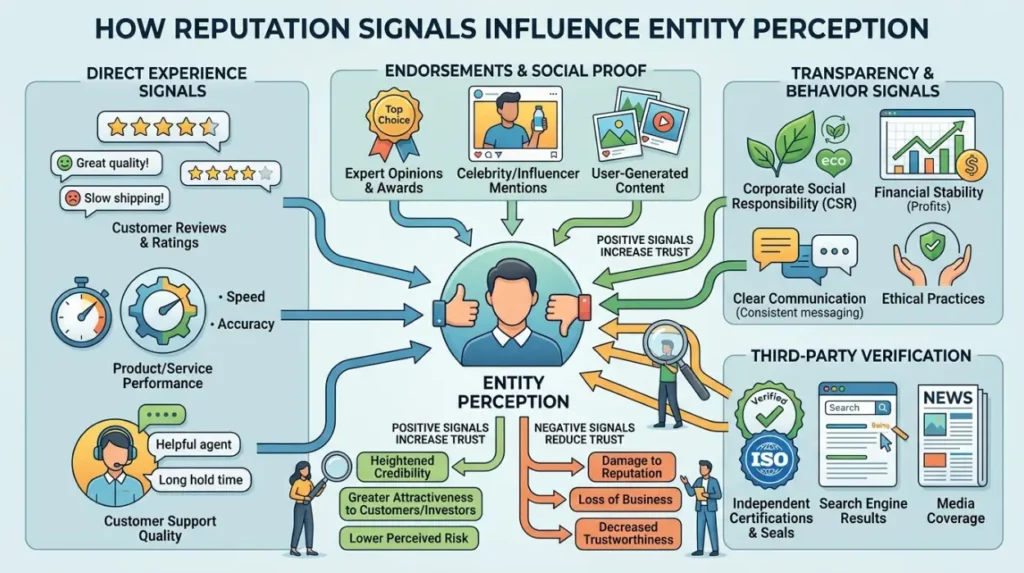
Reputation signals are observable pieces of information that contribute to how an entity is evaluated by users and search systems. These signals include reviews, authoritative profiles, news coverage, social content, business information, public discussions, and other relevant digital assets. Search engines use signals to understand entities and determine which information satisfies a user’s query. Users also interpret these signals when assessing credibility, reliability, and relevance. Reputation therefore emerges from an information ecosystem rather than from one isolated page.
Entity perception refers to the overall understanding formed around an individual, organisation, or brand through accumulated digital information. Positive authoritative content reinforces credibility, while persistent negative material introduces competing signals that influence interpretation. The relative prominence, consistency, and authority of these signals affect how the entity is understood. A single harmful post therefore has limited significance when isolated but gains greater reputational weight when it becomes part of a broader negative information pattern. Reputation analysis examines these relationships rather than evaluating content in isolation.
Authority and trust signals also influence interpretation. Authoritative sources provide stronger contextual information than anonymous or low-quality sources because users and search systems have greater reason to treat them as credible references. However, visibility and authority remain separate dimensions. Highly authoritative content that receives limited visibility has less immediate influence on users than prominent content encountered repeatedly. Effective reputation analysis therefore considers both information quality and information visibility.
Why Does Platform Moderation Often Follow Viral Distribution?
Platform moderation often follows viral distribution because automated distribution systems operate continuously while policy enforcement involves classification, detection, review, and decision processes. Automated systems distribute content based on available behavioural signals, while moderation determines whether the content satisfies platform rules. These processes have different objectives and operate at different stages of the content lifecycle. Distribution prioritises information delivery, whereas moderation prioritises policy compliance. The time required to evaluate content creates an interval in which harmful material gains exposure.
Automated moderation reduces this interval through machine-based detection, but classification remains dependent on defined policy categories and available evidence. Context-dependent content presents additional classification complexity because meaning can depend on wording, intent, surrounding discussion, or external information. A post therefore enters a moderation workflow that differs from the algorithmic system determining its initial reach. This separation explains why enforcement does not always prevent early exposure.
The delay has particular relevance to reputation systems because reputational damage often develops through accumulation. A harmful post receives engagement, derivative posts reproduce its claims, users search for the subject, and third-party discussions establish additional references. Each stage expands the information footprint associated with the entity. Moderation of the original content therefore does not automatically reverse every subsequent reputation signal. The broader digital footprint requires separate evaluation.
Dive Deeper With Our Expert Guides:
How Deepfake Content Spreads Across Social Media Platforms Quickly
Why Harmful Posts in Private Facebook Groups Are Hard to Track
How Do Reviews and Sentiment Signals Amplify Reputation Damage?
Reviews amplify reputation damage by converting individual experiences or claims into structured rating and sentiment information. Star ratings provide an immediately interpretable signal, while written reviews provide contextual information about the entity. A sudden increase in negative reviews changes sentiment distribution and can alter how users interpret the overall reputation profile. Search engines and platforms treat review content differently, but users frequently consider review information alongside other digital assets. This creates an important connection between social sentiment and broader reputation perception.
Sentiment interpretation involves identifying the emotional or evaluative orientation expressed within content. Negative sentiment becomes more significant when it appears repeatedly across independent sources or becomes associated with a recognisable entity. Coordinated or repetitive content creates a different analytical pattern from organically distributed criticism. Reputation analysis therefore examines timing, language, source relationships, rating concentration, and content context. These factors help distinguish a sustained reputation trend from a temporary burst of negative attention.
Review signals also influence decision-making because users often seek external validation before engaging with a business. A visible negative rating can alter initial expectations before users examine supporting information. This does not establish the accuracy of the rating, but it demonstrates the perceptual effect of prominent sentiment signals. The information environment therefore affects decision-making through both content quality and visibility.
What Makes Harmful Content Persist After Its Initial Viral Surge?
Harmful content persists when secondary distribution creates additional copies, references, discussions, or indexed assets after the original post receives attention. Reposts and screenshots preserve claims even when the original publication changes or disappears. External articles, forum discussions, videos, and social commentary then create additional references around the same subject. Search engines evaluate these assets independently according to their own indexing and ranking systems. The original post therefore becomes only one component of a larger digital footprint.
Digital footprint refers to the collection of accessible information associated with an entity across digital environments. A viral incident expands this footprint when new content repeatedly references the original claim or event. The expanded footprint creates additional reputation signals that remain relevant after the initial engagement period. This explains why deleting a single post does not necessarily eliminate the associated search or perception effects. Reputation analysis must therefore examine the entire information chain.
Persistence also depends on content relevance and continued user interest. If users continue searching for the subject, derivative content remains relevant to those queries. Search systems then continue evaluating the available information based on query intent and content relevance. This creates a distinction between viral duration and reputational duration. A post can stop trending while its associated information remains visible within search results.
How Can the Spread of Viral Harmful Content Be Analysed?
The spread of viral harmful content can be analysed by tracking distribution, engagement, indexing, sentiment, and changes in the entity’s digital footprint. Analysis begins by establishing when the content appeared and how quickly interaction increased. It then examines derivative content, reposts, references, search visibility, and sentiment changes. This creates a timeline showing how information moved between platforms and search environments. The objective is to identify the mechanisms responsible for persistence rather than simply measuring the number of views.
A structured analytical framework evaluates the following signals:
- Track engagement velocity by comparing reactions, comments, shares, and other interactions across defined time periods.
- Identify derivative content by locating reposts, screenshots, discussions, and references that reproduce the original narrative.
- Evaluate search visibility by monitoring indexed pages, query results, and changes in SERP composition associated with the entity.
- Measure sentiment distribution by comparing positive, negative, and neutral references before and after the content gains visibility.
- Assess authority signals by identifying which sources repeat or contextualise the harmful information and evaluating their relative credibility.
This framework connects social distribution with search reputation. It also separates temporary engagement from persistent visibility, which provides a more accurate understanding of reputational exposure. The resulting analysis identifies whether the primary risk exists within social feeds, search results, third-party content, or the combined information ecosystem. Understanding the mechanism provides the foundation for evaluating appropriate reputation responses.
What Is the Relationship Between Viral Content and Online Reputation?
Viral content becomes an online reputation issue when rapid distribution changes the information available around an entity and influences subsequent perception. Online reputation is formed through the cumulative interaction of content, visibility, credibility, sentiment, and user interpretation. Viral harmful material introduces a negative reputation signal that gains strength through repetition and exposure. Search systems then evaluate the resulting information alongside other indexed assets. The reputational effect therefore depends on how the viral content integrates into the wider digital footprint.
The distinction between virality and reputation is important. Virality measures the speed and scale of content distribution, while reputation reflects the broader perception created by accumulated information. A viral post does not automatically determine an entity’s reputation because authority, context, countervailing information, and long-term visibility also influence perception. However, sustained viral exposure increases the number of opportunities for users to encounter the negative narrative. This creates a measurable pathway from distribution activity to reputation risk.
Understanding this relationship also explains why slowing the spread of a viral harmful post requires analysis of both distribution and persistence. Limiting further exposure addresses the immediate visibility mechanism, while monitoring indexing and derivative content addresses the longer-term information footprint. These are distinct processes with different effects on reputation signals. Analysing both provides a clearer understanding of how harmful information moves through modern search ecosystems.
Why Does Harmful Content Go Viral Before Platforms Can Act?
Harmful content often achieves substantial visibility before moderation because content distribution and policy enforcement operate through separate mechanisms. Algorithms evaluate engagement, relevance, and behavioural signals to determine distribution, while moderation systems evaluate content against platform policies. This separation creates a period in which harmful material gains exposure and generates additional reputation signals.
Search visibility extends the issue beyond the original platform. Viral posts generate discussions, reposts, references, and indexed content that contribute to an entity’s digital footprint and influence SERP evaluation. Reputation therefore develops through the interaction of content visibility, sentiment, authority, credibility, and user interpretation.
Understanding these mechanisms provides a more accurate model of online reputation risk. The central issue is not simply how quickly a platform removes harmful content, but how rapidly information becomes distributed, indexed, repeated, and incorporated into the wider reputation ecosystem. Analysing these stages explains why early viral exposure carries significance and why search perception remains relevant after the original content loses its initial momentum.
Why does harmful content go viral before platforms can remove it?
Harmful content can spread quickly because platform algorithms prioritise engagement, relevance, and user interaction before moderation decisions are completed. Rapid sharing, comments, and reposts can increase visibility before a policy review takes effect.
How does viral harmful content affect online reputation?
Viral harmful content can create negative reputation signals that influence entity perception and public trust. Repeated exposure, reposts, and search visibility can extend the impact beyond the original social media post.
Can harmful social media content affect Google search results?
Harmful social media content can affect search visibility when it becomes indexed, referenced, or connected to searches about an entity. Its impact depends on factors such as relevance, authority, content quality, and SERP composition.
How do social media platforms decide which content becomes viral?
Platforms evaluate signals such as engagement, interactions, viewing behaviour, relevance, and audience response when distributing content. These signals indicate user interest but do not necessarily confirm that the content is accurate or credible.
How can businesses reduce the spread of harmful online content?
Businesses can monitor emerging content, document harmful material, assess policy violations, and track reposts and search visibility. A structured approach to social media content removal and reputation monitoring helps identify how harmful information spreads across digital ecosystems.