Harmful posts in private Facebook groups are hard to track because group content operates behind access controls, limits public indexing, and remains visible primarily to approved members. Reputation management is the structured process of monitoring, interpreting, and influencing information that shapes how an individual, organisation, or entity is perceived online.
Why are harmful posts in private Facebook groups difficult to discover?
Harmful posts in private Facebook groups are difficult to discover because their content is restricted by group membership and platform access controls. Private-group visibility separates the content from the openly accessible web environment that search engines routinely crawl and evaluate. Search engines depend on accessible pages, links, text signals, and other crawlable resources when constructing search indexes. A post inside a restricted group therefore occupies a different information layer from an openly published webpage, public social-media post, or indexed review. This distinction affects content indexing because restricted information does not enter the same discovery pathway as publicly accessible information. The result is a fragmented reputation landscape in which information affecting entity perception exists without appearing directly in conventional search results.
Private-group content also has a different relationship with search visibility because membership determines who can access the information. A search crawler operating outside the authorised group audience does not receive the same content context as an approved member. This creates a separation between content existence and content discoverability within digital reputation systems. Content existence refers to information being present on a platform, while content discoverability refers to the ability of users or automated systems to locate that information. Reputation analysis therefore requires attention to both indexed and non-indexed information. A harmful statement can influence human perception within a community without becoming a directly visible SERP result.
How does private-group content differ from publicly indexed content?
Private-group content differs from publicly indexed content primarily through accessibility, crawlability, and contextual visibility. Public content is available through an open web environment where search engines can analyse textual relevance, links, page structure, and other ranking signals. Private-group content operates within a controlled platform environment where access depends on membership or authorisation. This creates a boundary between platform-level visibility and search-engine visibility. The distinction is important because search ranking systems evaluate information that enters their available index rather than every piece of information stored across the internet. Consequently, a private post can remain relevant to reputation perception without functioning as a conventional indexed search result.
The difference also affects the evidence available for reputation monitoring. Public pages provide searchable URLs, titles, publication dates, visible text, and linking relationships that support systematic monitoring. Restricted posts provide a narrower observation environment because access depends on the platform’s permissions and the user’s relationship with the group. This limits automated discovery and reduces the consistency of external monitoring. Reputation signals therefore become distributed across different information environments rather than concentrated within search-engine results. A complete digital footprint includes both publicly discoverable material and information circulating within restricted online communities.
How do search engines evaluate reputation-related information?
Search engines evaluate reputation-related information through signals associated with relevance, authority, content quality, entities, links, user intent, and broader search context. Search engines organise accessible information into indexes and then evaluate indexed documents against queries. Reputation-related content enters this process when a page is accessible, crawlable, and eligible for indexing. The ranking system then determines how strongly that document satisfies a particular search intent and how it relates to other documents about the same entity. This process means that reputation is not represented by one universal score displayed to users. Instead, SERP evaluation produces query-specific arrangements of information that shape what users encounter.
Entity perception forms another layer of reputation evaluation. An entity represents a recognisable person, organisation, business, place, or concept associated with information across digital sources. Search systems connect documents and references to entities through contextual relationships, textual information, links, structured data, and other signals. Consistent information strengthens the clarity of an entity’s digital representation, while conflicting information introduces additional interpretive complexity. A harmful public article, inaccurate profile, negative review, or discussion thread therefore becomes part of the wider information environment surrounding an entity. Private-group content remains relevant to human perception even when it does not enter the same indexed entity environment.
How does content influence online reputation and search perception?
Content influences online reputation by supplying information that users interpret as evidence about an entity. Online reputation refers to the cumulative perception created by information associated with an individual, organisation, or entity across digital environments. Search perception refers specifically to how that information is encountered and interpreted through search results and related online sources. Positive, neutral, and negative documents each contribute to the information environment surrounding an entity. The influence of a document depends on factors including visibility, relevance, source authority, contextual accuracy, freshness, and the relationship between the document and the search query. Reputation analysis therefore examines information as a connected system rather than treating one isolated post as the complete reputation.
Publicly visible content has a direct relationship with search perception because users can encounter it through branded or entity-related queries. A negative page that ranks prominently receives greater exposure than an equivalent page that remains difficult to discover. This creates an important distinction between content sentiment and search visibility. Sentiment describes the direction of expressed opinion, whereas visibility describes the likelihood that users encounter the information. A harmful private-group post can have strong negative sentiment among its readers while having limited direct influence on conventional SERPs because its content remains outside open indexing pathways.
How do review signals affect reputation evaluation?

Review signals affect reputation evaluation by providing structured and repeated expressions of user experience associated with an entity. Reviews contain signals such as sentiment, rating patterns, textual themes, recency, reviewer activity, and platform context. Search systems process publicly available review information as part of the broader information environment surrounding businesses and other entities. Users also interpret review patterns independently when evaluating credibility and trust. A consistent pattern of negative sentiment therefore affects perception through both search exposure and human interpretation. Review signals form one component of reputation analysis rather than functioning as a standalone measure of overall credibility.
Sentiment interpretation involves identifying whether language expresses positive, neutral, or negative attitudes towards an entity or experience. Search systems and associated technologies analyse textual relationships and contextual meaning rather than treating every negative term as an equivalent reputation signal. A complaint containing a negative expression has a different contextual meaning from an accusation presented as factual information. The source, wording, topic, and relationship to the entity influence how the information is interpreted. Reputation analysis therefore distinguishes between sentiment intensity, factual claims, opinion, relevance, and source authority. This distinction prevents a simple sentiment count from being treated as a complete representation of online credibility.
How do authority and trust signals shape online credibility?
Authority and trust signals shape online credibility by influencing how information is evaluated within the wider information ecosystem. Authority refers to the recognised relevance, expertise, prominence, or reliability associated with a source in a particular context. Trust relates to the perceived reliability and consistency of information and its source. Search systems use multiple signals to determine how documents relate to queries, while users independently assess whether a source appears credible. A high-authority source therefore occupies a different informational position from an anonymous or weakly connected source. Reputation systems analyse these relationships through the combined context of content, source, entity, relevance, and visibility.
Trust signals also depend on consistency across the digital footprint. A digital footprint is the collection of publicly accessible information and references associated with an entity across online platforms. Consistent names, descriptions, professional information, organisational details, and authoritative references create a clearer informational representation. Contradictory claims introduce competing interpretations that increase the complexity of entity perception. Search engines evaluate available information through their ranking systems, while users compare information across sources during their own decision-making process. Online credibility therefore develops through the interaction of source quality, information consistency, relevance, and visibility.
Dive Deeper With Our Expert Guides:
How LinkedIn Handles Defamatory or Harassing Post Removal Requests
Why Reddit Threads Can Be Difficult to Get Removed in the UK
Why does content indexing matter when analysing harmful posts?
Content indexing matters because indexing determines whether information becomes directly available to search systems for retrieval and ranking. Crawling involves discovering accessible content, while indexing involves processing and storing eligible content within a search engine’s index. Ranking then determines which indexed documents appear for particular queries and in what order. These stages create a distinction between information that exists online and information that becomes visible through search. A harmful post inside a restricted Facebook group therefore occupies a different position from an openly accessible article containing the same statement. The information can remain operationally significant to group members while remaining absent from conventional search results.
Indexing also affects monitoring methodology. Publicly indexed pages can be tracked through search queries, page URLs, alerts, site-specific searches, and other monitoring methods. Restricted content requires access to the relevant platform environment and group context. This makes discovery dependent on platform permissions rather than search-engine indexing alone. The difference explains why a search-engine-only assessment does not represent the entire digital reputation environment. Reputation monitoring requires an understanding of both indexed visibility and platform-specific information circulation.
How can users understand the relationship between private posts and search reputation?
Users can understand the relationship between private posts and search reputation by separating platform visibility from search visibility. A private post has platform-level visibility when authorised members can access it within the group. Search visibility exists when information becomes discoverable through search-engine results or other publicly indexed pathways. These two forms of visibility operate through different technical and social mechanisms. A post can therefore have substantial influence within a defined online community without becoming a prominent SERP result. Conversely, information originating from a private discussion can enter a wider public information environment if the content is reproduced or referenced elsewhere.
This distinction also explains why reputation signals can move between information environments. A statement published inside a restricted group can be copied into a public post, quoted in an article, referenced on another website, or discussed on an openly accessible platform. Once information appears in a crawlable environment, it enters a different indexing and ranking pathway. The resulting public document becomes independently evaluable within search systems. Reputation analysis therefore tracks the movement of information rather than assuming that the original publication location determines its entire future visibility. The information pathway, source relationships, accessibility, and subsequent publication context all contribute to search perception.
What does reporting harmful Facebook group content involve?
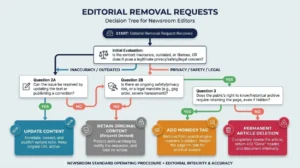
Reporting harmful Facebook group content involves using the platform’s available reporting mechanisms to identify content that violates applicable platform rules or policies. The reporting process is distinct from search-engine indexing because it operates at the platform level rather than directly changing SERP evaluation. A platform can evaluate reported content according to its own policies, account context, group rules, and enforcement procedures. The outcome therefore depends on the nature of the content and the relevant platform standards. Reporting is an information-governance mechanism, while search ranking is an information-retrieval mechanism.
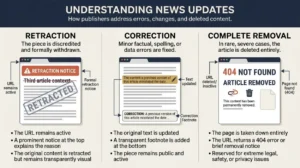
Understanding How to Report and Remove Content From a Facebook Group requires distinguishing between content removal, account or group moderation, and search visibility. Removing a post from its original platform location changes the availability of that specific source. It does not automatically remove copies, references, screenshots, quotations, or independently published versions elsewhere. Search perception therefore depends on the complete information pathway rather than only the original publication point. This distinction is central to understanding why reputation-related content requires source-level and search-level analysis as separate concepts.
What is the overall relationship between private content and reputation management?
Private content forms part of the broader reputation environment even when it remains outside conventional search indexing. Reputation management is the structured analysis of information, signals, sources, and perceptions associated with an entity across digital environments. Search reputation represents the subset of that environment that becomes visible through search systems and related discovery mechanisms. Private Facebook groups introduce a separate access-controlled layer where information can circulate among defined audiences without entering public SERPs. Public reposting, quotation, screenshots, or references can transfer information from that restricted layer into openly accessible environments. The resulting reputation impact depends on where information appears, who can access it, how it is interpreted, and whether search systems can index it.
The central distinction is between existence, accessibility, indexing, ranking, and perception. Information exists when it is published, becomes accessible when authorised users can view it, becomes searchable when users can locate it through available discovery mechanisms, becomes indexed when a search engine processes it for retrieval, and becomes influential in search perception when users encounter and interpret it. These stages are related but not interchangeable. Private-group content demonstrates why a reputation assessment based only on Google-style search results provides an incomplete picture of online information. Understanding the complete ecosystem requires analysis of platform boundaries, content indexing, reputation signals, authority, sentiment, entity relationships, and search visibility.
Harmful posts in private Facebook groups are difficult to track because restricted access separates them from the open web environment used by search engines for crawling and indexing. Reputation management is therefore broader than monitoring conventional SERPs because digital reputation develops across public, private, indexed, and non-indexed information environments. Search visibility depends on accessibility, indexing, relevance, authority, and ranking relationships, while human perception also responds to information that remains outside search results. Private-group content becomes more significant to search reputation when it is reproduced, referenced, or transferred into publicly accessible sources. Analysing these distinctions provides a clearer understanding of how digital footprints, entity perception, trust signals, sentiment, and search visibility interact within modern reputation systems.
Why are private Facebook group posts hard to track?
Private Facebook group posts are difficult to track because access is restricted to approved members and the content is not openly crawlable like public webpages. This limits content indexing and direct visibility in search engine results.
Can private Facebook group posts appear in Google search results?
Private Facebook group posts generally do not appear directly in Google search results because their content is access-controlled. However, copied, quoted, or reposted content can become publicly accessible and enter search engine indexes.
Can harmful content in a private Facebook group affect online reputation?
Yes, harmful content can influence online reputation when group members see and share the information. Its impact on search visibility depends on whether the content or references to it become publicly accessible and indexed.
How can harmful content in a Facebook group be reported?
Harmful content can be reported through Facebook’s available reporting mechanisms when it violates applicable platform policies or group rules. Reporting is separate from search-engine removal because platform moderation and search indexing operate through different systems.
Does removing a Facebook group post remove it from Google?
Removing the original Facebook group post does not automatically remove copies, screenshots, quotations, or references published elsewhere. Search visibility depends on whether related content remains available on other publicly accessible and indexed sources.