
Sole traders often expose their home addresses because UK business registration and public business records can connect an individual’s trading identity with a residential address. This creates a searchable digital footprint in which personal information becomes associated with a business entity and can appear across search results, directories and third-party databases.
Reputation management is the process of analysing, influencing and maintaining the information that shapes how an individual or entity is perceived across digital environments. Online reputation refers to the collection of indexed information, reputation signals, content and associations that search engines and users encounter when evaluating a person or business.
Why does a sole trader’s home address become connected to a business identity?
A sole trader’s home address becomes connected to a business identity when registration records, business directories or published contact information associate the individual’s legal or trading identity with that location. The connection creates an identifiable relationship between a person, a commercial activity and a physical address within the digital information ecosystem.
A sole trader does not have the same legal separation between individual and business that exists with a limited company. The business identity therefore remains closely connected to the proprietor’s personal identity. When an address enters a public or searchable record, search engines can process the address alongside the person’s name, trading name and other business information.
This association forms part of the individual’s digital footprint. A digital footprint is the collection of information about a person or entity that exists across online systems, databases, websites and indexed documents. Address information becomes particularly significant when the same data point appears consistently across multiple sources.
Search engines do not interpret an address as an isolated data field. They evaluate relationships between entities, names, locations, websites and documents. When the same address repeatedly appears alongside a sole trader’s name, those references reinforce the relationship between the individual and the business entity in search databases.
How does business registration contribute to a sole trader’s digital footprint?
Business registration contributes to a sole trader’s digital footprint by creating structured information that can be reproduced, indexed or referenced by other online systems. Once information enters a public business ecosystem, it can become part of a wider network of data relationships.
A digital footprint is not limited to social media accounts or personal websites. It includes business records, directories, professional profiles, review pages, archived documents and other sources that identify an individual or entity. Each source adds information to the broader representation that search engines construct around a name.
Content indexing is the process through which search engines discover, process and store information so that it can appear in search results. Indexed information can include structured business details, addresses, trading names and references contained within web pages. The visibility of this information depends on factors including relevance, authority, accessibility and search demand.
The same address can also propagate through data aggregation systems. Business directories and information providers frequently collect business details from public or commercial datasets. When an address is repeated across these systems, the digital footprint becomes more interconnected and easier for search engines to associate with the individual.
How do search engines interpret a sole trader’s address?
Search engines interpret a sole trader’s address as an entity attribute when reliable sources repeatedly associate that location with a particular person or business. The address therefore becomes part of the contextual information used to understand the entity represented by a search query.
Entity perception refers to how a search system understands the identity, attributes and relationships surrounding a person, organisation or business. A sole trader can function as both an individual entity and a commercial entity, creating overlapping signals within the search ecosystem.
Search engines analyse relationships between names, locations, websites, business categories and other identifiable information. Consistent references can strengthen the perceived connection between these attributes. An address appearing alongside the same name across authoritative sources provides a clear entity relationship.
This does not mean that every indexed address receives identical visibility. Ranking dynamics determine which sources appear prominently for particular queries. A highly authoritative business database can receive stronger SERP visibility than an obscure directory, even when both contain the same address.
Why can a residential address affect online reputation?
A residential address can affect online reputation because it introduces a personal location into the information used to identify a commercial entity. The issue is therefore connected to information exposure rather than the address itself acting as a direct reputation signal.
Online credibility is shaped by the consistency, authority and context of information surrounding an individual or entity. When personal information becomes closely associated with professional search results, the distinction between personal identity and business identity becomes less clear.
Search perception also depends on what users encounter when searching for a name. If an individual’s name produces business information alongside residential details, the resulting SERP can communicate a broader and more detailed representation of that person than the individual intended to publish.
The reputational effect is therefore contextual. A home address appearing in a legitimate business record does not inherently indicate negative information. Its significance comes from the relationship between the address, the person’s identity, the prominence of the source and the extent to which the information becomes replicated across the wider search ecosystem.
How does address information spread across search results?
Address information spreads when the same business data is copied, referenced or incorporated into additional websites and databases. Each additional occurrence creates another digital reference connecting the address with the sole trader’s identity.
Data aggregation is one mechanism behind this process. Information providers collect business details from public records, commercial datasets and other sources, then distribute those details through directories or search-oriented databases. The resulting duplication can increase the number of indexed pages containing identical or closely related information.
Directory consistency also affects entity recognition. When a person’s name, trading name and address appear consistently across multiple sources, search engines gain stronger contextual evidence about the relationship between those attributes. This contributes to entity resolution, where different references are interpreted as belonging to the same underlying entity.
Archived and cached content introduces another layer. A page can remain discoverable through search systems or external references even after its visible version changes. This demonstrates why information exposure involves the wider content ecosystem rather than a single webpage.
How do reviews influence the reputation of a sole trader with an exposed address?
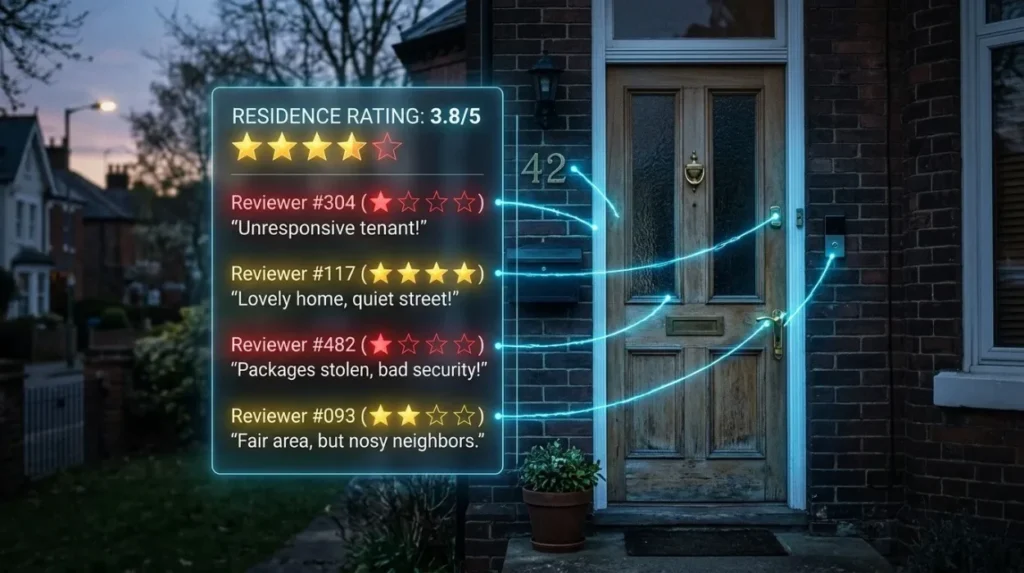
Reviews influence reputation by connecting sentiment, business identity and customer experiences to the same entity that can also be associated with an address. Review signals therefore add qualitative information to the factual business attributes already present in search systems.
Review sentiment refers to the positive, negative or neutral interpretation of language associated with an entity. Search engines can analyse textual relationships and contextual relevance, while users independently interpret reviews when evaluating credibility.
An address does not determine whether reviews are positive or negative. Instead, the address can strengthen the connection between the reviewed business and the individual proprietor. When a sole trader operates under their personal name, this relationship becomes particularly direct.
Review pages also possess their own authority and indexing characteristics. A review hosted on an established platform can receive substantial search visibility because the platform itself has strong domain authority and established relevance for business-related queries. Consequently, reputation analysis requires consideration of both the sentiment and the source carrying that sentiment.
What trust signals shape the online reputation of a sole trader?
Trust signals are evidence points that help establish whether information associated with an entity appears credible, consistent and authoritative. These signals include source authority, information consistency, professional references, established business profiles and corroborating third-party information.
Authority is determined partly by the strength and relevance of the source publishing information. A recognised professional platform carries different search significance from an unknown website containing unverified business details. Search engines evaluate these sources within their broader ranking systems.
Consistency also functions as a trust signal. Matching business names, categories, websites and contact details across authoritative sources create a coherent entity representation. Contradictory information introduces ambiguity and can make entity identification less straightforward.
Trust does not depend on one isolated signal. Search systems evaluate interconnected information across documents, domains and entities. Reputation analysis therefore focuses on the information environment surrounding a sole trader rather than treating one address or one webpage as the complete representation.
How does search visibility change when personal and business information overlap?
Search visibility changes according to the relevance, authority and query relationship of the content connecting personal and business information. When a sole trader’s personal name is also the primary business identity, commercial and personal references can compete or coexist within the same SERP.
SERP evaluation examines which pages provide the strongest response to a user’s query. A search for an individual’s name can therefore return professional profiles, business directories, review platforms, social accounts, news references and other relevant pages.
The overlap becomes more significant when the same name appears across multiple contexts. Search engines use contextual relationships to distinguish entities with similar names, locations and occupations. A residential address can function as one of the attributes that helps connect otherwise separate references.
This demonstrates why digital footprint management is broader than controlling one page. Search perception results from the combined visibility of indexed sources. Address exposure therefore becomes a component of a larger entity representation rather than an isolated privacy event.
How can sole traders protect their address when registering a business?
Sole traders can reduce unnecessary address exposure by understanding which information becomes public, separating business contact channels from personal details where permitted, and monitoring how registration information propagates across online sources. The central principle is to distinguish legally required information from information voluntarily distributed through secondary platforms.
How Sole Traders Can Protect Their Address When Registering a Business involves understanding the information pathway from official registration records to directories, websites and search indexes. This analysis begins by identifying the original source of the address and then evaluating which external platforms reproduce or reference that information.
Information mapping provides a structured way to understand this process. It identifies the sources containing an address, the relationship between those sources and the person’s identity, and the search queries through which the information becomes visible.
Monitoring also provides evidence about changes in search visibility. A sole trader can evaluate branded searches, name-based searches and business-related queries to determine which sources dominate the SERP. This separates actual search exposure from information that exists online but has limited visibility.
The distinction between publication and ranking is important. Information can exist in a database without receiving prominent search visibility, while a highly authoritative page can rank prominently even when it contains relatively limited information. Reputation analysis therefore evaluates both information existence and search prominence.
What does address exposure mean for long-term online reputation?
Address exposure becomes a long-term reputation consideration when personal location data remains connected to an individual’s name and business identity across persistent digital sources. The duration and visibility of that relationship depend on indexing, source persistence, replication and search ranking dynamics.
Digital information can remain accessible through established databases long after its original publication. Changes to one source therefore do not automatically remove references held elsewhere. This creates a distinction between correcting an original record and controlling the wider information footprint.
Long-term reputation analysis examines how information accumulates around an entity. New reviews, business references, professional profiles and directory entries can reinforce existing associations. The resulting entity profile develops through repeated information signals rather than through one isolated publication.
This makes information governance relevant to search reputation. Understanding what information enters the digital ecosystem, where it is replicated and how it ranks provides a more accurate explanation of reputation formation than focusing exclusively on individual pages.
Dive Deeper With Our Expert Guides:
What to Do if Your National Insurance Number Is Exposed Online
How Old Employer and School Records Can Expose Personal Information
What is the relationship between personal information and search reputation?
Personal information and search reputation are connected because personal attributes can become part of the indexed context through which an individual entity is evaluated. Names, addresses, professional details and business associations can collectively influence what users encounter in search results.
Search reputation is the visible search representation of an entity across relevant queries. It includes factual information, reviews, professional references, social content and third-party publications that contribute to the perceived identity of the subject.
The relationship becomes particularly important for sole traders because the individual and business are closely connected. A business-related search can therefore expose information that also identifies the proprietor personally. The search ecosystem does not always maintain the same boundaries that people use when separating private and professional identities.
Understanding this mechanism provides a clearer view of reputation risk. The key issue is not simply that an address exists online, but that personal information can become connected, indexed, replicated and ranked alongside an individual’s professional identity.
What can sole traders learn from address-related reputation risks?
Sole traders can learn that reputation is shaped by interconnected information systems rather than by individual webpages. Business registration, directory publication, content indexing, reviews and search ranking all contribute different signals to the entity representation visible in search.
The first principle is information provenance: identify where a data point originated and distinguish the primary source from secondary copies. The second is entity association: analyse which names, addresses and business references search systems connect. The third is search visibility: evaluate which sources actually appear prominently for relevant queries.
The final principle is ongoing monitoring. Digital footprints change as businesses acquire new reviews, directory references, professional profiles and indexed content. Monitoring therefore provides evidence about how an entity’s search representation develops over time.
A sole trader’s home address can consequently become more than a registration detail. Once connected to an identifiable business entity, it can participate in a wider digital information network that influences search visibility, entity perception and the context in which users evaluate the individual.
Why does home address exposure matter to reputation management?
A sole trader’s home address becomes a reputation-management consideration when it links personal identity with a searchable business entity. Registration records, directories, reviews, websites and data aggregation systems can create interconnected references that contribute to an individual’s digital footprint.
Reputation management is therefore closely connected to information structure. Understanding content indexing, entity perception, authority, trust signals and SERP evaluation explains how personal and business information becomes visible and interpreted across search ecosystems.
The key distinction is between information existing online and information receiving prominent search visibility. A complete analysis considers both the sources holding personal information and the ranking mechanisms determining how prominently those sources appear.
For sole traders, understanding these systems provides a clearer framework for assessing address exposure, digital footprint development and long-term online credibility without treating reputation as the result of a single webpage or isolated search result.
Why do sole traders have to use their home address when registering a business?
Sole traders often use their home address because there is no separate legal entity between the individual and the business. Depending on the registration or business activity, this information can enter public records and become part of the sole trader’s online footprint.
Can a sole trader’s home address appear in Google search results?
Yes, a home address can appear in Google search results when it is published on an indexed business directory, public record, website or third-party database. Search visibility depends on the authority, relevance and indexing status of the source containing the address.
How does exposing a home address affect a sole trader’s online reputation?
An exposed home address can connect a sole trader’s personal identity with their professional or business identity across search results. This association becomes part of the digital footprint that influences how information about the individual is interpreted online.
Can personal information removal services remove a sole trader’s home address online?
Personal information removal services focus on identifying and addressing exposed personal details across relevant online sources. Removal depends on the source, its publication rules, legal requirements and whether the information originates from a public or third-party record.
How can sole traders protect their home address from appearing online?
Sole traders can reduce unnecessary exposure by understanding which business details become public and monitoring directories, databases and search results for duplicated address information. Regular digital footprint checks help identify where personal information is being published and indexed.