

Reputation management is a systems discipline that defines how signals, content, and entity attributes interact across indexed platforms to produce search outcomes. Online reputation refers to the aggregate of indexed content, review signals, and metadata that search engines use to construct an entity’s public profile within SERPs.
What is the primary role of a content removal agency in complex cases?
A content removal agency defines the procedural and technical pathway to remove, suppress, or recontextualise indexed content that an individual cannot address alone.
Definition: A content removal agency is an entity that specialises in mapping content provenance, legal options, platform policies, and indexing mechanisms to alter an entity’s searchable footprint.
Mechanism: The agency evaluates content origin, hosting jurisdiction, and platform moderation pathways, then executes takedown requests, legal notices, or technical interventions (for example, DMCA notices, defamation takedowns, or URL de-indexing petitions) and monitors indexing status until SERP adjustments stabilise.
Impact on search visibility: Intervening through these channels directly influences content indexing and ranking signals; successful removal reduces the presence of targeted URLs in search results and shifts entity perception by changing the composition of top-ranked content, thereby improving overall search visibility for preferred assets.
How does a specialist content removal approach differ from an individual’s actions?
A specialist agency provides structured, legally-framed, and technically-informed processes that an individual cannot replicate at scale.
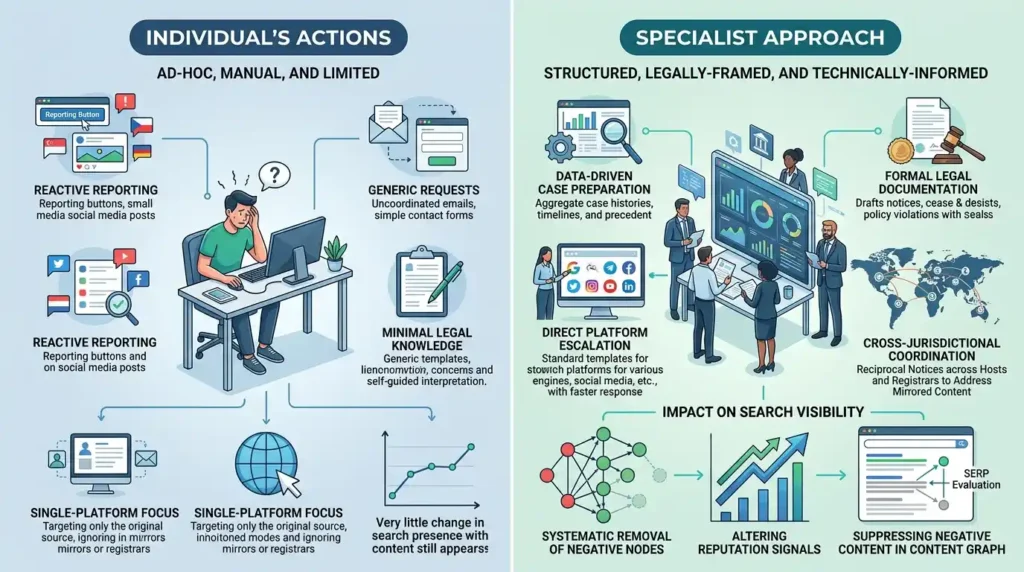
Definition: Specialist intervention refers to coordinated legal, technical, and policy-based actions that integrate evidence, precedent, and escalation strategies.
Mechanism: Agencies aggregate case histories, prepare formal legal documentation, engage platform escalation teams using standardised templates, and coordinate cross-jurisdictional processes (for example, filing reciprocal notices across hosts and registrars to address mirrored content).
Impact on search visibility: These coordinated actions alter reputation signals by systematically removing or suppressing negative nodes in the content graph, changing relevance and authority calculations that search engines use during SERP evaluation.
What legal and policy mechanisms enable content removal within search ecosystems?
Legal and policy mechanisms define the enforceable pathways that lead to content de-indexing or takedown across hosting and search platforms.
Definition: Legal mechanisms are statutory or judicial instruments that compel content removal; policy mechanisms are platform-specific rules that permit moderation or content restriction.
Mechanism: Agencies translate legal grounds (for example, privacy rights, defamation law, intellectual property law) into formal notices and combine these with platform policy claims (for example, terms-of-service violations or community guideline breaches) to target both hosting providers and indexing caches.
Impact on search visibility: Enforcement actions prompt hosting providers or search engines to remove URLs or apply de-indexing, which changes the corpus available for ranking and alters reputation signals that influence entity perception in SERPs.
How do search engines interpret trust and credibility signals during SERP evaluation?
Search engines evaluate a constellation of signals that jointly define trust and credibility for indexed entities.
Definition: Trust signals are measurable attributes—such as backlink quality, domain authority proxies, content freshness, and structured data—that search algorithms use to score credibility.
Mechanism: Algorithms compute signal weightings across on-page factors, off-page link graphs, user interaction metrics, and structured metadata; they then apply machine-learned models to determine relevance and authority for query intents.
Impact on search visibility: Enhancing positive trust signals or suppressing negative signals shifts ranking outcomes. When an agency removes harmful content nodes, the link graph and engagement metrics recalibrate, modifying the search engine’s probability estimates during SERP evaluation and thereby influencing which pages surface for entity queries.
How is reputation formed within search engines from a systems perspective?
Reputation in search engines forms as an emergent property of accumulated content, link structures, and user behaviour signals associated with an entity.
Definition: Reputation is the aggregated state of indexed attributes that represent an entity’s perceived authority, reliability, and relevance within query contexts.
Mechanism: Search ecosystems ingest new content, evaluate content provenance and authority through links and citations, and record user interaction metrics (click-through rates, dwell time, pogo-sticking) which feed back into ranking models. Entity recognition layers tie disparate content to a single identifier through structured data, knowledge graph signals, and consistent naming conventions.
Impact on search visibility: The emergent reputation determines which assets rank for branded queries and topical searches. Agencies influence formation by reducing negative nodes, strengthening authoritative assets, and aligning structured data to ensure entity attributes are correctly attributed during indexing and SERP evaluation.
How do review signals and sentiment interpretation affect entity perception?
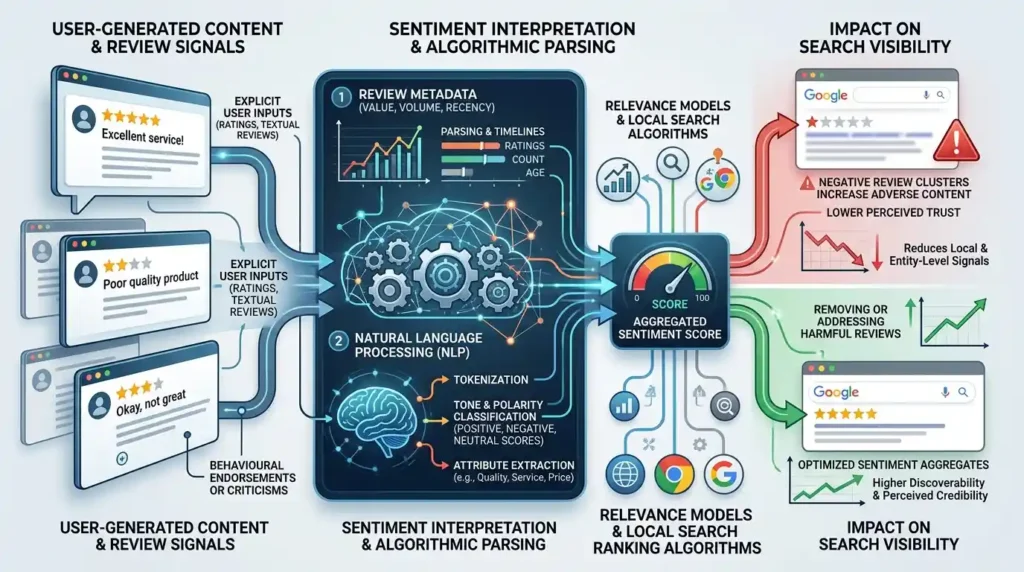
Review signals and sentiment interpretation define how subjective user-generated content modifies reputational scoring within search ecosystems.
Definition: Review signals are explicit user inputs (ratings, textual reviews) that serve as behavioural endorsements or criticisms; sentiment interpretation is the automated classification of review tone and polarity.
Mechanism: Algorithms parse review metadata (rating value, review volume, recency) and apply natural language processing to quantify sentiment and extract salient attributes. Aggregated sentiment metrics integrate into relevance models and local search ranking algorithms.
Impact on search visibility: Negative review clusters increase the propensity for adverse content to appear in SERPs and lower perceived trust; removing or addressing harmful reviews changes sentiment aggregates, adjusting local and entity-level ranking signals that affect discoverability and perceived credibility.
How does content indexing interact with removal requests and suppression strategies?
Content indexing defines the state of a URL or asset within the searchable corpus; removal requests and suppression strategies alter that state to change SERP composition.
Definition: Indexing refers to a search engine’s storage and representation of a content item within its retrieval system.
Mechanism: When a removal request is accepted by a host or a search engine, the indexing status transitions from ‘indexed’ to ‘removed’ or ‘de-prioritised’. Suppression strategies use algorithmic replacement, promoting alternative content, optimising metadata, and building authoritative links to push undesired results below the fold.
Impact on search visibility: De-indexing eliminates a node from SERP evaluation; suppression changes ranking probabilities without removing content. Agencies combine both approaches to ensure negative assets either exit the index or occupy low-ranking positions, thereby modifying the visible composition of entity-related search results.
How do authority and trust signals interplay with digital footprint and entity reputation?
Authority and trust signals provide measurable anchors that map a digital footprint to entity reputation.
Definition: Authority signals are external endorsements and provenance indicators (high-quality backlinks, citations, verified profiles); trust signals are credibility markers (secure domains, verified contacts, consistent structured data).
Mechanism: Search algorithms aggregate these signals across an entity’s digital footprint—websites, social profiles, press coverage—and reconcile inconsistencies through entity resolution processes. High-quality endorsements increase authority scores; mismatches or spammy associations reduce trust metrics and introduce negative entity perception.
Impact on search visibility: Strengthened authority and trust signals raise the ranking potential of preferred assets. A content removal agency reduces negative associations that dilute authority and repairs trust metrics by aligning structured data and removing problematic links within the link graph.
How does a structured removal workflow manage cross-platform and cross-jurisdiction complexity?
A structured workflow defines sequential, evidence-based actions that address legal, technical, and indexing aspects across platforms and jurisdictions.
Definition: A workflow is a mapped sequence of investigative, legal, platform, and monitoring steps designed to achieve content removal or suppression outcomes.
Mechanism: The workflow begins with evidence collection (screenshots, timestamps, URL provenance), proceeds to policy or legal pathway selection, executes formal notices to hosts and platforms, and then verifies indexing changes through search console tools and API checks; remediation includes backstop legal filings when policy channels fail.
Impact on search visibility: A disciplined workflow ensures efficient alteration of indexing states and reduces the risk of content reappearance or replication, thereby stabilising SERP composition and improving long-term entity perception.
How does content influence perception when re-indexed or mirrored across domains?
Mirrored or re-indexed content spreads reputation signals across multiple hosts, amplifying negative entity associations.
Definition: Mirroring refers to replication of content across different domains or platforms; re-indexing is the process by which search engines again evaluate and store replicated assets.
Mechanism: Algorithms detect duplication and evaluate canonicalisation signals, but mirrored content on distinct high-authority domains retains potential to rank independently. Agencies identify canonical inconsistencies, request removal from origin hosts, and issue takedowns to mirror hosts; they also use canonical tags and noindex directives where control exists.
Dive Deeper With Our Expert Guides:
What Negative Content Removal Covers and the Platforms It Applies To
Why Content Published Online Rarely Disappears Without Expert Intervention
Impact on search visibility: Eliminating original and mirror nodes compresses the negative signal distribution across the content graph. If mirrors persist on authoritative hosts, negative content continues to surface in SERPs; therefore control over replication points is crucial to altering long-term entity perception.
What operational metrics demonstrate successful reputation remediation in search ecosystems?
Operational metrics define measurable outcomes that correlate with improved entity perception and search visibility.
Definition: Operational metrics are quantifiable indicators indexing status, ranking positions for branded queries, share of positive assets in top results, and sentiment aggregates that measure remediation effectiveness.
Mechanism: Agencies track URL removal confirmations, index status via search console reporting, ranking shifts for targeted queries, changes in backlink profiles, and sentiment score trends derived from review analysis. Continuous monitoring detects reappearances and informs of additional interventions.
Impact on search visibility: Positive changes in these metrics indicate successful alteration of the entity’s indexed footprint and improved SERP composition. Sustained improvement in metric baselines demonstrates a durable shift in reputation signals and entity perception.
For deeper insight explore:
What Separates a Specialist Content Removal Agency From a General PR Firm? This analysis defines how content removal agencies operate within reputation systems, explains the mechanisms by which legal, policy, and technical actions alter indexing and ranking, and evaluates how search engines synthesise trust, authority, and sentiment into entity perception. Effective remediation requires precise evidence, jurisdictional clarity, coordinated suppression or de-indexing strategies, and continuous metric-based monitoring to stabilise favourable search visibility and repair reputation signals.
Answers to Key Questions:
How does Clear Your Name approach Facebook content removal?
Clear Your Name evaluates the content, collects evidence (screenshots, URLs, timestamps), and assesses applicable Facebook policies and legal grounds before submitting formal removal requests or escalation notices. This process aligns with platform moderation mechanisms and documents actions for indexing and reputation tracking.
What types of Facebook content qualify for removal requests?
Content that violates Facebook policies (hate speech, harassment, explicit material), infringes intellectual property, or breaches privacy and defamation laws qualifies for removal requests. Clear evidence of policy or legal breach accelerates review and improves the likelihood of takedown.
Can removing Facebook content improve search visibility and reputation?
Removing or de-indexing defamatory or harmful Facebook posts reduces negative nodes in search results, alters reputation signals, and improves entity perception in SERPs. Supplementary actions optimising authoritative content and correcting structured data support sustained search visibility gains.
What documentation is required for a Facebook content removal claim?
Required documentation includes precise URLs, evidence of the content (screenshots), identification of the claimant, and legal or policy rationale (copyright notice, privacy breach details, or defamation statement). Clear Your Name compiles and formats these materials to match Facebook’s submission requirements.