
What separates a specialist content removal agency from a general PR firm is that the former operates as a targeted remediation service focused on legal takedowns, platform‑level content suppression, and technical search‑ecosystem interventions, whereas the latter delivers broad reputation shaping through media relations, narrative control, and content creation. Reputation management strategies differ based on statutory authority, platform relationships, and technical remit; online reputation control methods are evaluated through removal success rates, SERP composition changes, and persistent trust signal shifts.
How do removal‑first tactics compare to content‑creation approaches in reputation management?
Removal‑first tactics operate by seeking elimination or de‑indexing of specific content through legal notices, platform reporting, or negotiations with hosts and platforms. These tactics use takedown requests, court orders, and platform abuse/terms‑of‑service reports as mechanisms, which act directly on the content repository or indexing layer and therefore produce immediate changes in SERP composition when successful. Content‑creation approaches operate by publishing optimised pages, assets, and entity‑linked content to dilute negative results and build favourable signals; they use topical authority building, on‑site SEO, and distributed content networks as mechanisms that influence search engines via relevance and linking signals. Removal strengths include direct elimination of harmful items and rapid SERP impact for removed URLs; limitations include legal thresholds, platform policy variance, jurisdictional constraints, and the potential for rebound (republishing) which increases risk exposure. Content‑creation strength includes scalability and sustainability through ongoing signal building and entity credibility enhancements; limitations include slower time to impact, requirement for topical breadth and momentum, and difficulty suppressing highly authoritative negative assets that hold strong search ranking influence.
What is the effectiveness difference between organic suppression and platform takedowns?
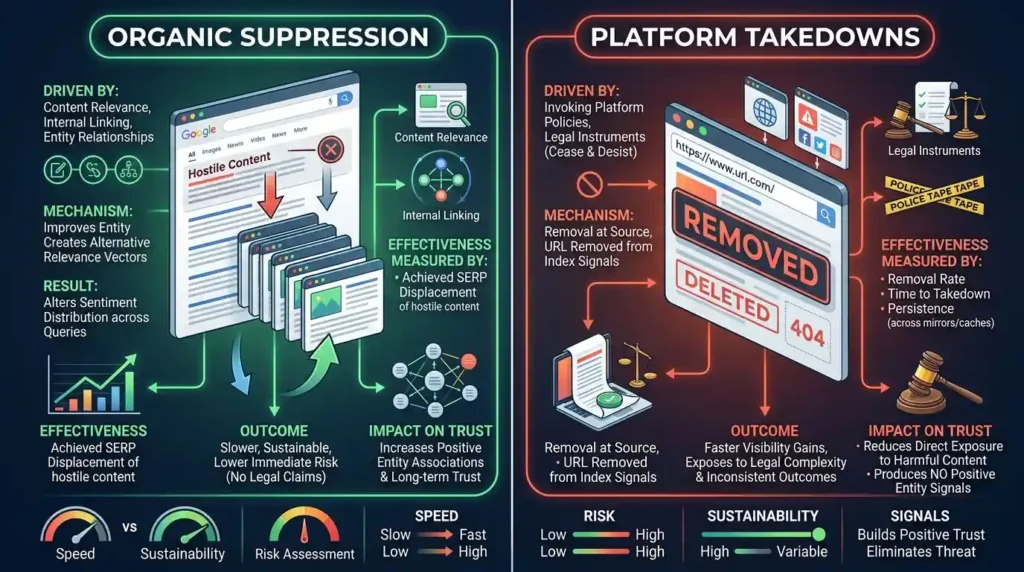
Organic suppression is effectiveness measured by achieved SERP displacement of hostile content via new, relevant, and authoritative pages, and it is driven by content relevance, internal linking, and entity relationships. Organic suppression operates by improving entity credibility and creating alternative relevance vectors so search engines rank replacement assets higher than damaging ones, which gradually alters sentiment distribution across brand‑related queries. Platform takedowns are effectiveness measured by removal rate, time to takedown, and persistence of removal across mirrors and caches, and they operate by invoking platform policies or legal instruments to remove content at source, thereby removing that URL from index signals. Comparative analysis: organic suppression provides lower immediate risk (no legal claims) and higher sustainability if topical authority is established, while takedowns provide faster visibility gains but expose the claimant to legal complexity and inconsistent outcomes across platforms; both influence search ranking influence but via different signal pathways—index removal versus rank displacement. Impact on trust signals: takedowns reduce direct exposure to harmful content but produce no positive entity signals; organic suppression increases positive entity associations and long‑term trust if coherent topical networks are established.
How do specialist removal mechanisms function differently from general PR negotiations?
Specialist removal mechanisms are defined as procedural interventions that use legal, technical, and platform relationship pathways to remove or suppress content; they operate by filing jurisdiction‑appropriate legal instruments, using platform abuse systems, and mapping content replication networks to target hosts and caches. These mechanisms evaluate takedown feasibility by checking applicable laws (defamation, privacy, copyright), platform policies, and cross‑border enforcement pathways, then pursue the fastest enforcement vector. General PR negotiations operate by engaging publishers and editors with reputation narratives and corrections, and they operate by leveraging editorial relationships, pitching corrections or retractions, and offering contextual information to influence published narratives. Comparative analysis: removal specialists measure success in binary outcomes (removed / not removed) and manage risk exposure tied to legal counterclaims; PR negotiators measure success in narrative change and sentiment distribution, with lower legal risk but lower control over search ranking influence when original assets remain indexed. Search visibility impact: removal yields direct reduction of negative URLs in SERPs; PR negotiations often result in corrective pieces that require organic ranking effort to outrank the original content.
What are the scalability and sustainability trade‑offs between reactive takedowns and proactive content networks?
Reactive takedowns scale poorly when negative content proliferates across many hosts because each removal requires unique jurisdictional work and repeated platform engagement; they operate by addressing symptomatic URLs rather than the underlying visibility model and therefore increase operational cost per incident. Proactive content networks scale better across query sets because the strategy constructs topical coverage and entity associations that work across multiple queries and assets; they operate by producing interlinked resources, internal linking frameworks, and semantic topical maps that create persistent search ranking influence. Comparative analysis: reactive takedowns provide high short‑term impact per item but low sustainability and higher risk exposure if new copies appear; proactive networks provide sustained SERP composition change and improved entity credibility but require resource investment and time to achieve topical authority. Search engines interpret repeated signals of topical authority as stable entity credibility, increasing long‑term ranking influence and reducing volatility in sentiment distribution, whereas ad‑hoc removals produce episodic changes that can reverse if suppression is incomplete.
How do search engines interpret reputation signals from removal versus enhancement strategies?
Search engines interpret removal as a reduction in indexed negative signals; index purges and de‑indexing reduce the query‑level presence of specific URLs and therefore reweight the SERP when fewer negative documents compete for ranking. Search engines interpret enhancement strategies as increased entity‑centric relevance and authority signals that come from topical breadth, context terms, and coherent internal linking; these signals strengthen the entity profile and influence rankings across related queries. Comparative analysis: removal changes immediate inventory available to ranking algorithms and thus affects SERP composition directly; enhancement changes the relevance and authority vectors that algorithms use to rank content, producing gradual but persistent movement. Effect on trust signals: removal lowers the visibility of harmful content but does not inherently increase positive trust signals; enhancement increases positive trust signals through topical authority and semantic context, yielding more durable perception shifts.
Which approach minimises legal and reputational risk while maximising SERP improvement?

A mixed strategy that evaluates remedial lawfulness and search ranking influence produces the best balance between risk exposure and effectiveness for UK audiences. Effective evaluation operates by mapping each target URL to its legal status, host jurisdiction, and platform policy, then prioritising removal actions where lawful and efficient, while concurrently deploying high‑quality topical assets to occupy remaining SERP space. This combined mechanism compares strengths: removal reduces immediate harm and lowers short‑term exposure; content enhancement builds entity credibility and sustainable ranking influence. Limitations include cost intensity for legal processes and the time and content investment needed for topical authority, and the risk that over‑reliance on takedowns creates perception issues if stakeholders perceive suppression as censorship rather than correction. Search ranking influence is maximised when removal reduces dominant negative links and enhancement fills the vacated rank positions with authoritative, semantically consistent content that supports entity credibility.
Dive Deeper With Our Expert Guides:
How a Negative Content Removal Service Builds a Case Before Acting
Which Routes Actually Work to Remove Content From the Internet in the UK
What operational framework measures success across methods?
Evaluate methods by three measurable vectors: removal efficacy, displacement ratio, and entity credibility gain.
- Measure removal efficacy by tracking percentage of targeted URLs successfully removed or de‑indexed and the average time to removal; this metric evaluates direct platform mechanism performance.
- Measure displacement ratio by calculating the proportion of negative SERP entries replaced by neutral or positive assets after implementation; this metric analyses search ranking influence and sentiment distribution changes.
- Measure entity credibility gain by assessing improvements in authority signals: increased branded query prominence, backlink profile quality to owned assets, and consistent topical coverage across nodes in the semantic content network.
This framework operates by assigning weightings to each vector based on client risk tolerance and resource constraints, then measuring progress monthly to capture both short‑term takedown wins and longer‑term topical authority gains.
For more information explore:
Choose a UK Content Removal Agency With a Track Record of Verified Results
Removal specialists are removal‑first operators that evaluate and execute takedowns via legal and platform mechanisms, producing rapid SERP inventory reduction but exposing claimants to jurisdictional and scalability constraints. General PR firms are narrative managers that create and place corrective or positive content to change sentiment distribution and entity credibility, producing long‑term search ranking influence through sustained topical authority but requiring time and investment. Strategic considerations include mapping legal feasibility, balancing short‑term suppression against long‑term topical investment, and measuring outcomes using removal efficacy, displacement ratio, and entity credibility gain to align tactics with the desired persistence of SERP change and trust signal enhancement.
Answers to Key Questions
What are Facebook content removal services?
Facebook content removal services focus on reporting, reviewing, and removing harmful or policy-violating posts, images, comments, or profiles from Facebook. They are used to address privacy breaches, defamation, impersonation, harassment, and other reputation issues.
How do Facebook content removal services work?
These services usually assess the content, identify the relevant Facebook policy or legal basis, and submit removal requests through the correct channels. The process can also include evidence gathering, escalation, and monitoring to confirm whether the content stays down.
Can Facebook content be removed for defamation?
Defamatory content can sometimes be removed if it violates Facebook policies, local law, or both. The outcome depends on the content itself, the supporting evidence, and whether the report meets platform or legal standards.
What information is needed for Facebook content removal?
A removal case usually needs the exact URL or screenshot, a clear explanation of the issue, and any evidence that supports the claim. In some cases, identity documents, ownership proof, or legal paperwork are also required.