
Reputation management is the process of shaping how an entity is understood through search results, pages, and signals across the web. Online reputation refers to the collection of indexed content, mentions, reviews, and authority cues that influence how search engines and users judge credibility.
What does online content removal mean in reputation systems?
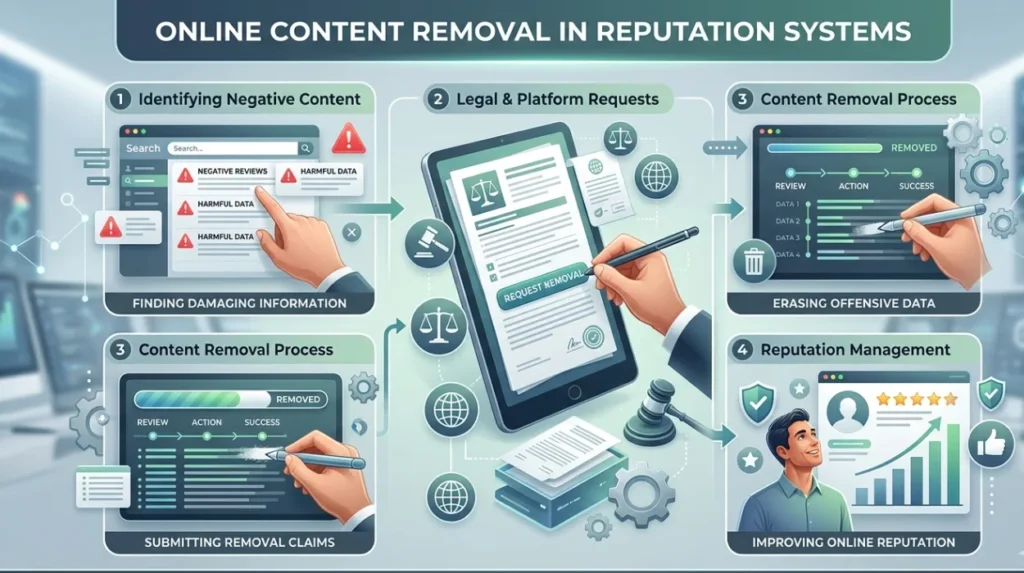
Online content removal means reducing or eliminating a page’s visibility, availability, or index status within search ecosystems. It refers to the process of changing whether harmful content remains accessible, indexed, or prominent in SERPs, which directly alters entity perception and search visibility.
Dive Deeper With Our Expert Guides and Related Blog Posts:
How Images Get Indexed in Google and What Privacy Rights Apply to Your Photos
What a Content Removal Service Does and Who Actually Needs One
Content removal does not always mean deleting a page from the source server. It also includes deindexing, cache removal, canonical changes, robots directives, and platform takedown actions. These methods affect whether search engines can retrieve, store, or display the content for a query. The impact reaches beyond the original page because search visibility depends on what the engine can access and rank. A page that loses indexation loses much of its power to shape reputation signals.
Removal matters because search engines evaluate content as part of a wider entity graph. A single harmful page can distort perception when it ranks for a name, brand, or topic. Search engines read that page alongside linked pages, mentions, and trust cues. When the page disappears or loses prominence, the entity profile becomes less negative. That change can improve credibility signals without altering the underlying facts on other pages.
How do search engines decide what appears first?
Search engines decide what appears first by evaluating relevance, authority, freshness, and trust signals. SERP evaluation is the process of ordering pages according to their likelihood of satisfying the query while also reflecting content quality, link authority, and contextual relevance.
The first layer is indexing. If a page is indexed, the engine has already stored and interpreted it. The second layer is ranking. Ranking compares the page against competing pages for the same query. The third layer is presentation. Presentation decides whether the title, snippet, and surrounding results reinforce or weaken perception. These layers combine to form search visibility.
Authority signals influence this process through links, mentions, and historical behaviour. Trust signals include domain consistency, content integrity, and association with credible sources. Freshness also matters when the query relates to current entities or ongoing issues. A harmful page with strong authority can stay visible for a long time. That is why removal often requires more than a simple request.
Why does harmful content keep shaping perception?
Harmful content keeps shaping perception because search engines preserve indexed material until it is removed, demoted, or replaced by stronger competing signals. Content perception is the result of repeated exposure across rankings, snippets, and supporting references, all of which reinforce the entity’s public image.
A page that ranks near the top for a name or topic receives disproportionate attention. Users treat the top results as the most relevant and the most credible. This makes the visible search environment a reputation system in itself. Once a negative page enters that environment, it becomes part of the digital footprint that users interpret before any direct contact occurs.
Search engines also interpret consistency. If one negative page contradicts a large body of neutral or positive content, the engine still keeps the page active when it has sufficient ranking strength. Removal interrupts that consistency by taking the page out of the visible pattern. That changes the balance of reputation signals, which is the practical reason content removal influences perception.
What forms of removal exist inside search ecosystems?
There are four main forms of removal inside search ecosystems: page deletion, deindexing, content correction, and visibility suppression. Each method changes search visibility in a different way, and each one affects reputation signals with a different level of permanence.
Page deletion is the strongest form because the content disappears from the source. Deindexing removes the page from search results while the source may still exist. Content correction changes the material so that the harmful element no longer creates the same reputational effect. Visibility suppression lowers the ranking strength of the page by increasing the prominence of competing content.
These methods differ in outcome and control. Deletion creates the cleanest endpoint. Deindexing depends on search engine compliance. Correction requires the source owner to agree or respond. Suppression depends on ranking competition, which can shift over time. Professional expertise becomes important because the wrong method wastes time and leaves the original risk in place.
Why does content removal require professional expertise?
Content removal requires professional expertise because each case depends on source type, platform policy, indexing behaviour, and legal or procedural thresholds. Professional expertise is the ability to match the right removal method to the content type, which reduces error and improves the chance of lasting SERP control.
A simple request does not solve every case. Some pages respond to webmaster action. Some platforms require policy based reports. Some situations need legal notices or formal rights based arguments. Other cases involve cached copies, mirrored pages, or reposts that continue to influence perception even after the original page changes. Expertise matters because these layers interact.
Professional handling also reduces the risk of weak submissions. A poor removal request often lacks evidence, correct terminology, or the right escalation path. That delays action and leaves the content visible longer. When harmful material stays indexed, its reputation signals continue to shape entity perception. Expertise improves precision, and precision matters when search visibility drives trust.
How do reputation signals influence online credibility?
Reputation signals influence online credibility by shaping how search engines and users interpret trust, authority, and consistency. A reputation signal is any indexed cue that helps establish whether an entity appears credible, stable, or risky within a search ecosystem.
These signals include review sentiment, page quality, mention patterns, link relationships, and the ranking position of content about the entity. A strong pattern of neutral or positive references increases credibility. A pattern of unresolved negative pages decreases it. The search engine does not read this like a human judge, but it does use those patterns to order content and evaluate relevance.
Online credibility depends on the combined effect of those signals. A business or individual with a cleaner SERP profile tends to receive less friction from users. A profile dominated by negative pages creates a trust gap. Removal reduces that gap by altering the balance of visible evidence. The result is not just fewer harmful pages, but a more stable digital footprint.
How does removal affect the digital footprint?
Removal affects the digital footprint by changing removal service in the UK which traces remain accessible, which traces disappear from search, and which traces continue to define the entity. Digital footprint refers to the total searchable record of pages, mentions, and references associated with an entity across the web.
A digital footprint includes owned pages, third party pages, archived material, reviews, and snippets. When harmful content is removed, the footprint becomes less fragmented. The entity appears more coherent because the search environment stops presenting conflicting or damaging signals at the top of results. This improves the way both users and algorithms interpret the entity.
The footprint does not vanish entirely because the web stores content in multiple places. Copies can exist in caches, mirrors, or external discussions. That is why professional expertise matters. Effective removal work tracks where the content appears, how it is indexed, and whether the search engine still surfaces it elsewhere. The goal is not only deletion. The goal is controlled visibility.
What role do reviews and sentiment play in removal work?
Reviews and sentiment play a major role because they are among the strongest short form reputation signals in search results. Sentiment refers to the positive, neutral, or negative direction of language associated with an entity, and search engines use that pattern to interpret public perception.
Review signals can change search behaviour even when the original page is not a review site. A negative review cluster can create a perception problem that extends across brand search queries. Search engines also surface review rich results in some contexts, which increases exposure. That means sentiment is not just a public relations issue. It is a search visibility issue.
Removal work becomes relevant when the review or content is false, harmful, private, or unsupported. If the material remains indexed, it continues to influence the sentiment environment around the entity. Removing or correcting it improves the surrounding reputation signals. That is why review and content removal often sit inside the same broader reputation management process.
How do authority and trust signals support removal?
Authority and trust signals support removal by helping search engines accept new, cleaner content while reducing the weight of harmful pages. Authority signals are indicators of source strength, while trust signals are indicators of reliability, consistency, and credibility across the entity’s search profile.
When harmful content is removed, the gap it leaves needs reinforcement from stronger pages. Trusted owned pages, accurate profiles, and neutral references help occupy the space. That reduces the chance that the negative material returns to prominence through secondary ranking signals. Trust signals make the removal outcome more durable because the search ecosystem sees a more stable pattern.
This is where professional expertise becomes visible. The work is not only about removing the harmful page. It is also about understanding what replaces it in search. If nothing credible fills the space, the engine can continue to amplify older signals. Removal and trust building therefore operate together inside reputation systems.
What does a professional removal process usually track?
A professional removal process usually tracks source status, index status, ranking movement, and perception change. These four measurements show whether the content is still active, whether it remains visible, and whether the entity’s search reputation is improving.
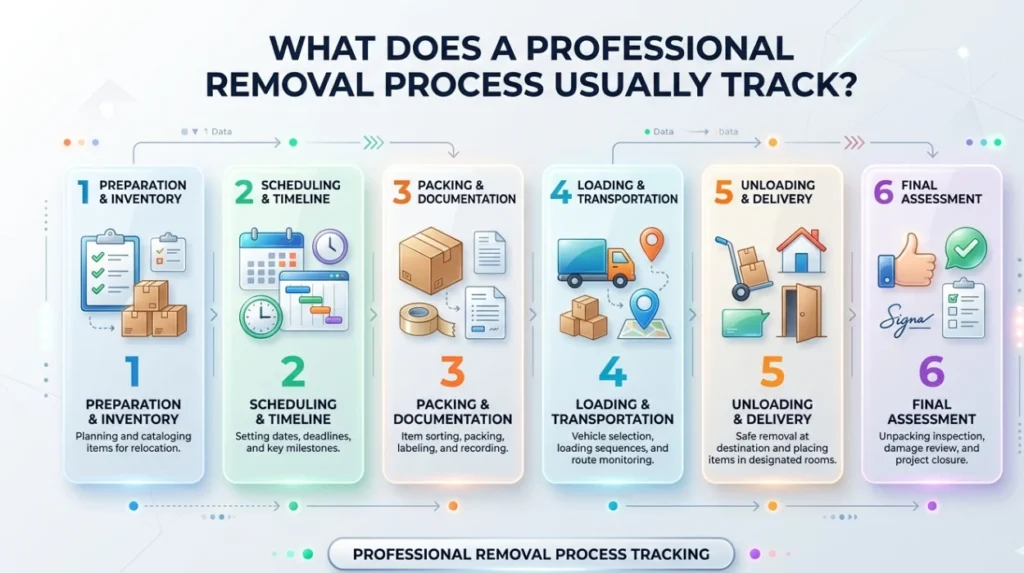
Source status confirms whether the page still exists on the original site. Index status confirms whether the engine can still retrieve it. Ranking movement shows whether the page loses or gains visibility after the action. Perception change reflects the broader effect on the digital footprint and SERP composition. Each layer answers a different question.
This tracking is important because removal outcomes are not always immediate or permanent. A page can disappear from one search result and still surface through another query. A page can be deleted but remain cached for a period. A professional process accounts for those differences and measures the result rather than assuming success from one action alone.
Core removal checkpoints
- Verify the source status, for example whether the page still exists on the host site.
- Check indexation, for example whether the page still appears in search results.
- Measure ranking change, for example whether the page drops below the visible trust threshold.
- Inspect cached or mirrored copies, for example whether legacy versions still influence perception.
- Review surrounding sentiment, for example whether the removal shifts the balance of visible reputation signals.
Why does professional expertise change the outcome?
Professional expertise changes the outcome because it aligns technical action with reputation strategy. Without expertise, removal efforts often stop at the request stage; with expertise, they move through content indexing, visibility control, and perception management as one system.
Search ecosystems reward precision. The wrong method can leave harmful content partly visible, incorrectly indexed, or replaced by another damaging page. A skilled process handles these dependencies in the correct order. That improves the probability of real change in the SERP rather than a temporary procedural response.
This is the central reason content removal is not a purely administrative task. It is a reputation discipline. It requires knowledge of how engines evaluate pages, how trust signals accumulate, and how perception changes when content disappears or loses prominence. The result is a cleaner and more controlled search presence.
Online content removal works by changing what search engines can index, display, and prioritise. It affects reputation signals, digital footprint, and entity perception at the same time. Professional expertise matters because the process depends on the correct removal route, the correct evidence, and the correct understanding of search visibility.