
A UK website removal service advances cases that direct platform‑reporting cannot resolve by combining legal‑grounds, search‑algorithm‑signals, and structured‑reputation‑controls that direct user‑takedown requests typically lack. Reputation management strategies differ based on whether they rely on pure‑removal‑requests, content‑suppression, or narrative‑reconstruction, and online reputation control methods are evaluated through how they shift SERP‑composition, entity‑credibility, and public‑perception.
How does a UK website removal service differ from simple takedown reporting?
A UK website removal service extends beyond basic takedown reporting by aligning legal‑arguments, policy‑violations, and technical‑search‑signals into a structured dossier that platforms and search engines treat more seriously than a single‑user‑complaint.
Dive Deeper With Our Expert Guides and Related Blog Posts:
What Legal and Technical Routes Support Removing a Website From Google UK
Direct reporting operates through user‑level‑flags that any guest can submit. A page that violates platform‑guidelines may disappear if the violation is clear‑cut, but borderline‑content often survives because the evidence‑package is weak or generic. The mechanism is low‑effort and low‑risk, but also low‑leverage.
Website removal services operate by:
- Compiling case‑specific‑documentation, jurisdiction‑rules, and data‑protection‑or defamation‑clauses into a formal‑submission.
- Cross‑referencing evidence with hosting‑policies, ISP‑rules, and search‑quality‑guidelines.
- Escalating unresolved cases to higher‑support‑tiers or regulatory‑bodies when the host refuses.
This approach maintains exactly the same copyright‑or‑abuse‑routes that individual users use, but organises them into a coherent‑argument that platforms can process without guesswork.
How does a removal service influence search visibility when a host refuses to act?
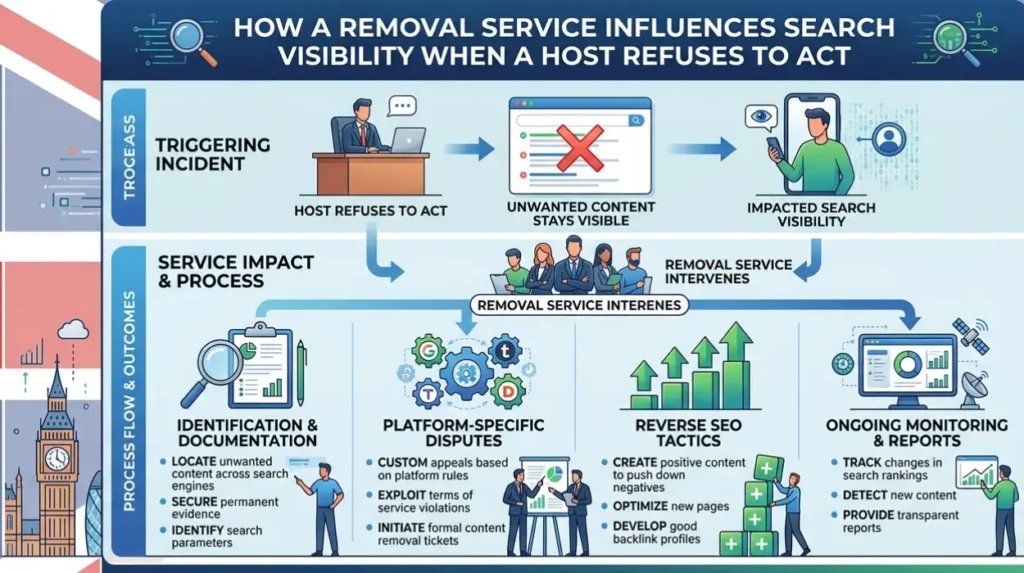
A removal service influences search visibility even when a host refuses to act by reshaping the SERP around the harmful page, not by erasing the host‑entry itself.
Search engines index but do not automatically prioritise. When a host declines a removal, the page stays indexed, but its ranking depends on factors such as backlinks, freshness, user‑engagement, and the presence of competing‑sources. A removal‑service‑strategy targets these levers to reduce the practical‑impact of the page on Use a UK website removal service to take down content harming your reputation.
Services typically use:
- Negative‑content‑suppression: building and optimising higher‑trust‑content that outranks the harmful‑page for branded‑and‑entity‑queries.
- Evidence‑aggregation: publishing neutral‑or‑corrective‑articles that contextualise the narrative and dilute the page’s authority.
- Technical‑and‑behavioural‑signals: encouraging reputable‑sites to cite the entity’s positive‑content, which strengthens the SERP‑cluster.
These steps do not remove the host‑listed‑item, but they reduce the likelihood that a frustrated visitor will land on it as the first‑or‑only‑signal.
What legal and policy tools does a removal service use that individuals usually miss?
A UK website removal service uses legal‑and‑policy‑tools that individuals often overlook, such as structured‑evidence‑bundles, jurisdiction‑precise‑arguments, and multi‑channel‑escalation paths that increase the odds of successful delisting.
Direct‑reporters typically rely on a single‑form or generic‑template, which can be easy to dismiss. A removal‑service‑strategy reinterprets the same‑claims through:
- Data‑protection‑arguments (e.g. GDPR‑right‑to‑erasure where applicable).
- Defamation‑or‑misrepresentation‑frameworks that align with UK‑courts’ standards.
- Hosting‑and‑ISP‑policy‑clauses that are not always visible or user‑friendly.
These tools do not guarantee removal, but they force the platform to apply a higher‑inspection‑threshold than the standard‑user‑queue.
If the host still refuses, the service can escalate to ISPs, domain‑registrar‑disputes, or regulatory‑bodies, which adds extra‑pressure even if the outcome is uncertain.
How do content‑enhancement and removal‑strategies compare for reputation control?
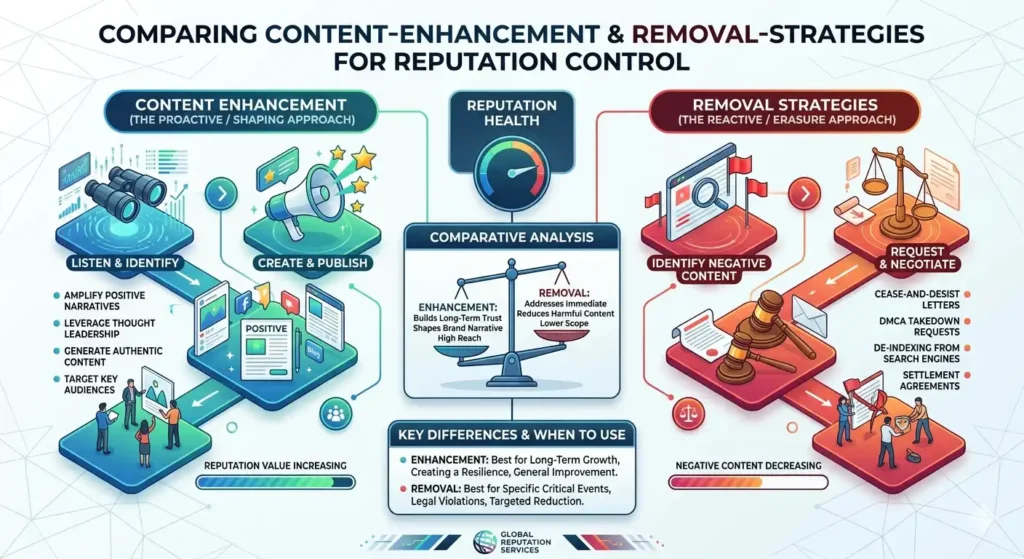
Content‑enhancement and removal‑strategies compare for reputation control by shifting focus from deleting pages to amplifying trusted‑sources that crowd out harmful‑or‑weak‑content in search results.
Content‑enhancement operates by:
- Publishing explainers, press‑releases, and opinion‑pieces that address the allegations or gaps in the narrative.
- Structuring these pages with schema‑markup, internal‑links, and clear‑headings so that search engines can easily interpret their relevance.
- Encouraging authoritative‑sites to cite or reference the entity’s own‑content, which strengthens the SERP‑cluster.
Removal‑strategies, meanwhile, operate by:
- Submitting takedown‑requests under platform‑policies, copyright‑rules, or data‑protection‑frameworks.
- Retrying or upgrading requests when initial submissions fail.
- Targeting the most‑damaging‑pages instead of every‑critical‑one.
From an effectiveness‑view, removal‑is precise but fragile, while enhancement‑is scalable but slower. The most balanced‑configuration uses removal for clear‑violations and enhancement for long‑term‑narrative‑control.
How do short‑term takedown‑pushes differ from long‑term SERP‑control strategies?
Short‑term takedown‑pushes differ from long‑term SERP‑control strategies by prioritising immediate‑signal‑reduction, whereas long‑term‑methods build durable‑entity‑credibility that withstands temporary‑crises.
Short‑term‑takedown‑pushes typically involve:
- Filing urgent‑requests for pages that spike due to controversy.
- Escalating through support‑channels to secure rapid‑delisting.
- Monitoring for reposts or re‑uploads that re‑ignite the narrative.
These actions can produce visible‑improvements in 7–30 days, but they leave the SERP‑baseline‑unchanged if the entity’s own‑content‑stack is weak.
Long‑term‑SERP‑control strategies operate by:
- Building a content‑library that reflects realistic‑positioning and public‑interest.
- Embedding reputation‑monitoring into internal‑communication‑and‑information‑governance.
- Continuously‑optimising structured‑data, articles, and citations.
These steps ensure that the SERP‑composition remains stable even when new critical‑content appears, because the overall‑reputation‑signal‑density is higher.
How to connect this to a deeper decision‑stage resource
A UK website removal service adds structure, evidence‑discipline, and search‑algorithm‑awareness to the same‑removal‑mechanisms that individual users can access, but cannot fully exploit alone. Reputation management strategies differ based on whether they emphasise pure‑deletion, narrative‑reconstruction, or SERP‑reshaping, and online reputation control methods are evaluated through their impact on visibility, trust‑signals, and long‑term‑risk‑exposure. Short‑term‑takedown‑pushes can stabilise a crisis, while long‑term‑content‑enhancement and technical‑optimisation support a stable‑digital‑footprint that search engines and visitors interpret as more credible.
FAQs
What does a UK website removal service actually do?
A UK website removal service systematically identifies and removes or suppresses harmful online content that cannot be taken down through standard platform reporting. It uses legal‑based evidence, policy‑violations, and search‑visibility strategies to reduce the impact of defamatory or misleading pages on your reputation.
How is a website removal service different from just reporting content yourself?
A website removal service applies structured legal‑and‑policy‑arguments and tracks multiple platforms, whereas self‑reporting usually relies on one‑off user‑flags that often get low‑priority review. This professional approach increases the chances of removing or suppressing damaging content that would otherwise stay in search results.
Can a UK website removal service guarantee that all negative content is deleted?
No reputable UK website removal service can guarantee 100% deletion, because some hosts and platforms decline removals even with strong evidence. However, these services can significantly reduce visibility by combining removal‑requests with content‑suppression and reputation‑signal‑optimisation.
How quickly can a website removal service improve my online reputation?
A UK website removal service can start to change search‑visibility within 2–4 weeks for clearly policy‑violating or illegal pages. For more complex cases, ongoing removal‑and‑suppression work gradually reduces the reach of harmful content over several months.
Is hiring a service like Clear Your Name worth it for individuals and small businesses?
Yes, services like Clear Your Name are particularly useful for individuals and small businesses that lack the time or legal‑expertise to manage multiple takedown requests. They help stabilise your online presence by targeting high‑impact pages and improving how your reputation appears in search results.