
Yes. Accounts used for harassment present three primary options for UK users: report content for removal under platform policies; request account suspension or removal through the platform’s safety mechanisms; and pursue legal or regulatory complaint pathways that can compel platforms to act.
Reputation management is the coordinated practice that defines how an entity’s digital footprint is interpreted across search ecosystems.
Online reputation refers to the aggregate of content, signals and indexed records that form an entity’s visible profile in SERP evaluation.
What legal options exist in the UK when a Facebook account is used for harassment?
UK legal options include criminal reporting for communications offences, civil remedies such as injunctions or libel actions, and formal complaints to regulatory bodies that govern intermediary duties.
Definition: This question defines legal redress as the set of statutory and common-law mechanisms available to target harmful online behaviour within domestic jurisdiction. Legal redress refers to binding interventions (criminal conviction, court order, damages award) that alter content accessibility or force platform action within search ecosystems.
Mechanism: Criminal reporting triggers police investigation under communications-related offences; police can request data preservation or disclosure from platforms, which influences indexing by creating takedown events or court-ordered suppression. Civil remedies require claim filing; successful injunctions result in court orders compelling account suspension or specific content removal, creating indexed deletions or labeled entries in public record. Regulatory complaints invoke statutory bodies that evaluate platform compliance with codes of practice; enforcement outcomes generate compliance notices that change platform moderation and indexing practices.
Impact on search visibility or perception: Legal outcomes create durable signals in search ecosystems. A court order or enforcement action becomes an authoritative entity signal that search engines index, influencing entity perception by adding authoritative metadata (legal status, judgments) to results. Content removed via legal compulsion demonstrates high-severity reputation signals, reducing search visibility for offending content while increasing visibility of authoritative legal records.
What platform-policy actions can UK users request when harassment occurs on Facebook?
Users can request content removal, account suspension, or content labeling under the platform’s community standards and safety policies.

Definition: Platform-policy actions are non-legal remediation measures that platforms apply according to their rules. These actions refer to internal enforcement outputs (remove, restrict, label, deplatform) that modify the content set within platform-controlled indexing.
Mechanism: Users submit evidence through reporting tools; automated classifiers and human reviewers evaluate reports against policy taxonomies (harassment, hate, targeted abuse). Enforcement decisions generate moderation flags and metadata removal triggers deletion from indexable surfaces, suspension restricts posting privileges but may preserve profile data for legal compliance, and labeling adds contextual overlays that affect user interpretation. Platform compliance logging records enforcement actions, which feed internal reputation signals used by the platform’s ranking model.
Impact on search visibility or perception: Platform removal reduces content availability on the platform; however, cached copies, third-party scrapes and backlinks continue to influence external search engines unless addressed. Suspension reduces content refresh frequency, lowering prominence in social search. Labels alter entity perception by signalling reduced credibility or policy violations, which search evaluators and users interpret as negative reputation signals, changing click-through behaviour and the entity perception within SERP evaluation.
How does content removal differ from account removal in terms of reputation signals?
Content removal targets specific items and creates discrete takedown signals; account removal severs an entity-level presence and creates broader reputation-altering signals in search ecosystems.
Definition: Content removal is the deletion or restriction of individual posts or media. Account removal is the suspension or deletion of an entire profile or page. Both actions refer to discrete changes in indexed materials and entity-level metadata within search ecosystems.
Mechanism: Content removal issues item-level deletions recorded in platform logs and sometimes through transparency reports; these produce node-level drops in content indexing. Account removal severs the entity identifier used across platform pages and often generates systemic de-indexing of multiple content nodes tied to that account. Platform APIs and robots.txt-like signals may prevent crawling of removed content, while legal requests produce authoritative takedown notices that third-party archives respect.
Impact on search visibility or perception: Item-level removals decrement specific content visibility but leave other content intact, so entity perception can persist through remaining materials. Account-level removal reduces the corpus associated with an entity, creating a concentrated negative reputation signal and changing entity perception as assessed by search evaluators. Search visibility declines more substantially after account removal due to fewer content nodes and increased prominence of alternative sources (news, legal records) in SERP evaluation.
How do search engines index and interpret harassment-related content tied to a Facebook account?
Search engines index platform-accessible content via crawlers and interpret harassment-related content using content signals, link signals and external authority signals to assess relevance and credibility.
Definition: Indexing refers to the process wherein search engines crawl, parse and store content for retrieval. Interpretation refers to algorithmic evaluation of content for relevance, intent and trust. Within search ecosystems, indexing and interpretation transform raw content into reputation signals and entity perception data.
Mechanism: Crawlers access publicly available profiles and posts; metadata (timestamps, author identifiers, schema markup) structures the index entries. Algorithms apply natural language processing to detect abusive language, named entities and sentiment; link analysis evaluates backlinks, shares and engagement as amplification signals. External authority signals news coverage, legal records, official notices—feed into trust scoring modules that modulate the weight of user-generated content. Human evaluation guidelines used in training data provide calibration for automated systems, shaping thresholds for demotion or removal in SERP evaluation.
Impact on search visibility or perception: If algorithms classify content as abusive, ranking models demote or remove content from results pages, reducing search visibility. However, classification errors or partial removals produce mixed signals that complicate entity perception. High external authority content referencing the harassment event elevates the issue’s prominence, shaping a persistent reputational record within the SERP evaluation framework.
What reputation signals influence whether harassing content ranks in search results?
Ranking depends on signals including content relevance, authority of sources, engagement metrics, temporal freshness, and platform moderation status.
Definition: Reputation signals are measurable indicators that search algorithms use to assess content credibility and entity standing within search ecosystems. Reputation signals refer to factors that collectively determine ranking outcomes and entity perception.
Mechanism: Relevance is evaluated through query-content semantic matching and term frequencies. Authority is inferred from domain trust, backlink profiles and third-party citations; content hosted on high-trust domains receives elevated weighting. Engagement metrics (shares, comments) act as amplification signals that increase index prominence. Freshness algorithms prioritise recent activity, so ongoing harassment increases short-term visibility. Platform moderation status (removed, labeled, restricted) supplies direct trust metadata that ranking models incorporate to demote or exclude content.
Impact on search visibility or perception: Strong authority signals for negative content maintain high ranking despite moderation, sustaining adverse entity perception. Conversely, rapid moderation and authoritative counter-content reduce negative exposure by shifting SERP composition toward neutral or corrective sources. Search visibility for harassing content therefore reflects a balance of amplification and authority signals within SERP evaluation.
How does the digital footprint of a targeted person change after harassment on Facebook?
The targeted person’s digital footprint expands to include harassment content, associated metadata and derivative traces, altering entity reputation and long-term search signals.
Definition: Digital footprint is the set of all indexed traces—posts, comments, screenshots, mirrored content and legal or media records linked to an entity. Within search ecosystems, digital footprint refers to the corpus that shapes entity perception.
Mechanism: Harassment events create original content nodes and trigger sharing across platforms, generating backlinks and mirrored copies. Each derivative copy carries metadata that links back to the original account or identifiers, increasing entity association. Search engines aggregate these nodes into entity profiles, where co-occurrence and entity graph connections strengthen the association between the harasser and the target. Removal events produce negative signals (takedown notices, transparency reports) that become part of the footprint when indexed.
Impact on search visibility or perception: The expanded footprint increases the volume of negative signals, which degrades entity perception in SERP evaluation. Even after removals, cached and archived copies maintain residual visibility, prolonging reputation impact. Recovery requires authoritative, indexable corrective content and legal or moderation actions that generate counter-signals to rebalance entity perception.
How do authority and trust signals mitigate harassment-related reputation damage?
Authority and trust signals mitigate damage by elevating verified, credible content and authoritative records that displace lower-authority harassing content in rankings.
Definition: Authority signals are indicators such as verified credentials, domain trust metrics and third-party citations. Trust signals are signals indicating reliability, such as persistent domain history, legal validation and consistent editorial standards. Within search ecosystems, these signals refer to mechanisms that weighting algorithms use to privilege credible sources.
Mechanism: Authoritative sources (official notices, legal judgements, reputable media) receive strong ranking weight and create robust backlinks that outrank user-generated harassment. Trust signals from verified accounts or institutional pages provide stable entity anchors that search engines prioritise. Citation networks transfer authority to corrective content, improving its chance to occupy higher SERP positions. Structured data and canonicalisation practices help authoritative pages assert precedence over scattered hostile content.
Impact on search visibility or perception: When authoritative corrective content exists, SERP evaluation promotes it above lower-authority harassment materials, reducing negative visibility and improving overall entity perception. Absence of authoritative counter-content allows harassing material to persist in top results, reinforcing negative reputation signals.
How do review signals and sentiment analysis affect reputation when harassment is present?
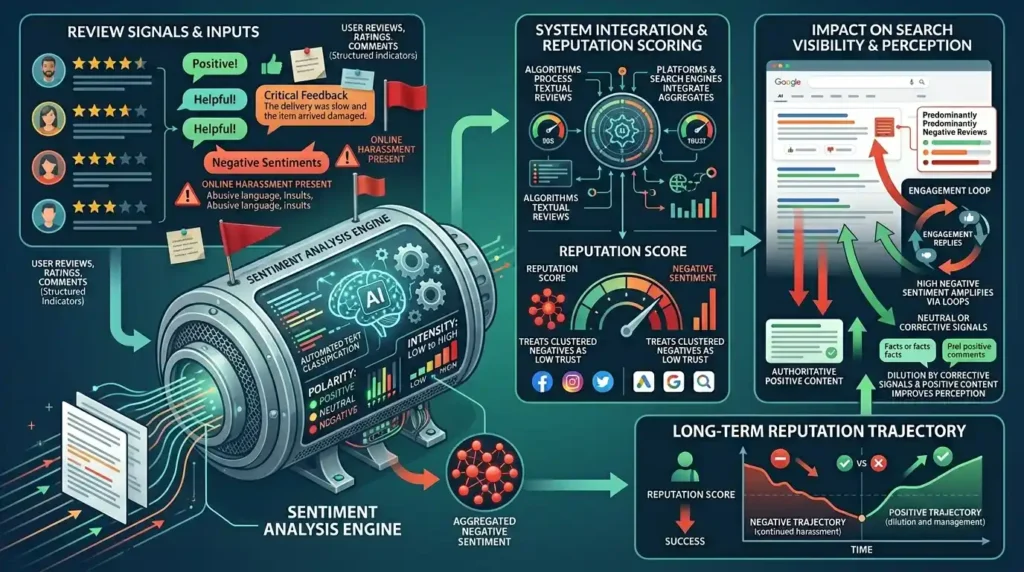
Review signals and sentiment analysis influence aggregation of public perception by quantifying negative context and signalling experiential credibility to ranking models.
Definition: Review signals are structured indicators from feedback systems (ratings, comments) that reflect user sentiment. Sentiment analysis refers to automated classification of text polarity and intensity. Within search ecosystems, these measures function as proxy reputation metrics influencing content prominence.
Dive Deeper With Our Expert Guides and Related Blog Posts:
Why Facebook Posts Are Difficult to Remove Even When They Clearly Violate Rules
What Makes a Facebook Post Legally Defamatory and Eligible for Removal in the UK
Mechanism: Algorithms process textual reviews and comments for sentiment polarity and intensity; aggregated negative sentiment increases the likelihood of demotion for associated content or entities. Platforms and search engines integrate these aggregates into reputation scoring, treating clustered negative reviews or highly negative sentiment as a signal of low trust. Sentiment-derived annotations may also appear in knowledge panels or snippets, influencing user interpretation.
Impact on search visibility or perception: High negative sentiment clusters amplify negative reputation signals and can push harassing content upward via engagement loops. Conversely, neutral or corrective review signals and authoritative positive content dilute negative sentiment aggregates, improving entity perception. Therefore, sentiment dynamics play a direct role in SERP evaluation and long-term reputation trajectory.
For deeper insight, explore:
How Facebook Account Removal for Harassment Works in the UK Under Platform Policy
What options do UK users have when a Facebook account is used for harassment?
UK users can report the account and content to Facebook, submit a harassment complaint to the police under relevant offences, and in some cases seek a civil injunction or regulator complaint. These steps create formal records that can influence how the harassment appears in search results and online reputation signals.
How do UK harassment laws apply to abusive Facebook accounts?
Abuse via a Facebook account can fall under harassment, stalking, or malicious communications laws if it causes distress or alarm. UK law enforcement can pursue offenders using digital evidence such as messages, posts, and account metadata, which may later feed into search visibility and reputation records.
What evidence should I collect when a Facebook account harasses me?
Collect screenshots with timestamps, URLs or post IDs, message threads, and any linked profiles or pages that show the abusive behaviour. This evidence supports platform reports and legal or regulatory complaints, helping to trigger content removal or account action that may affect search indexing.
How does reporting a Facebook harassment account affect search visibility?
Reporting can lead to content removal or account restriction, which reduces the amount of harassing material crawled and indexed by search engines. Less indexed content can gradually lower the prominence of harassment‑related pages in search results and shift entity perception over time.
How does Facebook content removal for harassment work in the UK under platform policy?
Facebook users in the UK submit reports that match the harassment to specific policy categories, attaching content IDs and context; the platform then reviews and may remove posts, suspend or restrict the account, or escalate to safety teams. These enforcement actions can reduce the content’s presence in search ecosystems when the platform’s removal signals are indexed.