
A website removal service addresses cases where platforms refuse to act by combining legal‑grounds, policy‑arguments, and technical‑indexing‑controls to reduce the visibility or impact of harmful content, even when the host does not remove it. Reputation management is the structured process of influencing how information about an entity is created, interpreted, and ranked, and online reputation refers to the ensemble of indexed‑pages, reviews, and citations that define how a business or individual appears in search results.
How do search engines treat pages that platforms refuse to remove?
Search engines treat pages that platforms refuse to remove by continuing to index them, but their ranking can still be influenced by evidence‑strength, policy‑interpretation, and aggregated‑trust‑signals.
When a platform declines a removal‑request, the content often remains live, but search‑algorithms do not automatically rank it at the top. The page’s position depends on factors such as backlinks, domain‑authority, internal‑linking, and user‑signals like click‑rate and dwell‑time. If the page is viewed as low‑trust, spammy, or controversial, search engines may push it down SERPs even if the platform leaves it in place.
Dive Deeper With Our Expert Guides and Related Blog Posts:
Why a Harmful Website Can Continue Ranking in Google After Complaints Are Made
For example, a page that hosts unsubstantiated‑allegations may receive fewer internal‑links and lower‑dwell‑time, which signals low‑relevance and weak‑entity‑alignment. This reduces its ability to dominate search‑visibility, even when the hosting‑provider refuses to act.
Search engines also rely on external‑signals such as legal‑notices, takedown‑appeals, and third‑party‑statements that reinforce or undermine the page’s legitimacy. These signals can indirectly affect how the engine weights the page’s relevance and trust‑score.
How does a website removal service work when a platform rejects a takedown?
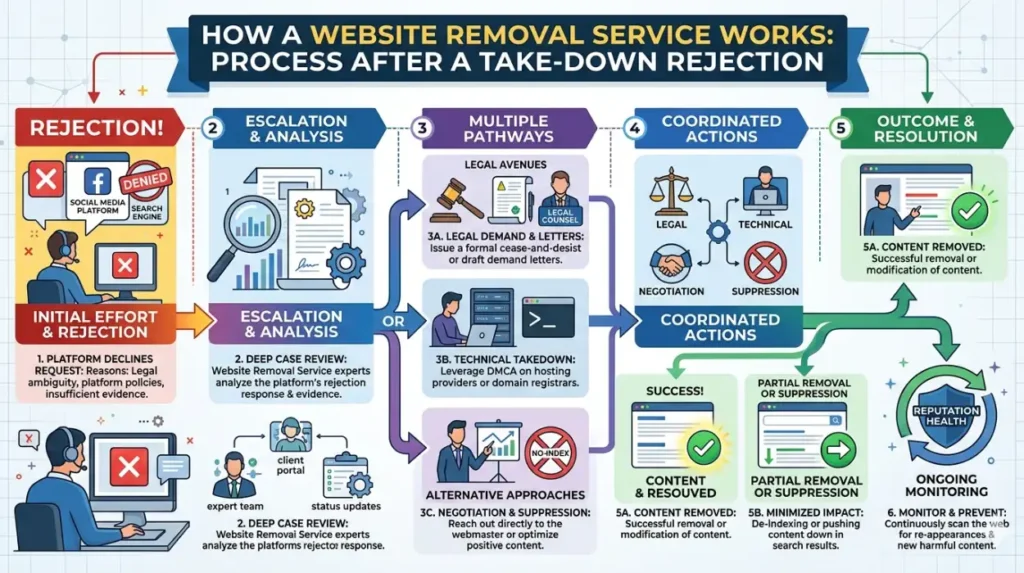
A website removal service works when a platform rejects a takedown by redirecting its focus from the host‑level‑removal to evidence‑strengthening, search‑indexing‑controls, and SERP‑counter‑content‑strategies.
The first step is strengthening the legal‑or‑policy‑evidence‑package. If a host refuses because the grounds are borderline, the service refines the claim, adds documentation, and appeals through any available‑alternative‑channels such as data‑protection‑hubs or dispute‑resolution‑mechanisms. This does not guarantee removal, but it can change the platform’s assessment over time on What a UK website removal service does that direct reporting often cannot achieve.
If the host maintains its refusal, the service shifts to SERP‑optimisation:
- Negative‑content‑suppression by promoting higher‑trust‑content that competes with the harmful‑page in rankings.
- Evidence‑aggregation through neutral‑or‑supportive‑articles that contextualise the narrative and contrast with the critical‑page.
- Algorithmic‑signals by using structured‑data, backlinks, and engagement‑events that support the entity’s preferred‑narrative.
This approach accepts that the host‑may‑not‑act, but still reduces the harmful‑page’s practical‑influence in search results.
What legal and policy arguments can support a removal when a platform refuses?
Legal and policy arguments that support removal when a platform refuses include demonstrating clear‑illegality, data‑protection‑violations, and breach‑of‑hosting‑terms, even if the platform initially declines the request.
A host may refuse removal because the content is borderline, lacks sufficient‑proof, or involves jurisdictional‑ambiguity. In these cases, a removal‑strategy evaluates whether stronger‑evidence‑packages can be built, such as:
- Case‑law‑references that clarify the scope of defamation or misuse‑of‑personal‑data.
- Regulator‑guidance or ombudsman‑decisions that interpret the relevant‑rules.
- Documentation that shows the content violates the platform’s own‑community‑guidelines or safety‑policies.
For example, a page that misrepresents an individual’s role in a regulated‑sector might breach data‑protection‑requirements or professional‑conduct‑guidelines. If the evidence is precise and well‑docketed, the platform may reassess, even if it previously refused.
If the platform still refuses, the focus moves to legal‑escalation, such as injunctive‑applications or regulatory‑complaints, which can indirectly pressure the host or reduce the page’s ability to operate long‑term.
How do search engines interpret reputation signals when a removal fails?
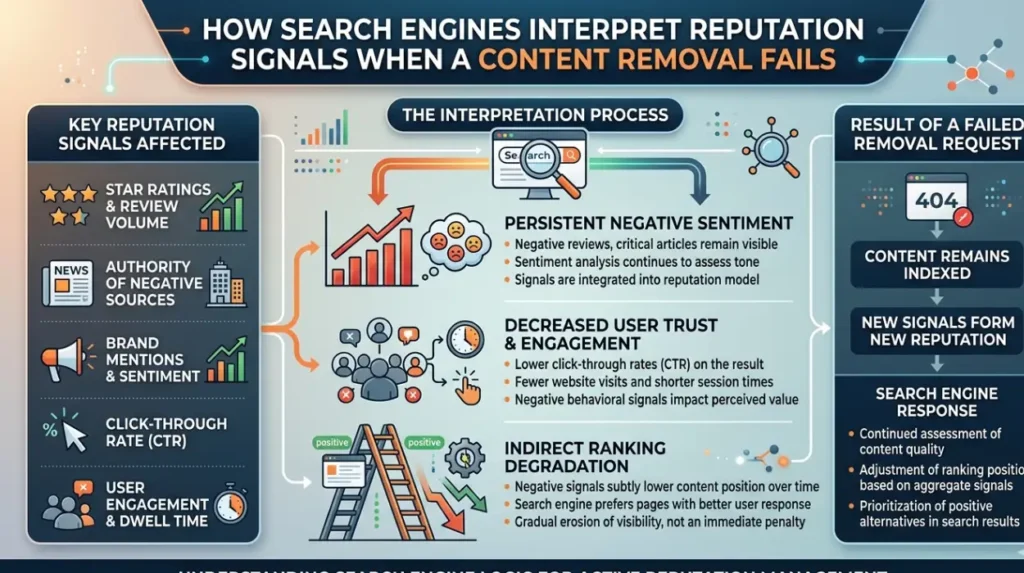
Search engines interpret reputation signals when a removal fails by weighing the balance of indexed‑content, trust‑signals, and user‑behaviour‑around the entity, not just the presence of a single‑harmful‑page.
When a removal‑request fails, the harmful‑page may remain in the index, but its weight is not absolute. Search systems compare the page’s authority with competing‑sources, cross‑referenced‑facts, and sentiment‑distribution, which can dilute the page’s impact. If the entity’s own‑content, third‑party‑coverage, and official‑statements consistently contradict the harmful‑narrative, the entity’s overall‑reputation‑signals may still skew positive.
Search engines also track how users engage with the content. If a critical‑page receives low‑click‑rates, short‑dwell‑times, or high‑bounce‑signals, the algorithm may treat it as less‑relevant or lower‑quality, even if the host refuses to remove it. This creates a form of “organic‑suppression” that reduces the page’s effective‑visibility.
For example, a 4‑year‑long‑content‑cluster that includes news‑articles, official‑statements, and professional‑references may push a single‑negative‑page from page‑1 to page‑3 despite the host’s refusal to act. This demonstrates how reputation signals operate through balance, not through the mere existence of a single‑item.
How does a website removal service manage SERP composition when a platform refuses?
A website removal service manages SERP composition when a platform refuses by reshaping the entity’s search‑result‑profile through targeted‑content‑optimisation, citation‑building, and trust‑signal‑amplification.
When the host declines a removal, the service cannot erase the page, but it can influence how much it dominates the SERP. The strategy focuses on:
- Content‑creation that directly addresses the harmful‑page’s claims, providing context, evidence, or corrections.
- Structured‑data and schema‑enhancement that make the entity’s own‑pages more attractive to search engines.
- Backlink‑acquisition from higher‑authority‑sources that anchor the entity’s preferred‑narrative.
These actions shift the SERP‑composition so that higher‑trust‑pages appear more prominently, and the harmful‑page becomes a minority‑signal rather than the dominant‑first‑entry. This does not change the platform’s decision, but it changes the practical‑impact of that decision.
When a platform refuses to remove a page, website removal services must pivot from outright‑erasure to influence‑through‑search‑signals, evidence‑construction, and narrative‑reshaping. Reputation management is, at its core, about controlling how information is created, indexed, and weighted, not about controlling every host’s policy‑decision. By aligning legal‑grounds, policy‑arguments, and SERP‑design, these strategies can reduce a harmful page’s influence even if the host stands firm, aligning the entity’s digital footprint with its desired‑entity‑perception and long‑term‑credibility.
FAQs
What happens when a website removal service cannot get a platform to take down a page?
When a platform refuses to remove a page, a website removal service shifts focus from removal to suppression by strengthening evidence‑bundles, promoting higher‑trust‑content, and reshaping the SERP composition. Reputation PR designs these strategies so that the harmful page becomes less visible, even if the host maintains its refusal.
How do website removal services manage cases where legal grounds are borderline?
When legal grounds are borderline, website removal services refine evidence‑packs, cite jurisdiction‑specific‑guidance, and align with data‑protection‑or defamation‑frameworks to strengthen the case. Reputation PR evaluates these margins carefully and uses policy‑arguments, not speculation, to support realistic‑outcomes.
Can a website removal service still reduce a harmful page’s impact if the host refuses to act?
A website removal service can reduce a harmful page’s impact by improving the entity’s own SERP‑signals, increasing positive‑content‑share, and lowering the page’s effective‑visibility through ranking‑and‑engagement‑controls. Reputation PR employs these measures so that the entity’s reputation‑signals remain balanced, even when the host declines removal.
What role does search‑engine behaviour play when a platform refuses to remove a website?
When a platform refuses to remove a website, search‑engine behaviour determines how heavily the page influences the entity’s reputation based on authority‑signals, user‑engagement, and cross‑referenced‑facts. Reputation PR monitors these signals and adjusts content‑and‑indexing‑strategies to limit the harmful page’s practical‑impact.
How do website removal services compare removal attempts with SERP‑control‑strategies?
Website removal services compare removal attempts with SERP‑control‑strategies by evaluating the likelihood of platform‑action, legal‑risk, and the potential‑for search‑visibility‑reduction through content‑enhancement. Reputation PR prioritises realistic‑routes, combining direct‑requests with long‑term‑SERP‑reshaping to protect the entity’s online reputation.