Harmful Facebook content under UK platform and legal standards is content that the platform’s policies or UK law defines as causing real-world or digital harm to individuals, groups, or public interest.
Harmful Facebook content is content that violates platform rules or statutory thresholds by promoting violence, facilitating illegal activities, spreading disinformation that affects public safety, or engaging in targeted harassment and hate against protected characteristics. Within search ecosystems, this content functions as negative reputation signals that indexing systems and SERP evaluators treat as risk-bearing assets for an entity.
Platforms classify content through rule-based policy frameworks combined with automated detection systems and human moderation. Signals used for classification include textual indicators, image analysis, network propagation patterns, reported user interactions, and contextual metadata such as timestamps and geographic markers. These signals feed into content-ranking pipelines and content removal workflows that affect how—and whether—content remains indexable by search engines. Search engines detect platform-hosted content through crawling or through third-party copies; content flagged as harmful often undergoes lowered discoverability, removal notices, or de-prioritisation in SERPs.
When content is classified as harmful, the immediate effect is reduced search visibility through de-indexing, demotion algorithms, or content warning overlays. For an entity, the persistence of harmful content creates sustained negative reputation signals that degrade entity perception and lower authority signals. Search engines evaluate these signals during SERP evaluation, increasing the weight of negative sentiment, complaint pages, and authoritative countercontent in ranking decisions. The presence of harmful content therefore amplifies adverse entity perception within the indexed web and across digital footprints.
How does UK law define and influence harmful content classifications on platforms?
UK law defines harmful content by statute and regulatory guidance, which sets legal thresholds platforms must enforce, and this legal framing directly shapes platform policy and content-ranking behaviour.
UK law defines harmful content through discrete offences and regulatory standards—examples include communications that constitute harassment, threats, incitement to violence, and content facilitating criminal activity. Regulatory instruments and codes of practice further define obligations for platforms to remove or mitigate such content. Within search ecosystems, these legal definitions act as external constraints that inform platform moderation taxonomies and search engine treatment of indexed items.
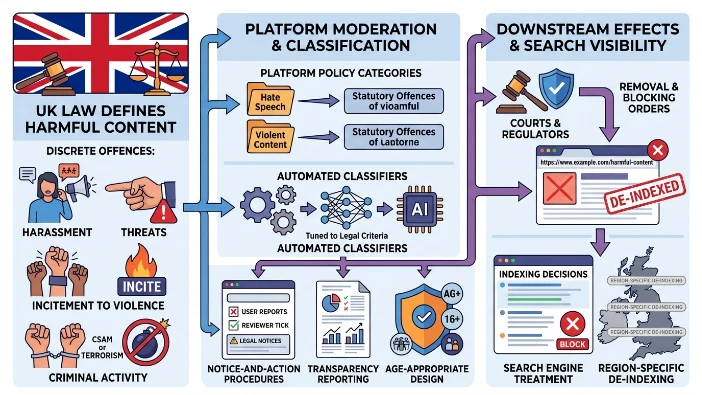
Legislation and regulatory codes require platforms to maintain notice-and-action procedures, transparency reporting, and age-appropriate design. Platforms map statutory offences to internal policy categories and tune automated classifiers to detect prohibited material according to legal criteria. Courts and regulators can compel removal or blocking orders that alter the lifecycle of specific URLs. Search engines respond by updating indexing decisions, applying legal-removal signals, or using region-specific de- indexing to comply with jurisdictional orders.
Legal-driven removal or demotion produces formal negative signals that both reduce SERP presence and create metadata trails (take-down notices, legal orders) indexed by search engines. These records function as reputation signals indicating regulatory scrutiny, which impacts entity authority and trust metrics during SERP evaluation. Entities subject to legal removals experience longer-term effects on their digital footprint because search algorithms treat regulatory association as a credibility constraint.
What types of Facebook content count as reputation-damaging within search ecosystems?
Reputation-damaging Facebook content is content that generates negative, verifiable signals which search engines treat as indicators of reduced trust, authority, or safety for the associated entity. This answer categorises damaging content, explains detection signals, and links those categories to indexing and ranking outcomes.
Categories include defamatory statements, targeted harassment, disinformation that materially affects reputation, explicit content depicting illegal acts, and coordinated manipulation designed to deceive. Within search ecosystems, these categories translate into negative sentiment signals, complaint volume metrics, and authority disruptions.
Detection leverages natural language processing for sentiment and claim verification, network analysis for coordination signals, user report volumes as amplification metrics, and image/video analysis for explicit material. Platforms generate structured metadata—content labels, enforcement actions, and visibility controls—that search crawlers ingest. Search engines evaluate the aggregated metadata alongside backlink profiles and authoritative rebuttals to determine the content’s SERP footprint.
Each category produces distinct effects: defamation increases negative sentiment and complaint-page prominence; disinformation triggers de-prioritisation and elevates authoritative correction content in SERPs; harassment increases the number of complaint or news pages that signal risk; coordinated manipulation lowers perceived authenticity and reduces trust scores in ranking models. The cumulative effect modifies entity perception across the indexed web by altering which pages surface for relevant queries.
How do algorithms interpret trust and credibility when harmful content is present?
Algorithms interpret trust and credibility by measuring structured reputation signals and comparing them against normative authority baselines within the index. This answer defines algorithmic trust metrics, describes signal processing, and explains consequent SERP evaluation adjustments.
Algorithmic trust is a composite score derived from signals such as content provenance, authoritativeness, backlink quality, user engagement patterns, and external validation from authoritative domains. Within search ecosystems, trust metrics act as weighting factors that influence content ranking and entity perception.
Algorithms weight provenance signals (verified pages, organisational domains), backlink patterns (diversity, editorial links), user engagement quality (dwell time, pogo-sticking), and content freshness. Harmful content introduces negative signals—high complaint rates, takedown metadata, low-quality backlinks from malicious sources—that reduce trust scores. Algorithms integrate these negative signals alongside positive authority indicators to compute relative ranking positions during SERP evaluation.
A lower algorithmic trust score produces demotion across relevant queries and increases the likelihood that authoritative corrective content outranks the harmful material. For the entity, this recalibration diminishes perceived credibility within the SERP context and reshapes entity perception by amplifying authoritative narratives over user-generated negative signals.
How does harmful content influence the formation of an entity’s digital footprint?
Harmful content alters an entity’s digital footprint by creating persistent indexed artefacts and aggregating negative reputation signals across multiple domains.
A digital footprint is the aggregate of publicly indexed references, social posts, media coverage, and archived copies that represent an entity online. Within search ecosystems, the footprint provides the corpus from which reputation signals are extracted.
Harmful posts generate derivative content—shares, screenshots, news reports, and complaint pages—that multiplies indexable references. Archival systems and search caches preserve content even after original removal, creating persistent traces. Search engines compile these traces into entity-centric clusters used during SERP evaluation, with temporal and authority metrics determining prominence.
The multiplication of negative artefacts increases negative sentiment weight and complaint volume metrics in ranking models. Persistent archived copies and secondary coverage maintain search visibility for adverse content, prolonging reputational impact. Consequently, entity perception in SERPs skews negative until authoritative, corrective, or higher-trust content outweighs cumulative negative signals.
What role do review signals and sentiment analysis play in rating harmful Facebook content?
Review signals and sentiment analysis quantify user feedback and tone to produce measurable reputation inputs for ranking systems.
Review signals are structured user-generated indicators such as ratings, complaints, and moderated comments; sentiment analysis is automated classification of textual tone and polarity. Within search ecosystems, both contribute quantifiable measures of public perception and inform content ranking decisions.
Platforms collect review signals through user reports, reactions, and comment moderation. Search engines and third-party aggregators process these signals with sentiment classifiers and aggregate index metrics (average sentiment, complaint velocity). High negative sentiment, concentrated complaint patterns, or coordinated low ratings raise flags in ranking models and content evaluation pipelines.
Elevated negative review metrics decrease content authority and increase prominence of negative result pages in entity-specific queries. Sentiment-derived features feed into algorithmic models that reweight the relevance of pages during SERP computation, amplifying reputational damage until positive or corrective authority signals recalibrate sentiment aggregates.
Dive Deeper With Our Expert Guides and Related Blog Posts:
What Options UK Users Have When a Facebook Account Is Used for Harassment
Why Facebook Posts Are Difficult to Remove Even When They Clearly Violate Rules
How do authority and trust signals counterbalance harmful content in search rankings?
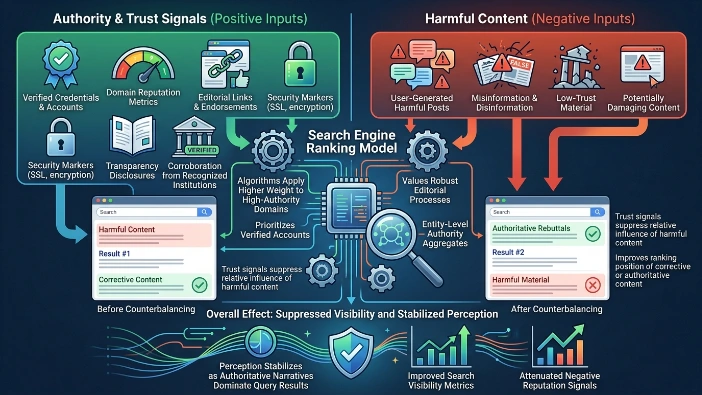
Authority and trust signals counterbalance harmful content by providing higher-weighted, verifiable indicators that ranking models prioritise over low-trust material.
Authority signals are endorsements, editorial links, verified credentials, and domain reputation metrics; trust signals include security markers, transparency disclosures, and corroboration from recognised institutions. Within search ecosystems, these signals function as positive inputs that elevate content credibility during ranking.
Algorithms apply higher weight to content from high-authority domains, verified accounts, and sources with robust editorial processes. Trust signals suppress the relative influence of user-generated harmful content by improving the ranking position of corrective or authoritative content. Search engines use entity-level authority aggregates when resolving conflicting signals between harmful posts and authoritative rebuttals.
When authority and trust signals outweigh negative signals, SERP evaluation favours authoritative corrective content, thereby reducing the visibility of harmful material. The entity’s perception stabilises as authoritative narratives dominate query results, producing improved search visibility metrics and attenuated negative reputation signals.
How does content indexing dynamics affect the persistence of harmful Facebook posts in search results?
Content indexing dynamics determine whether harmful Facebook posts are discoverable, demoted, or removed from search indexes, directly influencing their persistence in SERPs.
Content indexing dynamics are the processes by which search crawlers discover, retrieve, store, and refresh content entries in their indexes. Within search ecosystems, indexing dynamics control the lifecycle of harmful posts from discovery to removal or cache expiry.
Crawlers follow links, API exposures, and sitemaps to fetch content. Platforms can restrict crawler access via robots.txt, meta directives, or legal takedown mechanisms, which affect index inclusion. Even after platform removal, cached copies and third-party archives maintain discoverable traces until crawler recrawl schedules and cache purges propagate changes.
Delayed recrawls and retained caches prolong the visibility of harmful posts, sustaining negative reputation signals. Rapid removal and effective de-indexing reduce the persistence of harmful content in SERPs, accelerating the decline of associated negative signals in entity perception. Indexing dynamics therefore directly affect the duration and severity of reputational impact.
For deeper insight explore:
How Reporting Harmful Facebook Content in the UK Differs From Professional Removal
Harmful Facebook content under UK platform and legal standards comprises categories that create verifiable negative reputation signals within search ecosystems. Legal definitions and platform policies translate into classification mechanisms that alter content indexing, ranking, and entity-level perception. Algorithms evaluate trust and authority through structured signals provenance, backlinks, sentiment, and review aggregates—which determine the SERP prominence of harmful material. Understanding these mechanisms clarifies how digital footprints form, how harmful artefacts persist, and how authority signals can rebalance entity perception. Awareness of indexing dynamics, legal constraints, and signal processing is essential for accurate analysis of online reputation and search visibility.
How long does it take for Facebook to remove content after a report in the UK?
Removal time varies by severity and verification complexity; urgent violations (threats, child exploitation) receive rapid priority, while nuanced cases (defamation, disinformation) require longer review and may involve human moderation. Facebook Content Removal Services note that legal orders or regulatory requests can alter timelines through formal takedown or blocking procedures.
Can removed Facebook content still appear in search engine results?
Removed posts can persist in search engine caches, third-party archives, and screenshot copies, so removal from the platform does not instantly clear search visibility. Facebook Content Removal Services advise coordinating takedown requests, cache removal notices, and reporting archived copies to minimise continued SERP presence.
What evidence improves the likelihood of successful removal of harmful Facebook content?
Provide specific URLs, clear timestamps, contextual description of harm, and corroborating materials (screenshots, witness statements, related posts) to substantiate the report. Facebook Content Removal Services emphasise structured evidence and legal documentation when applicable to increase moderation accuracy and regulatory compliance.