

Reputation management is the practice of overseeing how an entity’s identity and credibility are represented and interpreted across digital systems. Online reputation refers to the cumulative set of signals, content, and indexed records that search engines and platforms use to form an entity’s public profile within search ecosystems.
How can an Instagram post harm my reputation without tagging me?
An Instagram post harms reputation without tagging by publishing content that creates indirect association signals textual mentions, visual identifiers, co-occurrence links, and engagement patterns that search engines and platform indexing systems map to an entity’s digital footprint.
Definition: Indirect reputational harm refers to content that establishes association between an entity and material (negative or misleading) without explicit tagging or direct identifiers. This content relies on contextual clues rather than direct metadata links.
Mechanism (how it works): Search engines and social platforms extract signals from images, captions, comments, hashtags, geotags, and account networks. Natural language processing (NLP) identifies named entities and contextual co-occurrence; image recognition models extract faces, logos, and scene elements; graph analysis maps account interactions and shared followers. When an Instagram post contains identifiers company names in captions, recognisable logos in images, location data, or repeated conversational phrases these elements create association edges in entity graphs even if no tag exists. Indexing systems then incorporate these edges into content pools that inform SERP evaluation.
Impact on search visibility or perception: Indirect association increases the probability that search queries related to an entity return the harmful post or derivative content in SERPs and social search. Reputation signals degrade when negative content generates high engagement metrics (comments, shares, saves) because ranking algorithms equate engagement with perceived relevance. Consequently, entity perception shifts for both algorithmic evaluators and human searchers, reducing favourable visibility and elevating negative semantic clusters within the entity’s indexed profile.
How do search engines and platforms identify untagged associations?
Search engines and platforms identify untagged associations by analysing textual co-occurrence, visual features, metadata, network topology, and temporal correlation to infer entity relationships.
Definition: Untagged association detection refers to algorithmic processes that infer links between content and entities absent explicit metadata tags.
Mechanism (how it works): NLP pipelines parse captions and comments to extract named entities and sentiment. Computer vision models perform facial recognition (when authorised), logo detection, and scene classification. Metadata parsing reads EXIF, geolocation, and timestamp patterns. Graph algorithms evaluate follower overlap, mutual mentions, and repeated co-posting. Temporal correlation algorithms link a sudden cluster of posts about a single topic to related search queries. Signals combine into an association score that ranks likelihood of a post referencing the entity.
Impact on search visibility or perception: High association scores feed into content indexing and influence SERP evaluation by providing additional evidence that the post belongs to the entity’s semantic neighbourhood. Search visibility for negative content increases when association scores intersect with high engagement, creating durable reputation signals that affect entity perception across search ecosystems.
What reputation signals does negative Instagram content generate?
Negative Instagram content generates reputation signals including sentiment polarity, engagement-weighted relevance, topical co-occurrence, visual-identification markers, and network amplification metrics.
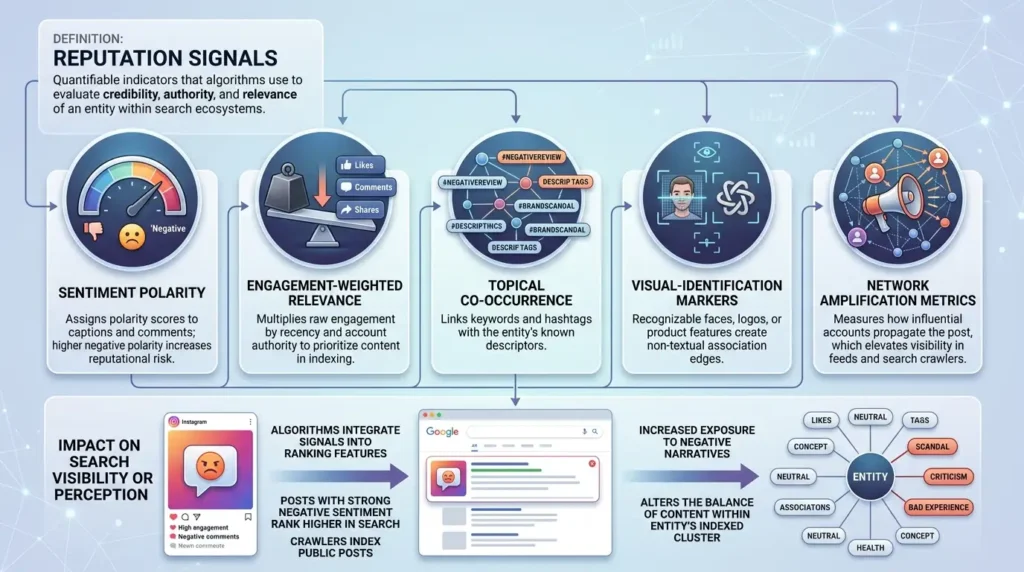
Definition: Reputation signals are quantifiable indicators that algorithms use to evaluate credibility, authority, and relevance of an entity within search ecosystems.
Mechanism (how it works): Sentiment analysis assigns polarity scores to captions and comments; higher negative polarity increases reputational risk. Engagement-weighted relevance multiplies raw engagement (likes, comments, shares) by recency and account authority to prioritize content in indexing. Topical co-occurrence links keywords and hashtags with the entity’s known descriptors. Visual-identification markers (recognisable faces, logos, or product features) create non-textual association edges. Network amplification metrics measure how influential accounts propagate the post, which elevates visibility in both platform feeds and external search crawlers.
Impact on search visibility or perception: Algorithms integrate these signals into ranking features. A post with strong negative sentiment and high network amplification ranks higher in platform search and can appear in general web SERPs when crawlers index public posts. This affects entity perception by increasing exposure to negative narratives and by altering the balance of content within the entity’s indexed cluster.
How does platform moderation affect the presence of harmful untagged posts?
Platform moderation affects harmful untagged posts by removing, downranking, or annotating content based on policy enforcement, automated detection, and user reports, thereby altering the post’s indexing likelihood and its contribution to entity perception.
Definition: Platform moderation refers to policy-driven actions executed by automated systems and human reviewers to manage content distribution within the platform.
Mechanism (how it works): Automated classifiers flag content based on policy criteria (hate, harassment, defamation indicators), signal-to-noise thresholds, and pattern recognition of repeated problematic posts. Human reviewers adjudicate borderline cases and apply contextual reasoning. Moderation actions include removal, reduced reach via ranking penalties, content labelling, or restricting discoverability in search and explore surfaces. Metadata changes (e.g., applying private visibility settings or stripping geolocation) reduce crawlers’ access and lower probability of external indexing.
Impact on search visibility or perception: Removal prevents indexing and severs a post’s contribution to the public entity graph. Downranking reduces engagement potential, thereby lowering the post’s engagement-weighted relevance and diminishing its SERP footprint. Annotations and labels influence user interpretation during SERP evaluation by signalling lower credibility. Therefore, moderation reshapes reputation signals by either eliminating or attenuating harmful content’s algorithmic weight.
How do content indexing and external crawlers convert Instagram posts into web search results?
Content indexing and external crawlers convert Instagram posts into web search results by scraping public post HTML, following embedded metadata, and aggregating social signals into search indexes that feed SERP evaluation models.
Definition: Content indexing refers to the process by which search engines collect, parse, and store web content to enable retrieval for queries.
Mechanism (how it works): Crawlers access public Instagram pages and gather HTML, JSON endpoints, and open graph metadata. Parsers extract caption text, timestamps, image URLs, hashtags, and account profiles. Indexers normalise these elements into the search engine’s document store and compute ranking signals based on relevance, authority, and freshness. Social aggregation services and news scrapers further surface posts into secondary sites that themselves are indexed. Backlinks and embeds on third-party pages create additional signals that elevate a post’s discoverability in web SERPs.
Impact on search visibility or perception: Public posts become durable web documents once indexed, contributing to the entity’s search visibility. Even deleted posts can persist through cached pages or third-party archives, maintaining negative reputation signals. Consequently, indexed Instagram content affects entity perception by occupying search result positions and by seeding derivative content that forms part of the entity’s searchable narrative.
How do reviews, comments, and sentiment on Instagram influence entity authority and trust?
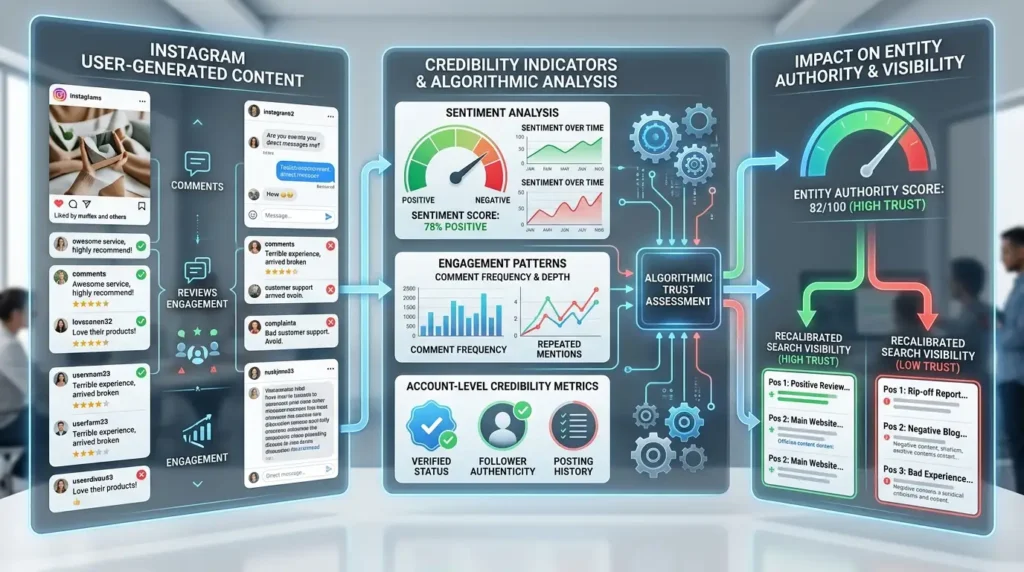
Reviews, comments, and sentiment on Instagram influence entity authority and trust by contributing user-generated credibility indicators, which ranking systems interpret as signals of reliability, relevance, and public perception.
Definition: User-generated credibility indicators refer to feedback elements (reviews, comments, engagement) that algorithms use to assess the trustworthiness and authority of an entity.
Mechanism (how it works): Comment sentiment analysis aggregates user attitudes into polarity scores; persistent negative sentiment reduces perceived trust. Structured review-like content and star ratings on ancillary platforms feed authority signals through backlinks and cross-domain references. Engagement patterns (lengthy conversations, repeated mentions) indicate topical importance and factor into SERP evaluation. Account-level credibility metrics verification status, follower authenticity, and posting history weigh the influence of these indicators.
Impact on search visibility or perception: Aggregated negative user-generated signals lower entity authority within algorithmic assessments, reducing favourable content ranking and increasing prominence of negative items. Search visibility shifts according to recalibrated trust scores; lower trust translates into poorer SERP evaluation for positive assets and higher exposure for critical content.
What role do content networks and cross-platform behaviour play in forming search perception?
Content networks and cross-platform behaviour form search perception by creating multi-source evidence trails link graphs, shared narratives, and repeated associations—that search ecosystems synthesise into entity-level knowledge graphs.
Definition: Content networks refer to interconnected posts, accounts, and third-party sites that collectively represent an entity’s presence across the web.
Mechanism (how it works): Cross-platform propagation occurs when an Instagram post is shared on other social networks, embedded in blogs, or referenced in news aggregation. Each instance creates new backlinks, anchor text and contextual paragraphs that reinforce topical co-occurrence and authority. Search engines merge signals from multiple sources to populate knowledge graphs and to assign entity attributes such as reputation descriptors, common names, and topical relevancy. Repetition across platforms increases confidence in associations and amplifies negative content’s impact on SERP evaluation.
Impact on search visibility or perception: Cross-platform reinforcement enhances content indexing and raises the likelihood that negative materials occupy prime SERP positions. Entity perception becomes more rigid as search ecosystems treat repeated signals as higher-quality evidence, thereby hardening negative reputation signals into persistent search results.
Dive Deeper With Our Expert Guides:
What Constitutes Harmful Facebook Content Under UK Platform and Legal Standards
What Options UK Users Have When a Facebook Account Is Used for Harassment
Actions to reduce association (list)
- Redact identifying metadata: remove geotags or location metadata from image files to limit geospatial association.
- Obfuscate recognizable visuals: crop or blur logos and faces before publishing to reduce computer vision match scores.
- Neutralise contextual language: edit captions to remove entity-specific terms that create textual co-occurrence.
- Limit network amplification: restrict resharing and disable public embeds to reduce backlink propagation.
- Request deindexing: submit takedown or removal requests to crawlers and host platforms and supply precise URLs and evidence.
For more information explore:
What Instagram’s Platform Tools Allow When Removing a Post Harming Your Reputation
This analysis defines how untagged Instagram posts influence reputation systems by generating association signals through textual co-occurrence, visual recognition, metadata, engagement metrics, and cross-platform propagation. Search engines and platforms evaluate these signals during content indexing and SERP evaluation to construct entity perception and authority. Understanding the mechanisms, how signals form, how moderation and indexing modify them, and how network effects amplify them provides a systematic framework for assessing reputational risk arising from social content without explicit tagging.
How do Facebook Content Removal Services work?
Facebook Content Removal Services evaluate the content against platform policies, prepare evidence-based removal requests, and submit them through Facebook’s reporting and appeals channels. They track case status and document outcomes to support future takedown or deindexing actions.
What information is required to request removal of content on Facebook?
Provide the exact URL, clear description of the harmful material, proof of ownership or rights (if relevant), and any supporting evidence such as screenshots or timestamps. Including precise legal basis or policy citations speeds up review and improves the removal request’s credibility.
Can Facebook Content Removal Services help with content that is untagged but still harms my reputation?
Yes, specialists analyse textual co-occurrence, images, metadata, and network context to build an association-based case for removal or moderation. They submit targeted reports that explain how the content creates reputational harm even without explicit tagging.
When should I involve Clear Your Name for Facebook content issues?
Involve Clear Your Name when content significantly impacts search visibility, entity perception, or commercial reputation, or when repeated or cross-platform propagation occurs. Early engagement helps preserve evidence, coordinate cross-platform actions, and improve outcomes for deindexing and moderation.