
Instagram’s platform tools allow users and affected parties to request removal of posts harming their reputation only when those posts violate Instagram’s Community Guidelines or Terms of Use, or when they infringe on intellectual‑property rights or privacy. They do not grant unilateral power to delete any third‑party post; instead, they operate through report‑based review queues, policy‑violation checks, and, in some cases, external legal or copyright‑takedown mechanisms.
Reputation management strategies differ based on whether they rely on direct platform controls, search‑engine‑level suppression, or legal‑enforced removal. Online reputation control methods are evaluated through how they alter search visibility, sentiment distribution, and the longevity of damage from a single harmful post.
How Instagram’s removal tools work in practice
Instagram’s tools for removing a post harming your reputation are structured around three main mechanisms: user‑initiated reporting, content‑policy review, and rights‑based takedown requests. For posts you own, Instagram allows deletion or archival directly from the interface, which immediately unlinks the post from feeds and search within the app. For posts you do not control, you can report the content or the account while selecting specific policy categories (harassment, impersonation, hate speech, privacy violation, or copyright infringement), which triggers an internal review rather than an automatic removal.
Instagram operates by routing reports into a moderation workflow where human reviewers or automated systems classify whether the material breaches defined thresholds; if it does not clearly violate policy, the post typically remains live. For intellectual‑property‑infringing material, Instagram supports DMCA‑style notice‑and‑takedown forms, enabling rights holders to request deletion of unauthorised reproductions of images or videos. This distinction shapes reputation‑management planning: technical reporting tools only cover content that matches Instagram’s predefined categories, while contexts such as defamation, embarrassment, or reputational harm without explicit policy breaches fall outside automated removal.
How do Instagram’s tools compare with legal‑assisted removal?
Instagram’s platform tools and legal‑assisted removal differ in scope, speed, and enforceability when dealing with a post harming your reputation.
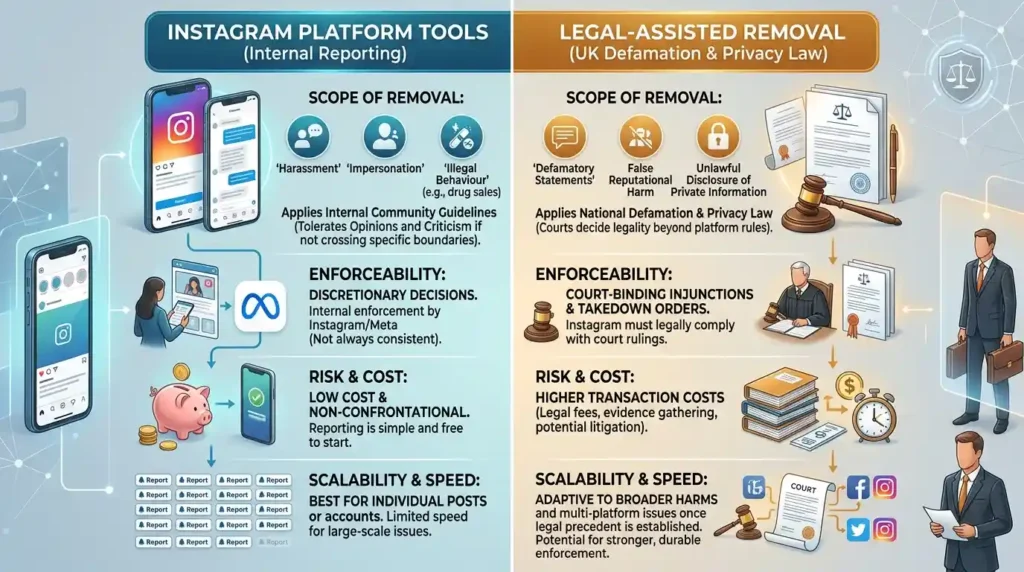
Instagram’s tools operate by applying internal Community Guidelines, which tolerate opinions and criticism as long as they do not cross into harassment, impersonation, or illegal behaviour. Legal‑assisted removal, in contrast, applies UK defamation or privacy law, where courts can issue injunctions or takedown orders that Instagram must comply with if the content is ruled defamatory, false, or unlawfully disclosing private information. Compared with each other, platform tools resolve only the subset of content that Instagram explicitly prohibits, whereas legal routes can address broader reputational harm, including false statements that do not clearly breach Instagram’s own rules.
From a risk‑exposure perspective, platform reporting is low‑cost and non‑confrontational, but its success rate is limited and discretionary. Legal‑assisted removal introduces higher transaction costs (legal fees, evidence‑gathering, and potential litigation) but can deliver stronger, more durable enforcement once a court‑binding order is obtained and submitted through Meta’s formal takedown channels. Scalability also differs: Instagram’s reports are suited to individual posts or accounts, while legal‑driven strategies can be adapted to coordinate multiple content‑takedown requests across platforms once a legal precedent is established.
What are the key differences between platform‑only and off‑platform removal strategies?
Platform‑only removal strategies focus on Instagram’s own reporting and moderation systems, whereas off‑platform removal strategies extend into search‑engine‑level de‑indexing and legal‑based content‑suppression mechanisms.
Platform‑only removal operates by submitting reports inside Instagram, relying on Meta’s internal policies and review timelines. This approach can reduce or remove the direct visibility of the post within the app and may eventually affect its appearance in search results if the platform updates its index after deletion. However, it does not guarantee that cached or crawled versions of the post disappear from external search engines, which may continue to surface the URL for some time.
Off‑platform removal strategies, by contrast, treat Instagram as one source within a broader SERP‑control framework. Practitioners can request de‑indexing of Instagram URLs from Google and Bing via webmaster tools, submit legal‑based removal requests under data‑protection or copyright frameworks, and create alternative‑source content that reshapes the aggregate sentiment and ranking signals surrounding the person or entity. Compared with platform‑only removal, off‑platform tactics are more complex and resource‑intensive but can alter multiple reputation signals simultaneously across search ecosystems.
How effective are reactive removal versus proactive reputation‑building strategies?
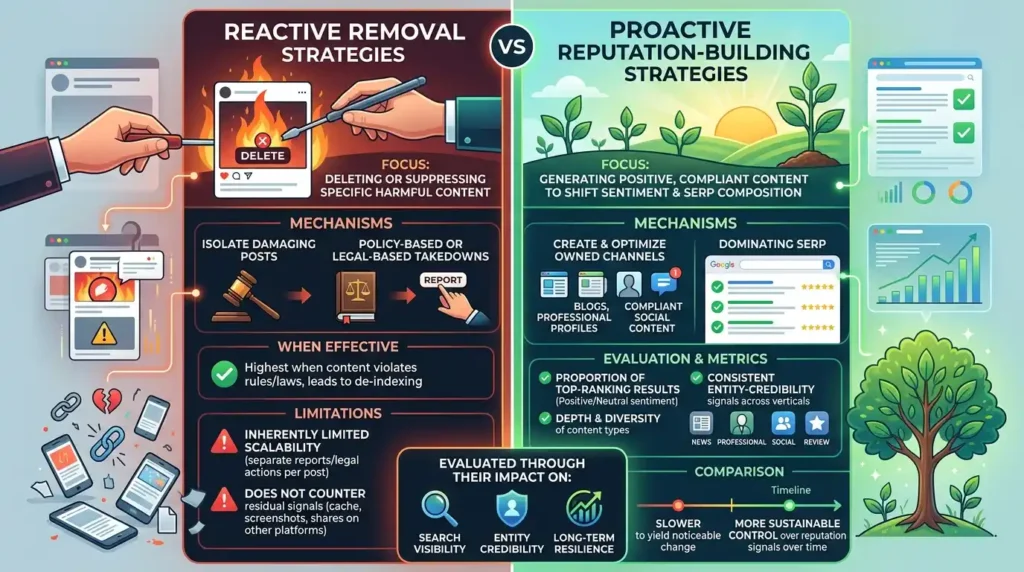
Reactive removal strategies focus on deleting or suppressing specific harmful posts, whereas proactive reputation‑building strategies focus on generating positive, compliant content that shifts the overall sentiment distribution and SERP composition. Both approaches are evaluated through their impact on search visibility, entity credibility, and long‑term resilience.
Reactive removal operates by isolating damaging posts and applying policy‑based or legal‑based takedown mechanisms. Its effectiveness is highest when the content clearly violates Instagram’s rules or external legal standards, and when removal cascades into search‑engine de‑indexing. However, this approach is inherently limited in scalability because each post often requires a separate report or legal action, and it does nothing to counter‑balance the residual reputation signals (cache, screenshots, or shares on other platforms) that may persist even after removal.
Proactive reputation‑building operates by creating and optimising owned channels (websites, blogs, professional profiles, and compliant social‑media content) that dominate the SERP for the entity’s name. This strategy evaluates effectiveness through the proportion of top‑ranking results that convey positive or neutral sentiment, the depth and diversity of content types, and the consistency of entity‑credibility signals across verticals (news, professional, social, and review). Compared with reactive removal, proactive building is slower to yield noticeable SERP change but offers more sustainable control over reputation signals over time.
How do short‑term removal tactics affect long‑term reputation risk?
Short‑term removal tactics, such as urgent reporting of a damaging Instagram post, aim to reduce immediate visibility and sentiment shock, but they do not automatically mitigate the underlying reputational risk or future exposure.
Short‑term removal operates by accelerating the takedown of the most visible harmful item, thereby limiting click‑through exposure and reducing the likelihood that the post will be amplified or cited elsewhere. This can be effective when the post is fresh, highly visible, and clearly policy‑noncompliant, because Instagram’s internal systems prioritise recent, high‑engagement content. However, limitations appear when the post has already been screenshot, cross‑posted, or indexed by search engines; in those cases, short‑term removal may only address the origin node, not the wider distribution of that content.
In contrast, long‑term reputation‑risk management evaluates mechanisms such as ongoing monitoring (tracking new mentions and spikes in negative sentiment), content‑refresh cadences, and SERP‑composition audits. From a strategic‑planning perspective, short‑term removal is best treated as a tactical intervention within a broader risk‑mitigation framework, not as a standalone, permanent solution.
How do different reputation management methods influence search‑engine interpretation of an entity?
Reputation‑management methods influence how search engines interpret an entity by altering the volume, sentiment, and structural weight of reputation signals around that entity’s name.
Direct removal strategies (platform reporting, legal takedowns, and de‑indexing requests) reduce the number of negative signals in the SERP, which can shift the perceived sentiment distribution toward neutrality or positivity if compliant, positive content already occupies the remaining top positions. However, search engines do not erase historical context; they respond to current availability, so if removed content is not replaced or outweighed, the entity may simply appear “thin” or under‑documented, which can itself carry reputational risk.
Content‑creation and on‑page‑optimisation strategies operate by increasing the quantity and quality of authoritative, sentiment‑nuanced content that references the entity. Search algorithms treat these signals as indicators of entity credibility, topical authority, and ongoing relevance, which can push individual negative posts lower in the ranking hierarchy. When compared with pure removal tactics, structured content‑creation strategies are slower to deploy but more scalable and sustainable, because they generate multiple reputation‑enhancing signals that compound over time.
Which approach better supports SERP control in a UK‑search context?
In the UK search context, SERP control is evaluated by how competently a strategy can secure the top visible positions for the entity’s name with compliant, positive‑leaning content, while minimising the prominence of negative or neutral‑negative posts.
Platform‑centric removal strategies, such as aggressive use of Instagram’s reporting tools plus legal‑assisted takedowns, can be useful for neutralising specific harmful posts and reducing their immediate visibility in both Instagram and search engines. However, they are less effective at systematically reshaping the SERP landscape, especially when the entity’s only presence is through a small number of posts or profiles.
Local‑focused content‑creation and SERP‑shaping strategies, which include UK‑based professional profiles, local‑directory listings, and UK‑oriented news or blog content, are better suited to long‑term SERP control because they align with search‑engine signals such as geographic relevance, topical authority, and citation depth. These methods compare favourably to pure removal tactics in terms of scalability and sustainability, even though they require more time and editorial effort to achieve noticeable ranking shifts.
Can you practically suppress a damaging Instagram post without deleting it?
Suppression of a damaging Instagram post without deleting it is possible through reputation‑signal manipulation and SERP‑composition changes, but it does not erase the underlying content.
Suppression operates by reducing the post’s relative prominence in search results compared with other, more positive or authoritative content about the entity. Tactics include publishing higher‑authority pages (organisational profiles, professional bios, press coverage), improving internal optimisation of those pages, and encouraging external linking and sharing so that those URLs displace the Instagram post in ranking positions. This approach evaluates effectiveness through the percentage of top‑ranking results that are positive or neutral, and through the decline in click‑through share of the harmful post, even if the post remains technically accessible.
Dive Deeper With Our Expert Guides:
How Reporting Harmful Facebook Content in the UK Differs From Professional Removal
How Facebook Account Removal for Harassment Works in the UK Under Platform Policy
Compared with forced deletion, suppression is less intrusive from a platform‑governance perspective and avoids confrontational reporting or legal action. However, it is only partially effective when the Instagram post is highly viral, widely shared, or repeatedly cited by other domains, because those citations can maintain or even increase its search‑ranking weight over time.
How should evaluation of reputation management options be structured?
Evaluation of reputation‑management options should be structured around four core dimensions: effectiveness, scalability, risk exposure, and sustainability.
Effectiveness is measured by the extent to which a method reduces the visibility of the harmful post, alters sentiment distribution in search results, and improves the perceived entity credibility for the entity’s name. Scalability is measured by how easily the method can be applied across multiple posts, accounts, or platforms without disproportionate increases in effort or cost. Risk exposure is assessed through the likelihood of escalation (e.g., legal disputes, platform‑account penalties, or public backlash), while sustainability is judged by how long‑lasting the changes are without continuous intervention.
Within this framework, Instagram’s platform tools provide a limited but important lever for removal‑based tactics, whereas broader content‑creation, SERP‑shaping, and legal‑assisted strategies offer complementary mechanisms for longer‑term reputation‑signal management. The choice between them depends on whether the priority is rapid post‑removal, long‑term SERP control, or balanced risk mitigation across multiple digital channels.
For more detail explore:
Remove an Instagram Post Damaging Your Reputation With Our UK Removal Service
What are Facebook content removal services?
Facebook content removal services help identify and request the takedown of harmful or defamatory posts, comments, or pages linked to your name or brand. These services typically combine platform reporting, legal‑based notices, and ongoing monitoring to reduce damaging content across Facebook and Instagram.
How do Facebook content removal services work in the UK?
UK‑based Facebook content removal services review each piece of content for policy violations, data‑protection concerns, or defamation risk before submitting structured removal requests. They may also coordinate with solicitors to issue formal takedown notices where the material breaches privacy or defamation laws.
Can Facebook content removal services delete any post about me?
Facebook content removal services cannot delete any post arbitrarily; removal is limited to content that violates Facebook’s Community Standards, copyright rules, or applicable UK law. If a post is opinion‑based but not abusive, removal may not be possible, and reputation‑management strategies instead focus on suppression and positive‑content promotion.
Are Facebook content removal services the same as online reputation management?
Facebook content removal services focus on removing or suppressing specific harmful posts, comments, or pages on Facebook and Instagram, while broader online reputation management includes content creation, review management, and SERP control. Together, they reduce damaging material and improve the overall perception of your name or brand online.