
UK defamation law provides an actionable legal framework to request removal of false and defamatory material, enabling legal notices, takedown requests, and court orders that compel platforms or publishers to remove or correct content. Reputation management strategies differ based on whether the objective is content suppression (removal) or content enhancement (creating authoritative content); online reputation control methods are evaluated through search ranking influence, entity credibility signals, sentiment distribution, and legal enforceability.
How does removal-based reputation management compare with enhancement-based approaches in definition and purpose?
Removal-based reputation management is a strategy that operates by eliminating or suppressing specific hostile content; it focuses on legal requests, platform takedowns, and search de-indexing to reduce visible harms. Enhancement-based reputation management is a strategy that operates by producing, optimising, and amplifying authoritative content to displace negative items in search engine results pages (SERPs) and reshape sentiment distribution.
Removal operates by triggering legal mechanisms—defamation notices, court injunctions, or platform-specific reporting flows—that cause content to be delisted, taken down, or labelled. Enhancement operates by creating high-quality pages, structured data, and social signals that increase search ranking influence for positive or neutral pages, thereby changing SERP composition.
Removal’s strength is direct reduction of harmful content visibility and clarity of entity credibility restoration when successful; its limitations include legal threshold requirements under UK defamation law, jurisdictional complexity, and potential for publication of the dispute to generate secondary visibility (the Streisand effect). Enhancement’s strength is sustainability: building a corpus of authoritative content alters sentiment distribution and provides long-term search ranking influence; its limitation is the time and resource requirement and the inability to eliminate the original negative item.
How effective are legal takedowns under UK defamation law compared with platform-based moderation requests?
Legal takedowns under UK defamation law are an enforceable remedy that evaluates falsity and reputational harm, and they operate by establishing legal liability and obtaining court orders or negotiated retractions. Platform-based moderation requests operate by using provider-specific reporting systems, community standards, or terms of service to secure removal without litigation.
Legal takedowns compare favourably on enforceability: they create legally executable obligations (court orders, damages) and strengthen entity credibility through an adjudicative process. Platform moderation requests compare favourably on speed and cost: they can produce rapid removal on the basis of provider policies, often without proof of defamation, and operate transnationally within the platform’s control. A key limitation of legal takedowns is procedural burden: UK defamation law requires showing false statements that harmed reputation and often requires legal representation, leading to higher cost and longer timelines. Platform moderation requests are limited by inconsistent policy application, algorithmic review errors, and platform incentives that prioritise content retention; these limitations reduce predictability of outcomes.
In SERP terms, legal takedowns that result in statute-backed removal or court-ordered blocking produce definitive changes to search visibility; search engines respond to court orders and may de-index content. Platform moderation removals also reduce visibility but sometimes leave cached or syndicated copies that preserve negative signals. Regarding risk exposure, legal routes increase litigation risk and public attention but produce stronger long-term suppression when successful; platform requests expose entities to policy inconsistency and less definitive outcomes but reduce immediate visibility faster and with lower upfront expenditure.
How do reactive removal strategies measure against proactive content creation for long-term sustainability?
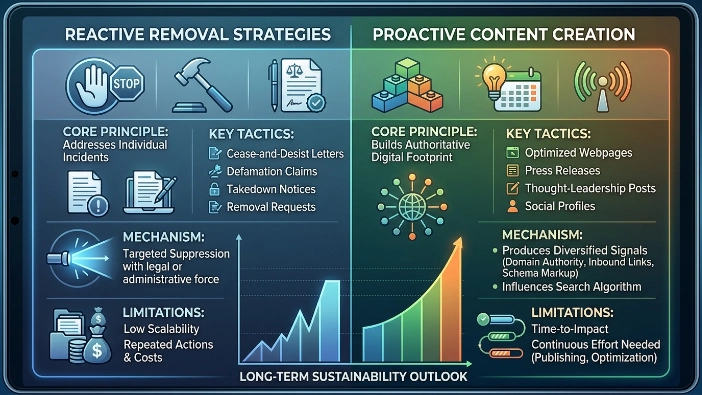
Reactive removal strategies are tactics that operate by addressing individual incidents: issuing cease-and-desist letters, filing defamation claims, submitting takedown notices, and requesting content removal from platforms. Proactive content creation is a strategy that operates by building an authoritative digital footprint—optimised webpages, press releases, thought-leadership posts, and social profiles—to shape entity credibility and the sentiment distribution across search queries.
Reactive removal measures are effective at quickly addressing discrete, high-impact items where falsity or illegality is clear. Proactive creation measures are effective at shaping baseline reputation and preventing single items from dominating SERPs. Reactive removal’s mechanism provides targeted suppression with direct legal or administrative force; proactive creation’s mechanism produces a diversified set of reputation signals (domain authority, inbound links, schema markup) that influence search ranking influence algorithmically.
A limitation of reactive removal is low scalability: repeated incidents require repeated legal or reporting actions and raise legal costs. A limitation of proactive creation is time-to-impact: building search ranking influence requires continuous publishing, link acquisition, and technical optimisation.
Search engines interpret reactive signals—takendowns, legal notices, and DMCA-like removals—as content removal actions that change SERP composition quickly. Engines interpret proactive signals—consistent authoritative content—as cumulative reputation signals that increase the volume and ranking of benign content over time. For long-term sustainability, proactive creation is more resilient: it reduces dependency on the binary outcome of takedown requests and builds persistent entity credibility that withstands future negative entries.
For more detail explore:
Use UK Defamation Law to Remove Damaging Online Content With Our Legal Team
How do content suppression tactics compare with content augmentation in terms of impact on search ranking influence?
Content suppression is an umbrella term that operates by removing, de-indexing, or limiting access to negative items; content augmentation operates by adding, optimising, and promoting positive or neutral content to occupy SERP real estate.
Suppression impacts search ranking influence by directly reducing the number of negative URLs the search engine returns for target queries; suppression’s mechanism includes court orders, platform takedowns, and legal notices. Augmentation impacts ranking influence by increasing the relative share and relevance signals of approved content—optimised titles, meta descriptions, canonical tags, structured data, and backlink profiles. Strengths of suppression include immediate SERP changes and a clear reduction in negative sentiment distribution. Limitations include imperfect suppression (mirrors, reuploads, caches) and the possibility that suppression notices themselves surface as news. Strengths of augmentation include improved entity credibility and diversified discovery channels (news, knowledge panels, social), while limitations include slower effect and higher resource requirements.
Search engines weigh both types of signals: removal reduces negative signal presence, whereas augmentation strengthens positive signals. A balanced strategy yields the most durable change to search ranking influence: suppression to remove egregious falsehoods plus augmentation to fill the vacuum with high-credibility content. Risk exposure differences are notable: suppression carries legal and reputational exposure when aggressively pursued; augmentation carries operational exposure related to ongoing content governance and editorial capacity.
For more detail explore:
What Instagram’s Platform Tools Allow When Removing a Post Harming Your Reputation
How Reporting Harmful Facebook Content in the UK Differs From Professional Removal
How scalable and sustainable are legal-focused strategies versus SEO-based reputation strategies?
Legal-focused strategies are actions that operate by invoking statutory rights and judicial mechanisms—defamation claims, injunctive relief, and statutory remedies—to compel removal or correction. SEO-based reputation strategies operate by leveraging search engine optimisation, content marketing, and digital PR to influence SERP composition and entity credibility.
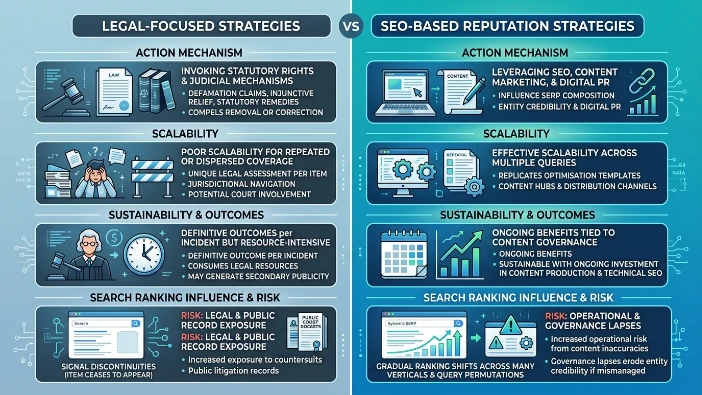
Legal-focused strategies scale poorly for repeated or dispersed negative coverage because each contested item often requires unique legal assessment, jurisdictional navigation, and potential court involvement. SEO-based strategies scale effectively across multiple queries and content types by replicating optimisation templates, content hubs, and distribution channels. In terms of sustainability, legal-focused remedies deliver definitive outcomes per incident but consume legal resources and may generate secondary publicity; SEO-based remedies deliver ongoing benefits tied to content governance and are sustainable with ongoing investment in content production and technical SEO.
Search ranking influence arises differently: legal success produces signal discontinuities—an item ceases to appear—while SEO gains produce gradual ranking shifts across many verticals and query permutations. From a risk perspective, legal actions increase exposure to countersuits and public litigation records; SEO strategies increase operational risk from content inaccuracies and governance lapses that would erode entity credibility if mismanaged.
How do search engines interpret reputation signals from legal removals versus content authority?
Search engines interpret legal removals as external interventions that alter the available indexable content; these actions remove URLs or reduce their visibility, which adjusts SERP composition abruptly. Search engines interpret content authority signals—high-quality backlinks, domain trust, consistent schema, and engagement metrics—as indicators of entity credibility that gradually increase search ranking influence.
Legal removals generate binary signals: a removed item no longer contributes negative sentiment distribution and therefore reduces the negative signal footprint. However, engines also index coverage of the legal action (news articles, legal databases), which can reintroduce reputational signals. Content authority produces continuous signals: relevance, topical depth, and trust signals accumulate to raise the rank of favourable pages. A limitation of relying solely on legal removal is that the engine’s index is susceptible to replicates and third-party archives. A limitation of relying solely on content authority is that high-ranking authoritative pages require sustained editorial quality and technical SEO to maintain ranking.
Protect and strengthen your digital reputation with expert Facebook Content Removal Services designed to reduce harmful visibility and improve entity trust signals in search results. Combining strategic removals with authority-building content helps businesses achieve stronger long-term credibility, higher trust perception, and better SERP control
How can Clear Your Name use UK defamation law to request removal of false online content?
Clear Your Name can initiate a defamation notice under the Defamation Act 2013 to request correction or removal of false statements, then pursue a court injunction or claim if the publisher refuses. This process uses legal remedy, takedown requests, and evidentiary proof of falsity and reputational harm to compel removal.
What evidence is needed to support a removal request under UK defamation law?
Provide documented proof showing the statement is false, demonstrable reputational harm (lost contracts, enquiries, or measurable reputation signals), and the statement’s publication context (URLs, screenshots, timestamps). Courts and platforms evaluate falsity, publication to third parties, and the absence of valid defences such as truth or honest opinion.
How long does it take to remove defamatory content using legal and platform routes?
Platform moderation routes can produce outcomes in days to weeks depending on review complexity, while legal actions under UK defamation law typically take months and possibly over a year if litigation proceeds. Timelines vary with jurisdictional issues, evidentiary preparation, and whether a court injunction or settlement is required.
Can requesting removal under UK defamation law affect search results on Google and Facebook?
Successful legal takedowns or platform removals remove or suppress specific URLs from Google and Facebook, which changes SERP composition and reduces negative visibility. Search engines and platforms also index related legal notices and news coverage, so removal reduces the original negative item but may not eliminate all secondary references.