
Reputation management is the structured monitoring and influence of how information about a person, business, or organisation appears, ranks, and is interpreted in search ecosystems. Online reputation refers to the collection of content signals that define how an entity is perceived when users interact with SERPs, social platforms, and digital archives in the UK and globally.
What a content removal service actually does
A content removal service is a specialised process that analyses, flags, and requests the withdrawal of specific digital content from online platforms, search‑indexed pages, and social media ecosystems. It operates within the editorial and legal frameworks of each publisher, not through direct deletion of data from the underlying web or from search engines themselves.
Mechanically, a content removal service first identifies the URLs and domains where unwanted content resides, then determines the applicable removal pathway: user‑account moderation, platform‑specific reporting tools, or legal‑notice workflows such as privacy‑based requests or defamation‑linked takedown procedures. For each channel, the service aligns the request with the site’s terms of service, data‑protection rules, or relevant statutory provisions, such as the UK’s Data Protection Act or the Online Safety Act, where applicable.
Within search ecosystems, this work primarily reduces the density of negative reputation signals that can reinforce a skewed SERP evaluation of an entity. When materially offensive, inaccurate or unlawfully persistent content is removed, the remaining index signals can shift in distribution, which may alter how algorithms assemble reputation‑related clusters for that person or organisation over time. The impact is not automatic ranking change but a recalibration of the available evidence that search engines reuse to model trust and credibility.
How online reputation is formed in search engines
Online reputation, within search ecosystems, is the aggregate pattern of content signals that algorithms associate with a specific entity or brand. Search engines do not “read” sentiment in a human sense; they infer reputation‑like judgements by evaluating how often, where, and in what context certain entities are mentioned, linked, and cited.
Entity‑centric indexing means that search platforms group mentions of a person or business under a shared identifier, then cross‑reference these references against authority signals such as domain quality, backlink profiles, and engagement metrics. Where a concentration of negative or adversarial content appears on high‑trust sites, that cluster can anchor the SERP’s primary perception of that entity, even if counter‑narrative material exists elsewhere but is less prominent or less linked.
Search engines also treat reviews, legal‑notice timestamps, and user‑generated content as reputation signals, weighting them according to source authority, freshness, and syntactic cues indicating criticism or endorsement. This creates a feedback loop: once a negative evaluation cluster forms, it attracts more linking and sharing, which can further entrench unfavourable perception in SERP evaluation unless the underlying content mix is altered.
What “Facebook content removal services” can realistically achieve
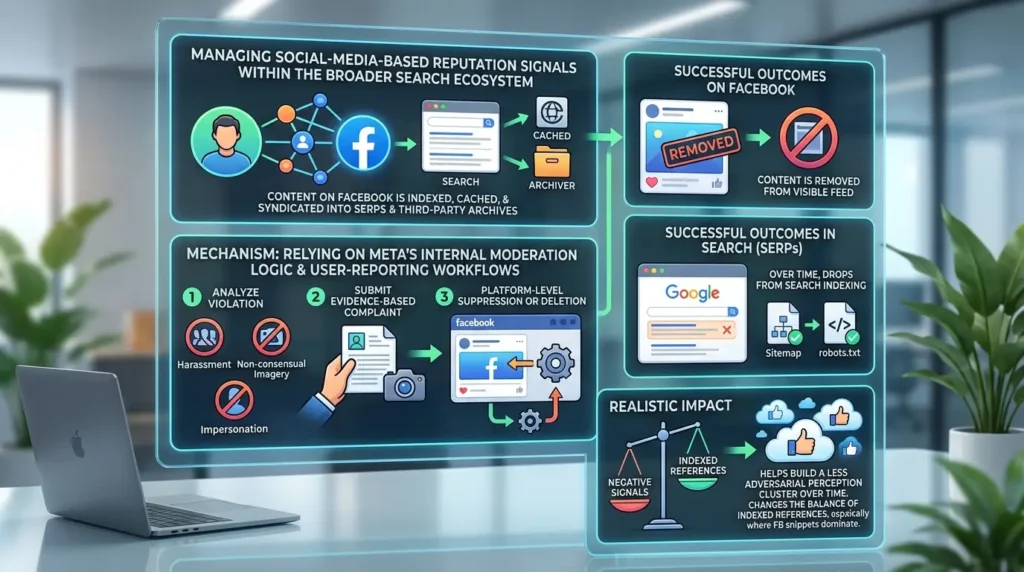
When discussing so‑called “Facebook content removal services”, the macro topic is the management of social‑media‑based reputation signals within the broader search ecosystem. These services focus on content hosted on Facebook, but their effect extends beyond the platform itself because posts, comments, and groups can be indexed, cached, and syndicated into SERPs and third‑party archives.
Mechanically, any Facebook‑related removal effort relies on Meta’s internal moderation logic and user‑reporting workflows rather than wholesale deletion of historical data. Removal requests analyse whether a post or comment violates specific community rules, such as harassment, non‑consensual imagery, or impersonation, then submit evidence‑based complaints that attempt to trigger platform‑level suppression or deletion. If successful, the content is removed from the visible feed and may, over time, drop from search indexing as the platform’s sitemap and robots‑txt signals are updated.
Within search visibility, the practical impact is a reduction in the number of socially‑sourced reputation signals that depict an entity in a negative or contested light. This does not rewrite an entity’s overall reputation but can change the balance of indexed references, especially where Facebook‑generated snippets, author tags, or group discussions dominate the early‑ranking SERP items. Over time, cleaner social‑media footprints can help search engines assemble a less adversarial perception cluster around that entity.
Who actually needs a content removal service
A content removal service is relevant only when unwanted content meaningfully interferes with the SERP‑based perception of an entity or creates demonstrable legal or reputational risk. Need is defined not by discomfort but by measurable misalignment between accurate reality and the prevailing indexed narrative in search ecosystems.
Individuals who may require such a service typically feature in SERPs in contexts that misrepresent their identity, such as mistaken‑for profiles, defamatory posts, or non‑consensual imagery. For businesses, the threshold is when indexed negative reviews, fake listings, or adversarial third‑party articles form a persistent cluster that skews consumer perception, even though those items rely on factual errors, manipulated data, or breaches of platform rules.
In practice, need maps onto three conditions: the content is inaccurate or unlawful, it is indexed and ranked in reputation‑sensitive queries, and it cannot be corrected solely through positive publishing or standard customer‑service channels. Under these conditions, content removal becomes a targeted intervention within reputation management rather than a routine maintenance task.
How content removal affects search visibility and perception

Within reputation management, content removal functions as a boundary‑setting operation on the digital footprint available to search engines. It does not erase the entity from the web but recalibrates the set of documents that algorithms can aggregate into evaluative clusters about trust, reliability, and social sentiment.
Search visibility shifts when high‑impact pages drop from the SERP or are demoted due to their loss of indexing status or content quality signals. When multiple negative items are removed or suppressed, the remaining positive or neutral content can receive relatively higher weighting in entity‑perception models, which can alter the tenor of the SERP’s overall narrative without changing the underlying facts.
However, search engines continuously update their understanding of entities based on new content, links, and engagement, so the effect of removal is not permanent. If no new, credible, voluminous content enters the index to anchor a more balanced perception, search algorithms can re‑surface older or residual references, or construct fresh adversarial clusters from remaining or newly emerged material. This is why removal is one component of a broader reputation‑signal‑management strategy rather than a standalone fix.
How to compare content removal services before you pay anything
When evaluating content removal services, the central question is how each provider defines, locates, and verifies the removal‑eligible content within the wider search ecosystem. A reputable service will map out the current SERP landscape, highlight the specific URLs and domains that contribute to the negative perception cluster, and explain the realistic likelihood of removal on each platform.
Dive Deeper With Our Expert Guides:
What UK Defamation Law Covers When Applied to Online Articles Reviews and Posts
How Instagram Posts Can Damage Your Reputation Even Without Tagging You Directly
Mechanically, a strong comparison exercise involves assessing the proposed workflow: whether the provider starts with an index‑based audit of all relevant domains, then matches each item against platform‑specific policies and jurisdictional rules, rather than relying on generic problem‑statements. For each candidate page, the service should outline the intended removal mechanism (e.g., user‑account deletion, platform moderation, DMCA‑style notice), the evidence required, and the expected processing timeframe.
In terms of reputation impact, the key differentiator is transparency about limitations. A responsible service will state that removal cannot guarantee top‑ranking changes or alterations to how search engines infer entity perception, particularly if other negative or unremovable content remains active. This honest framing aligns with the way search engines interpret signals and prevents misleading expectations about the degree of SERP recalibration achievable.
For deeper insight explore:
How to Compare Content Removal Services Before You Pay Anything
What do Facebook content removal services actually do?
Facebook content removal services identify unwanted or harmful posts, comments, or profiles on Facebook and submit removal requests using Meta’s reporting and moderation tools. They help individuals or businesses reduce damaging content that can affect online reputation and search visibility.
How long does it take to remove content from Facebook?
Removal timelines depend on Meta’s review process, platform complexity, and whether the content violates Facebook’s Community Standards. Many straightforward cases see action within a few days, while contested or legally nuanced items may take longer to resolve.
Can a Facebook content removal service delete search results too?
A Facebook content removal service focuses on removing or suppressing content on Facebook; it does not directly delete search engine results. However, once content is removed from Facebook, it may eventually drop from Google’s index and improve overall search perception over time.
When should someone use Facebook content removal services?
Facebook content removal services are useful when defamatory, harassing, or inaccurate posts damage a person’s or business’s online reputation. They are particularly relevant if the content spreads widely, appears in search results, or is difficult to remove through standard account controls.