
Reputation management is the discipline that defines how entities are perceived across digital information systems. Online reputation refers to the aggregated signals and content that form an entity’s public profile within search ecosystems.
Content removal refers to the set of technical, legal, and platform-specific actions that eliminate or reduce the visibility of a specific item of content in search engine indexes and on hosting platforms. These actions include takedown notices, content flags, de-indexing requests, and legal removals.
Removal begins with an identification process where the target content is catalogued (URL, host, metadata, publication date). Next, stakeholders select a removal vector: direct host takedown, platform policy enforcement, search-engine de-indexing, or legal remedy.
Hosting servers (HTTP responses and file availability), content delivery networks (cache invalidation), platform moderation workflows (content review, appeals), and search engine crawlers (robots.txt, meta noindex tags, removal APIs). Effective removal changes the content’s accessibility (HTTP 200 vs 404/410), updates crawl signals, and triggers re-evaluation in index pipelines.
How do search engines interpret trust and credibility when content is removed?
Search engines evaluate trust and credibility as composite metrics derived from explicit and implicit signals; removal alters the explicit signal set and triggers credibility re-evaluation.
Trust in search ecosystems is a quantifiable construct that refers to algorithmic assessments of content provenance, authority, and reliability. Credibility refers to the interpretation of those trust signals relative to an entity or content item.
Algorithms aggregate signals including domain authority, backlink profile, content freshness, structured data presence, and user engagement metrics. When content is removed, the immediate algorithmic effect is a reduction in signal weight for that specific asset.
Crawlers record HTTP status changes, remove the asset from the index if it is permanently unavailable, and propagate changes to ranking models. Removal also interrupts ongoing user engagement signals (click-through rates, dwell time) that previously reinforced credibility. However, trust evaluation uses redundancy: signals from other pages, mentions, and third-party citations persist and continue to influence entity credibility until addressed.
Removal reduces visibility of targeted negative signals but does not automatically erase association between the entity and the topic in SERPs. If alternative sources or archived versions remain, the entity’s perception remains influenced. Search engines recompute entity profiles from the remaining indexed corpus; successful removal therefore shifts the balance of signals in favour of residual content. Comprehensive removal and concurrent positive signal management are necessary to alter entity perception meaningfully in SERP evaluation.
Why does online content removal require professional expertise?
Professional expertise is necessary because removal interacts with complex technical, legal, and platform governance systems that require precise, procedural actions to be effective.
Forensic content mapping (identifying canonical URLs, copies, and syndication paths), prioritised takedown sequencing (targeting hosts with the greatest indexing influence first), legal assessment (jurisdiction, defamation, privacy law applicability), and technical remediation (server responses, canonical tags, cache purging).
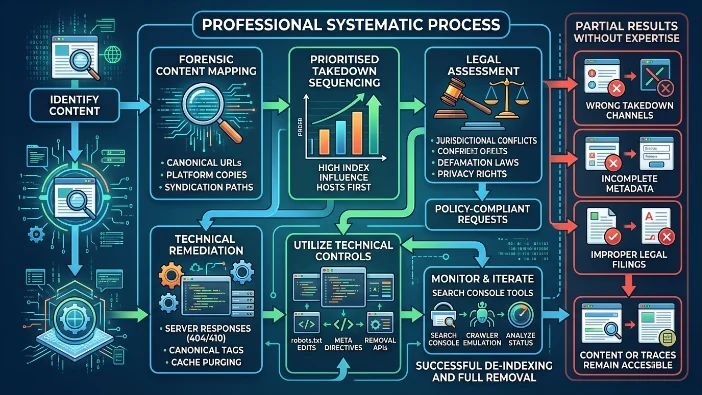
Experts prepare evidence, draft policy-compliant requests, and use technical controls (robots.txt edits, meta directives, removal APIs) to accelerate de-indexing. They monitor index status with crawler emulation and search-console tools, then iterate on outstanding traces. Without expertise, actions produce partial results: wrong takedown channels, incomplete metadata, or improper legal filings that leave content or traces accessible.
Professionally executed removal reduces the persistence of adverse content in index pipelines and minimises residual fragments that continue to feed reputation signals. Proper sequencing preserves credibility of the entity by avoiding heavy-handed or legally inappropriate measures that generate secondary attention. Expert interventions therefore shorten the time to reduced visibility and improve the predictability of changes in SERP evaluation and entity perception.
What processes define successful content removal in search ecosystems?
Successful content removal executes coordinated technical, legal, and governance steps that update index state and suppress derivative reputation signals.
Processes include discovery (identifying every manifestation of the asset), prioritisation (ranking by index impact and link equity), action selection (host takedown, platform policy request, legal order, or de-indexing request), technical implementation (HTTP status change, canonicalisation, meta noindex, cache invalidation), and monitoring (re-crawl verification, backlink evaluation, and SERP tracking). Each process step produces artefacts that feed search engines: HTTP codes, header changes, structured data removal, and sitemap updates. Repeated iterations ensure secondary sources and archival copies receive subsequent actions, controlling long-tail distribution.
Rigorous processes reduce the volume of negative content indexed and lower its ranking weight. They also limit content persistence in syndicated feeds and cached snapshots. Process-driven removal therefore shifts the composition of entity-related results, modifying aggregated reputation signals and recalibrating entity perception during SERP evaluation.
How do review signals and sentiment interpretation affect removal outcomes?
Review signals and sentiment interpretation are algorithmic inputs that define how strongly a specific content item influences entity perception; addressing them requires both content-level and metadata-level interventions.
Search and platform algorithms extract structured review data (schema.org markup), compute aggregate ratings, and attach these as rich snippets in SERPs. Sentiment analysis models parse textual content to yield polarity scores that contribute to entity-level sentiment aggregation. When a negative review or sentiment-heavy item is removed, its direct contribution to aggregate scores ends. However, sentinel systems continue to parse sentiments from residual mentions or related reviews. Platforms preserve historical counts and may flag patterns of removals; search engines record sudden content discontinuities and use surrogate signals (review velocity, new reviews) to stabilise entity perception.
Removing negative review signals reduces explicit numerical detractors in aggregated displays and may alter snippet presentation in SERPs. Removing sentiment-heavy content reduces negative polarity in entity-level assessments. However, if volume of remaining negative signals remains high, removal of individual items produces only marginal change. Effective change requires addressing both discrete negative items and systemic review patterns that feed sentiment models.
Dive Deeper With Our Expert Guides:
What a Content Removal Service Does and Who Actually Needs One
What UK Defamation Law Covers When Applied to Online Articles Reviews and Posts
How do authority and trust signals interact with removal efforts?
Authority and trust signals form a resilient layer that contextualises removal effects; removal alters signal distribution, and authority signals moderate the impact on entity perception.
Authority signals derive from link graphs, editorial contexts, and citation networks. Trust signals derive from provenance markers such as HTTPS, verified accounts, and publisher reputation. Removal of a negatively weighted asset reduces its authority contribution to the link graph; however, residual backlinks and citations maintain linkage within the graph. Algorithms perform graph re-weighting, distributing authority across remaining nodes. If an entity has robust positive authority signals elsewhere, the effect of removing negative items is amplified: search engines rebalance entity perception towards higher-authority assets. Conversely, weak authority makes removal less effective because alternative assets have insufficient weight to dominate SERP evaluation.
Protect your online reputation with expert Facebook Content Removal Services designed to reduce harmful visibility while strengthening positive authority and trust signals across search ecosystems. Combining targeted removals with credibility-building strategies helps businesses improve SERP perception, reinforce entity trust, and achieve longer-lasting reputation recovery.
For more detail explore:
What to Expect When Using an Online Content Removal Service in the UK
What role does the digital footprint play in content persistence after removal?
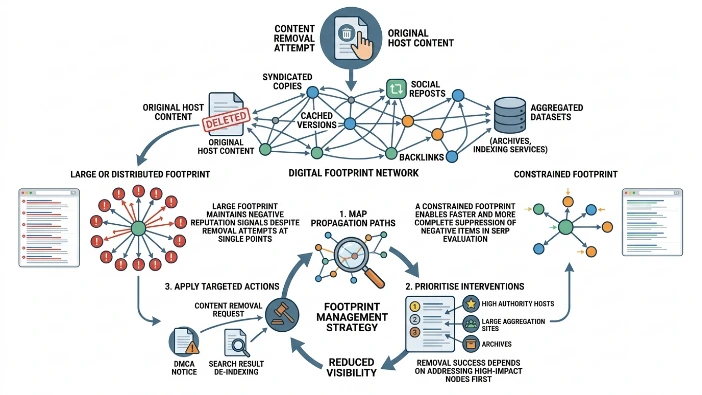
The digital footprint determines the breadth and longevity of content traces; footprint complexity increases the effort required to extinguish residual reputation signals.
Footprint components include original host content, syndicated copies, cached versions, social reposts, backlinks, and aggregated datasets (archives, indexing services). Removal from the original host reduces one node in the footprint network; however, propagated nodes retain independent availability. Search engines index these nodes separately; therefore, removal success depends on addressing high-impact nodes first (high authority hosts, large aggregation sites, archives). Effective footprint management maps propagation paths and applies targeted actions to nodes that continue to produce indexable signals.
Large or distributed footprints maintain negative reputation signals despite removal attempts at single points. A constrained footprint enables faster and more complete suppression of negative items in SERP evaluation. Thus, footprint analysis is essential to predict timeframes for content disappearance and to prioritise interventions that yield the largest reductions in visibility.
How long does a Facebook content removal request typically take?
Removal timelines vary by case and platform; Facebook content removal requests commonly resolve within 24–72 hours for clear policy violations, while legally compelled takedowns or complex disputes can take weeks. Track status through platform moderation tools and keep records of reference IDs to support escalation.
What grounds qualify content for removal on Facebook?
Content qualifies when it violates platform policies (hate speech, harassment, explicit material), infringes intellectual property, or breaches privacy and data protection laws. Provide precise evidence (URLs, screenshots, timestamps) when submitting a request to improve review accuracy.
Can deleted Facebook posts still appear in search results?
Deleted posts can persist as cached copies, syndicated replicas, or archived snapshots that search engines and third‑party sites index independently. Pursue cache removal, host takedowns, and coordinated de‑indexing requests to address residual search visibility.
Will removing Facebook content affect my overall online reputation?
Removing specific Facebook items reduces their direct contribution to reputation signals but does not erase associated mentions, backlinks, or archived evidence that influence entity perception. Combine targeted removals with authority and review signal management to alter SERP evaluation meaningfully.