

Reputation management is the practice of monitoring, shaping, and remediating an entity’s visible information across digital channels. Online reputation refers to the aggregate of content, signals, and interpretations about an entity within search ecosystems that influence search visibility and entity perception.
A hosting location is the physical or jurisdictional place where content files, databases, or service infrastructure reside and where the provider is legally incorporated. Jurisdiction defines applicable law, notice-and-take-down procedures, and the authority required to issue content removal orders.
Content on servers within a jurisdiction is subject to that jurisdiction’s statutes, intermediary liability frameworks, and court orders. Content distributed via content delivery networks (CDNs) or cached by search engines invokes additional technical layers—origin server removal does not automatically remove cached copies or aggregated index entries.
Search visibility changes when hosting location mechanisms execute removal: de-indexing requests reduce indexed URLs, HTTP responses change (e.g., 404, 410, 451), and search engines update SERP evaluation based on freshness and canonical signals. If the origin content remains accessible in another jurisdiction or via caches, entity perception persists in SERPs despite action at the origin.
How does search indexing affect the persistence of content?
Search indexing is the process where search engines crawl, parse, and store representations of web pages and associated metadata for retrieval in SERPs.
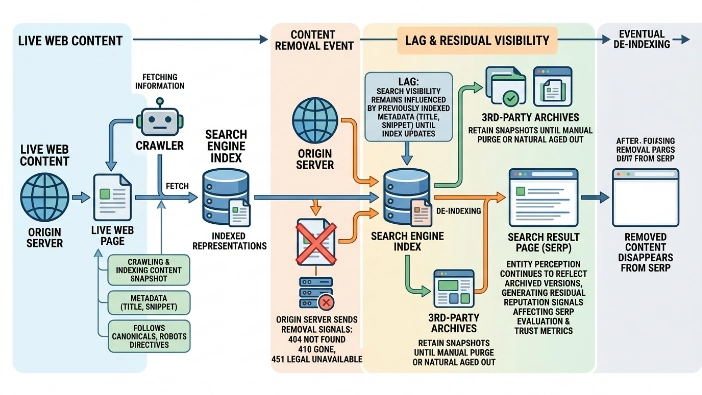
Crawlers fetch URLs, read HTTP headers, follow canonical tags and robots directives, and record content snapshots. When origin servers return removal signals (404: not found, 410: gone, or 451: unavailable for legal reasons), crawlers mark entries for de-indexing. However, cached copies and third-party archives retain snapshots until manually purged or naturally aged out.
Index persistence creates lag between content removal and SERP disappearance. Search visibility remains influenced by previously indexed metadata (title, snippet, structured data) until indexing cycles update. Entity perception continues to reflect archived or cached versions, generating residual reputation signals that affect SERP evaluation and trust metrics.
Which legal mechanisms enable content removal based on hosting jurisdiction?
Legal mechanisms are statutory or case-law processes that compel hosting providers or intermediaries to remove or restrict access to content.
In some jurisdictions, claimants obtain court injunctions requiring hosts to delete content or block access. Intermediary liability frameworks assign responsibilities to hosts upon receiving lawful notices. Statutory takedown procedures enable administrative requests for removal for specific categories (defamation, privacy, copyright, hate speech). Cross-border enforcement introduces mutual legal assistance treaties or order domestication requirements.
Legal removal orders produce authoritative signals for platforms and search engines to remove or demote URLs. When search engines receive validated legal signals (e.g., 451 status or verified court order), they adjust indexing and snippet visibility, altering entity perception and SERP evaluation. Conversely, unresolved jurisdictional conflicts maintain content availability and negative reputation signals.
Which technical methods remove or suppress content depending on hosting type?
Technical methods are configuration or platform-level actions that change content accessibility or indexing behaviour.
Impact on search visibility: Each technical method generates differing index responses and SERP outcomes. A 410 accelerates de-indexing, noindex actively removes from index during next crawl, and robots.txt prevents crawling but may not remove existing index entries until reprocessed. Cache purges reduce cached snippets and influence snippet-based reputation signals.
Which methods are most effective for removing content from the internet?
Effectiveness is the degree to which a method removes live content, cached copies, and indexed references across search ecosystems.
Secure a lawful order when applicable, then execute origin deletion to issue definitive HTTP statuses (410). Immediately purge CDN and platform caches, submit URL removal requests to search engine webmaster tools, and apply meta robots noindex or canonicalisation to remaining equivalents. For third-party archives and aggregators, submit formal takedown notices per their policies or obtain court-ordered removal.
Impact on search visibility: A layered approach addresses live content, cached snapshots, and indexed references thereby reducing search visibility, weakening negative reputation signals, and altering entity perception. Without origin-level action, suppression via search-only requests yields temporary index suppression while underlying content continues to generate reputation signals through direct access or redistribution.
How do platform types (social networks, forums, hosting providers) change removal strategies?
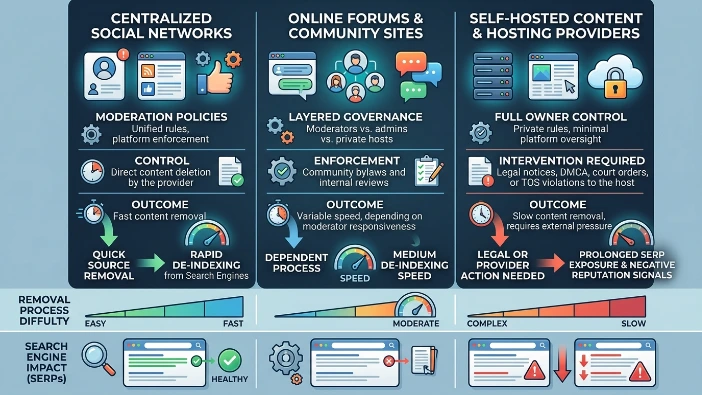
Platform type categorises services by governance model, moderation controls, and hosting architecture. Centralised platforms can expedite de-indexing when content removal occurs at source; however, platform moderation policies determine thresholds for action, affecting frequency and speed. Self-hosted content requires legal or hosting-provider intervention, which prolongs exposure and maintains negative reputation signals in SERPs until resolved.
Dive Deeper With Our Expert Guides:
How a Content Removal Agency Approaches Cases That Individuals Cannot Resolve Alone
What Negative Content Removal Covers and the Platforms It Applies To
How do review signals and sentiment interpretation influence reputation after removal?
Review signals are structured and unstructured feedback items (ratings, textual reviews) that search ecosystems parse for relevance and sentiment analysis.
Search engines and reputation systems aggregate review data from multiple sources, perform sentiment analysis, and factor results into entity reputation scoring and snippet generation. Removal of one review reduces weighted influence but does not nullify cumulative sentiment if other sources remain. Algorithms evaluate recency, diversity, and authority of reviews; historical reviews continue to influence entity perception until replaced by new, authoritative signals.
Strengthen online reputation with professional Facebook Content Removal Services that help reduce the impact of damaging reviews and negative sentiment signals across digital platforms. Combining content removal with reputation management strategies helps businesses improve entity credibility, enhance SERP perception, and reinforce long-term trust.
How do authority and trust signals interact with removed content?
Authority signals are indicators of source credibility (backlinks, domain age, structured data), while trust signals refer to verifiable attributes (secure connections, publisher reputation) within search ecosystems.
Algorithms weigh authority and trust alongside content relevance. Content from high-authority domains retains higher indexing priority and persistent SERP presence; removal from high-authority hosts triggers broader ripple effects across aggregated indexes. Trust signals influence the threshold for downgrading content; content lacking trust markers is more likely to be suppressed by ranking algorithms even without formal removal.
When removed content originates from authoritative hosts, residual links and archived copies maintain visibility and contribute to entity perception. Conversely, content removal from low-trust sources produces quicker reductions in reputation signals. Strategic manipulation of authority and trust signals by updating canonical sources and structured data accelerates SERP recovery after removal.
Content removal effectiveness depends on hosting location, search indexing behaviour, legal frameworks, technical controls, platform governance, review aggregation, and authority signals. Reputation management in search ecosystems requires precise interventions at origin servers, coordinated cache and index purges, and legal validation when jurisdiction demands. Entity perception in SERPs evolves as removal signals propagate through crawlers and reputation algorithms; comprehensive approaches that address origin, caches, and aggregated signals reduce search visibility and alter long-term reputation signals.
Learn More Here:
Which Methods Are Most Effective for Removing Content From the Internet
FAQs About Facebook Content Removal Services
How do I remove personal content from Facebook?
To remove personal content from Facebook, use the platform’s built-in reporting tools or adjust privacy settings to restrict visibility. For persistent or harmful content, Clear Your Name offers Facebook content removal services that guide users through formal reporting and legal takedown pathways.
Can Facebook remove content that violates their policies?
Yes, Facebook removes content that violates its Community Standards, including hate speech, harassment, or misinformation. Users can report violating posts directly, and Clear Your Name helps escalate complex cases through Facebook content removal services for faster review and action.
How long does it take to remove content from Facebook?
Removal timelines vary: Facebook typically reviews reports within 24–48 hours, but complex cases may take longer. Clear Your Name’s Facebook content removal services expedite the process by submitting properly documented reports and following up with platform moderators.
What types of Facebook content can be removed?
Facebook allows removal of content including defamatory posts, unauthorized photos, doxxing information, impersonation accounts, and non-consensual intimate imagery. Clear Your Name specializes in Facebook content removal services for sensitive reputation-damaging material that meets platform or legal removal criteria.