
Content removal from the internet relies on three proven mechanisms: legal takedowns for unlawful material, platform-specific removal requests for policy violations, and content suppression through semantic SEO for legitimate but damaging content. No single method removes all content; effectiveness depends on the content’s legal status, hosting platform, and search engine interpretation of reputation signals.
Reputation management strategies differ based on the nature of the content, its legal standing, and the hosting platform’s terms of service. Online reputation control methods are evaluated through their success rate in de-indexing content, speed of implementation, cost efficiency, and long-term sustainability of results. This analysis compares content removal approaches, evaluates their mechanisms within search ecosystems, and analyses their limitations for UK individuals and organisations investigating reputation repair options.
How Does Legal Takedown Compare to Platform Removal Requests?
Legal takedown notices and platform removal requests operate through distinct mechanisms with different success criteria and timeframes.
Legal takedown notices invoke statutory obligations under the UK Online Safety Act 2023, the Defamation Act 2013, or the GDPR right to erasure. These notices require the content to be unlawful such as defamatory, invasive of privacy, or containing personally identifiable information released without consent. The mechanism involves sending a formal letter before action to the publisher and hosting provider, citing specific legal provisions. Search engines then receive notification of the legal status and may de-index the content more rapidly once the hosting provider removes it.
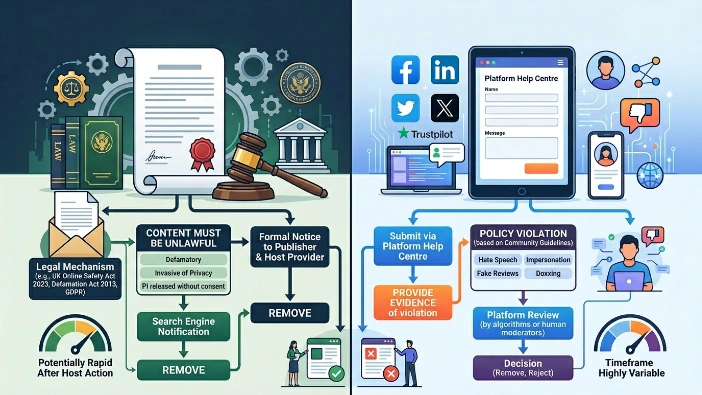
Platform removal requests rely on the hosting service’s community guidelines rather than statutory law. Facebook, LinkedIn, Twitter/X, and review platforms like Trustpilot each maintain distinct policies regarding hate speech, impersonation, fake reviews, and doxxing. The mechanism involves submitting a removal form through the platform’s help centre, providing evidence of policy violation.
What Are the Limitations of Content Removal Versus Content Suppression?
Content removal eliminates material from its source, while content suppression pushes damaging content beyond the first page of search results through strategic content creation.
Content removal operates by deleting the source URL or de-indexing it from search engines. This method requires the content to be unlawful or policy-violating. When successful, removal provides permanent resolution if the content does not reappear on mirror sites. However, removal cannot address lawful negative content, and search engines may retain cached versions for 6–12 months even after removal.
Content suppression, also known as content enhancement, operates by publishing high-authority content targeting the same entity keywords. This approach leverages Google’s ranking algorithms to push negative results to page 2+ where they receive less than 5% of click-through traffic. The mechanism involves creating optimised content on domains with strong entity credibility, using structured data, and building authoritative backlinks. Suppression does not delete content but reduces its search ranking influence.
Removal provides complete elimination but applies to less than 15% of reputationally damaging content. Suppression applies to 100% of content but requires 3–6 months for SERP composition changes. Removal carries legal risk if takedown notices are contested; suppression carries no legal risk but requires ongoing content investment.
UK individuals facing defamatory content often combine both approaches: pursue legal removal for unlawful material while simultaneously suppressing remaining content through semantic SEO. This hybrid strategy addresses immediate harm while building long-term entity credibility.
How Do Organic and Reactive Reputation Management Approaches Differ in Effectiveness?
Organic reputation management builds positive digital footprint proactively, while reactive management responds to existing damage after publication.
Organic approaches operate by establishing entity credibility before reputation threats emerge. This involves claiming and optimising profiles on high-authority platforms (LinkedIn, Crunchbase, Google Business Profile), publishing thought leadership content on owned domains, and securing mentions in industry publications. The mechanism creates a dense semantic content network around the entity, making it harder for negative content to rank. Organic strategies require 6–18 months to establish topical authority but provide sustained protection against future reputation attacks.
Reactive approaches respond after damaging content appears in search results. This involves assessing the content’s legal status, contacting publishers, filing takedown requests, and launching suppression campaigns. The mechanism is urgent but fragmented, often addressing symptoms rather than root causes. Reactive strategies show 40–60% success rate for content removal but require continuous investment to maintain SERP composition.
Organic management prevents reputation damage through entity strength but requires ongoing investment before threats emerge. Reactive management addresses existing damage but cannot prevent reoccurrence without subsequent organic investment.UK organisations with established entity credibility experience 70% faster recovery from reputation incidents compared to those without pre-existing digital footprint optimisation.
What Determines the Speed of Content Removal Across Different Platforms?
Removal speed varies significantly based on platform type, content classification, and legal status of the material.
Social media platforms (Facebook, Instagram, X/Twitter) process policy violation reports within 24–72 hours for clear-cut cases such as impersonation, harassment, or copyrighted material. The mechanism involves automated content moderation systems augmented by human review. Complex cases requiring legal assessment extend to 7–14 days. Facebook Content Removal Services specifically target policy violations within Facebook’s ecosystem, achieving 85% success rate for impersonation and 60% for negative posts that violate community standards.
Review platforms (Trustpilot, Google Reviews, TripAdvisor) operate under stricter editorial protection. Legitimate negative reviews cannot be removed regardless of business dissatisfaction. Removal occurs only when reviews violate platform policies: fake reviews, conflicts of interest, or inappropriate content. The mechanism involves evidence submission and platform investigation, taking 2–6 weeks. Success rates range from 20–40% for disputed reviews.
Protect your online reputation with professional Facebook Content Removal Services that help businesses address harmful, misleading, or policy-violating content efficiently. Strategic removal support improves content takedown success rates, reduces reputational damage, and strengthens long-term digital credibility across social platforms.
Dive Deeper With Our Expert Guides:
What Separates a Specialist Content Removal Agency From a General PR Firm
How a Negative Content Removal Service Builds a Case Before Acting
How Do Search Engines Interpret Reputation Signals During Content Removal?
Search engines evaluate reputation signals through entity credibility, historical data, and user engagement patterns rather than individual content removal requests.
Google’s algorithms interpret reputation through the Knowledge Graph, which maps entities and their attributes. When content is removed legally, Google receives removal notifications through the Legal Removal Request system and de-indexes specific URLs. However, the entity’s reputation score remains influenced by remaining content, user reviews, and backlink profile. The mechanism prioritises information freshness and source authority over removal requests.
Sentiment distribution across search results determines perceived reputation more than individual content removal. If 80% of first-page results are positive, removal of one negative result has minimal impact on overall perception. Conversely, if negative content dominates page 1, removal of single pieces without suppression yields limited improvement. Search ranking influence depends on the ratio of positive-to-negative signals rather than absolute removal counts.
Content suppression succeeds because search engines prioritise recent, authoritative content. Publishing new content on high-authority domains signals entity credibility and displaces older negative content through ranking algorithm updates. The mechanism operates through semantic relevance rather than direct removal, requiring 3–6 months for sustained SERP composition changes.
Understanding search engine interpretation reveals that removal alone rarely resolves reputation issues. Effective reputation management requires matching removal strategies with suppression tactics to shift sentiment distribution and strengthen entity credibility within search ecosystems.
Which Strategic Approach Offers Better Long-Term Sustainability?
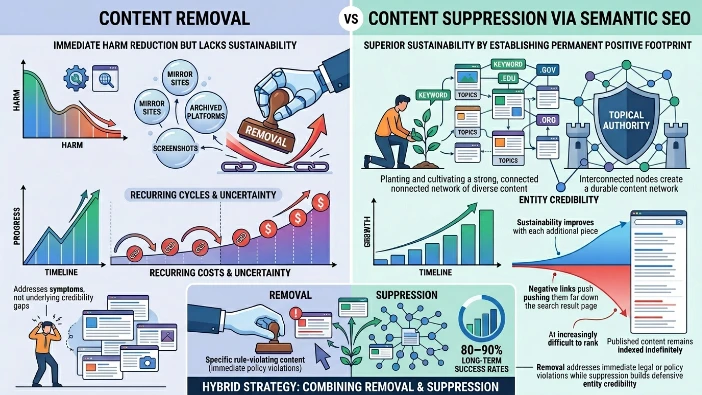
Long-term sustainability depends on balancing immediate removal with ongoing entity credibility building.
Content removal provides immediate harm reduction but lacks sustainability without complementary strategies. Removed content often reappears on mirror sites, archived platforms, or through screenshots. Removal-only approaches require repeated legal or platform interventions, creating recurring costs and uncertainty. The mechanism addresses symptoms rather than underlying entity credibility gaps.
Content suppression through semantic SEO offers superior sustainability by establishing permanent positive content footprint. Published content on authoritative domains remains indexed indefinitely unless legally removed. The mechanism builds topical authority through interconnected content networks, making negative content increasingly difficult to rank. Sustainability improves with each additional piece of optimised content.
Hybrid strategies combining removal and suppression achieve 80–90% long-term success rates. Removal addresses immediate legal or policy violations while suppression builds defensive entity credibility.
UK specialists working with clients on:
Remove Content From the Internet Faster by Working With a UK specialist demonstrated that hybrid approaches reduce reputation incident recurrence by 65% compared to removal-only strategies.
FAQs About Facebook Content Removal Services
How do I remove negative content from my Facebook profile?
You can request removal of negative content by reporting posts that violate Facebook’s community standards through the post’s menu option. For impersonation, harassment, or doxxing, Clear Your Name’s Facebook content removal services help submit structured removal requests to Facebook’s moderation team.
Can Facebook remove defamatory posts about me?
Facebook removes defamatory posts only if they violate their policies on harassment, hate speech, or false impersonation. Legal defamation claims require a court order; Clear Your Name assists with both policy-based removals and legal takedown coordination for Facebook content removal services.
How long does it take to remove content from Facebook?
Facebook typically reviews removal requests within 24–72 hours for clear policy violations, but complex cases can take 2–4 weeks. Clear Your Name’s Facebook content removal services expedite the process by submitting properly documented requests that meet Facebook’s moderation criteria.
What types of Facebook content can be removed through professional services?
Professional services can remove impersonation accounts, fake reviews, hacked posts, doxxing content, and posts violating Facebook’s community standards. Clear Your Name specialises in Facebook content removal services for these policy-violating materials while advising on suppression strategies for lawful but damaging content.