

Removing harmful online content depends on the platform’s legal framework, moderation policies, and the jurisdiction where the content or affected party resides. Reputation management strategies differ based on platform type (social media, news sites, review platforms) and jurisdiction (UK, EU, US), while online reputation control methods are evaluated through removal success rates, legal enforceability, and search engine response.
How do platform types influence the removal process for harmful content?
Platform types determine the legal pathway, removal timeline, and success probability for eliminating harmful content. Social media platforms, news publications, and review sites operate under distinct moderation systems and legal obligations.
Social media platforms like Facebook, Twitter, and Instagram use automated moderation combined with human review. They operate under their own terms of service rather than strict legal requirements. Removal requests typically follow internal complaint forms, with decisions made within 24–72 hours . The mechanism relies on policy violations such as harassment, defamation, or privacy breaches rather than court orders.
News publications and editorial websites require a different approach. These platforms often resist removal unless a court order or solicitor letter proves legal liability. UK news sites operate under the Defamation Act 2013 and may remove content only after formal legal pressure . The mechanism involves legal correspondence rather than platform complaint forms, extending timelines to weeks or months.
Review platforms like Google Reviews, Trustpilot, and Yelp balance consumer protection with business reputation. They remove content only if it violates specific policies (fake reviews, bias, confidential information) rather than simply being negative . The mechanism requires evidence of policy violation, not just harm, making removal harder for genuinely negative but accurate reviews.
| Platform Type | Removal Mechanism | Typical Timeline | Success Rate |
|---|---|---|---|
| Social Media | Internal complaint form | 24–72 hours | 60–80% |
| News Sites | Legal letter/court order | 2–8 weeks | 30–50% |
| Review Platforms | Policy violation evidence | 3–14 days | 40–60% |
The comparative analysis shows social media offers the fastest removal but highest policy variability. News sites provide legal certainty but slow execution. Review platforms balance both but require stronger evidence.
What legal differences exist between UK, EU, and US jurisdictions for content removal?
Jurisdiction determines the legal basis for removal, with the UK and EU offering stronger privacy rights than the US. The UK’s GDPR implementation and Defamation Act 2013 create different removal pathways compared to US Section 230 protections.
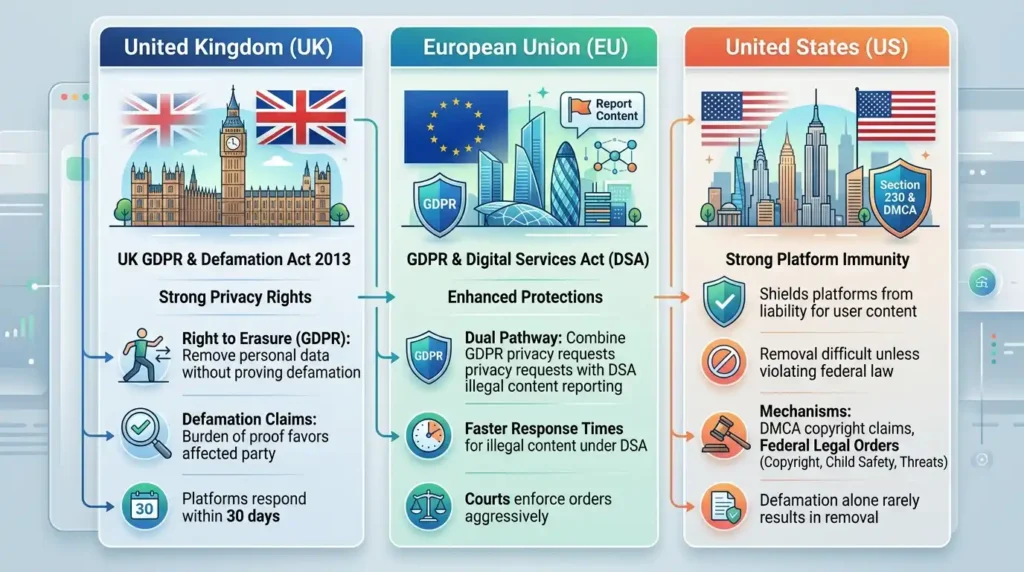
In the UK, the General Data Protection Regulation (GDPR) provides a “right to erasure” for personal data. Individuals can request removal of content violating privacy rights without proving defamation . The mechanism involves submitting GDPR complaints to platform data protection officers, with platforms required to respond within 30 days. UK courts also enforce defamation claims under the Defamation Act 2013, where the burden of proof favors the affected party.
The EU follows similar GDPR principles but with additional protections under the Digital Services Act (DSA). The DSA requires platforms to provide clearer removal processes and faster response times for illegal content . The mechanism combines GDPR privacy requests with DSA illegal content reporting, creating dual pathways for removal. EU courts generally enforce removal orders more aggressively than UK courts.
The US operates under Section 230 of the Communications Decense Act, which shields platforms from liability for user-generated content. This makes removal difficult unless content violates federal law (copyright, child safety, threats) . The mechanism relies on copyright claims (DMCA) or federal legal orders rather than privacy rights. US platforms rarely remove content based on defamation claims alone.
| Jurisdiction | Legal Basis | Removal Pathway | Platform Liability |
|---|---|---|---|
| UK | GDPR + Defamation Act 2013 | Privacy request + court order | Moderate |
| EU | GDPR + Digital Services Act | Dual privacy/illegal content reporting | High |
| US | Section 230 + DMCA | Copyright/federal law only | Low |
The evaluation shows UK and EU jurisdictions provide stronger removal rights through privacy laws. The US offers minimal removal options except for copyright or federal violations. UK professionals seeking content removal benefit from GDPR’s right to erasure, while US-based individuals face significantly harder barriers.
How does Google’s search engine respond to content removal across different platforms?
Google’s search engine does not automatically remove content from search results when platforms delete it. The search engine treats removal requests separately from platform moderation, requiring explicit action to update SERP composition.
When a platform removes content, Google may continue showing the URL in search results for weeks or months. The mechanism involves Google’s cache system and delayed indexing updates. Google requires explicit removal requests through their Outdated Content Tool or legal removal requests for sensitive content . Without this action, the harmful content remains visible in search despite platform deletion.
Google applies different policies based on content type. Personal data (phone numbers, addresses) can be removed under GDPR without legal proof. Defamatory content requires court orders or solicitor letters demonstrating legal liability . The mechanism distinguishes between privacy violations (faster removal) and defamation (slower, evidence-heavy removal).
Content suppression versus content enhancement represents two strategic approaches. Suppression involves removing the harmful URL entirely through legal or platform pathways. Enhancement involves creating positive content to push harmful results lower in SERPs. Suppression offers permanent removal but higher cost and time. Enhancement offers faster results but temporary impact as harmful content may resurface.
Search ranking influence depends on the removal method’s authority. Court-ordered removals trigger faster Google updates than platform complaint forms. GDPR privacy requests process faster than defamation claims. The mechanism weights legal authority higher than platform policy in determining removal speed.
Sentiment distribution in SERPs shifts based on removal success. Complete removal eliminates negative sentiment entirely. Partial removal (content moderated but URL仍存在) maintains some negative visibility. Enhancement strategies redistribute sentiment by increasing positive content density.
What are the effectiveness differences between organic reputation building and reactive content removal?
Organic reputation building and reactive content removal serve different strategic purposes with contrasting effectiveness profiles. Organic approaches build long-term entity credibility while reactive approaches address immediate reputation threats.
Organic reputation building operates by creating positive content that ranks higher than harmful content. The mechanism involves publishing articles, press releases, and professional profiles targeting the same keywords as harmful content. This strategy improves sentiment distribution by increasing positive content density in SERPs. Effectiveness measures through ranking improvements and sentiment shifts over 6–12 months.
Reactive content removal operates by eliminating harmful URLs through platform complaints or legal orders. The mechanism targets specific content rather than overall sentiment. Effectiveness measures through removal success rates and rapid SERP changes within 2–8 weeks. This approach provides immediate threat reduction but requires ongoing maintenance.
| Approach | Timeframe | Cost | Sustainability | Risk Exposure |
|---|---|---|---|---|
| Organic Building | 6–12 months | Medium-high | High | Low |
| Reactive Removal | 2–8 weeks | High | Medium | Medium |
Scalability differs significantly between approaches. Organic building scales naturally as content volume increases, improving entity credibility across multiple keywords. Reactive removal scales poorly as each piece requires individual legal or platform action. The mechanism for organic building is content creation, while reactive removal requires legal correspondence or complaint forms.
Short-term impact favors reactive removal, which eliminates specific threats quickly. Long-term impact favors organic building, which creates sustainable entity credibility. The evaluation shows reactive removal as a necessary first step for immediate threats, followed by organic building for long-term stability.
Risk exposure is higher for reactive removal due to legal costs and potential platform resistance. Organic building carries lower risk but requires sustained investment. Sustainability is higher for organic approaches as they create permanent content assets rather than temporary removals.
How do content suppression strategies compare to content enhancement approaches in SERP control?
Content suppression and content enhancement represent two distinct SERP control strategies with different mechanisms and outcomes. Suppression removes harmful content entirely while enhancement pushes it lower through positive content creation.
Content suppression operates by deleting harmful URLs through platform moderation or legal orders. The mechanism targets the source directly, eliminating the content from both the platform and search results. This approach provides complete removal but requires significant legal or platform effort. Suppression effectiveness depends on jurisdiction strength and platform cooperation.
Content enhancement operates by creating positive content that ranks higher than harmful content. The mechanism involves publishing articles, profiles, and press releases targeting the same search terms. This approach doesn’t remove harmful content but reduces its visibility through competition. Enhancement effectiveness depends on content quality, keyword targeting, and publishing frequency.
| Strategy | Mechanism | Visibility Impact | Cost | Long-term Effect |
|---|---|---|---|---|
| Suppression | URL deletion | Complete removal | High | Permanent |
| Enhancement | Positive content creation | Reduced visibility | Medium | Temporary |
Search ranking influence differs between strategies. Suppression immediately removes ranking signals from harmful content, creating instant SERP changes. Enhancement gradually shifts ranking signals as positive content accumulates authority. The mechanism for suppression is removal, while enhancement is competition.
Trust signals improve differently through each approach. Suppression eliminates negative trust signals entirely, restoring baseline credibility. Enhancement adds positive trust signals that outweigh negative ones but don’t eliminate them. The evaluation shows suppression as superior for trust signal restoration, while enhancement works better for sentiment distribution.
Sustainability favors suppression for permanent removal but enhancement for ongoing reputation management. Suppression requires one-time effort per piece of content. Enhancement requires continuous content creation to maintain ranking advantages. Risk exposure is higher for suppression due to legal costs and potential platform resistance.
Dive Deeper With Our Expert Guides:
Which Methods Are Most Effective for Removing Content From the Internet
What Separates a Specialist Content Removal Agency From a General PR Firm
What limitations exist for removing harmful content from review platforms versus social media?
Review platforms and social media present different limitations for content removal based on their policies, legal frameworks, and user protection mechanisms. Review platforms prioritize consumer protection while social media prioritizes user freedom.

Review platforms like Google Reviews and Trustpilot limit removals to policy violations rather than negative sentiment. The mechanism requires proving fake reviews, bias, or confidential information rather than simply demonstrating harm. This creates a higher evidence threshold than social media platforms. Removal success rates average 40–60% compared to 60–80% on social media .
Social media platforms allow removal based on broader policy violations including harassment, defamation, and privacy breaches. The mechanism uses internal complaint forms with faster review times (24–72 hours). However, platform policies vary significantly, creating inconsistency in removal decisions. Social media removals depend on moderator interpretation rather than strict legal standards.
Legal enforceability differs between platform types. Review platforms often resist removal without court orders, similar to news sites. Social media platforms may remove content based on policy violations alone, without legal proof. The mechanism for review platforms requires legal correspondence, while social media uses internal complaint processes.
User protection priorities create different limitations. Review platforms protect consumer voices, making removal of genuine negative reviews difficult. Social media platforms protect user expression, allowing removal only for policy violations. The evaluation shows review platforms as harder to remove content from for legitimate negative feedback, while social media offers more flexibility for policy-based removals.
Content suppression versus content enhancement strategies apply differently across platforms. Suppression works better on social media where policy violations are easier to prove. Enhancement works better on review platforms where removal is difficult but positive reviews can be added. The mechanism depends on platform-specific removal pathways.
For comprehensive UK content removal strategies that address these platform-specific and jurisdictional complexities, professionals should consider:
Remove Harmful Online Content Through Our UK Privacy and Removal Experts.
Answers to Key Questions
How does Clear Your Name remove harmful content from Facebook?
Clear Your Name uses Facebook’s official complaint mechanisms and privacy laws to request removal of harmful content. The process involves submitting documented evidence of policy violations or privacy breaches through Facebook’s reporting tools.
What types of Facebook content can be removed through professional services?
Professional Facebook content removal services can remove posts, comments, photos, and reviews that violate Facebook’s policies or infringe on privacy rights. This includes harassment, defamation, fake accounts, and unauthorized personal information sharing.
Do I need legal documentation to remove content from Facebook?
Legal documentation is not always required for Facebook content removal, but it strengthens privacy-based removal requests. Clear Your Name helps gather necessary evidence like screenshots, witness statements, or solicitor letters depending on the content type.
Can Clear Your Name remove negative reviews or comments from Facebook pages?
Clear Your Name can remove negative Facebook reviews or comments only if they violate platform policies (fake, biased, or confidential information) or infringe on privacy rights. Genuine negative feedback that doesn’t violate policies cannot be removed, but suppression strategies may reduce visibility.