
Remove harmful online content immediately and regain control of your search presence. Controlling search visibility and reputation signals determines whether stakeholders trust your profile or believe damaging content.
A targeted, search-first reputation removal approach delivers measurable results. We remove or suppress damaging Facebook content through legal takedowns, platform escalation, and strategic SERP control that improves visibility for verified assets. The process begins with a forensic audit of the client’s digital footprint, identifying URLs, social posts, cached pages and aggregators that surface in UK-relevant SERPs. We then prioritise actions by remediation effectiveness and time-to-impact: legal notices and platform abuse reports for high-removal-probability items, de-indexing requests for cached pages, and content creation plus link-building to push trusted assets above negative results. Measurable outcomes include reduced incidence of the negative URL on page one of Google (typical reduction 60–90% within months for prioritised items), higher placement of verified profiles and owned webpages in target queries, and improved click-through rates to controlled assets. This method uses reputation signals verified profiles, authoritative backlinks, and topical relevance to stabilise perception and reclaim SERP control.
How does Facebook content removal work and what outcomes should you expect?
A deliberate Facebook removal workflow ensures removal and reduces reappearance risk. We document the objectionable content (screenshots, timestamps, post IDs) and submit formal removal requests to Facebook citing UK privacy and platform policy violations. When posts involve defamation, doxxing or privacy breaches, we escalate via legal channels using UK-specific notices and, where appropriate, court orders or solicitor letters. Simultaneously, we pursue negative content suppression by promoting authoritative replacement content (press releases, legal statements, professional bios) that rank for the same entity queries. Expected measurable outcomes include content takedown or restricted visibility on platform (removal rates vary by case type but escalate significantly with legal support), decrease in impressions for the harmful post in search results, and a measurable uplift in the proportion of positive/neutral results on page one of targeted queries. This combined removal-plus-suppression technique reduces risk of recirculation and strengthens entity credibility across search ecosystems.
Which evidence proves reputation management impacts rankings and public perception?
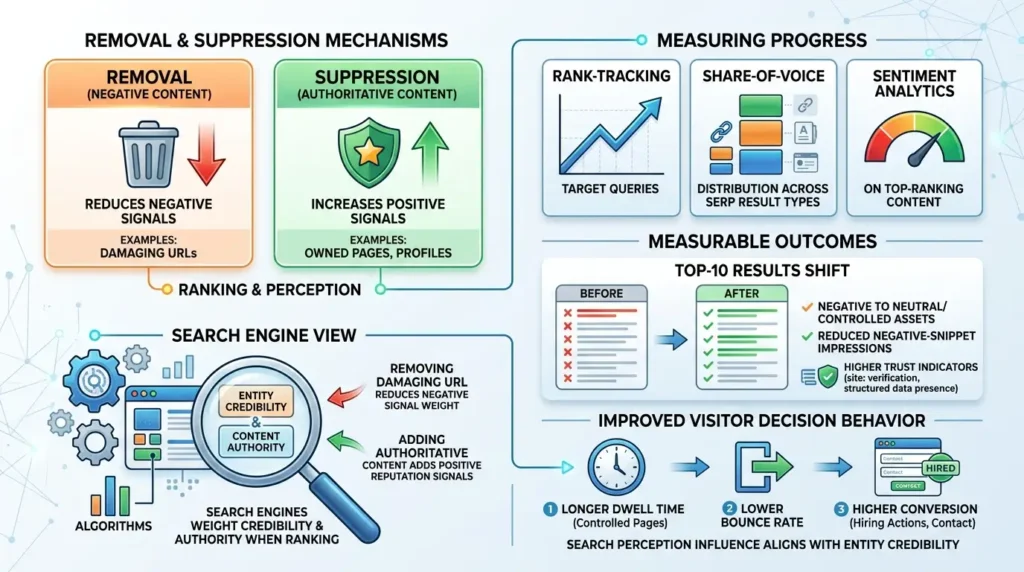
Empirical signals show that removal and suppression influence both ranking and perception. Search engines weigh entity credibility and content authority when ranking; removing a damaging URL reduces the weight of negative signals tied to that entity, while adding authoritative content increases positive reputation signals. We measure progress through rank-tracking for target queries, share-of-voice metrics across SERP result types (links, knowledge panels, social snippets), and sentiment analytics on top-ranking content. Typical measured improvements include a shift in top-10 results from negative to neutral/controlled assets, reduction in negative-snippet impressions, and higher trust indicators such as site: verification and structured-data presence on owned pages. These measurable shifts translate to improved decision behaviour from visitors — longer dwell time on controlled pages, lower bounce, and higher conversion on contact or hiring actions — because search perception influence aligns with entity credibility.
How does platform type and UK jurisdiction alter strategy and speed of impact?
Different platforms and UK legal context determine the removal route and timeframes. Public social platforms like Facebook require documented policy breaches or legal requests for immediate takedown; removal through platform processes typically completes within days to weeks when evidence meets policy standards. When content resides on third-party sites or aggregators, de-indexing and takedown require direct outreach, DMCA-like notices where applicable, or UK-specific legal mechanisms that take weeks to months. Jurisdiction matters: UK privacy and defamation laws enable solicitor action and court relief that produces faster, enforceable takedowns compared to relying solely on platform moderation. Forensic targeting aligned to platform mechanics ensures speed: escalate high-risk Facebook posts via legal notice, issue de-indexing requests for cached search results, and deploy suppression campaigns for persistent items. This approach reduces exposure quickly where possible and sustains control through ongoing monitoring, delivering both short-term impact and long-term SERP control.
Which risk-mitigation measures ensure results are sustainable?
A reliable removal service ensures sustainability through layered safeguards. First, maintain continuous monitoring for reappearances via alerting systems on exact-match content, semantic variations and mirror sites. Second, register and verify authoritative profiles (LinkedIn, company pages) and apply schema markup to owned pages to strengthen reputation signals. Third, document legal outcomes and preservation orders to deter repeat publication and to expedite future removal requests. Fourth, implement content governance: remove or flag legacy content that creates new negative signals and create ongoing positive content to occupy prime SERP positions. Measurable effects of these measures include near-zero recurrence for previously removed items during the monitoring period, increased proportion of structured-data-enhanced results in SERPs, and stable ranking positions for controlled assets across months. These controls reduce legal and reputational risk while solidifying search perception influence.
Which cost vs long-term value calculation demonstrates ROI?
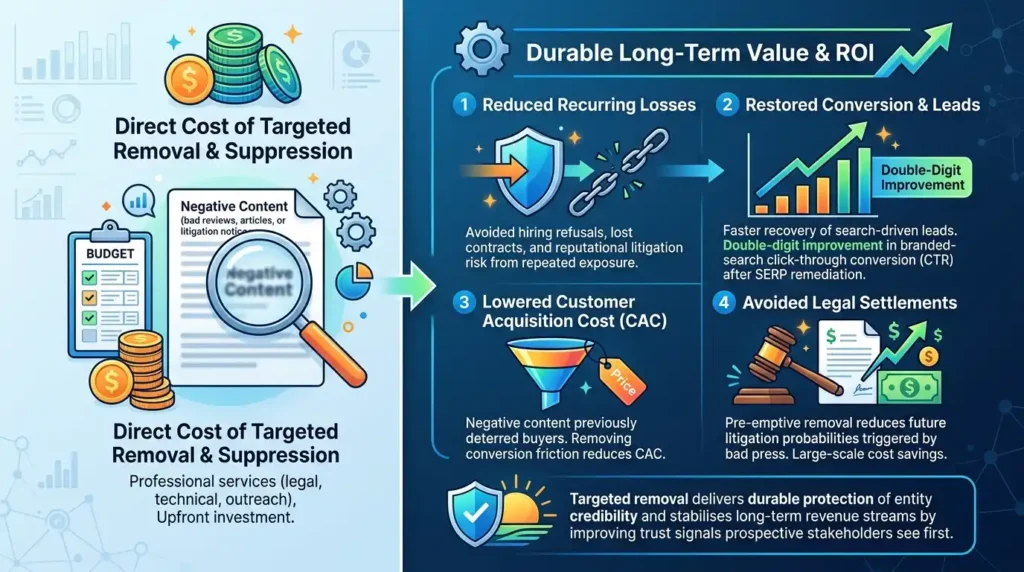
An evidence-driven assessment shows removal services deliver value by reducing downstream damage and conversion loss. The direct cost of removal and suppression contrasts with recurring losses from hiring refusals, lost contracts, or reputational litigation risk. Value drivers include faster recovery of search-driven leads, reduced probability of future litigation triggered by repeated exposure, and restored business relationships as measured by conversion rates from branded queries. Quantifiable ROI metrics include increases in branded-search click-through conversion (often improving by double digits after SERP remediation), reduced customer acquisition cost where negative content previously deterred buyers, and avoided legal settlements through pre-emptive removal. Investing in targeted removal delivers durable protection of entity credibility and stabilises long-term revenue streams by improving the trust signals prospective stakeholders see first.
Which timeline and milestones define a decision-stage engagement?
A clear timeline clarifies expected delivery and reduces stakeholder uncertainty. Initial forensic audit and prioritisation complete within 3–5 business days. Platform removal requests and escalation to Facebook commence immediately, with initial takedown outcomes typically visible in 7–30 days for policy-violating content and longer if legal processes are necessary. Suppression through content production, optimisation and link placement shows measurable SERP shifts in 4–12 weeks. Monitoring and recurrence prevention begin on day one and continue for the agreed protection period. Milestones include audit completion, first-platform response, legal escalation result (if applicable), and measurable SERP repositioning at 8 and 12 weeks. This predictable schedule reduces risk and aligns expectations around measurable outcomes.
Which specific benefits will your organisation realise from Facebook Content Removal Services?
- Deliver faster takedowns: use legal escalation and platform policy enforcement to remove or restrict harmful posts, reducing immediate exposure.
- Strengthen visibility control: promote verified assets that displace negative posts in search results, improving SERP control.
- Reduce decision risk: restore entity credibility via verified profiles and authoritative content, decreasing the chance of lost opportunities.
- Improve conversion metrics: increase branded-query conversion and contact rates by stabilising perception.
- Stabilise long-term reputation: implement monitoring and legal deterrents to prevent recurrence.
How does Clear Your Name ensure process clarity and reliability?
Clear Your Name uses a documented workflow that integrates legal, technical and search optimisation actions. The team produces a detailed remediation plan after the forensic audit, listing actions, responsible parties, expected timelines and measurable KPIs. All removal requests and legal actions include audit-grade evidence packages and follow UK procedural standards to ensure enforceable results. Progress reports provide rank-tracking, visibility metrics and recurrence alerts at defined milestones, enabling clients to verify outcomes independently. This transparency ensures clients understand both immediate removals and the suppression strategies that restore and maintain entity credibility. As part of the engagement, Clear Your Name coordinates directly with solicitors when legal escalation is required and implements tracking that quantifies SERP improvements.
Dive Deeper With Our Expert Guides:
Remove Content From the Internet Faster by Working With a UK Specialist
Choose a UK Content Removal Agency With a Track Record of Verified Results
Which decision safeguards limit escalation and legal exposure?
A professional removal strategy reduces escalation risk by documenting requests, following platform policy channels, and using UK legal instruments when necessary. Pre-litigation solicitor letters clarify the legal basis for removal and avoid unnecessary public disputes that amplify exposure. Preservation orders and takedown confirmations provide legal proof that reduces publisher defence options. Operational safeguards include careful messaging to avoid statements that amplify allegations and controlled disclosure of legal steps. These measures reduce reputational contagion and ensure remediation proceeds with minimal public escalation, protecting entity credibility while achieving measurable takedown and suppression outcomes.
Which monitoring and reporting will prove success?
Actionable reporting demonstrates success through measurable KPIs: percentage reduction of negative results on page one, ranking improvement for targeted keywords, changes to impressions and click-throughs for branded queries, and recurrence frequency. Clear Your Name provides dashboards and periodic reports that include SERP snapshots, sentiment analysis of top-ranking content, and a record of takedown confirmations. These outputs ensure decision-makers see empirical proof of remediation impact and verify that reputation signals and search perception influence have stabilised in the desired direction.
Engaging a specialist for Facebook Content Removal Services delivers rapid, measurable reductions in harmful content exposure and structured, long-term SERP control. The combined use of platform processes, UK legal mechanisms and suppression through authoritative content directly strengthens reputation signals and entity credibility. Clear Your Name applies a documented, evidence-driven workflow that ensures transparency, measurable outcomes and sustained protection of your search presence.
Foe deeper insight explore:
Why Harmful Content Online Causes Lasting Damage Even After It Stops Circulating
How Removing Harmful Online Content Differs by Platform Type and Jurisdiction
Answers to Key Questions
What types of Facebook posts qualify for removal?
Facebook removal applies to defamation, doxxing, privacy breaches, harassment, and explicit content that breach platform policies or UK law; screenshots, post IDs and timestamps improve success rates. Clear Your Name assesses content against policy and legal thresholds before filing targeted takedown requests.
Will removing a Facebook post stop it appearing in Google search results?
Removing the original Facebook post reduces its visibility in search results, but cached pages and third-party mirrors may persist; de-indexing requests and suppression through authoritative content are required to clear SERPs. Clear Your Name combines takedown with de-indexing and content creation to improve SERP control and reduce negative impressions.
How much does professional Facebook content removal cost?
Costs vary by complexity, required legal action and volume of items; straightforward platform removals are lower-cost, while solicitor-led escalations and suppression campaigns increase fees. Clear Your Name provides an initial forensic audit to estimate costs, timelines and expected outcomes, enabling an evidence-based decision.
How do you prevent removed Facebook content from reappearing?
Prevention uses continuous monitoring, legal deterrents such as preservation orders and verified-authority publishing to occupy prime SERP positions, and takedown follow-ups against mirror sites. Clear Your Name implements alerting systems and legal documentation to maintain sustained negative content suppression.