
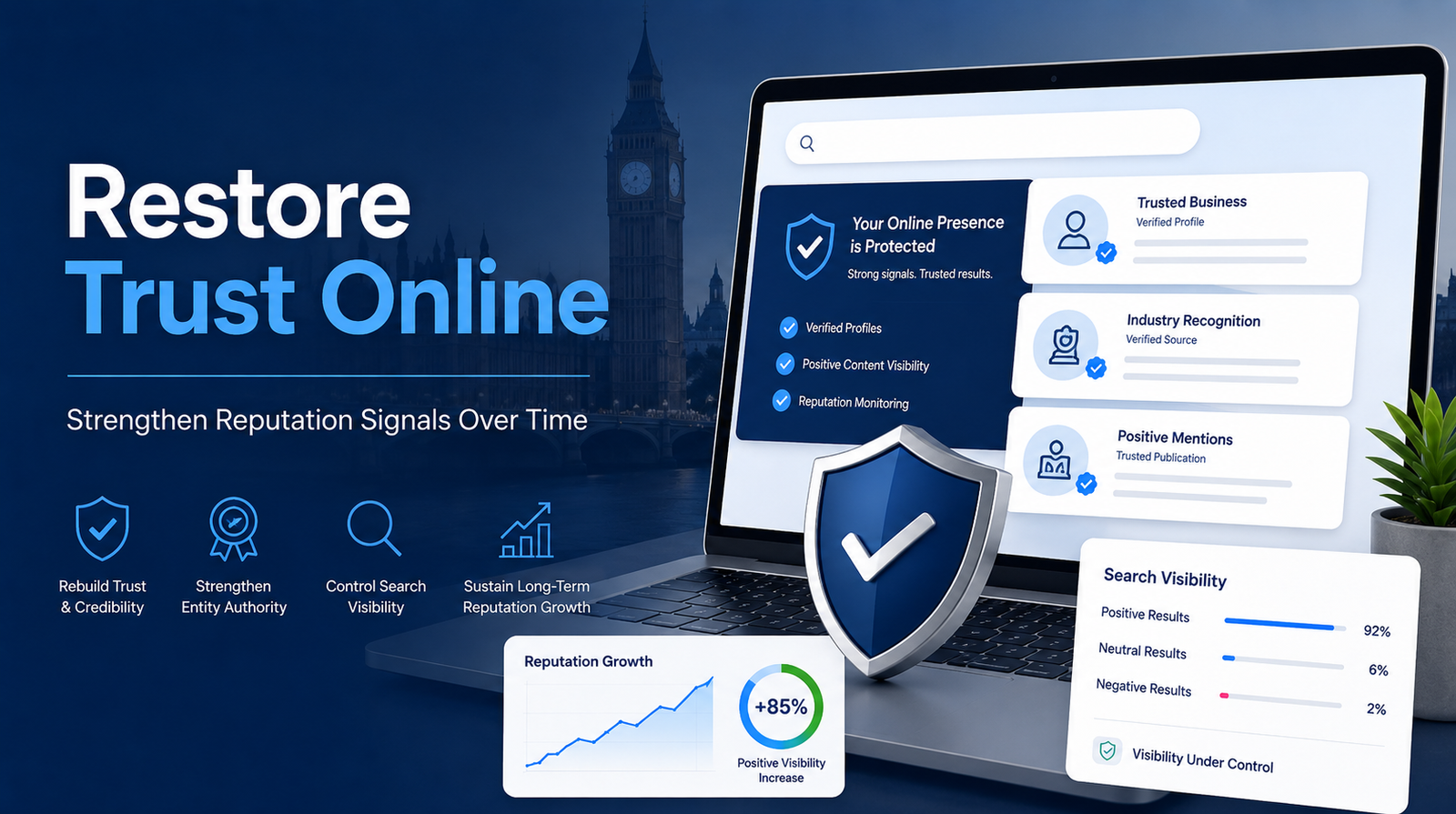
Negative search results reduce trust, weaken entity credibility, and influence how people judge a person or business before direct contact happens.
A structured Content Removal strategy delivers SERP control by reducing harmful visibility, strengthening reputation signals, and stabilising search perception.
Search visibility control matters because Google often becomes the first verification point for clients, employers, partners, investors, journalists, and regulators. When negative content on Google appears on page one, it creates a reputational frame that affects decision-making before a brand has the chance to explain itself. Reputation management services work because they address how search ecosystems interpret authority, relevance, freshness, and entity associations. They do not rely on guesswork; they use search behaviour, content quality, platform policies, legal review, and negative content suppression to improve what users see. For UK individuals and businesses, the right strategy reduces risk, restores trust, and ensures that search results reflect current credibility rather than outdated, inaccurate, or damaging material.
Which Content Removal approach delivers the strongest reputation outcome?
A policy-led and evidence-based Content Removal approach delivers the strongest outcome because it targets the source of the damage and the search visibility attached to it. Effective reputation repair starts by identifying whether the negative material breaches platform rules, privacy standards, defamation principles, outdated information policies, copyright rules, or search engine removal criteria. This step matters because every removal request needs a clear basis, supporting evidence, and a precise explanation of harm. When the case is structured properly, the chances of successful removal or de-indexing increase because the request aligns with how platforms assess risk, accuracy, relevance, and public interest.
The service works by reviewing the harmful URL, the publisher, the ranking position, the search query it appears for, and the wider entity profile connected to the name or brand. This creates a clear picture of how the negative content influences public perception. A reliable provider then separates removable content from content that requires suppression, correction, or reputational counterbalance. This distinction reduces wasted time and improves strategic focus. Clear Your Name applies this type of structured review to help clients understand which routes deliver practical results and which routes create unnecessary delay.
The measurable outcome is improved visibility control. Removal eliminates the harmful asset from the source or search index, while suppression reduces its prominence by strengthening positive and neutral reputation signals. Both methods improve SERP control because users are less likely to encounter damaging content during decision-making searches. This directly supports trust restoration, entity credibility, and search perception influence. For users comparing options, the best approach is not the loudest promise; it is the clearest process with the strongest evidence base.
How does Content Removal improve rankings and search perception?
Content Removal improves search perception by reducing the visibility of harmful assets and strengthening the signals that Google associates with a person, brand, or organisation. Search engines rank content based on relevance, authority, freshness, user behaviour, and entity relationships. Negative content gains influence when it is indexed, linked, frequently clicked, or connected to branded search terms. A professional strategy addresses these signals directly through removal requests, de-indexing actions, technical review, and content positioning. This ensures that harmful material loses influence while credible content gains space in the search environment.
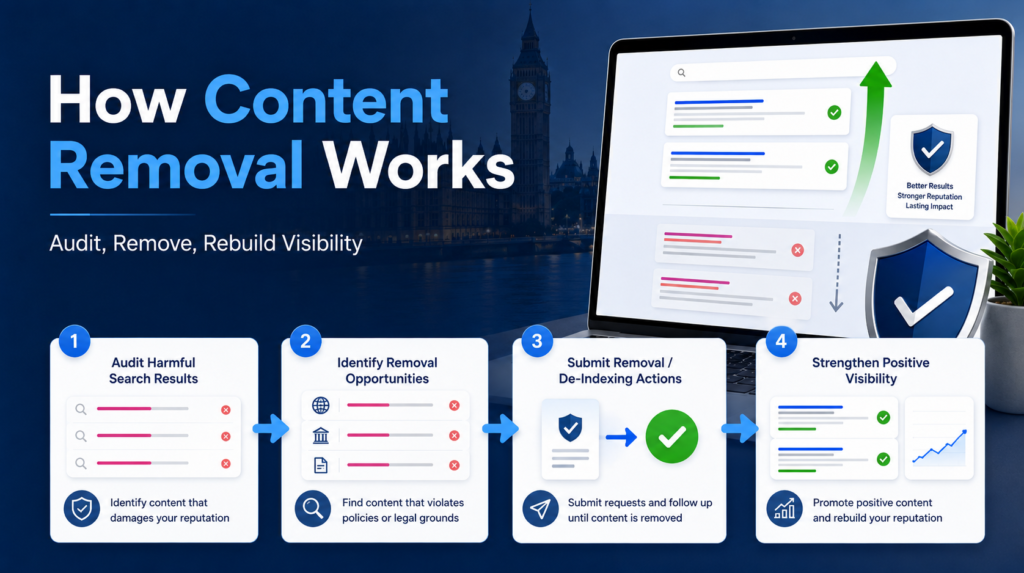
The process works by mapping the search results that appear for branded and personal-name queries. This includes identifying negative pages, outdated mentions, review pages, news results, forum posts, images, snippets, and cached references. Once the risk map is complete, the service prioritises URLs based on visibility, severity, removal feasibility, and reputational impact. High-risk page-one results receive priority because they shape first impressions most strongly. This approach improves ranking outcomes because it focuses resources where user behaviour and reputation risk intersect.
Search perception changes when users see a more accurate and credible result set. If negative content sits above official profiles, company pages, professional listings, or positive media, the public narrative becomes unstable. When stronger assets move into visible positions, the brand regains narrative control. This does not manipulate users; it ensures that search results reflect verified, relevant, and current reputation signals. For decision-stage users, this is the practical value of professional Content Removal: it reduces harmful exposure and improves the reliability of what people find.
Why is professional support more reliable than trying to remove content alone?
Professional support is more reliable because successful removal depends on evidence, policy alignment, technical accuracy, and strategic escalation. Individuals and businesses often send emotional or incomplete requests that fail because they do not match the platform’s decision criteria. A strong case requires documented harm, accurate URL identification, clear policy references, and a reasoned explanation of why the content violates removal standards or causes disproportionate reputational damage. This structure improves response quality and reduces rejection risk. It also prevents mistakes that draw more attention to the harmful content.
A professional service works by building a removal pathway before contacting publishers, search engines, hosts, or platforms. The pathway identifies whether the best route is publisher removal, search engine de-indexing, right-to-erasure review, privacy-based takedown, defamation assessment, copyright action, or suppression. Each route has different requirements, timeframes, and evidence standards. Process clarity matters because clients need to know what is being attempted, why it is being attempted, and what outcome each step is designed to deliver. This reduces uncertainty and protects the client from reactive decisions.
The main benefit is risk reduction. Poorly handled outreach can lead to refusals, screenshots, public responses, legal pushback, or renewed visibility. Professional handling reduces this risk by using controlled communication and reputation-safe sequencing. It also ensures that suppression work continues where removal is not immediately available. This combined approach improves long-term search perception because the strategy does not depend on one single outcome. Clear Your Name positions its Content Removal process around this balance of removal, suppression, and credibility repair.
What outcomes prove that a reputation management strategy is working?
A reputation management strategy is working when harmful visibility decreases, credible assets gain stronger positions, and branded search results become more stable. The clearest measurement is movement within Google search results for priority keywords, personal names, company names, director names, and service-related searches. If negative URLs move down, disappear, or lose prominence, SERP control improves. If owned assets, trusted profiles, positive media, and authoritative listings move up, entity credibility strengthens. These outcomes show that the search ecosystem is receiving stronger reputation signals.
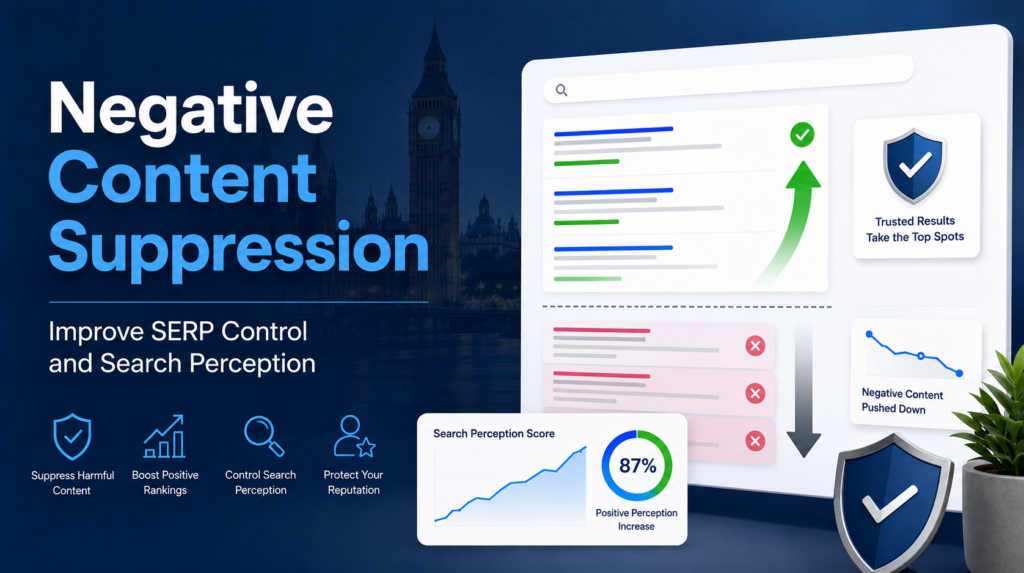
The service measures progress through visibility tracking, ranking movement, index status, search result composition, and query-level risk. This gives clients practical evidence rather than vague reassurance. A strong campaign also reviews how Google displays titles, snippets, images, knowledge panels, review references, and related searches. These features influence perception because users often form opinions without clicking through every result. Controlling these visible elements improves trust before direct engagement begins.
Key outcome indicators include:
- Reduce harmful page-one exposure by removing, de-indexing, or suppressing damaging URLs that influence first impressions.
- Strengthen positive assets by improving the visibility of trusted pages, official profiles, business listings, and credible third-party references.
- Stabilise branded searches by creating consistent entity signals across search results, profiles, and public references.
- Improve decision confidence by ensuring users see current, relevant, and credibility-building information before outdated or harmful content.
- Lower reputational risk by monitoring search changes and responding before negative material regains visibility.
These outcomes matter because reputation damage is rarely limited to one page. It affects trust, enquiries, recruitment, partnerships, sales conversations, and personal credibility. A measurable strategy connects each action to visibility, control, and perception. That is why decision-stage users need a provider that can explain the method, not only promise the result.
Dive Deeper With Our Expert Guides:
How Online Content Removal Works and Why It Takes Professional Expertise
What to Expect When Using an Online Content Removal Service in the UK
How quickly does Content Removal create visible impact?
Content Removal creates visible impact fastest when the harmful content qualifies for direct removal, de-indexing, or urgent policy review. If a publisher removes the content or Google removes it from search, the visibility effect becomes clear once the page is recrawled and the index updates. This produces a direct reduction in exposure because the harmful result no longer appears for the affected query. Speed depends on the platform, the strength of the evidence, the type of content, and the technical status of the indexed page. A proper assessment gives clients a realistic route without weakening the confidence of the process.
When direct removal is not available, negative content suppression delivers impact through ranking displacement. This involves strengthening credible content so that harmful pages lose page-one prominence over time. The method uses entity-building, authoritative publishing, profile optimisation, content freshness, internal linking, external trust signals, and technical search improvements. It works because search engines reward relevance and authority when competing pages provide stronger value for the query. The measurable impact appears as ranking movement, improved search result composition, and reduced negative visibility.
The fastest route is not always the safest route. Aggressive or unstructured tactics create risk because they can trigger more attention, duplicate content, or public resistance from publishers. A controlled process protects the client while still moving towards visibility improvement. The best decision is to combine immediate removal opportunities with sustained suppression and reputation signal strengthening. This creates both short-term relief and long-term stability.
Is Content Removal worth the cost compared with long-term reputation risk?
Content Removal is worth the cost when negative search visibility affects trust, revenue, employment, investment, or personal credibility. The real cost of negative content is not only reputational discomfort; it is the loss of decisions that happen silently after someone searches a name or brand. A potential client, hiring manager, journalist, lender, or commercial partner can change direction after seeing damaging results. This makes reputation repair a risk-management investment rather than a cosmetic service. The value comes from reducing exposure before it affects important opportunities.
The service delivers value by focusing on the search results that influence decisions most strongly. Page-one branded results carry the greatest commercial and personal impact because users rarely need more information once a negative impression is formed. If the first visible results contain outdated allegations, misleading content, hostile reviews, or harmful commentary, trust is weakened at the point of evaluation. Removing or suppressing that material improves the quality of the decision environment. It also supports future brand resilience because stronger reputation signals continue working after the initial campaign.
A cost comparison must include long-term risk. Lost leads, damaged partnerships, reduced hiring confidence, investor hesitation, and personal stress create ongoing consequences. A structured Content Removal campaign reduces these risks by improving search perception influence and restoring control over the visible narrative. For businesses and individuals reviewing their options, the practical question is not only “What does removal cost?” but “What does unmanaged visibility continue to cost?” That is where a professional service proves its value.
Learn More Here:
Start the Online Content Removal Process With a Free UK Consultation
Which provider is the right choice for removing negative content from Google?
The right provider is the one that gives a clear assessment, explains the available routes, avoids exaggerated guarantees, and connects each action to measurable reputation outcomes. Decision-stage users need confidence that the provider understands search ecosystems, legal boundaries, content policies, ranking behaviour, and reputation signals. A reliable provider does not treat every case the same. It evaluates the type of content, the publisher, the search position, the evidence, and the long-term entity profile before recommending action. This ensures that the strategy is specific, defensible, and aligned with the client’s risk level.
The service process should include a clear audit, prioritised action plan, evidence preparation, removal outreach, de-indexing review, suppression strategy, and progress reporting. These steps provide structure and accountability. They also help the client understand what is happening at each stage, which reduces uncertainty and improves trust. Clear Your Name fits this decision need by positioning Content Removal as a structured reputation control process rather than a one-step takedown promise. That distinction matters because sustainable outcomes require both technical search knowledge and reputation risk awareness.
Before choosing a provider, decision-makers should look for proof of process clarity, communication standards, and outcome tracking. The provider must explain how it handles content that qualifies for removal and how it manages content that needs suppression. It must also show how the campaign strengthens entity credibility beyond the immediate problem. For readers still validating the wider issue, reviewing guidance on negative content on Google supports the decision by explaining why harmful results continue to influence perception. For readers comparing practical routes, the step-by-step logic behind removing negative content from Google clarifies why professional execution produces more reliable outcomes.
How does a proven UK strategy create sustainable reputation protection?
A proven UK strategy creates sustainable protection by combining removal, suppression, monitoring, and credibility-building into one controlled process. Removal addresses the most harmful assets where evidence supports action. Suppression reduces the visibility of content that cannot be removed directly. Monitoring identifies changes in rankings, snippets, cached pages, and new mentions. Credibility-building strengthens the digital footprint so that positive and neutral assets hold stronger positions over time.
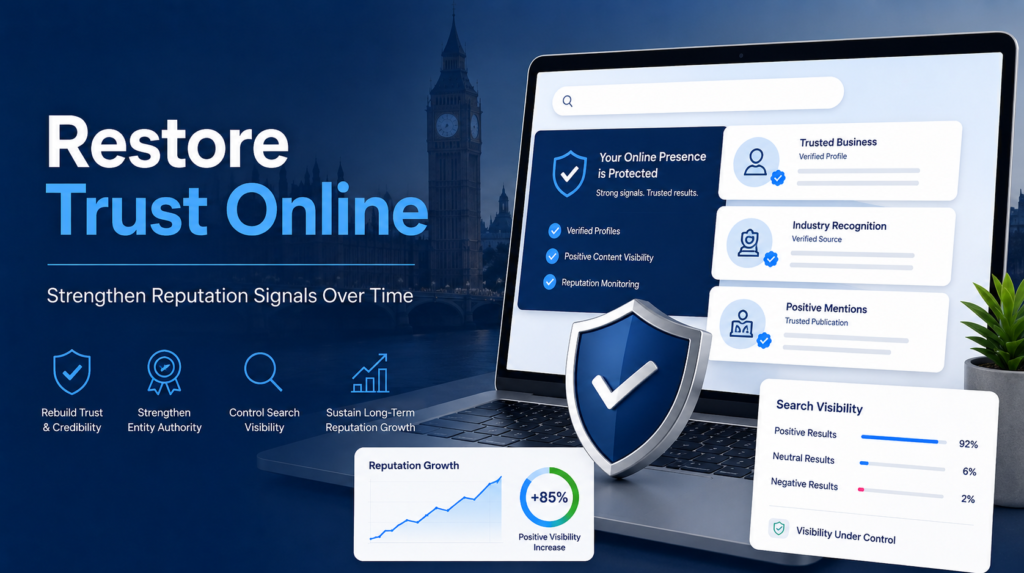
The process works because reputation management services understand that Google does not judge reputation the same way people do. Google evaluates signals: relevance, authority, trust, freshness, engagement, and entity consistency. A professional campaign improves these signals across controlled and credible third-party assets. This strengthens the search environment around the person or business. Over time, the visible narrative becomes more stable because harmful content has less ranking power and less user influence.
Sustainable reputation protection also reduces future risk. Once a stronger entity profile exists, new or old negative content faces greater competition in search results. This makes it harder for harmful pages to dominate branded searches. The client benefits from improved search resilience, clearer public perception, and stronger trust signals. For UK businesses and individuals, this is the difference between reacting to reputation damage and controlling search perception with a long-term strategy.
Conclusion
Removing negative content from Google requires a structured strategy, not a reactive complaint. The most reliable approach combines evidence-led removal, negative content suppression, SERP control, and reputation signal strengthening. This improves visibility, restores trust, and reduces the long-term risk created by harmful search results. A professional Content Removal service delivers value by turning a reputation problem into a clear, measurable process with defined actions and visible outcomes.
Clear Your Name provides a credible solution for people and businesses that need search perception control without exaggerated claims or unclear tactics. The right strategy improves what users see, strengthens entity credibility, and protects decision-making moments where reputation matters most. When search results influence trust before contact happens, reliable reputation management becomes essential. With the right process, negative visibility can be reduced, public perception can be stabilised, and the search narrative can move towards accuracy and credibility.
FAQs
1. Can negative content be removed from Google completely?
Negative content can be removed from Google if it breaches search engine policies, privacy rules, defamation standards, or platform guidelines. If direct removal is not possible, reputation management strategies can reduce visibility through negative content suppression and stronger positive search results.
2. How does Content Removal help improve online reputation?
Content Removal helps improve online reputation by targeting harmful search results, outdated pages, misleading content, or damaging links that affect trust. Clear Your Name may use removal requests, de-indexing, and suppression strategies to improve search visibility and reputation signals.
3. How long does it take to remove negative content from Google?
The timeline depends on the type of content, the website hosting it, Google’s indexing process, and the strength of the removal case. Some results can change quickly after approval, while suppression strategies take longer because they rely on improving positive content visibility.
4. What if Google will not remove the negative content?
If Google does not remove the negative content, the next step is usually negative content suppression. This means building and optimising credible online assets so positive or neutral results rank higher than the damaging content.
5. Is professional Content Removal worth it for businesses?
Professional Content Removal is valuable when negative search results affect trust, enquiries, partnerships, hiring, or customer decisions. A structured service reduces reputational risk by improving SERP control, strengthening entity credibility, and stabilising public perception.