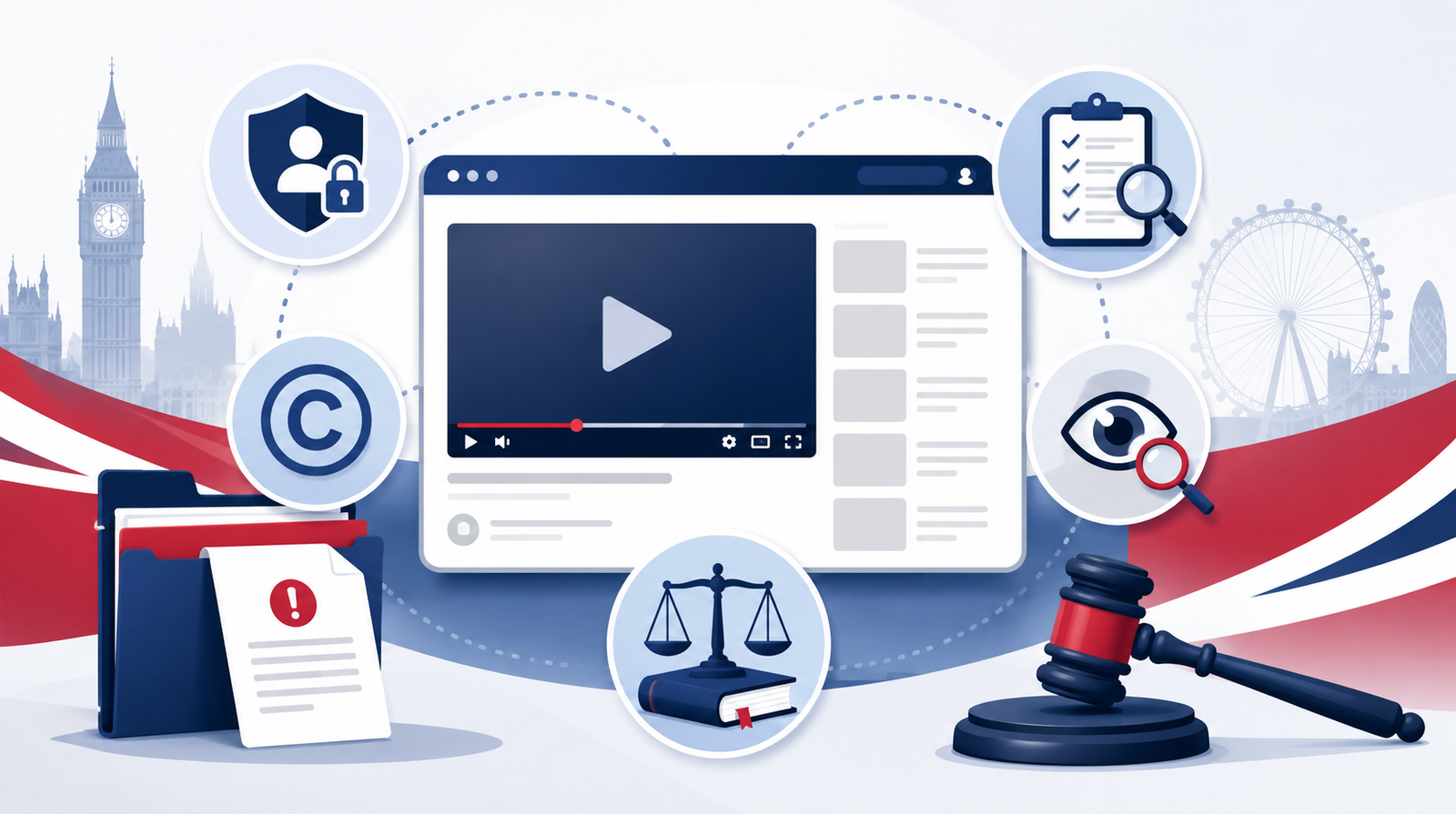
YouTube accepts removal requests in the UK when a video falls under recognised privacy, copyright, legal, safety, harassment, impersonation, or platform policy grounds. A removal request is evaluated by matching the reported issue against defined rules, evidence, context, and the public-interest value of the content.
Reputation management is the structured analysis of how information about a person, organisation, or entity is created, interpreted, indexed, ranked, and evaluated across digital systems. Online reputation refers to the visible and implied meaning that search engines, platforms, and users attach to indexed content, especially when video results, social content, reviews, news pages, and profile references appear together in search engine results pages.
What grounds does YouTube accept when reviewing a video removal request in the UK?
YouTube accepts removal grounds when the reported video connects to a recognised rights issue, safety issue, privacy issue, copyright issue, or policy violation. A removal ground is the formal reason used to explain why a piece of content conflicts with a platform rule, legal right, or protection framework. Within reputation management, this matters because a video does not only exist as media; it becomes a reputation signal once it is indexed, shared, embedded, ranked, or quoted by other pages.
The mechanism works through classification. A platform evaluates whether the video contains identifiable personal information, copyrighted material, targeted abuse, harmful misinformation, threats, non-consensual exposure, impersonation, or another restricted category. Search engines then process the video page through content indexing, metadata, user engagement, backlinks, and relevance signals. If the video remains public, it can appear in SERPs for a person’s name, company name, product name, workplace, location, or controversy-related query.
The reputation impact comes from entity perception. A video result often carries high visual authority because users treat moving images as direct evidence. A negative title, thumbnail, transcript, comment section, or description can influence SERP evaluation even before the video is watched. In search ecosystems, the accepted ground for removal defines whether the issue is treated as a rights matter, a safety matter, a content-quality matter, or a platform-policy matter.
How does privacy define a valid YouTube removal ground?
Privacy defines a valid removal ground when a video reveals or displays an identifiable person in a way that conflicts with personal privacy protection. Privacy is the control of personal information, likeness, voice, image, location, or identifying context within public digital environments. In reputation systems, privacy becomes relevant when exposure creates a searchable connection between a person and information that users can interpret without consent.
The mechanism depends on identification. A platform evaluates whether the person is uniquely recognisable through face, name, voice, image, address, workplace, vehicle details, family references, or surrounding context. The content is then assessed against public interest, news value, consent, and the degree of exposure. A video that identifies a person through direct visual or verbal markers carries stronger privacy relevance than a vague or non-identifying reference.
The search impact is direct because identifiable media strengthens entity association. Once indexed, the video can connect the person’s name with a specific event, allegation, location, or appearance. Search visibility increases when the title, description, tags, comments, or external pages repeat the identifying information. Privacy-based review therefore analyses the relationship between exposure, identifiability, and the reputational meaning created by search access.
Explore Our Expert Guides:
How YouTube Decides Which Videos Are Eligible for Removal Under Its Policies
What a YouTube Video Removal Service Covers That Platform Reporting Alone Does Not
How does copyright create a recognised video removal route?
Copyright creates a recognised removal route when a video contains protected material used without permission from the rights holder. Copyright is a legal protection for original works such as video footage, music, images, graphics, written material, recordings, or creative production. Within search ecosystems, copyright-related content affects reputation because unauthorised use can misrepresent ownership, authorship, brand association, or professional credibility.
The mechanism is rights verification. The claimant identifies the protected work, explains ownership or authority, and specifies where the allegedly infringing material appears in the video. The platform then evaluates whether the request contains the required information for a legal copyright process. This differs from general dissatisfaction because copyright review focuses on protected expression, not whether the content is negative, embarrassing, or unfavourable.
The reputation impact concerns authority and trust signals. Search engines evaluate content pages through signals such as source authority, engagement, citations, and topical relevance, but copyright disputes change how ownership and legitimacy are understood. A video that misuses a creator’s work can rank for their name or brand while transferring attention to the uploader. In reputation management, copyright is therefore not only a legal route; it is also a mechanism for correcting false authorship signals in indexed media.
How do platform policies affect YouTube video removal decisions?
Platform policies affect removal decisions by defining what content is allowed, restricted, age-limited, demonetised, or removed. A platform policy is a rule system that governs safety, abuse, harmful conduct, misleading behaviour, regulated material, and community standards. In reputation management, policy enforcement matters because harmful content can remain highly visible when it does not fit a legal category but still violates platform rules.
The mechanism is policy matching. A reported video is compared against categories such as harassment, threats, hate, harmful acts, scams, impersonation, child safety, graphic content, or dangerous behaviour. The reviewer analyses the video itself, its title, description, thumbnail, comments, target, and wider context. A video can be restricted or removed when the content crosses the defined threshold for a policy violation.
The search impact comes from content ranking dynamics. A policy-violating video can still generate strong engagement through outrage, conflict, or curiosity before enforcement occurs. Engagement signals can increase visibility across video recommendations, search results, and external pages. When a policy action removes or restricts the video, the reputation signal attached to that media asset changes because the content no longer carries the same public visibility.
How does harassment influence reputation and removal review?
Harassment influences removal review when a video targets a person or group through abuse, intimidation, threats, humiliation, or repeated hostile framing. Harassment is targeted conduct that uses language, imagery, editing, or audience mobilisation to attack an identifiable subject. Within search ecosystems, harassment is especially significant because repeated hostile content can create a distorted reputation profile.
The mechanism centres on targeting. A platform evaluates whether the content identifies a person, directs abuse towards them, encourages viewers to attack them, reveals private information, or uses degrading claims linked to protected characteristics or physical traits. Context defines the difference between criticism, commentary, satire, and harassment. The evaluation therefore analyses both the words used and the functional effect of the content.
The reputational effect is cumulative. A single hostile video can become a source page for comments, reaction videos, forum posts, social shares, and search snippets. These secondary pages reinforce the original framing and create stronger entity perception around the target. In SERP evaluation, repeated negative phrasing can make a person or organisation appear defined by conflict, even when the underlying content lacks reliable evidence.
How does misinformation or harmful content affect search perception?
Misinformation or harmful content affects search perception by presenting inaccurate, unsafe, or misleading claims in a format that users treat as evidence. Misinformation is content that communicates false or unsupported claims in a way that changes understanding, behaviour, or trust. In reputation management, harmful content becomes a search issue when it attaches inaccurate meaning to an entity and then gains visibility through ranking systems.
The mechanism involves claim interpretation. A platform evaluates whether the content conflicts with defined safety rules, regulated topics, manipulated media policies, or harmful behaviour standards. Search engines evaluate the same page through relevance, source signals, user interaction, and supporting context from other pages. When misleading claims are repeated in titles, transcripts, and external references, the content becomes easier for systems to classify around that topic.
The impact on reputation is semantic. Search engines build associations between entities and recurring terms. If a video repeatedly links a person or organisation with fraud, danger, misconduct, or controversy, those words can influence autocomplete, related searches, snippets, and content clusters. Removal review therefore connects platform safety rules with the broader structure of search reputation.
How do authority and trust signals shape video visibility?
Authority and trust signals shape video visibility by helping search systems evaluate which content deserves prominence for a query. Authority refers to the perceived reliability, relevance, and recognition of a source. Trust signals refer to indicators that support credibility, including consistent metadata, account history, external references, viewer engagement quality, and alignment with policy-compliant publishing behaviour.
The mechanism works through ranking interpretation. Search systems analyse the title, description, transcript, channel context, upload history, user engagement, backlinks, embeds, comments, and topical relevance. A video from a recognised or highly active source can gain stronger visibility than a weak or isolated upload. This explains why reputation risk is not limited to the content itself; the publishing environment also shapes how the content is interpreted.
The effect on entity perception is significant. A negative video with strong authority signals can outrank neutral or positive pages because the ranking system evaluates relevance and engagement, not reputational fairness. A video thumbnail, headline, and snippet can therefore define the first impression of a person or organisation. In reputation analysis, visibility is not the same as truth; it is the result of indexed relevance, authority, and user behaviour.
How does a digital footprint affect YouTube-related reputation?
A digital footprint affects YouTube-related reputation by connecting video content with every searchable trace linked to the same person, organisation, or topic. A digital footprint is the total body of indexed and discoverable information connected to an entity. It includes videos, comments, social posts, websites, reviews, articles, images, directories, forum discussions, and cached references.

The mechanism is entity linking. Search engines connect names, locations, images, topics, accounts, channels, and repeated phrases across platforms. A YouTube video becomes part of that footprint when it is indexed or referenced by other pages. If the video contains strong identifiers, it contributes more directly to the entity profile built by search systems.
The impact on search perception depends on repetition and prominence. A video that appears once with limited engagement has weaker influence than a video repeated across articles, social posts, thumbnails, clips, and reaction content. Search engines interpret repeated references as stronger topical association. This is why the broader question of how to remove YouTube video UK content connects to digital footprint analysis rather than only video deletion.
How do SERPs evaluate reputation-related YouTube content?
SERPs evaluate reputation-related YouTube content by organising indexed pages according to relevance, authority, freshness, engagement, and query satisfaction. A SERP is the visible ranking environment where users form immediate judgments about an entity. For reputation management, SERPs matter because they compress complex digital information into titles, snippets, thumbnails, dates, and source labels.
The mechanism is result selection. Search engines decide which pages best answer a query and then display them in a structured order. YouTube videos can appear as standard results, video carousels, rich snippets, image-led results, or embedded media panels. Each format changes how strongly the video influences perception because visual results attract attention faster than plain text.
The impact is reputational framing. When a video appears for a name-based search, users connect that video with the identity of the person or organisation. If the surrounding SERP also contains negative reviews, critical articles, or repeated allegations, the video strengthens the overall negative cluster. If the SERP contains balanced, authoritative, and context-rich information, the same video carries less interpretive dominance.
How do review signals and sentiment influence online credibility?
Review signals and sentiment influence online credibility by shaping the trust environment around an entity. Review signals are structured or unstructured indicators of public evaluation, including ratings, comments, testimonials, complaints, and discussion patterns. Sentiment refers to the positive, neutral, or negative meaning expressed through language and user response.
The mechanism is pattern recognition. Search systems and users interpret repeated opinion signals across video comments, review platforms, social discussions, and article responses. A YouTube video with a hostile comment section can strengthen negative sentiment even when the video itself is neutral. Sentiment is therefore not limited to the uploaded content; it includes the visible reaction layer attached to that content.
The reputational impact is credibility transfer. Negative sentiment in comments, shares, and linked discussions can transfer onto the subject of the video. Positive or neutral sentiment can reduce reputational pressure by creating alternative interpretations. In search ecosystems, credibility is formed through content, source quality, audience response, and repeated language patterns.
Get More Insights:
Use a UK YouTube Video Removal Service to Take Down Content Damaging You
Why does understanding removal grounds matter for reputation analysis?
Understanding removal grounds matters because reputation systems depend on classification, evidence, visibility, and interpretation. A removal ground is not a general objection to unwanted content; it is a defined category that explains why a video conflicts with privacy rules, copyright rights, safety rules, harassment policies, impersonation standards, or legal obligations. This distinction defines how the issue is reviewed and how the content is understood within search ecosystems.
The mechanism connects platform governance with search visibility. A video can damage reputation because it is indexed, ranked, clipped, shared, embedded, quoted, and discussed. Removal review evaluates the original platform-level issue, while search engines evaluate the indexed footprint created around that video. Effective analysis separates these layers so the reputation issue is understood as both a content problem and a visibility problem.
The key conceptual insight is that online reputation is not created by one video alone. It is formed through the relationship between content indexing, SERP evaluation, authority signals, sentiment patterns, digital footprint expansion, and entity perception. YouTube removal grounds in the UK therefore sit within a wider reputation system where rights, policies, algorithms, and user interpretation all shape public visibility.
Conclusion
YouTube accepts video removal requests in the UK when the request aligns with recognised privacy, copyright, legal, safety, harassment, impersonation, or platform-policy grounds. Each ground functions as a classification route that defines how the content is reviewed and what evidence is relevant. Within reputation management, these grounds matter because video content can influence search visibility, entity perception, digital footprint formation, and SERP evaluation.
Search reputation is created through indexed content, ranking dynamics, trust signals, sentiment patterns, and repeated associations across platforms. A video becomes reputationally significant when it appears in search results, attracts engagement, gains external references, or connects an entity with negative or misleading meaning. Understanding removal grounds therefore provides a structured way to analyse how platform rules and search ecosystems interact.
FAQs
1. What grounds does YouTube accept for removing a video in the UK?
YouTube accepts removal requests when a video violates privacy rights, copyright rules, community guidelines, harassment policies, impersonation rules, or legal obligations. In the UK, a valid YouTube video removal request needs a clear reason, supporting evidence, and a link between the content and the reported issue.
2. Can a YouTube video be removed for privacy reasons in the UK?
Yes, a YouTube video can be reviewed for removal if it reveals identifiable personal information, images, voice, address, workplace, or private details without proper consent. YouTube assesses whether the person is clearly identifiable and whether the content creates a privacy risk.
3. Can copyright be used to remove a YouTube video?
Copyright can be used when a YouTube video includes protected material such as music, footage, images, graphics, or written content without permission. The copyright owner usually needs to show ownership of the work and identify where the copyrighted material appears in the video.
4. Does YouTube remove videos for harassment or abuse?
YouTube reviews videos for removal when content targets a person with threats, repeated abuse, humiliation, or harmful harassment. The platform looks at the video, title, description, comments, and wider context to decide whether the content breaks harassment policies.
5. How does a YouTube video affect online reputation in search results?
A YouTube video can affect online reputation when it appears in Google search results, video carousels, or name-based searches. Clear Your Name explains that video titles, thumbnails, comments, and engagement signals can influence search visibility, entity perception, and digital trust.