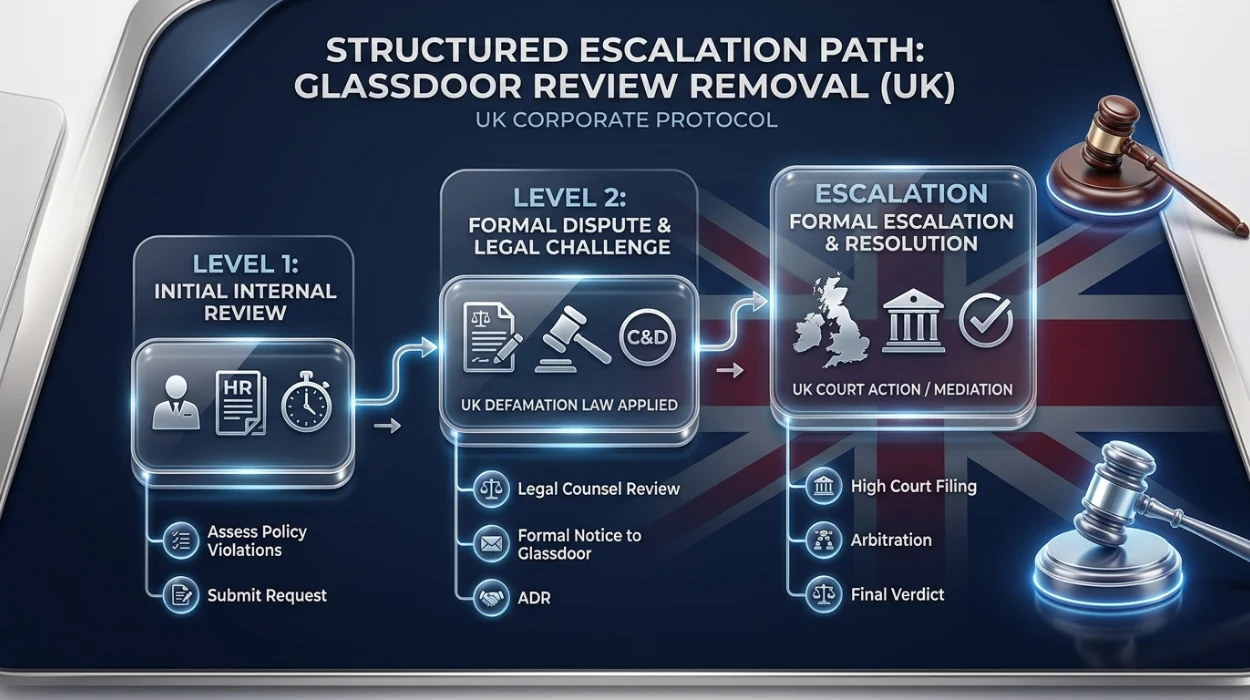
Removing a Glassdoor review in the UK depends on whether the review breaches platform policies, legal standards, or escalation criteria rather than its effect on reputation alone. Reputation management strategies differ based on review eligibility, platform governance, and the mechanisms that influence search visibility within search ecosystems.
Reputation management strategies differ based on how search engines interpret review content, reputation signals, and entity credibility across digital ecosystems. Online reputation control methods are evaluated through moderation policies, content indexing, sentiment distribution, and search ranking influence instead of simple removal requests. Employer reviews become part of an organisation’s digital footprint after indexing, contributing to long-term search perception and SERP composition. Different reputation management approaches operate through review reporting, escalation procedures, content suppression, and content enhancement. Comparing these methods provides a clearer understanding of their effectiveness, limitations, and sustainability.
What determines whether a Glassdoor review qualifies for removal?
Eligibility determines whether a Glassdoor review enters the platform’s moderation or escalation process because removal decisions rely on policy compliance instead of reputational impact. Review removal refers to deleting user-generated content that breaches published community standards or applicable legal requirements. Search ecosystems recognise these moderation decisions as part of the platform’s governance framework rather than search engine ranking adjustments. Reputation management therefore evaluates review eligibility before comparing alternative reputation control strategies. Understanding eligibility provides the foundation for assessing every available response.
Platform moderation distinguishes between policy violations and permitted opinions. Reviews containing prohibited material, fraudulent claims, discriminatory language, confidential information, or other restricted content undergo different assessment procedures from compliant workplace opinions. Search visibility changes only after moderation decisions affect indexed content. Reputation signals therefore remain connected to objective moderation outcomes rather than subjective disagreement with published reviews. This structured evaluation reduces inconsistency across moderation decisions.
How do platform reporting and escalation routes compare?
Platform reporting and escalation routes represent separate mechanisms for requesting review reassessment. Platform reporting operates through standard moderation procedures that compare reported reviews against community guidelines. Escalation routes operate by introducing additional review processes when policy interpretation, legal considerations, or procedural issues require further examination. Both mechanisms influence review visibility differently because one follows routine moderation while the other involves expanded assessment frameworks.
Reporting provides an initial pathway for evaluating potentially non-compliant content. Escalation becomes relevant when additional documentation or procedural review supports a more detailed assessment. Search ecosystems reflect successful moderation outcomes through future indexing updates rather than immediate ranking changes. Reputation management compares these methods because they differ in procedural complexity, evidence requirements, and long-term search visibility impact. Structured comparison improves understanding of available reputation management options.
Procedural certainty depends upon policy alignment and evidence quality rather than the selected submission route. Standard reporting follows predefined moderation workflows, producing consistent evaluation against published rules. Escalation introduces additional procedural review when supporting documentation justifies further assessment. Reputation management therefore analyses certainty according to policy compliance instead of submission type.
Search visibility changes only after completed moderation and indexing updates. Both reporting and escalation contribute to reputation management because each operates within the broader governance framework established by review platforms and search ecosystems.
How do content removal and content suppression differ?
Content removal and content suppression influence search perception through separate operational mechanisms. Content removal eliminates review content after successful moderation or legal review, changing the information available for future indexing. Content suppression operates by improving the visibility of alternative authoritative content that reduces the prominence of negative information within search results. Both approaches influence reputation signals, although their operational objectives and long-term sustainability differ substantially.
Removal changes SERP composition directly because the review becomes unavailable following successful moderation and indexing updates. Suppression changes SERP composition indirectly by strengthening competing content that demonstrates greater authority and semantic relevance. Search engines evaluate these stronger resources comparatively, adjusting visibility according to overall informational quality. Reputation management compares these approaches because they influence entity credibility through different technical pathways. Comparative analysis demonstrates that removal addresses specific content, whereas suppression strengthens broader search perception.
Long-term sustainability depends upon continuous authority development rather than isolated moderation outcomes. Content suppression strengthens semantic relevance across multiple digital assets, reinforcing positive reputation signals over time. Content removal remains effective for policy-violating content but depends upon ongoing eligibility and moderation consistency. Search ecosystems reassess both approaches continuously through indexing and ranking updates.
Reputation management therefore evaluates sustainability according to authority growth, semantic coverage, and stable reputation signals instead of immediate visibility changes. Stronger authority contributes to more resilient entity credibility across evolving search environments.
How do reactive and proactive reputation management approaches compare?

Reactive and proactive reputation management approaches differ according to the timing of reputation signal management within search ecosystems. Reactive strategies analyse existing review content after it becomes publicly visible, focusing on moderation requests, escalation procedures, and search visibility adjustments. Proactive strategies strengthen digital footprints before reputational challenges emerge by expanding authoritative information and reinforcing positive entity associations. Both approaches influence search perception, although they operate through different strategic objectives.
Reactive methods evaluate available responses to existing review visibility, comparing policy-based removal with broader reputation management techniques. Proactive methods focus on strengthening semantic authority through consistent, authoritative digital assets that improve entity credibility across search ecosystems. Comparative analysis demonstrates that proactive strategies contribute to stronger resilience, while reactive approaches address existing search perception challenges. Search engines interpret these activities through evolving authority signals rather than isolated actions.
How do content enhancement and review removal compare?
Content enhancement and review removal represent different reputation management methods that influence search perception through separate mechanisms. Content enhancement is the process of strengthening an entity’s digital footprint by expanding authoritative, relevant, and semantically connected information. Review removal operates by eliminating review content that breaches platform policies or applicable legal standards after moderation or escalation. Both approaches influence reputation signals, although they differ in scalability, sustainability, and search ranking influence. Comparative evaluation demonstrates that enhancement develops broader authority while removal targets specific sources of negative visibility.
Search engines interpret enhanced content by measuring semantic relevance, topical authority, and contextual relationships across indexed resources. Review removal changes search visibility only when moderation alters the availability of indexed information. Content enhancement influences SERP composition indirectly because stronger authoritative resources compete more effectively during ranking evaluation. Reputation management therefore analyses these approaches according to their operational objectives rather than treating them as interchangeable methods. Search perception improves through different pathways depending on the selected strategy.
How do search engines evaluate reputation signals after moderation decisions?
Search engines evaluate reputation signals independently after review platforms complete moderation decisions. Reputation signals are measurable indicators of authority, trustworthiness, relevance, and contextual consistency that contribute to entity credibility within search ecosystems. Moderation determines whether review content remains published, while search engines determine how indexed content influences search visibility. These systems operate independently because publication governance and search ranking evaluation perform different functions. Reputation management compares both processes to explain how moderation outcomes affect SERP composition over time.
Entity credibility develops through cumulative authority rather than isolated moderation actions. Search algorithms reassess indexed information by comparing semantic relevance, topical authority, and trust signals across multiple sources. Stronger authority improves contextual confidence because search ecosystems identify reliable informational relationships between recognised entities and trusted resources. Reputation management therefore evaluates moderation as one component within a broader reputation signal framework. Search visibility changes progressively through ongoing indexing and algorithmic reassessment.
Dive Deeper With Our Expert Guides:
What Evidence Supports a Glassdoor Review Removal Request in the UK
What limitations affect different Glassdoor review management approaches?
Every review management approach operates within technical, procedural, and governance limitations. Platform reporting depends upon published moderation policies, while escalation routes depend upon additional evidence and procedural review. Content suppression relies on stronger authority signals to reduce the prominence of negative information, whereas content enhancement strengthens digital footprints through broader semantic relevance. Comparative analysis demonstrates that each method addresses different aspects of search perception and reputation management.
Search ecosystems evaluate these approaches independently because each interacts differently with indexing systems and ranking algorithms. Removal changes indexed content availability, suppression redistributes visibility, and enhancement improves entity credibility through sustained authority development. Reputation management therefore compares these mechanisms according to operational effectiveness rather than assuming universal applicability. Strategic evaluation improves understanding of both strengths and limitations.
The following framework compares the principal mechanisms influencing reputation management effectiveness.
- Evaluate policy eligibility by determining whether review content breaches moderation standards or legal requirements.
- Assess authority by analysing whether stronger semantic content improves search ranking influence and entity credibility.
- Measure sustainability by comparing long-term reputation signals during continuous indexing and algorithm updates.
- Compare scalability by determining how effectively each method supports expanding digital footprints and broader search ecosystems.
Each evaluation criterion analyses measurable search behaviour rather than subjective reputational outcomes.
How do short-term and long-term reputation strategies differ?
Short-term reputation strategies focus on addressing existing review visibility through moderation requests, escalation procedures, or targeted suppression methods. Long-term strategies strengthen entity credibility by expanding authoritative information, improving semantic relevance, and reinforcing trust signals across digital ecosystems. Both approaches influence search perception, although they differ significantly in sustainability and search ranking influence. Comparative evaluation demonstrates that short-term interventions address immediate visibility concerns while long-term strategies strengthen broader reputation resilience.
Search engines reassess indexed information continuously through crawling, semantic interpretation, and ranking evaluation. Stable authority therefore becomes increasingly important as digital footprints expand across multiple information sources. Reputation management analyses these interactions because sustained search visibility depends upon consistent contextual relevance rather than isolated moderation outcomes. Long-term authority contributes to more resilient SERP composition and stronger online credibility.
Why does sustainability remain a defining evaluation factor?
Sustainability refers to the ability of a reputation management strategy to maintain effectiveness despite ongoing search engine reassessment. Search ecosystems reward authoritative and semantically relevant information because it strengthens search quality and entity perception. Sustainable reputation strategies therefore reinforce stable trust signals through continuous authority development instead of temporary visibility adjustments. Reputation management evaluates sustainability as a central measure of long-term digital trust.
Removing a Glassdoor review in the UK involves evaluating multiple reputation management approaches rather than relying upon a single moderation request. Platform reporting, escalation procedures, content removal, content suppression, and content enhancement each operate through distinct mechanisms that influence reputation signals, search ranking influence, entity credibility, and SERP composition differently. Comparative analysis demonstrates that effectiveness depends upon policy eligibility, evidence quality, authority development, scalability, and long-term sustainability rather than review sentiment alone. Search engines continue interpreting indexed information through semantic relevance, trust signals, and contextual authority after moderation decisions occur. Understanding these differences provides a structured framework for evaluating reputation management strategies within evolving digital search ecosystems.
How can I remove a Glassdoor review in the UK?
A Glassdoor review can be removed in the UK if it breaches the platform’s community guidelines or applicable legal requirements. The process typically involves submitting a report through the platform or using the appropriate escalation route supported by relevant evidence.
What is the difference between reporting and escalating a Glassdoor review?
Reporting is the standard moderation process used to assess whether a review violates Glassdoor’s policies. Escalation involves additional review procedures when policy interpretation, legal considerations, or supporting evidence require further assessment.
Do Glassdoor Reviews Removal Services guarantee review removal?
No. Glassdoor Reviews Removal Services assess whether a review meets the platform’s removal criteria and identify the most appropriate reputation management approach. Clear Your Name recognises that final removal decisions remain subject to Glassdoor’s moderation policies and applicable legal standards.
Can a Glassdoor review affect my online reputation in Google Search?
Yes. Indexed Glassdoor reviews contribute to an organisation’s digital footprint, influencing search visibility, reputation signals, and entity credibility. Search engines evaluate these reviews alongside other authoritative online sources when presenting search results.
What happens after a Glassdoor review is removed?
Once a review is removed from the platform, search engines recrawl and update their indexes before the content disappears from search results. The timing depends on search engine indexing cycles and the availability of the updated webpage.