
Working with a UK team provides a structured process for removing policy-violating Google reviews through accurate evidence, platform compliance and search-focused reputation management. Professional review management strengthens search visibility control, protects reputation signals and improves the accuracy of public perception.
Search visibility directly influences customer decisions because Google reviews form a significant part of local search results and Google Business Profiles. Reputation signals shape entity credibility, making a structured review removal process essential for reducing risk, maintaining SERP control and protecting long-term digital trust.
Which approach delivers the most reliable Google review removal outcome?
A structured reputation management process delivers the most reliable outcome because every stage follows Google’s review policies and focuses on measurable reputation improvements.
Google removes reviews according to policy compliance rather than customer preference. A successful removal strategy therefore begins with analysing whether the published review breaches Google’s prohibited content guidelines before any report is submitted. This evidence-led process improves procedural accuracy, reduces unnecessary delays and strengthens the quality of information presented during moderation. Search ecosystems also benefit because policy-violating reviews gradually stop contributing to publicly visible reputation signals once moderation and indexing updates occur. Clear Your Name applies this structured methodology through its professional Google Review Removal Services, ensuring each stage supports accurate policy assessment and effective search perception management.
Why does expert review assessment improve removal success?
Expert review assessment improves removal success because every review is analysed against Google’s published policies before reporting begins.
A structured assessment identifies the precise policy category applicable to the review instead of relying on general disagreement or dissatisfaction. This process evaluates prohibited content, reviewer behaviour, supporting evidence and contextual information before selecting the most appropriate reporting pathway. Accurate categorisation improves moderation efficiency because Google’s review systems receive reports supported by relevant policy reasoning. Search perception also benefits because policy-based removals improve the overall quality of reputation signals displayed within Google Business Profiles and local search results.
A structured review removal process follows a clear sequence designed to improve procedural accuracy and reduce unnecessary delays.
- Assess the review by identifying whether the content breaches Google’s prohibited review policies.
- Collect supporting evidence through screenshots, URLs and contextual information relevant to the reported violation.
- Submit a policy-focused report using the most appropriate reporting category within Google’s moderation framework.
- Monitor moderation progress by reviewing platform responses and evaluating changes in search visibility after moderation decisions.
Each stage contributes to greater procedural consistency while supporting stronger reputation signals across Google’s search ecosystem.
Why are Google Review Removal Services more effective than reporting reviews independently?
Google Review Removal Services provide greater effectiveness because they combine policy analysis, search ecosystem knowledge and structured evidence evaluation within a single process.
Independent reports frequently focus only on the negative impact of a review instead of demonstrating a specific policy violation recognised by Google. Professional assessment evaluates both the review itself and its influence on search visibility, entity credibility and reputation signals before determining the strongest reporting strategy. This broader evaluation increases procedural accuracy because every submission aligns with Google’s published moderation framework. Reputation management therefore extends beyond reporting individual reviews by considering the wider impact on digital trust and SERP control.
Structured review management also reduces unnecessary procedural errors by ensuring reports remain evidence-based throughout the moderation process. This improves efficiency while strengthening the overall quality of reputation management outcomes.
Which measurable outcomes demonstrate successful review removal?
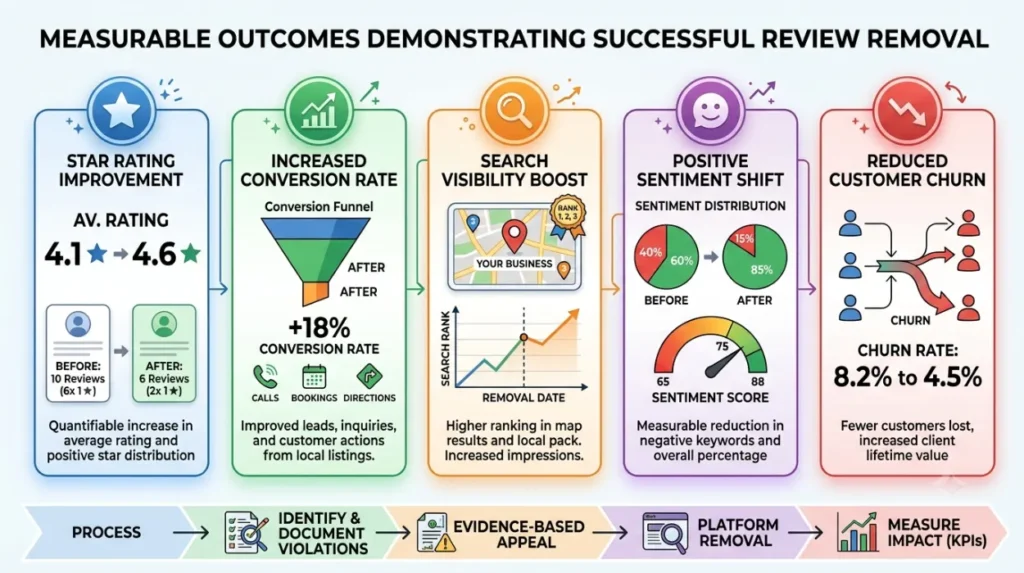
Successful review removal produces measurable improvements in search visibility, reputation signals and public trust.
The first measurable outcome is the reduction of policy-violating content within Google Business Profiles, improving the accuracy of publicly visible customer feedback. Search engines subsequently reassess review information as moderation decisions become reflected across Google’s systems. This process strengthens entity credibility because compliant review data becomes a more accurate representation of genuine customer experiences. Improved reputation signals also support stronger user confidence during branded and local search queries.
Another measurable outcome is improved control over future reputation risks. Structured review monitoring identifies new policy violations early, reducing their influence before they accumulate significant search ranking influence.
Why does search visibility influence customer trust?
Search visibility influences customer trust because Google reviews frequently represent the first reputation signals users evaluate before engaging with a business.
Search algorithms combine review quality, relevance and authenticity with other local ranking factors when presenting Google Business Profiles. Highly visible reviews therefore influence first impressions and contribute directly to public perception. Removing policy-violating reviews improves the accuracy of visible reputation signals while preserving authentic customer feedback. This balanced representation strengthens digital trust because users evaluate businesses through information that more accurately reflects genuine customer experiences.
Understanding Google review removal grounds provides essential context before beginning any moderation process because removal depends entirely on Google’s published review policies. Likewise, reviewing Google review removal timelines helps explain how moderation stages influence search visibility and reputation management outcomes, enabling better-informed decision-making before initiating a structured removal strategy.
Which reputation management strategy delivers the strongest long-term value?
A structured reputation management strategy delivers the strongest long-term value because it combines review removal with continuous reputation monitoring and search visibility management.
Removing a policy-violating review resolves a specific reputation issue, but long-term credibility depends on maintaining accurate reputation signals across Google’s search ecosystem. Search engines continually reassess review quality, business information and entity credibility when determining local search visibility. Ongoing monitoring identifies new policy violations before they significantly influence public perception or search ranking influence. This continuous approach stabilises search perception influence while strengthening digital trust over time. Clear Your Name supports this process by combining policy evaluation, review management and long-term reputation monitoring within a structured methodology.
Which factors support sustainable reputation management?
Long-term reputation stability depends on maintaining accurate information and consistent reputation signals.
- Monitor review activity by identifying policy-violating content before it affects long-term search visibility.
- Strengthen entity credibility through authentic customer feedback that reflects genuine business experiences.
- Protect SERP control by reducing the visibility of misleading reputation signals across Google Search and Business Profiles.
- Evaluate reputation trends through continuous analysis of review quality, sentiment distribution and search perception influence.
Each action strengthens digital trust while reducing future reputation risks within Google’s search ecosystem.
How quickly can review removal improve search perception?
Search perception improves progressively as Google completes moderation decisions and updates review information across its search systems.
Platform moderation removes reviews only after policy violations have been confirmed. Following removal, Google’s systems reassess publicly visible review information during normal indexing and data refresh cycles. Updated review profiles provide users with more accurate reputation signals, improving confidence in the information displayed within search results. Search visibility therefore reflects the current state of compliant review content rather than outdated or policy-violating material.
This gradual improvement demonstrates why structured reputation management focuses on both immediate moderation outcomes and the longer-term development of entity credibility.
Dive Deeper With Our Expert Guides:
Report Fake Google Reviews More Effectively With Expert Guidance and Support
Remove Fake Google Reviews With a Service That Handles the Whole Process
Why is a professional review management process a lower-risk option?
A professional review management process reduces risk because every stage follows Google’s published review policies and uses evidence-based reporting.
Reports submitted without clear policy justification frequently experience unnecessary delays or unsuccessful outcomes because Google’s moderation systems evaluate compliance rather than dissatisfaction. Professional evaluation ensures the appropriate reporting category, supporting evidence and contextual information are identified before submission. This structured methodology improves procedural consistency while reducing avoidable reporting errors. From a search perspective, accurate moderation contributes to stronger reputation signals and more reliable public information.
Professional Google Review Removal Services also provide greater process transparency by explaining how review moderation, search visibility and reputation management interact. This clarity enables informed decisions while improving confidence in the overall reputation management process.
Which factors should influence the final decision?
The final decision should be based on policy expertise, process transparency, search ecosystem knowledge and long-term reputation protection.
An effective review management provider evaluates whether a review breaches Google’s published policies while understanding how review content influences search visibility, entity credibility and public perception. Process clarity ensures every moderation stage is supported by evidence rather than assumption. Long-term monitoring strengthens sustainable outcomes because new reputation risks can be identified before significantly affecting search perception.
Selecting a structured process also provides measurable value beyond the removal of a single review. Stronger SERP control, improved reputation signals and greater digital trust contribute to more stable online credibility over time. These outcomes demonstrate the long-term benefits of combining review policy expertise with search-focused reputation management.
Google review removal is most effective when every stage follows a structured process based on policy compliance, evidence evaluation and search ecosystem understanding. Removing policy-violating reviews improves the accuracy of reputation signals, strengthens entity credibility and supports greater SERP control across Google’s local search environment. Long-term reputation protection also depends on continuous monitoring, ensuring future review issues are identified before they significantly influence public perception.
Clear Your Name delivers a transparent and structured approach that combines policy expertise with search-focused reputation management. By evaluating review eligibility, managing moderation procedures and monitoring reputation signals, the process provides greater certainty, reduced risk and sustainable online credibility. This evidence-based methodology supports informed decision-making while strengthening long-term digital trust.
How can a UK team help remove a Google review?
A UK team evaluates whether the review breaches Google’s review policies, gathers supporting evidence and follows the correct reporting process. Google Review Removal Services focus on policy compliance because Google removes reviews based on guideline violations rather than customer dissatisfaction.
What types of Google reviews can be removed?
Google may remove reviews that contain spam, fake engagement, conflicts of interest, offensive content, impersonation or other material that breaches its published review policies. Genuine negative reviews based on real customer experiences are generally not eligible for removal.
How long does it take to remove a Google review?
The timeframe depends on Google’s moderation process, the complexity of the report and whether additional manual review is required. Reviews that clearly violate Google’s policies are often resolved more quickly than cases needing further investigation.
Why use Google Review Removal Services instead of reporting a review yourself?
Google Review Removal Services provide structured policy analysis, evidence assessment and a clear reporting strategy based on Google’s moderation guidelines. Clear Your Name supports this process by evaluating policy compliance before submission, while Google makes the final decision on review removal.
Can removing a Google review improve online reputation?
Removing a policy-violating review can improve the accuracy of reputation signals displayed within Google Business Profiles and search results. As Google’s systems update, authentic customer feedback has a greater influence on entity credibility, search visibility and public trust.