
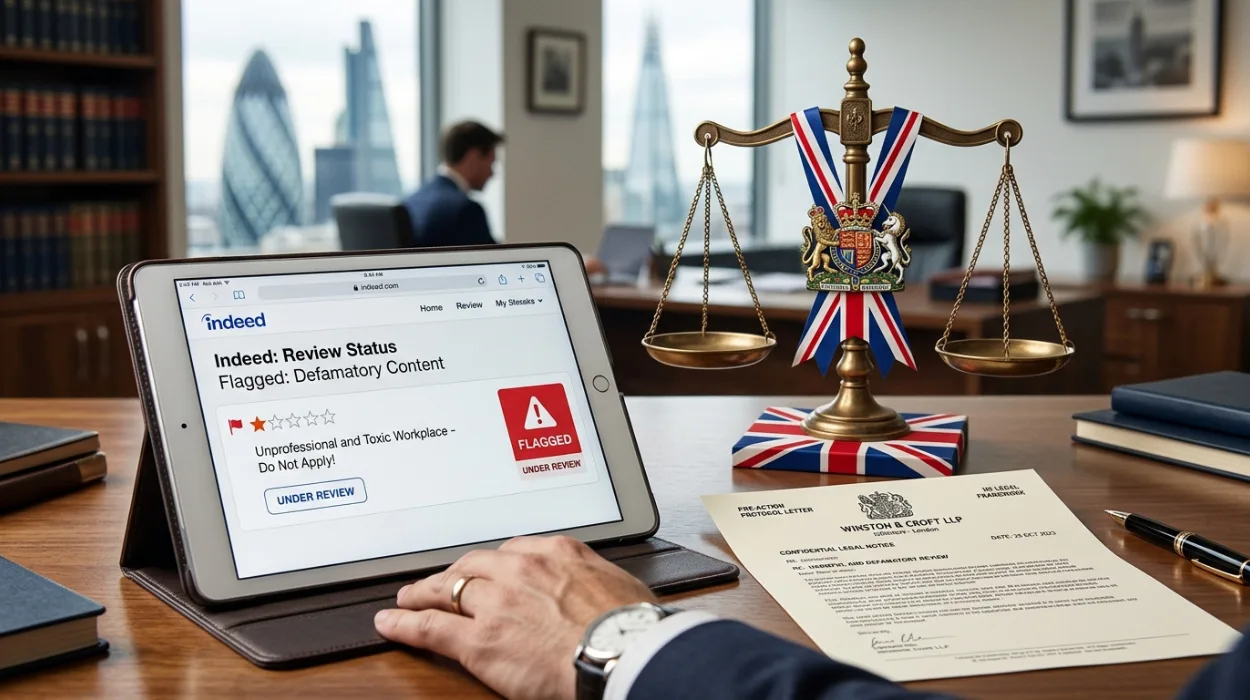
Legal escalation for a harmful Indeed review involves assessing whether the content crosses from opinion into a legally actionable false statement and determining whether the available evidence supports further action. The process differs from ordinary platform reporting because legal escalation focuses on applicable UK law, evidence, publication, harm and the identity of the reviewer.
Reputation management strategies differ based on whether the objective is content removal, reputation recovery or search perception control. Online reputation control methods are evaluated through their effect on review visibility, reputation signals, entity credibility and the wider SERP composition.
What makes legal escalation different from ordinary Indeed review removal?
Legal escalation differs because it evaluates the underlying legal basis for challenging content rather than relying solely on a platform’s internal moderation rules. An Indeed review removal process generally examines whether content violates the platform’s policies, while legal escalation examines whether publication creates a recognised legal issue. This distinction matters because a review can remain within a platform’s moderation framework while still raising separate legal questions about factual accuracy, defamation or unlawful publication. The two approaches therefore operate through different decision mechanisms and produce different evidential requirements. Platform removal focuses on policy compliance, whereas legal escalation focuses on legal rights, applicable standards and evidence. The strongest evaluation separates these mechanisms rather than treating them as interchangeable reputation management methods.
An Indeed review removal strategy is primarily reactive because it responds to published content after it enters the review ecosystem. Legal escalation is also reactive, but it introduces a formal assessment of evidence, harm and legal liability. Content creation represents a different approach because it does not directly challenge the harmful review; instead, it develops relevant authoritative content that can influence the surrounding search environment. Removal therefore targets the problematic asset itself, while content enhancement targets the broader SERP composition. The effectiveness of each approach depends on whether the principal problem exists on the review platform or across search results more broadly.
When does an Indeed review become a legal rather than a reputation-management issue?
An Indeed review becomes a legal issue when its wording and circumstances satisfy the relevant legal requirements rather than simply generating negative sentiment. In England and Wales, defamation generally concerns publication of a statement that causes or is likely to cause serious harm to reputation, with additional legal requirements and defences applying to individual cases. The distinction between fact and opinion is important because a negative opinion about workplace culture does not operate in the same way as an objectively verifiable allegation presented as fact. Evidence therefore needs to establish what was stated, how it was presented, who could access it and what reputational consequences followed. A review containing criticism alone does not automatically establish a legal claim. Legal evaluation must analyse the precise wording and surrounding circumstances rather than the overall emotional tone.
The practical assessment therefore separates factual assertions from evaluative commentary. A statement such as an allegation of specific misconduct presents a different evidential question from a reviewer’s assessment that management was poor or the workplace was unpleasant. This distinction affects both the potential legal route and the strength of an escalation strategy. It also limits the usefulness of generic review-removal arguments because platform policy and defamation law do not apply identical tests. A legally grounded approach consequently requires evidence that corresponds directly with the disputed statements. This creates a higher evidential threshold than simply demonstrating that a review is damaging to perception.
How does content removal compare with content enhancement for harmful reviews?
Content removal directly targets the harmful review, while content enhancement attempts to change the balance of information surrounding the review in search results. Removal operates at the source level when a platform accepts a valid policy or legal basis for taking content down. Content enhancement operates across an entity’s wider digital footprint by developing authoritative, relevant and indexable assets. The first strategy therefore attempts to reduce the availability of a negative reputation signal, while the second attempts to increase the relative prominence of positive or neutral reputation signals. Neither mechanism guarantees a particular SERP outcome because search engines independently evaluate pages, entities, relevance and other ranking signals. The strategic distinction is therefore between content suppression vs content enhancement.
Content removal provides a direct mechanism because eliminating an offending page or review reduces the availability of that specific source. Its limitation is that the underlying reputational association can persist through cached references, secondary discussions, screenshots or other indexed pages. Content enhancement has greater scalability because multiple authoritative assets can contribute to a broader digital footprint. Its limitation is that creating additional content does not erase the original source or establish that disputed claims are false. For this reason, content enhancement functions as a longer-term search perception strategy rather than a substitute for a valid removal mechanism.
Is reactive reputation management more effective than organic reputation building?
Reactive reputation management is more direct when a specific harmful asset creates the immediate reputational problem, whereas organic reputation building provides greater sustainability across the wider search environment. A reactive approach identifies an existing negative signal and attempts to remove, correct, challenge or contextualise it. An organic approach continuously develops credible digital assets, accurate organisational information and relevant third-party signals that contribute to entity credibility. The first approach concentrates resources on an identified problem, while the second strengthens the overall reputation architecture. Effectiveness therefore depends on whether the problem is isolated or distributed across multiple search surfaces. A single damaging review requires a different assessment from a pattern of negative results appearing across the SERP.
Reactive action also carries greater risk exposure when the factual basis is weak. An unsuccessful complaint can leave the original review unchanged while increasing the time and resources required to address the issue. Organic reputation building generally carries lower dependence on a single platform decision because it distributes reputation signals across multiple assets. Its limitation is speed, as search engines require time to discover, crawl and reassess newly published material. The comparison therefore favours reactive methods for immediate source-level problems and organic methods for sustained reputation development. A combined framework evaluates both according to the severity, distribution and persistence of the reputation issue.
How does legal escalation affect search visibility and SERP composition?

Legal escalation affects search visibility indirectly because a legal action does not itself instruct search engines to alter rankings. Search engines evaluate the pages and sources available to them after content changes, removals or other developments occur. If a harmful Indeed review is successfully removed at source, the corresponding page can become unavailable for future crawling or ranking, although other references to the same subject can remain. If removal does not occur, search visibility remains influenced by the continued existence and relevance of the review page. SERP composition therefore changes through alterations to the underlying content ecosystem rather than through the legal process alone. This distinction prevents legal escalation from being treated as an automatic search-ranking mechanism.
The effect also depends on the authority and relevance of competing results. A review can occupy a prominent position because it matches a person’s or organisation’s entity and satisfies the search engine’s relevance criteria. Other authoritative pages can occupy surrounding positions without necessarily displacing it immediately. This creates a distinction between removing a reputation signal and strengthening competing reputation signals. Search ranking influence therefore results from the combined composition of indexed content rather than from reputation management activity in isolation. A sound evaluation measures changes in SERP composition, source visibility and sentiment distribution rather than assuming that one action determines rankings.
What evidence matters most when evaluating legal escalation?
The most useful evidence connects the disputed review with identifiable factual claims, publication circumstances and measurable reputational consequences. Screenshots preserve the original wording and presentation, while publication dates establish when the content appeared. Records, documents or communications can help evaluate whether disputed factual statements are demonstrably inaccurate. Evidence of search visibility can establish where the review appears for relevant queries and how prominently it is displayed. Business records can also help assess whether the publication has produced identifiable consequences where such evidence is legally relevant. Evidence quality therefore matters more than the volume of material collected.
A practical evaluation framework can be structured around four actions:
- Preserve the original review and surrounding page information to establish what was published and when.
- Separate factual allegations from opinions to determine which statements require objective verification.
- Document contradictory evidence that directly addresses specific factual assertions rather than general disagreement.
- Measure search visibility and reputation signals to distinguish source-level harm from broader SERP effects.
This framework improves comparison between platform reporting, legal escalation and organic reputation strategies. It also reduces the risk of treating general reputational dissatisfaction as evidence of a legally actionable publication. Each disputed statement requires its own evidential assessment. The resulting record provides a more reliable basis for determining which mechanism has the strongest strategic fit.
Dive Deeper With Our Expert Guides:
How to Appeal an Indeed Refusal to Remove a Review
How to Escalate Beyond Indeed’s Flagging Tool When It Fails
Which approach offers the strongest long-term reputation outcome?
The strongest long-term outcome depends on whether the strategy addresses both the original reputation signal and the wider digital ecosystem. Removal strategies offer the most direct route when a review satisfies a valid platform or legal removal basis. Organic content enhancement provides greater sustainability when reputation issues extend beyond one review and involve multiple search results. Reactive approaches provide speed and specificity, while long-term reputation building provides broader resilience against future negative signals. These approaches therefore solve different parts of the same reputation problem. Evaluating them as competing rather than complementary mechanisms can produce an incomplete assessment.
Sustainability also depends on whether the underlying digital footprint remains credible and consistent. A removed review does not automatically establish positive entity credibility, just as publishing new content does not invalidate an existing factual allegation. Reputation signals develop through the combined information available across relevant sources. Sentiment distribution can therefore change gradually as authoritative and relevant content becomes more prominent. The long-term objective is not simply to eliminate one negative URL but to establish a reliable and coherent information environment around the entity. This makes measurement of source quality, relevance, visibility and persistence essential.
How should UK businesses compare Indeed review escalation strategies?
UK businesses can compare strategies by examining legal basis, evidence requirements, speed, scalability, risk exposure and sustainability. Removal is strongest where a specific review violates an applicable platform rule or has a defensible legal basis for challenge. Legal escalation requires a stronger evidential assessment because the consequences and standards differ from ordinary platform moderation. Content enhancement provides a broader mechanism for improving the surrounding SERP composition but does not directly remove disputed material. Reactive strategies address immediate reputation signals, while organic strategies strengthen the wider digital footprint over time. The appropriate comparison therefore focuses on mechanism and objective rather than assuming one universal solution.
| Approach | Primary mechanism | Main strength | Main limitation |
|---|---|---|---|
| Platform removal | Challenges the review against platform rules | Directly targets the source | Depends on platform acceptance |
| Legal escalation | Tests the publication against applicable law | Provides a formal legal route where requirements are met | Requires stronger evidence and legal assessment |
| Content enhancement | Builds authoritative competing assets | Supports long-term SERP development | Does not remove the original review |
| Reactive management | Responds to an existing reputation signal | Addresses immediate problems | Can remain dependent on individual incidents |
| Organic reputation building | Develops sustained reputation signals | Improves broader digital resilience | Requires ongoing effort and time |
A comparison based on these dimensions produces a more realistic assessment of reputation management effectiveness. The key issue is whether the selected mechanism matches the location and nature of the reputation signal. Search visibility, entity credibility and sentiment distribution require different interventions from a single-platform content dispute. Legal escalation therefore forms one component within a wider reputation management framework rather than functioning as an independent search-ranking solution. The strategic value comes from matching the intervention to the evidence, risk profile and intended outcome.
What is the relationship between Indeed review removal and wider reputation management?
Indeed review removal represents a source-level intervention, while wider reputation management evaluates the entire information environment surrounding an entity. Removing one harmful review can reduce one negative reputation signal, but other pages can continue influencing search perception. Conversely, improving the wider digital footprint can strengthen entity credibility without resolving the underlying dispute. These mechanisms operate at different levels of the search ecosystem and therefore require different measurements. Source-level removal is measured through availability and visibility of the disputed content. Wider reputation management is measured through SERP composition, source diversity, sentiment distribution and the relative prominence of authoritative information.
This distinction also explains why short-term and long-term strategies require different expectations. A source-level change can produce a relatively direct alteration to the available content, while search reassessment occurs through crawling, indexing and ranking processes. Long-term reputation development depends on maintaining accurate, relevant and credible information across the digital footprint. The most robust strategy therefore evaluates removal, legal escalation and content enhancement according to their individual mechanisms. It also recognises that search perception is an ecosystem-level outcome rather than the direct output of one action. This framework allows reputation decisions to remain evidence-driven rather than dependent on assumptions about guaranteed search results.
Legal escalation over a harmful Indeed review differs fundamentally from ordinary review reporting because it evaluates legal grounds, evidence, publication and reputational harm rather than platform policy alone. Content removal provides direct source-level suppression, while content enhancement strengthens competing reputation signals within the wider SERP. Reactive strategies offer targeted intervention for existing problems, whereas organic approaches provide greater long-term sustainability across the digital footprint.
The key strategic considerations are evidence quality, legal applicability, risk exposure, search visibility, scalability and sustainability. A review dispute therefore requires separate assessment of the content itself, the legal framework, the platform mechanism and the wider search ecosystem. Comparing these factors provides a clearer basis for determining whether removal, legal escalation, content enhancement or a combination of approaches best corresponds with the underlying reputation problem.
How can you escalate a harmful Indeed review in the UK?
A harmful Indeed review can be escalated by identifying the specific policy issue, gathering supporting evidence and submitting a formal review report or appeal through Indeed’s available channels. Clear Your Name can help explain the relevant review-removal process, but the final decision rests with Indeed.
Can Indeed remove a review that contains false information?
Indeed may remove or restrict a review if it violates its review guidelines, such as containing prohibited, irrelevant or otherwise disallowed content. A claim being negative or disputed does not automatically mean it qualifies for removal.
What evidence is needed to challenge a harmful Indeed review?
Useful evidence may include records showing factual inaccuracies, proof of the reviewer’s relationship to the business, or information demonstrating a breach of Indeed’s review policies. The evidence should directly support the specific reason given for the appeal.
How long does an Indeed review appeal take in the UK?
The timeframe for an Indeed review appeal can vary depending on the circumstances and the platform’s review process. Businesses should allow time for the reported content and supporting information to be assessed before expecting an outcome.
What happens if an Indeed review removal request is rejected?
If an Indeed review removal request is rejected, the business can review the stated reason and determine whether additional evidence or a further appeal is available. Where removal is not possible, reputation management can also focus on accurate, relevant information that provides broader context around the business online.