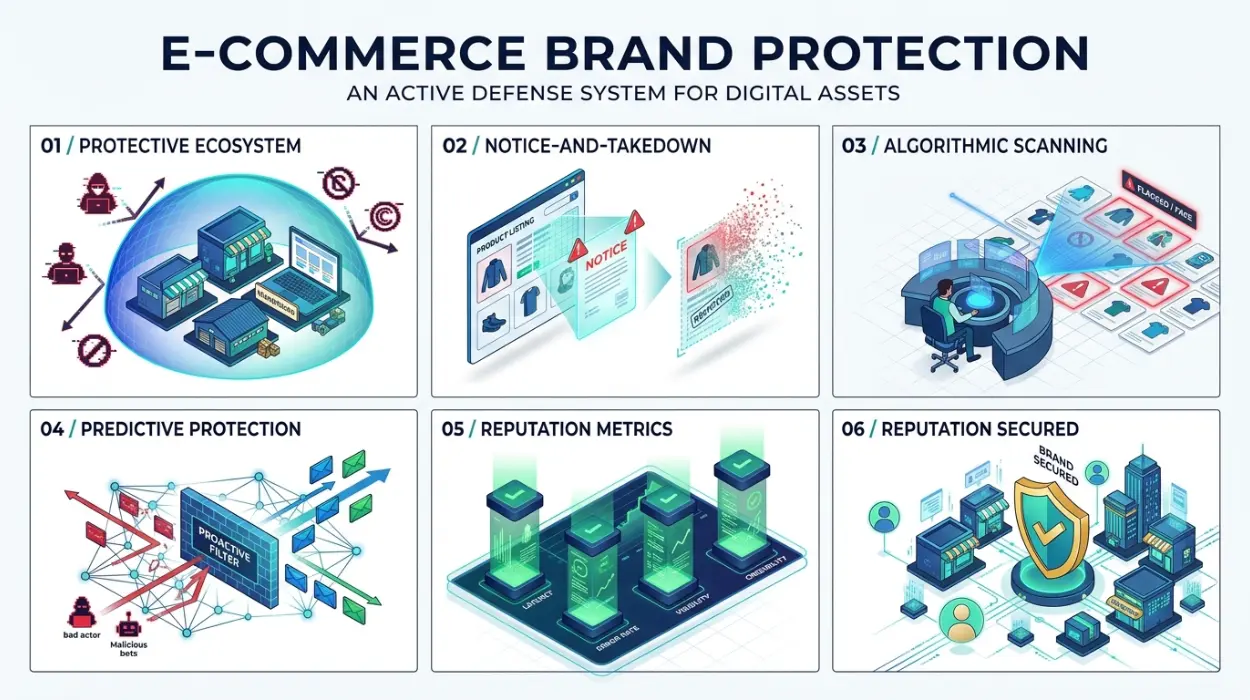
E-commerce platforms manage trademark infringement and counterfeit removal through notice-and-takedown procedures, automated brand-protection algorithms, and proactive algorithmic identification. Online reputation control methods are evaluated through processing latency, error rates, domain visibility impact, and entity credibility retention within search engine ecosystems.
How Do Automated Monitoring and Manual Notice-and-Takedown Systems Compare in Counterfeit Removal?
Automated monitoring and manual notice-and-takedown systems represent two distinct approaches to protecting brand identity and search perception. Automated monitoring relies on machine learning models, image recognition algorithms, and pattern matching to detect potential copyright and trademark violations across e-commerce product listings. Manual notice-and-takedown relies on human review, legal assessment, and formal submission of infringement notices under frameworks such as the UK Trademarks Act 1994 or international intellectual property directives.
Automated monitoring operates by continuously scanning platform databases, seller accounts, and newly indexed URL structures for matches against protected visual, textual, or structural brand assets. When a potential violation reaches a predetermined probability threshold, the automated system restricts the listing, flags the seller account, or suppresses the URL from public search functions. Manual notice-and-takedown operates by requiring rights holders or legal representatives to identify infringing assets, prepare formal legal notices, document evidence of infringement, and submit structured complaints through administrative platform channels.
The primary strength of automated systems lies in scalability, processing speed, and immediate suppression of non-compliant listings before search engines index the page. The core limitation of automated systems is a higher incidence of false positives, which disrupts legitimate distribution networks and creates seller grievances. The main strength of manual systems is legal precision, high submission acceptance rates, and accurate classification of complex intellectual property disputes such as fair dealing, parallel imports, or licensing exceptions. The core limitation of manual notice-and-takedown is high administrative overhead, delayed response times, and ongoing resource demands as infringers re-list suppressed items.
From a search ecosystem perspective, automated monitoring prevents unauthorized product pages from establishing domain authority or appearing in organic search results. Immediate removal minimizes negative user experiences and reduces brand association with substandard products, preserving positive sentiment distribution across search engine result pages. Manual notice-and-takedown acts as an administrative mechanism that alters search ecosystem dynamics after indexing has occurred, requiring subsequent search engine crawling to drop de-indexed pages from primary search indexes.
What Are the Mechanisms and Effectiveness Differences Between Content Removal and Search Content Suppression?
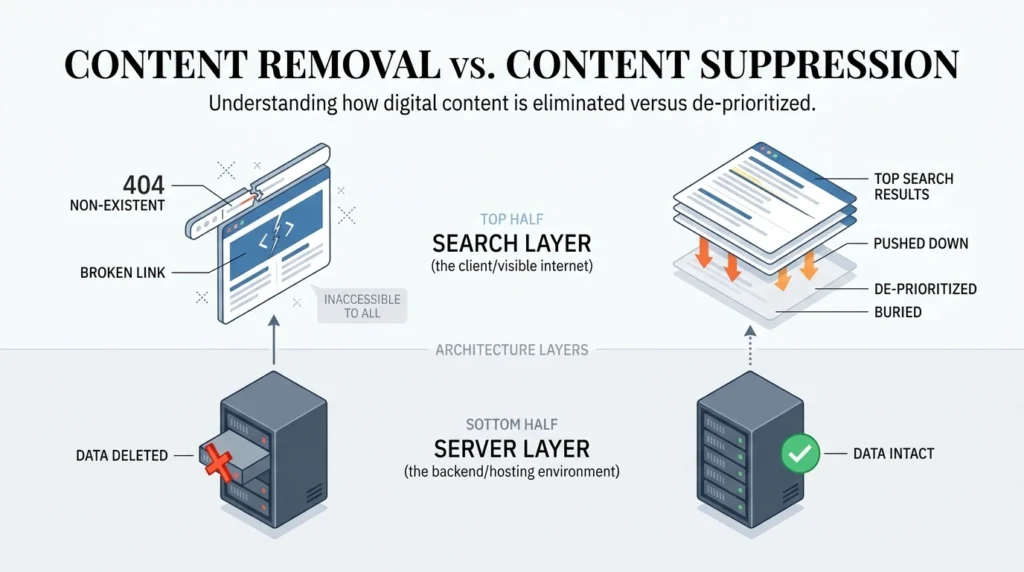
Content removal and content suppression operate on different layers of digital architecture to address unauthorized listings and damaging web entities. Content removal eliminates infringing content directly from the host platform, web server, or database, rendering the underlying URL non-existent. Content suppression leaves the original web asset intact on its host server but modifies search engine perception, indexation, or positioning to reduce public visibility.
Content removal operates by issuing administrative or legal takedown notices directly to e-commerce site operators, web hosts, or domain registrars under applicable intellectual property laws. Upon successful processing, the platform removes the database entry, returning a 404 or 410 HTTP status code that signals permanent deletion to search engine crawlers. Content suppression operates by utilizing search engine de-indexing requests, rights-holder legal filings under copyright and trademark provisions, or legal injunctions served directly to search engines. Alternatively, strategic search engine optimization builds higher-authority, positive web assets that outrank infringing listings on primary search engine result pages.
Content removal achieves complete eradication of infringing product listings from the source platform, eliminating direct point-of-sale transactions and long-term search indexing capabilities. Its effectiveness depends on platform responsiveness, host jurisdiction, and whether the seller operates within cooperative regulatory environments. Content suppression through search engine de-indexing prevents searchers from discovering infringing URLs via organic queries, even if the underlying product listing remains hosted on an obscure or uncooperative third-party website. Suppression via positive content creation alters the overall search perception landscape by displacing undesirable content, though the original infringing source remains accessible via direct link.
In terms of risk exposure and sustainability, content removal provides permanent risk elimination at the specific URL level, provided the operator prevents re-uploading. Content suppression through legal search de-indexing offers strong long-term visibility control across major search engine boundaries, though it does not stop traffic generated through social media, direct messaging, or direct URL entry. Content suppression via asset optimization requires ongoing maintenance to retain search engine authority against dynamic ranking updates and new competitor or infringer activity.
How Do Proactive Brand Protection Strategies Compare to Reactive Infringement Response?
Proactive brand protection strategies establish defensive frameworks before unauthorized listings or counterfeit sales occur across digital channels. Reactive infringement response addresses intellectual property violations after the infringing content has been indexed, ranked, and discovered by consumers or rights holders.
Proactive brand protection operates by integrating e-commerce brand registries, registering official trademark documentation directly within platform ecosystems, applying cryptographic serialisation to physical goods, and configuring automated platform filters. These systems screen seller registrations, inventory uploads, and metadata updates against verified brand parameters before publication. Reactive infringement response operates by scanning active marketplace listings, processing consumer complaints, monitoring external search engine results, conducting physical test buys, and issuing formal legal cease-and-desist documentation to identified infringers.
Proactive strategies provide operational scalability, rapid response cycles, and continuous protection across vast marketplace databases without requiring manual legal intervention for every transaction. Proactive frameworks reduce risk exposure by preventing counterfeit listings from ever achieving search engine visibility or establishing sales history. The limitation of proactive strategies lies in high initial setup complexity, technical integration requirements, and potential friction with authorized third-party sellers or distributors. Reactive frameworks allow targeted legal focus on high-impact infringers and complex legal violations, but they operate under constant performance lag, allowing bad actors to capture market share and alter consumer sentiment distribution before intervention occurs.
Search engines interpret long-term proactive brand protection as a signal of high entity stability, trust, and brand clarity. Maintaining clean marketplace environments reduces search noise, prevents confusion between official and unauthorized entities, and consolidates ranking signals into verified domain structures. Reactive responses frequently result in persistent search engine result page fluctuation, where removing one indexed infringing page creates a temporary vacuum quickly filled by another unauthorized seller URL until further takedown actions occur.
What Are the Strategic Differences Between Administrative Platform Takedowns and Judicial Enforcement Options?
Administrative platform takedown channels and judicial enforcement represent two distinct legal and operational pathways for resolving trademark infringement across e-commerce networks. Administrative platform takedown relies on private dispute resolution mechanisms provided directly by marketplace operators. Judicial enforcement utilizes court systems, formal legal injunctions, and legal judgments within specific country jurisdictions.
Administrative platform takedown operates by submitting evidence of registered intellectual property through proprietary platform portals, such as marketplace brand protection programs. The marketplace platform evaluates the claim against internal policies and contractual terms of service, subsequently removing listings or suspending seller accounts without formal court intervention. Judicial enforcement operates by initiating civil or criminal litigation through legal courts, obtaining preliminary injunctions, issuing subpoena orders to identify anonymous sellers, and securing court orders requiring platforms, domain registrars, or search engines to block access to infringing operations.
Administrative takedown offers high speed, low financial cost, and multi-jurisdictional reach through standardized corporate platform frameworks. Its limitation is strict adherence to platform-specific policies, lack of monetary damage recovery, and limited utility when addressing sophisticated infringers who operate across independent, non-cooperative websites. Judicial enforcement provides binding legal remedies, civil damage awards, domain seizures, and cross-platform enforcement capabilities. Its limitation stems from high costs, lengthy court timelines, complex international jurisdictional boundaries, and administrative burden when targeting small-scale, dispersed online infringers.
In search engine ecosystems, administrative platform takedowns quickly eliminate infringing URLs from marketplace search engines, indirectly reducing their external search engine indexation as platforms update sitemaps. Judicial enforcement produces formal court orders that major search engines must respect globally or regionally, resulting in root-level URL de-indexing from primary search engine indexes. This permanent legal suppression establishes definitive boundaries for entity reputation management and removes systemic search risks associated with persistent intellectual property abuse.
How Do E-Commerce Infringement Takedowns Influence Entity Credibility and Search Perception Metrics?
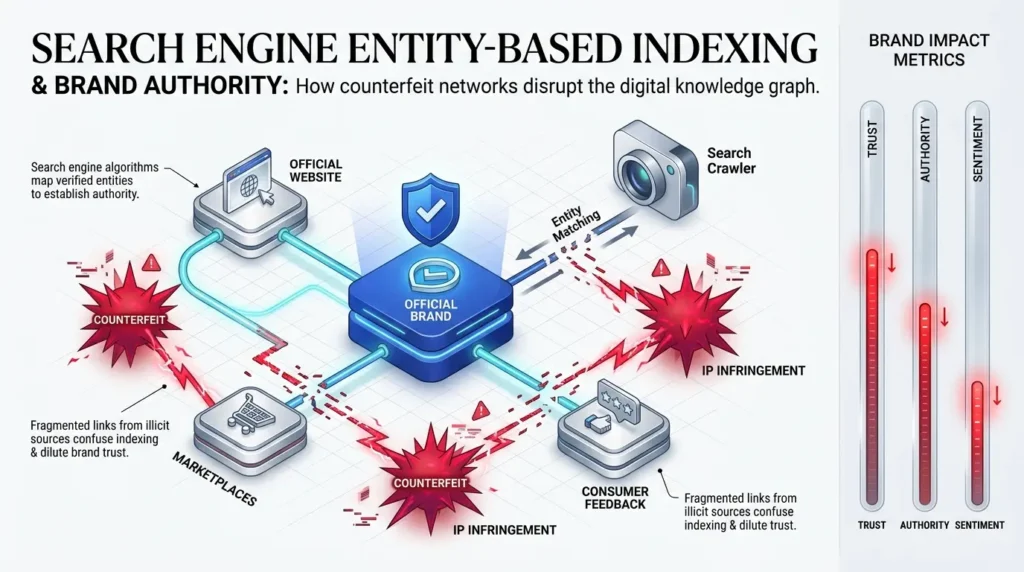
Search engines employ advanced entity-based indexing to understand relationships between brands, official websites, marketplace sellers, and consumer feedback signals. E-commerce trademark infringement and counterfeit availability directly affect how search algorithms assess entity authority, trust, and sentiment across digital knowledge graphs.
When unauthorized or counterfeit products proliferate across major e-commerce platforms, search engine crawlers index conflicting product specifications, inconsistent pricing data, and negative user reviews associated with the core brand entity. Search algorithms process these distributed signals, resulting in diluted topical authority, degraded sentiment scores, and potential drops in search ranking influence for official brand domains. Furthermore, algorithmic quality updates penalize search landscapes characterized by high user bounce rates, transaction security complaints, and poor user satisfaction metrics tied to counterfeit goods.
Implementing systematic copyright trademark removal mechanisms restores consistency across search engine indexes by eliminating non-compliant product data and negative consumer sentiment signals. When infringing listings disappear, search engines re-crawl marketplace domains and re-evaluate brand-related query results. This process consolidates algorithmic trust signals toward official digital assets, ensures accurate pricing and product information in search snippets, and stabilizes sentiment distribution across organic search result pages.
Systematic intellectual property protection maintains domain authority by preventing unauthorized third-party URLs from ranking above official distribution channels for branded queries. Securing brand queries ensures that high-intent commercial traffic reaches legitimate web properties, reinforcing the entity’s relevance and search credibility over extended operational periods.
What Strategic Frameworks Determine the Long-Term Sustainability of Online Reputation Control?
Evaluating long-term online reputation control requires analyzing processing latency, coverage completeness, resource allocation, and systemic risk mitigation across all active digital channels. Sustainable brand protection avoids relying solely on single-point enforcement methods, incorporating balanced, multi-layered strategies that adapt to evolving platform rules and infringer tactics.
A comprehensive evaluation framework measures four core operational dimensions:
- Calculate processing latency by tracking the time elapsed between initial listing publication, system detection, takedown submission, and final URL removal from search indexes.
- Evaluate coverage completeness by assessing the percentage of active marketplace platforms, search engine indexes, and social media channels actively monitored and cleared of unauthorized assets.
- Measure false positive rates by quantifying the volume of legitimate seller accounts or authorized distribution channels mistakenly disrupted by enforcement actions.
- Assess systemic risk reduction by evaluating whether enforcement actions produce permanent deterrence or merely shift infringing activity to alternate digital domains.
Organizations that combine automated scanning tools for rapid, high-volume detection with expert human review for complex legal analysis achieve superior long-term performance across all four evaluation dimensions. Automated tools provide continuous coverage and speed, while expert legal analysis prevents costly false positives and ensures enforcement actions withstand platform appeals or legal counter-notices.
Ultimately, maintaining digital trust systems requires aligning intellectual property enforcement with overall search perception objectives. Removing unauthorized listings is not merely an administrative exercise; it is an active mechanism for managing search engine understanding, controlling brand perception, and protecting long-term enterprise value within digital search ecosystems. Organizations seeking to protect your e-commerce brand with our intellectual property takedown team must evaluate these strategies through a rigorous structural lens to ensure sustainable brand integrity and search authority.
How do e-commerce platforms identify trademark infringement and counterfeit listings?
E-commerce platforms identify trademark infringement through automated image recognition software, pattern-matching algorithms, and keyword monitoring alongside manual notices submitted by brand owners. These systems continuously cross-reference product titles, visual assets, and seller data against registered intellectual property databases. When potential counterfeits or unauthorized uses are flagged, platforms enforce account restrictions or remove listings to prevent bad actors from misleading consumers.
What is the process for submitting a counterfeit removal request on online marketplaces?
Rights holders submit counterfeit removal requests by providing proof of registered trademarks, direct links to infringing product URLs, and evidence of unauthorized brand asset usage through administrative platform portals. Dedicated brand protection teams like Clear Your Name assist by managing copyright trademark services to streamline documentation submission and expedite listing takedowns. Once validated, platforms remove the database entry and issue status codes that signal permanent URL deletion to search engine crawlers.
How does removing counterfeit products from e-commerce sites impact organic search rankings?
Removing counterfeit product listings directly eliminates unauthorized pages that split keyword relevance and siphon commercial traffic away from official brand domains. Search engine crawlers update their indexes to remove de-indexed seller pages, consolidating domain authority and ranking signals back to verified corporate websites. This process improves search snippet accuracy, stabilizes sentiment distribution, and protects overall entity credibility within search engine results pages.