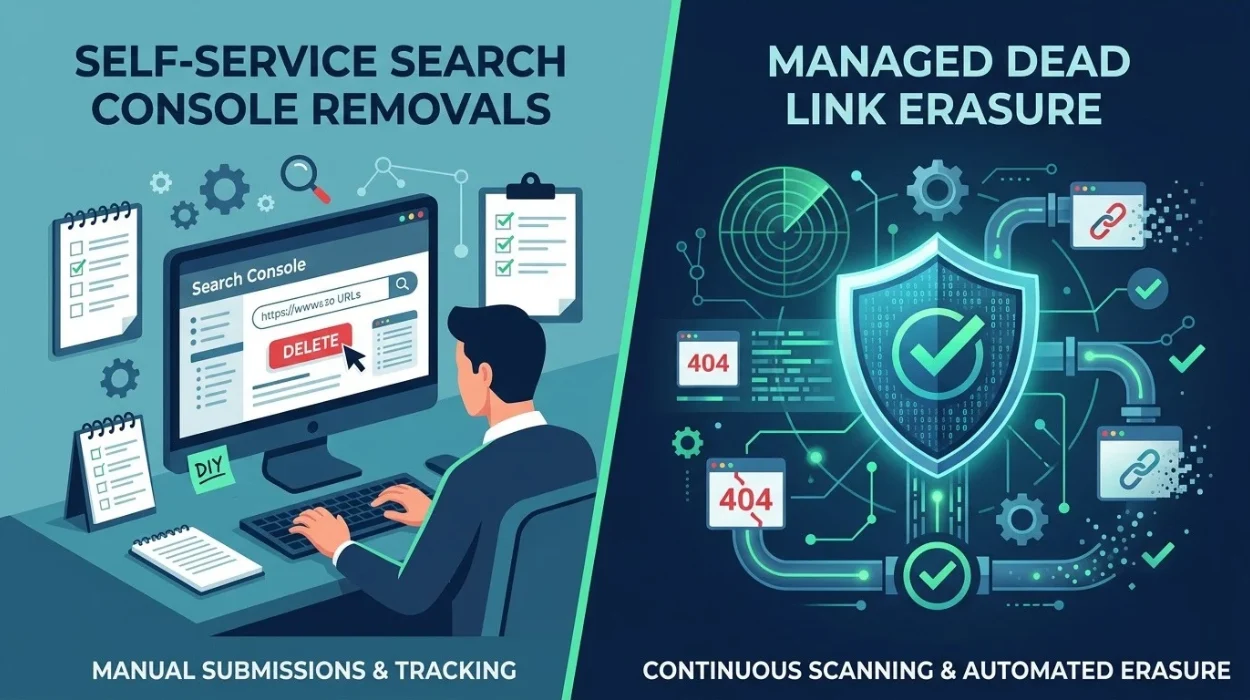
Self-service Search Console removals and managed dead link erasure address outdated search results through different mechanisms, levels of control and implementation requirements. Self-service tools primarily manage search visibility, whereas managed approaches coordinate technical investigation, source-level changes and removal procedures according to the circumstances of each URL.
Reputation management strategies differ based on whether the objective is to remove outdated information, suppress an eligible search result or strengthen the visibility of accurate content. Online reputation control methods are evaluated through effectiveness, permanence, scalability, risk exposure and their influence on search engine results pages (SERPs). Broken links, cached snippets and dead previews create distinct technical problems because a deleted resource and its previously indexed representation do not necessarily disappear together. Selecting an appropriate method requires understanding how crawling, indexing and result generation interact with the original content. The central consideration is whether the problem originates in the source, the search index or the wider network of external references.
How Do Self-Service Search Console Removals Compare with Managed Dead Link Erasure?
Self-service removals provide direct access to search engine tools, allowing eligible users to request temporary hiding of specific URLs from search results. Managed dead link erasure is a coordinated process that investigates the URL, identifies the source of outdated information and applies relevant technical or procedural remedies. The first approach places implementation responsibility on the website owner or individual, while the second involves delegated analysis and execution. Both approaches address search visibility, but they differ in scope, technical oversight and the allocation of responsibility. Their effectiveness depends on whether the selected mechanism matches the actual cause of the persistent result.
Self-service tools offer direct control over individual requests and make their status accessible through the relevant account interface. They are particularly suitable for straightforward cases where the URL is known, the user has the necessary access and the required action falls within the tool’s eligibility rules. Managed handling introduces a broader assessment of URL status, source ownership, indexing behaviour and possible dependencies between related pages. This wider scope supports more complex cases involving multiple URLs or inconsistent technical responses. However, delegation does not remove search engine eligibility requirements or guarantee a particular ranking or de-indexing outcome.
Which Approach Provides More Permanent Removal of Outdated Search Results?
Permanent removal depends primarily on whether the underlying source and indexing conditions are addressed, rather than on who submits the request. A temporary search removal hides an eligible URL from results for a defined period, but it does not permanently delete the source content. If the page remains accessible and continues to qualify for indexing, the result can reappear after the temporary restriction expires. Permanent de-indexing requires an appropriate underlying condition, such as a genuinely removed resource returning a suitable HTTP status code. The search engine then needs to recrawl and reassess the URL before its index reflects the change.
Managed dead link erasure focuses on identifying the appropriate remedy for each URL instead of treating every outdated result as the same problem. A deleted page that returns a 404 or 410 status communicates unavailability, while an accessible page containing obsolete information requires a different assessment. An incorrect redirect or a page returning a successful status despite displaying an error message can complicate indexing decisions. Managed handling can coordinate these distinctions across a collection of URLs, while self-service handling requires the user to understand and implement them independently. Neither approach establishes permanence through a temporary removal request alone.
How Do Content Suppression and Source-Level Removal Differ?
Content suppression reduces the visibility of a result without necessarily changing the underlying resource. It operates through eligible search engine removal mechanisms, supported legal or policy-based requests, or other measures that affect the result’s availability in search. Source-level removal changes the content or technical response at the origin, addressing the resource that search engines and users attempt to access. The distinction is important because a suppressed result can remain available through a direct URL, another search engine or an external website. Source-level removal addresses the original location, but copies and independent references require separate consideration.
Self-service removal tools are useful when the problem meets the search engine’s criteria and the user can identify the correct URL. Their limitations become apparent when the original publisher controls the content, when the page remains accessible or when a request requires evidence of a policy violation. Managed processes focus on matching each condition to the relevant route, including technical corrections, publisher requests and eligible search removal procedures. This approach provides broader coordination, but it does not override the authority of publishers, website owners or search platforms. Effective evaluation therefore distinguishes removal from the original source, suppression in search results and the reduction of visibility across the wider digital footprint.
How Do Organic and Reactive Reputation Strategies Influence SERP Composition?
Reactive reputation strategies address a defined problem after it becomes visible, such as an outdated snippet, a dead preview or an obsolete page title appearing in search results. These strategies operate by identifying the affected URL and applying a remedy suited to its status, ownership and indexing condition. Organic reputation strategies develop accurate, useful content and strengthen its discoverability through consistent entity information and relevant website structures. They influence the composition of search results by supplying alternative resources that search engines assess for relevance and usefulness. The two approaches address different objectives: reactive methods target a specific result, while organic methods improve the broader information environment surrounding an entity.
Content suppression and content enhancement also differ in their effects on reputation signals. Suppression targets the visibility of a particular result, whereas enhancement strengthens accurate resources through relevant content, clear information architecture and appropriate internal linking. Search engines evaluate pages according to relevance, quality, accessibility and other ranking systems rather than simply rewarding the publication of replacement content. Consequently, publishing additional pages does not guarantee that an outdated result loses visibility. A balanced evaluation measures whether the problematic result has changed, whether accurate resources are discoverable and whether the overall SERP better represents the entity’s current information.
Which Method Offers Better Scalability for Multiple Dead Links?
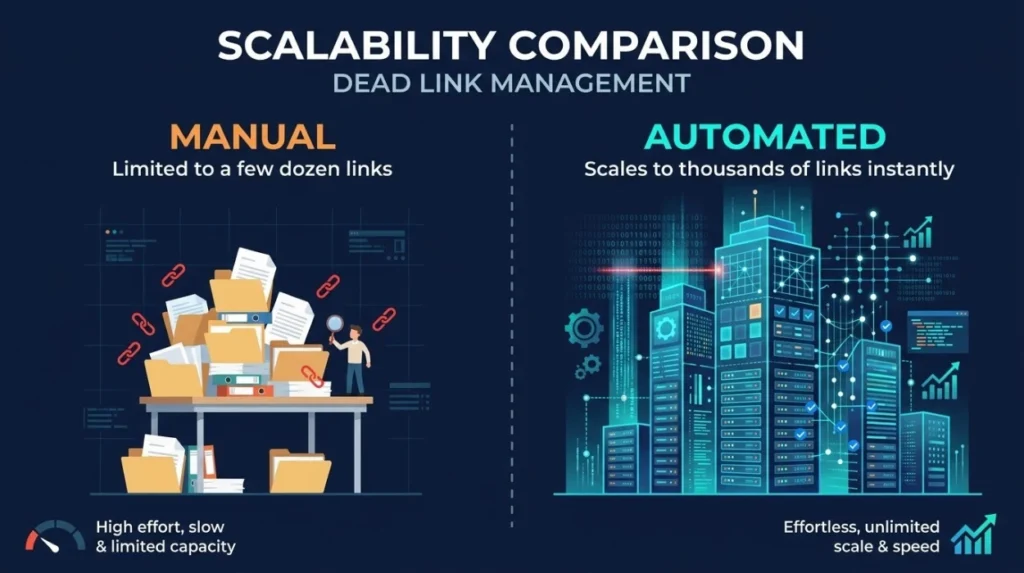
Scalability refers to the ability to manage a growing number of affected URLs without losing accuracy, traceability or procedural consistency. Self-service handling is straightforward for a small number of clearly identified URLs, especially when the user already understands the search engine’s requirements. As the URL count increases, the work expands to include status checks, evidence collection, request submission, progress monitoring and follow-up verification. Repeating these tasks manually increases administrative effort and creates opportunities for inconsistent decisions. The scalability of self-service handling therefore depends on the user’s technical capability, available time and ability to maintain reliable records.
Managed dead link erasure centralises investigation and coordination across multiple URLs. A structured workflow groups pages according to their technical status, source ownership, removal eligibility and required action, allowing related cases to follow consistent procedures. This is particularly relevant when an outdated title appears across multiple URLs or when external references complicate the removal process. Delegation can reduce the internal workload, but the quality of the process still depends on accurate diagnosis, clear reporting and appropriate technical implementation. Scalability is therefore measured through consistency, case tracking and verified outcomes rather than the number of requests submitted.
How Do Both Approaches Affect Risk Exposure and Entity Credibility?
Risk exposure includes the possibility of incorrect requests, unnecessary content removal, missed technical dependencies and mistaken assumptions about what a search result represents. Self-service methods give the user direct control, but that control also places responsibility for URL selection, evidence and implementation on the individual or organisation. An incorrectly targeted request can affect the wrong resource or fail to address the actual cause of the problem. A technically inappropriate redirect can create additional indexing complications instead of resolving the original issue. Risk management requires verifying the URL, confirming the source status and documenting the reason for each action.
Managed handling distributes implementation tasks but introduces its own oversight requirements. The scope of work, access permissions, evidence standards and reporting procedures determine how transparently the process operates. A reliable assessment distinguishes confirmed technical changes from requests that remain pending or outcomes controlled by an external platform. This distinction matters for entity credibility because claims of completed removal need to match observable search results and the status of the original resource. Neither self-service nor managed handling guarantees that every external reference disappears, so outcome reporting must account for search engines, publishers and third-party websites as separate information sources.
How Should Short-Term Results Be Measured Against Long-Term Reputation Impact?
Short-term performance is measured through immediate changes in search visibility, including whether an eligible result is hidden, whether the source page returns the correct status and whether the outdated snippet remains visible. These indicators establish whether the selected intervention has produced its intended technical or search-level effect. A temporary suppression can deliver a rapid visibility change without resolving the original content problem. Source-level correction addresses the underlying resource, although search engines require time to process and reflect the change. Evaluation must therefore separate immediate visibility outcomes from durable changes to the information available online.
Long-term performance concerns the stability of the correction and its relationship to the wider digital footprint. Relevant measures include repeated checks of the affected URL, confirmation that obsolete content is no longer served at the source and monitoring for renewed indexing. External copies, syndicated pages and independent references require separate analysis because correcting one URL does not change every other publication. Organic content development supports this work by maintaining accurate, accessible information about the entity, while reactive measures address specific technical or policy-based problems. Sustainable reputation management combines verifiable source corrections with ongoing monitoring rather than relying exclusively on temporary suppression or new content publication.
Dive Deeper With Our Expert Guides:
How Google’s Outdated Content Tool Processes Expired and Broken URLs
How Google Search Caching Works and How to Fix Persistent Ghost Results
When Is Managed Dead Link Erasure More Suitable Than Self-Service Removal?
Self-service removal is most suitable when the issue is clearly defined, the URL is eligible for the selected tool and the user can implement any required source-level correction. It provides a direct route for managing straightforward requests without introducing an additional coordination layer. Managed dead link erasure is more relevant when the issue involves multiple URLs, uncertain technical causes, external publishers or the need to coordinate several removal mechanisms. Its value lies in structured diagnosis and process management rather than privileged control over search engine decisions. The appropriate choice depends on the complexity of the case, available expertise, accountability requirements and the nature of the desired outcome.
For cases involving outdated cached snippets and dead previews, Clear Cached Search Snippets and Dead Previews represents the specific problem category in which source status, indexing and search visibility require coordinated assessment. The distinction between an unavailable page and a persistent search representation remains central to selecting the remedy. A technical correction, a temporary removal request and a publisher-level content change address different parts of the information lifecycle. Evaluation is most reliable when each action has a defined purpose and its outcome is verified independently. This prevents a submitted request from being treated as proof that the original content or every indexed reference has disappeared.
What Is the Most Reliable Framework for Comparing Removal Methods?
A reliable comparison evaluates each method against the same criteria rather than judging success by the speed of the first visible change. The assessment begins by confirming whether the source page is live, removed, redirected or returning an error. It then establishes whether the search result remains indexed, whether a temporary suppression is appropriate and whether another publisher controls a copy of the information. The next stage compares implementation effort, eligibility, permanence, oversight and the evidence available to verify the outcome. This sequence aligns the selected intervention with the actual source of the visibility problem.
The final assessment distinguishes technical completion from reputational impact. A URL returning the correct status confirms a source-level change, while a disappearing search result confirms a change in search visibility at the time of checking. Neither observation alone establishes that every copy has been removed or that search perception has permanently changed. Monitoring, accurate information architecture and relevant content help assess whether the wider SERP continues to represent the entity appropriately. This framework provides a consistent basis for comparing self-service removals, managed dead link erasure and complementary organic reputation strategies.
Self-service Search Console removals and managed dead link erasure differ in implementation responsibility, scope and the level of coordination required. Self-service tools provide direct control over eligible search visibility requests, while managed processes coordinate diagnosis, source-level corrections and appropriate removal routes. Permanent outcomes depend on the underlying URL status, search engine processing and the continued existence of external references. Organic content enhancement complements reactive removal by strengthening accurate information within the SERP, but it does not guarantee the displacement of a specific result. The most appropriate method is the one that addresses the identified cause, controls avoidable risk and produces verifiable outcomes over time.
What is the difference between Google Search Console removals and managed dead link erasure?
Google Search Console removals temporarily hide eligible URLs from Google Search, while managed dead link erasure involves investigating outdated URLs and coordinating appropriate technical or removal procedures. The right approach depends on source availability, indexing status and removal eligibility.
How can I permanently remove a dead link from Google search results?
Remove the source page or configure it to return an appropriate HTTP status, such as 404 or 410, then allow Google to recrawl and reassess the URL. A temporary removal request alone does not guarantee permanent de-indexing.
Is managed dead link removal better than using Google Search Console myself?
Self-service removal is suitable for straightforward cases where the URL and required action are clear. Managed dead link removal is useful for complex cases involving multiple URLs, technical issues or external publishers, but neither method guarantees removal.
How long does Google take to remove outdated search snippets?
The timeframe depends on crawling, indexing and the status of the original page. Submitting a removal request or correcting the source can help, but search-result updates are not always immediate.
Can removing dead links improve online reputation?
Removing outdated search results can reduce the visibility of obsolete information and improve the accuracy of an entity’s search presence. The overall reputation impact depends on whether the source is corrected, external references remain accessible and accurate content is discoverable.