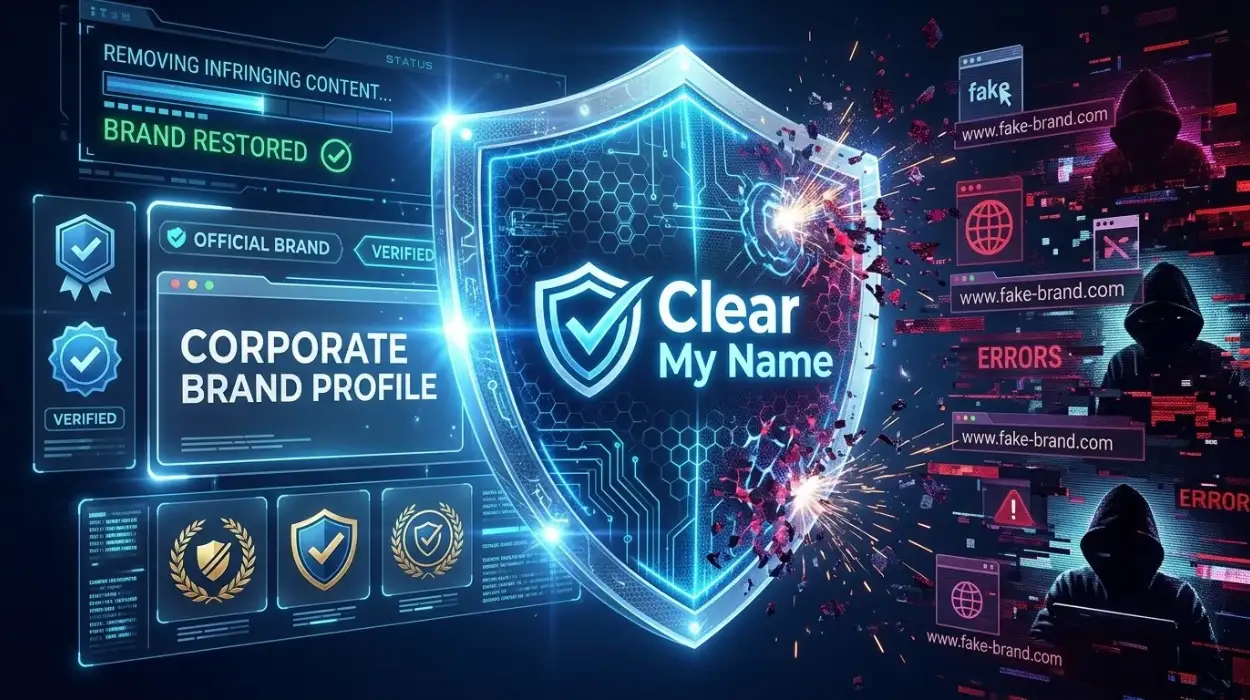
Clear Your Name provides copyright and trademark support to help businesses address unauthorised brand use, impersonation websites and infringing digital content. Effective intellectual property removal strengthens search visibility control, protects entity credibility and reduces the risk of misleading information influencing customer decisions.
Brand hijacking occurs when an unauthorised party exploits a company’s identity, trademarks or digital assets to mislead audiences or benefit from established brand recognition. Within search ecosystems, fake websites and impersonation pages create competing reputation signals that make it harder for users to identify official business information. A structured intellectual property removal process identifies the nature of the infringement, establishes the relevant evidence and directs complaints to the appropriate platforms or service providers. The objective is to address actionable violations while improving the accuracy of the company’s digital footprint. Clear Your Name applies this service-led approach to copyright and trademark concerns, with outcomes assessed through documented actions, content status and search visibility rather than unsupported guarantees.
How Can an IP Removal Team Eliminate Brand Hijackers and Fake Websites?
A dedicated IP removal team addresses brand hijacking by identifying unauthorised use, assessing the applicable intellectual property rights and submitting evidence-based complaints through appropriate reporting channels. This process distinguishes copyright infringement, trademark misuse, impersonation and general reputational harm because each issue requires a different response. Copyright complaints concern unauthorised use of protected creative works, such as original images, text, videos or graphics. Trademark complaints address qualifying misuse of protected brand identifiers, including names and logos, subject to the relevant legal requirements. Impersonation reports focus on deceptive representations of affiliation or identity under applicable platform policies.
The first stage involves documenting the suspected violation. An assessment records the relevant URLs, the original intellectual property, evidence of ownership or authority, the type of unauthorised use and the platform hosting the material. This evidence creates a clear connection between the protected asset and the reported content, supporting a more precise complaint. It also reduces the risk of targeting legitimate references, independent commentary or material covered by an applicable licence. Clear documentation provides a reliable basis for deciding whether a copyright notice, trademark complaint, impersonation report or another route is appropriate.
The second stage involves directing the complaint to an organisation with the authority to address the identified issue. A hosting provider can review content stored on its infrastructure, a social platform can investigate accounts operating on its service, and a search engine can assess requests concerning its own results. A domain registrar does not necessarily control website content, so reporting a page to the registrar alone does not guarantee removal. Matching the complaint to the responsible intermediary reduces procedural delays and keeps the requested action aligned with the problem. The result is a more accountable process for addressing unauthorised brand use across digital channels.
Which Copyright and Trademark Removal Services Address Brand Misuse?
Copyright and trademark removal services address different forms of intellectual property misuse, making accurate classification essential to a successful complaint. Copyright protection applies to qualifying original creative works, while trademark rights protect eligible signs that distinguish goods or services. A fake website that copies a company’s original product photography and written descriptions presents a potential copyright issue. A website using a protected logo or trading identity in a manner that meets the relevant infringement test presents a potential trademark issue. A fraudulent website impersonating the company can also breach platform policies, even where the evidence does not establish a copyright claim.
Copyright complaints work best when the claimant can identify the protected work and the specific unauthorised reproduction. Original files, publication records, ownership agreements and dated screenshots help establish the basis of the complaint. The notice identifies the material at issue and explains the claimant’s rights in accordance with the recipient’s requirements. A valid complaint can lead to the removal or disabling of access to infringing content, depending on the applicable procedure and recipient’s decision. It does not automatically justify removing every page that mentions the company or uses similar terminology.
Trademark complaints require evidence that connects the disputed use to the relevant protected mark and the applicable legal or platform standard. Registration details, proof of ownership, screenshots and URLs help establish the context of the alleged misuse. The assessment considers how the mark appears, what the page offers and whether the use falls within the scope of the relevant rights. Trademark ownership alone does not make every reference to a company unlawful, particularly where a use is descriptive, referential or otherwise permitted. Precise reporting therefore improves the quality of the complaint and reduces the risk of an unjustified removal request.
Businesses evaluating these options benefit from understanding how brand hijacking damages corporate reputation before selecting a removal route. This analysis connects the visible problem with its underlying mechanism, including misleading identity signals, competing branded search results and uncertainty about the authenticity of digital information. It also explains why a reputational concern alone does not establish an intellectual property violation. When the issue is correctly classified, the removal process becomes more targeted, defensible and measurable.
How Does Clear Your Name Improve Search Visibility and Entity Credibility?
Clear Your Name focuses on addressing actionable copyright and trademark concerns that affect how a company’s digital identity appears online. The process connects evidence collection, complaint preparation and platform-specific reporting with the objective of reducing the visibility or availability of unauthorised content. Its value lies in matching the intervention to the nature of the infringement rather than treating every negative search result as removable. This distinction matters because search engines evaluate content through their own indexing and ranking systems, while platforms and rights holders follow separate reporting and legal procedures. An effective removal strategy therefore measures verified outcomes instead of assuming that submitting a complaint automatically changes rankings.
Search visibility control begins with identifying where unauthorised material appears and how it relates to branded search queries. A review of search engine results pages (SERPs) establishes whether fake websites, copied assets or misleading pages are visible for the company’s name, products or official contact information. This baseline allows subsequent monitoring to distinguish removal of the source page from changes in indexing or ranking. If a platform removes infringing material, the original URL can still appear temporarily in search results until the search engine updates its index. Where the source remains available, search visibility can also persist even if another page receives a better ranking.
Entity credibility improves when users can distinguish legitimate corporate sources from unauthorised representations. Removing verified infringing material reduces one source of confusion, while consistent official information reinforces the relationship between the organisation, its website and its authorised communications. These changes support clearer search perception, particularly when users compare official pages with suspicious alternatives. However, a takedown does not automatically restore every trust signal or eliminate all negative discussion about a company. Reliable assessment separates confirmed removal outcomes from wider improvements in public perception.
What Process Makes Intellectual Property Removal Reliable and Transparent?
A reliable intellectual property removal process follows defined stages, records evidence and links each action to an identifiable outcome. Clear Your Name’s Copyright Trademark Services can be evaluated against these process requirements when a business is considering support for suspected infringement. The purpose of a structured workflow is to establish what happened, identify the correct reporting route and document the response received. This creates an auditable record of the complaint and helps the business understand the status of the disputed content. Clear process documentation also supports consistent decision-making when incidents involve more than one website or platform.
The process can be understood through five practical stages:
- Identify the suspected infringement by recording URLs, screenshots, publication details and the relevant brand asset.
- Verify ownership or authority by gathering registration records, original files, licences or other evidence appropriate to the claim.
- Classify the issue as copyright infringement, trademark misuse, impersonation or another policy concern before selecting a reporting route.
- Submit the complaint through the responsible platform, hosting provider or other relevant intermediary using its required procedure.
- Monitor the outcome by checking the reported URL, recording the recipient’s decision and verifying whether the content remains accessible or indexed.
Each stage addresses a specific source of procedural risk. Identification prevents vague complaints that fail to locate the disputed material, while verification establishes the basis for asserting the relevant rights. Classification helps prevent copyright notices from being used to address issues that depend on trademark law or platform policies. Submission creates a documented request for action, and monitoring distinguishes an accepted complaint from a completed removal. This structure improves accountability without promising that every report will succeed.
Transparency also requires clear communication about limitations. A provider cannot guarantee that an external platform will accept a complaint, that a foreign website will comply with a request or that every duplicate copy will disappear. The appropriate process depends on the evidence, the recipient’s authority, the applicable law and any dispute raised by the other party. A reliable service explains which actions have been taken and which outcomes remain outside its direct control. This clarity allows businesses to evaluate progress using documented evidence rather than assumptions.
Dive Deeper With Our Expert Guides:
Remove Stolen Brand Images and Photography Swiftly with Our Legal Service
Stop Competitor Trademark Misuse with Our Brand Protection Specialists
Is Professional IP Removal More Cost-Effective Than Managing Infringement Internally?
Professional IP removal is most valuable when the complexity of the incident, the volume of evidence or the need for consistent reporting exceeds the business’s available internal capacity. An internal team can handle straightforward cases when ownership records are accessible, the infringement is clear and the platform provides a usable reporting process. External assistance becomes more relevant when a case involves multiple URLs, different forms of intellectual property misuse or separate reporting procedures across platforms. The cost comparison therefore depends on the time required to investigate, prepare notices, monitor responses and manage disputed claims. Neither approach guarantees removal, and the decision should reflect the operational demands of the case.
Internal handling offers direct oversight and avoids some external service costs. However, staff time spent identifying hosts, checking rights, preparing evidence and following up with intermediaries has an operational cost even when no external invoice is issued. Inconsistent documentation also creates the risk of duplicate reports, incomplete notices or incorrect legal classifications. These problems increase the effort required to resolve the incident and make performance harder to measure. A defined internal process helps reduce these costs when the organisation has the appropriate expertise and capacity.
Professional support can consolidate evidence review, complaint preparation and follow-up into a more consistent workflow. Its value is assessed through the quality of submissions, clarity of reporting, time spent by internal staff and verified outcomes. Businesses can compare service fees with the internal resources required to perform the same work, while accounting for the possibility that a complaint is rejected or challenged. The comparison should also distinguish one-off removal activity from ongoing monitoring and repeat incidents. This produces a more realistic view of cost versus long-term value than measuring price alone.
How Quickly Can Fake Websites and Infringing Content Be Removed?

Removal speed depends on the type of violation, the completeness of the evidence, the recipient’s procedures and the complexity of the case. A straightforward complaint with clearly identified material and sufficient proof can be easier to assess than a disputed claim involving ownership, licensing or legal exceptions. Different platforms apply different review processes, so there is no universal timeframe for all copyright and trademark requests. International cases can introduce additional complexity when the parties, hosting infrastructure and relevant legal rules span different jurisdictions. A credible process communicates actual status and response milestones rather than promising a fixed completion date.
The first measurable milestone is submission of a complete complaint to the appropriate recipient. The next is acknowledgement or a decision from that recipient, followed by verification of whether the requested action has occurred. These milestones separate work completed by the reporting party from decisions controlled by external platforms or service providers. A submitted notice is not evidence that the content has been removed, and an acknowledgement does not necessarily indicate acceptance of the claim. Recording each stage provides an accurate picture of progress and identifies where further action is required.
Search engine updates introduce a separate timing consideration. When a hosting provider removes a page, the URL can remain visible in search results until the search engine recrawls the page or updates its index. Conversely, a search engine can remove a result from its own listings while the source content remains accessible elsewhere. Monitoring both the source and the relevant SERPs therefore provides a more complete view of the outcome. This distinction helps businesses understand whether the immediate infringement has been addressed and whether residual visibility remains.
How Does IP Removal Reduce Risk Without Creating New Legal Problems?
Risk-conscious IP removal begins with a valid legal or policy basis, supported by accurate evidence and a clearly defined request. The process must distinguish unauthorised copying or protected-mark misuse from lawful criticism, independent reporting and permitted references to a company. Overbroad complaints can be challenged and can create additional legal or reputational exposure. A business therefore benefits from documenting the specific material at issue and explaining how it relates to the rights being asserted. Narrow, evidence-based requests are easier to evaluate than general demands to remove unfavourable information.
Copyright procedures also include safeguards for disputed claims. Under the US DMCA framework, a qualifying counter-notification can trigger a process that allows the service provider to restore removed material unless the statutory conditions for preventing restoration are met. This means an initial takedown is not always permanent. The claimant must be prepared to assess a counter-notice and follow the applicable procedure rather than assuming the matter has ended. International disputes also require attention to jurisdiction and the rules that apply to the relevant service and rights.
Risk reduction extends to the way removal outcomes are communicated internally and externally. Businesses need accurate records showing what was reported, the evidence relied upon, the recipient’s response and the status of any remaining copies. These records support future decisions and reduce the chance of repeating an ineffective or unsuitable reporting method. They also allow management to distinguish a verified infringement from a suspected incident that remains unresolved. Responsible removal protects corporate credibility by applying intellectual property rights accurately rather than using takedown procedures as a general tool for suppressing criticism.
How Can Businesses Sustain Results After an IP Removal Request?
Sustainable results depend on combining incident-specific removal with ongoing monitoring and accurate official information. A successful takedown addresses the reported material, but it does not prevent a third party from publishing another copy, registering a similar domain or creating a new impersonation account. Businesses therefore need a clear record of affected assets, reported URLs and recurring patterns of misuse. Monitoring branded search results and official channels helps identify whether the original issue persists or reappears in a different form. This approach treats removal as a documented intervention within a wider reputation management process.
Content enhancement complements removal by making legitimate corporate information accessible, consistent and useful. Updated official pages, clear contact details, authorised social profiles and accurate product information help audiences verify the company’s identity. These measures support entity credibility and improve the quality of the digital footprint, although they do not guarantee a particular ranking position. Search engines evaluate pages according to their own systems, and competitors or independent publishers continue to influence SERP composition. The objective is to strengthen the visibility and clarity of legitimate sources while pursuing removal where the evidence supports it.
Long-term measurement should distinguish three outcomes: source availability, search visibility and reputation signals. Source availability records whether the disputed material remains accessible, search visibility tracks its presence in relevant results, and reputation signals capture the wider information associated with the company. These measures provide different evidence and should not be combined into a single claim of complete reputation recovery. Recurrence rates, the status of reported URLs and the consistency of official information offer practical indicators for continued evaluation. A sustainable approach uses those findings to refine monitoring and reporting rather than relying on a one-off removal request.
Why Choose Clear Your Name for Copyright and Trademark Removal?
Clear Your Name is relevant to businesses seeking a structured route for addressing suspected copyright infringement, trademark misuse and unauthorised digital representations. The decision rests on the clarity of its assessment process, the relevance of the proposed reporting method and the quality of the evidence supporting each complaint. Businesses need to understand what material is being challenged, which rights or policies apply and what result the proposed action seeks to achieve. A clear scope prevents expectations from extending beyond the authority of the relevant platform or service provider. It also gives the business a basis for evaluating whether the service aligns with the incident’s complexity and risk.
The practical value of an IP removal service lies in disciplined execution rather than an unconditional promise of deletion. Accurate classification, complete evidence, appropriate recipient selection and documented follow-up create a more reliable basis for addressing infringing content. These steps reduce avoidable procedural errors and make the status of each case easier to assess. Outcomes remain dependent on the facts, applicable law and decisions made by external providers, so credible service delivery reports those constraints openly. This approach supports informed decisions about cost, scope, timing and next steps.
Businesses considering professional copyright and trademark removal support can assess the proposed scope against their specific concerns, from copied creative assets to misleading uses of protected brand identifiers. The most relevant service is one that connects each suspected violation with an appropriate procedure and reports outcomes accurately. For further context, understanding international DMCA takedown procedures helps explain the evidence and process involved in copyright complaints across borders. Together, these considerations support a decision based on legal relevance, operational clarity and measurable progress rather than broad claims about controlling the entire search environment.
Clear Your Name’s Copyright Trademark Services provide a defined service option for businesses assessing suspected intellectual property misuse. The process centres on identifying the content, establishing the relevant rights, submitting an appropriate complaint and verifying the resulting action. This structure supports accountability and reduces the uncertainty associated with uncoordinated reporting. While final decisions remain with the relevant platforms, service providers or legal authorities, a clear evidence-led process gives businesses a sound basis for pursuing legitimate removal requests and evaluating their effect on online reputation.
How can I remove a fake website impersonating my business?
To remove a fake website impersonating your business, document the URL, capture screenshots and gather evidence of unauthorised use of your brand name, logo or copyrighted content. Clear Your Name’s Copyright Trademark Services address relevant infringement concerns through appropriate platform reporting and takedown procedures, depending on the evidence and applicable rules.
What is the difference between copyright infringement and trademark infringement?
Copyright infringement involves the unauthorised use of protected creative works, such as photographs, website copy or videos, while trademark infringement concerns qualifying unauthorised use of protected brand identifiers. Identifying the correct type of infringement helps determine the appropriate complaint process and supporting evidence.
Can an IP removal service remove fake websites from Google?
An IP removal service can submit appropriate complaints to website hosts, platforms or search engines when evidence supports a copyright, trademark or policy violation. Removing a website’s content and de-indexing its URLs from Google are separate actions, and neither outcome is guaranteed by submitting a complaint.
How long does it take to remove a brand hijacker or infringing website?
The time required to remove infringing content depends on the evidence, the reporting platform, the complexity of the claim and the applicable legal procedures. A complete complaint can support efficient review, but acknowledgement, removal and search engine index updates occur on different timelines.
How can copyright and trademark services protect a company’s online reputation?
Copyright and trademark services help businesses address qualifying unauthorised use of protected content and brand identifiers that creates confusion about their identity. Clear Your Name can help address these concerns through relevant reporting and takedown procedures, supporting clearer brand representation and reducing the visibility of confirmed infringing material where removal is approved.