Reputation management is the process of understanding how information shapes the credibility and public perception of an individual across digital environments. Online reputation refers to the collective interpretation of searchable information, including archived news articles, historical reports, public records and other content associated with a person’s identity.
Why Do Archived News Articles Continue to Affect Former Public Figures?
Archived news articles continue to affect former public figures because search engines preserve and rank historical content according to relevance, authority and other ranking signals, rather than the current status of the person described. An article published years earlier remains part of the digital footprint when its URL is accessible, its content remains indexed and external sources continue to reference it. The passage of time does not automatically remove a page from search results or change its original framing. Consequently, information connected to an individual’s previous public role can remain visible after that role has ended. This persistence creates a distinction between historical accuracy and present-day relevance.
An archived news article is a previously published report that remains accessible through a publisher’s website, digital archive or another online repository. Archival preservation supports historical research, public accountability and access to information. However, the context surrounding a report can change as an individual’s career, responsibilities and public standing develop. A story that accurately describes an earlier event does not necessarily provide a complete representation of the person’s present circumstances. Search visibility can therefore preserve an outdated impression without the underlying article becoming factually false.
The term harassment describes repeated unwanted conduct that causes distress or intimidation, but persistent search visibility does not automatically establish that a publisher or search engine is engaging in harassment. The distinction matters because the continued availability of historical reporting can have reputational consequences without demonstrating malicious intent. Search systems process accessible information through automated retrieval and ranking mechanisms, not through a complete assessment of an individual’s current life. Their results can therefore expose historical material repeatedly, even when the original news event no longer reflects the person’s present activities.
How Does Search Engine Indexing Keep Historical News Visible?
Content indexing allows search engines to store information about a webpage and consider it for inclusion in relevant search results. When a publisher maintains an archived article, the page remains eligible for crawling and indexing if technical settings and access conditions permit. Search engines analyse elements such as the page title, main text, links, structured information and relationships between entities to understand what the article concerns. These signals help determine which queries are relevant to the page. The article’s age alone does not determine whether it remains visible.
Ranking is a separate process from indexing. A page can be indexed without appearing prominently for a particular query, while a page with strong relevance and authority signals can occupy a prominent position for searches involving a person’s name. Search engine results pages (SERPs) present selected documents according to query-specific ranking systems. When someone searches for a former public figure, historical news coverage can rank because it directly mentions the individual’s name and addresses a topic associated with their public identity. The resulting visibility reflects the page’s relevance to the query, not necessarily its completeness as a description of the person.
External links also contribute to the way search engines discover and evaluate pages. A historical article referenced by other websites remains connected to the wider web, making it easier for crawlers to find and reassess the document. Links from established publications and relevant sources can contribute to a page’s perceived authority within search systems. Search engines do not simply rank the newest content first, nor do they automatically demote every article after a fixed period. Historical reporting therefore remains discoverable when its relevance, link relationships and other signals continue to support its ranking.
How Does an Old News Article Shape a Person’s Online Reputation?
An old news article shapes online reputation by influencing the information people encounter when they investigate an individual’s name, background or professional history. Online reputation is not a single score maintained by a search engine; it is an interpretation formed from the available digital footprint. That footprint includes news coverage, biographies, professional profiles, public statements, reviews and third-party references. The prominence of each source influences which aspects of a person’s history receive attention. When negative historical coverage dominates the first page of results, it can narrow the information available for an initial assessment.
Entity perception refers to how a person, organisation or other identifiable subject is understood through connected information sources. Search engines associate names with documents, topics, organisations, locations and events to interpret search intent. A former public figure linked repeatedly to one controversy can become strongly associated with that topic in the visible search environment. This association does not prove that the controversy defines the person’s overall character or present credibility. It demonstrates how repeated information relationships influence the digital representation of an entity.
The framing of an article also affects human interpretation. Headlines, opening paragraphs, selected quotations and the placement of contextual details influence how readers understand a report before examining the full text. A headline focused on an allegation can create a different initial impression from one that foregrounds a later finding or resolution. Search snippets may reproduce selected text from a page, depending on the query and search engine’s presentation systems. As a result, users sometimes form an initial judgement from a limited extract rather than the complete historical record.
Why Does Historical Context Matter When News Articles Appear in Search Results?
Historical context matters because the meaning and relevance of a report depend on the circumstances in which it was published and the developments that followed. A news article documents information available at a particular time, using the evidence and editorial framing applied during its preparation. Subsequent investigations, court decisions, corrections, official statements or changes in professional circumstances can alter how readers interpret that record. The original publication date does not guarantee that readers understand the later developments. Without accessible context, a historical report can be interpreted as a complete account of an issue that continued to evolve.
Search engines retrieve pages in response to present-day queries, but the content of an older article generally retains its original publication context unless the publisher updates it. Some publishers append corrections or follow-up information, while others preserve the original article unchanged. Search result displays do not always communicate the full sequence of events surrounding a story. Readers must therefore distinguish between the date of publication, the date of the events described and the status of any later findings. These distinctions are particularly important when the article concerns allegations, investigations or disputed claims.
Contextual accuracy also differs from simple factual accuracy. A report can accurately describe an allegation made at the time of publication while omitting a later outcome from the visible page. In that situation, the original statement and the broader impression created by the article are separate questions. Evaluating the complete record requires examining whether subsequent information changes the interpretation of the earlier reporting. This distinction explains why historical relevance and current reputational impact cannot be assessed through publication dates alone.
How Do Authority and Trust Signals Influence the Visibility of Archived News?

Authority signals help search engines assess the relationships between a page, its publisher and the wider information ecosystem. These signals include link patterns, source reputation, topical relevance and other features used by ranking systems. Established news publications often maintain structured archives with stable URLs, identifiable authors and clear publication dates. Such characteristics support discoverability and help readers evaluate provenance, although they do not guarantee that every article is complete or error-free. Authority is therefore a property used in information evaluation, not proof that a source is correct in every detail.
Trust and credibility also operate differently for algorithms and human readers. A search engine estimates relevance and quality through computational signals, whereas a reader interprets the source’s reputation, evidence, language and context. The two processes overlap but are not identical. A highly visible article can receive attention because it matches a query and comes from a recognised publication, while an individual reader still needs to evaluate its claims and limitations. Search prominence is not equivalent to a formal finding of truth, guilt or professional unreliability.
Publisher authority can also interact with the wider structure of a person’s digital footprint. When authoritative publications, reference websites and other sources repeat the same event or refer to the same article, the topic becomes more prominent within the searchable information environment. This repetition can reinforce the association between a person’s name and a historical issue. However, repeated references do not necessarily represent independent confirmation, particularly when later pages rely on the same original report. Assessing credibility requires tracing the origin of claims rather than treating every repetition as a separate source of evidence.
What Role Do Reviews and Sentiment Signals Play in Reputation Assessment?
Reviews and sentiment signals contribute to reputation assessment by expressing evaluations of a person, business or organisation through public-facing content. Reviews commonly concern service quality, professional conduct or customer experiences, while news articles report events and issues according to editorial processes. These content types serve different informational purposes and should not be treated as interchangeable evidence. Search engines may display both in response to a person’s or organisation’s name when the query indicates that users are seeking an overall assessment. Their combined visibility can influence perception even though their authorship, evidence standards and context differ.
Sentiment analysis refers to computational methods that classify language according to expressed opinion, emotional polarity or evaluative meaning. Such methods can help systems organise content, but sentiment classification does not establish whether a claim is accurate or whether the writer has reliable evidence. A negative statement can concern a verified finding, a disputed allegation, an opinion or a personal experience. The wording alone does not resolve these distinctions. Interpreting sentiment therefore requires attention to source type, factual support and the specific subject of the statement.
Historical news coverage can interact with review content when both address similar topics associated with the same entity. For example, a search result page that presents an old controversy alongside critical reviews can create a cumulative impression, even when the sources refer to different periods or circumstances. This effect emerges from the arrangement and interpretation of available information rather than from a single universal reputation score. A balanced assessment examines the date, origin, relevance and evidential basis of each item separately. It also distinguishes an individual’s historical public role from their current professional activity.
Dive Deeper With Our Expert Guides:
What Rights Do You Have When a Journalist Publishes Inaccurate Personal Details?
Why False News Reports Rank High on Google Search Results
How Can Former Public Figures Be Assessed Fairly in Search Results?
A fair assessment of a former public figure requires examining the accuracy, relevance, provenance and context of the information visible in search results. The first step is to identify the original source and establish what the article actually states. The next is to determine whether the report concerns a confirmed event, an allegation, an opinion or an unresolved matter. Subsequent reporting and official records provide additional context when they directly relate to the original claims. This process separates documented facts from assumptions formed through repeated exposure.
Temporal relevance is another important factor. Information can remain historically significant while becoming less representative of a person’s present circumstances. A report about a previous appointment, investigation or public dispute may accurately describe an earlier period without establishing the individual’s current role or conduct. Evaluating relevance involves asking whether the material answers the present query and whether later developments materially change its interpretation. This is not the same as assuming that older negative information is inherently inaccurate or unsuitable for publication.
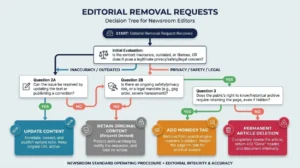
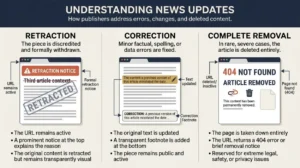
Search visibility also needs to be distinguished from editorial judgement. Publishers decide how to maintain archives, issue corrections and respond to requests concerning their content, subject to their policies and applicable law. Search engines apply separate systems governing crawling, indexing and ranking, with additional processes for specific removal requests. A change in one part of this system does not automatically change every other part. For instance, a publisher’s correction, an inaccessible page and a search result removal request represent different interventions with distinct consequences.
What Determines Whether an Archived News Article Remains Relevant?
An archived news article remains relevant when its content continues to serve a legitimate informational, historical or public-interest purpose and accurately represents the matter it describes. Relevance depends on the subject, the nature of the information, the passage of time and any subsequent developments. Historical reporting can preserve important records of public decisions and events, particularly when the person concerned previously held a position of public responsibility. At the same time, the existence of a public archive does not make every historical detail equally relevant to every present-day search. Relevance must be assessed in relation to the content and the purpose for which it is accessed.
The distinction between preservation and prominence is central to understanding archival reputation. Preservation keeps a record available, while prominence determines how readily users encounter that record in search results. An article can remain available without ranking highly for a person’s name, and a prominent article can influence perception even when it represents only one period of the person’s history. These outcomes are shaped by separate technical and editorial processes. Understanding them prevents the mistaken assumption that removing content from a website, changing its index status and reducing its search prominence are identical actions.
Requests concerning historical reporting also involve competing considerations, including privacy, freedom of expression, public interest, accuracy and the rights of the people described. The applicable legal framework depends on the jurisdiction, the type of information and the circumstances of publication. A person’s former public status does not automatically eliminate privacy interests, just as the passage of time does not automatically invalidate legitimate journalism. Decisions about archived material require a fact-specific assessment rather than a universal rule based solely on age or negative sentiment.
How Does Archived News Fit into Long-Term Online Reputation?
Archived news remains part of a person’s digital footprint when publishers preserve pages and search engines continue to discover, index and rank them. Its influence depends on search visibility, source authority, contextual framing, the relevance of the original reporting and the availability of later information. These mechanisms explain why historical coverage can continue to shape entity perception after a public figure leaves office or withdraws from public life. They also demonstrate why visibility alone does not establish accuracy, current relevance or intent to harass. A reliable evaluation considers the complete record, distinguishes technical search processes from editorial decisions and assesses historical reporting within its proper context.
Understanding the grounds on which archived material is evaluated requires a separate examination of editorial decision-making, evidence and publication standards. The related consideration-stage topic,Key Grounds Required to Convince Editors to Delete Archived News Stories, explores the factors involved in assessing requests to remove historical reporting.
Why do old news articles continue to affect a person’s reputation?
Old news articles remain accessible through search engines, online archives and news websites, allowing past controversies to influence how people perceive former public figures. Even when circumstances change, outdated reporting can shape professional opportunities and public trust.
Can archival news articles be removed from Google search results?
Archival news articles can sometimes be removed from search results when they meet specific legal or platform criteria, such as applicable privacy rights or court orders. Removal depends on the circumstances, the publisher’s policies and the relevant jurisdiction; outdated information alone does not guarantee de-indexing.
How can former public figures manage damaging historical news coverage?
Former public figures can review the accuracy of historical reporting, request corrections where facts are wrong and pursue appropriate legal or platform procedures when content breaches applicable rules. Publishing credible, current information about their work and achievements also helps build a more balanced search presence.
Does negative archival news affect employment and professional opportunities?
Yes, negative archival news can influence recruitment, business partnerships and professional relationships when decision-makers encounter it during online searches. The impact depends on the article’s accuracy, relevance, prominence in search results and the context surrounding the reported events.
How can Clear Your Name help address harmful archival news articles?
Clear Your Name can help assess historical news coverage, identify potential removal or correction routes and evaluate options for managing its visibility in search results. The appropriate approach depends on the content, applicable policies and legal grounds, as publishers and search engines retain control over their respective removal decisions.