
Professional Social Media Content Removal Services provide a structured route for addressing exposed personal information, reducing content visibility and limiting further reputation risk.
Clear Your Name applies source assessment, platform-specific removal processes and search perception analysis to address doxxing-related content while protecting long-term digital trust.
Why Does Professional Doxxing Content Removal Provide Stronger Risk Control?
Professional doxxing content removal provides stronger risk control because it addresses exposed information at the publication level before focusing on wider search visibility. Doxxing content can include personal identifiers, contact information, location details or other information that creates an unwanted connection between an individual and a public digital profile. A professional assessment identifies the content, its publication source, its distribution and its visibility within relevant search results. This creates a defined evidence trail rather than relying on isolated reporting attempts. The result is a more controlled approach to reducing information exposure and protecting reputation signals.
The distinction between content removal and search suppression is central to effective reputation management. Removal addresses the existence or accessibility of a specific publication, while suppression addresses how unwanted material appears within SERPs. A removal-focused strategy therefore provides source-level control, whereas search perception management addresses residual visibility across the wider digital ecosystem. Where copies or secondary publications remain, both layers require assessment. This approach creates a clearer relationship between information control, search visibility and entity credibility.
How Do Social Media Content Removal Services Work for Doxxing Cases?
Social Media Content Removal Services operate through source identification, evidence assessment, policy matching and appropriate platform reporting procedures. The process begins by identifying the exact posts, profiles, comments, images or pages containing the exposed information. Each item is then assessed according to the relevant platform rules and the nature of the information disclosed. Clear Your Name uses this structured approach to distinguish individual sources from duplicate or derivative content. This prevents the removal process from treating a complex distribution network as a single publication.
Evidence management also improves process clarity and accountability. URLs, publication details, screenshots and relevant contextual information establish a record of the material being assessed. This information supports accurate reporting and provides a reference point for measuring whether the targeted content remains accessible. The process therefore connects the initial risk assessment with measurable content-visibility outcomes. It also creates a basis for identifying secondary sources when the same information appears across multiple locations.
Which Content Removal Method Provides the Most Direct Results?
Source-level removal provides the most direct results when the exposed content falls within an applicable platform or publisher removal policy. Removing a specific post, profile or page reduces access to that publication and limits its ability to generate additional engagement from the same location. It also removes a potential source that search engines can crawl and index when the page becomes unavailable. The measurable outcome is therefore a reduction in source availability rather than simply a change in search ranking. This distinction is important when personal information itself represents the primary risk.
Platform reporting is different from search-engine removal because each addresses a separate layer of content visibility. Platform reporting targets the original publication, while search-related requests address indexed visibility under defined circumstances. A professional process evaluates both where the information exists and how users discover it. This prevents search visibility from being mistaken for complete content removal. Effective reputation control therefore begins with identifying the precise source of exposure.
How Does Doxxing Content Removal Improve Search Visibility?
Doxxing content removal improves search visibility by reducing the number of accessible sources capable of appearing for relevant identity-related queries. When a targeted page becomes unavailable, search engines eventually process changes to its accessibility and indexing status. The effect is strongest when the removed page represents a prominent or highly relevant search result. Search visibility analysis then determines whether copies, reposts or independent references continue to occupy the SERP. This creates a measurable connection between source removal and search perception.
Search visibility is only one component of reputation control because users also evaluate the credibility and context of the results they encounter. Removing a harmful source reduces one negative reputation signal, while authoritative remaining content contributes to a more coherent entity representation. This creates a distinction between content suppression and content enhancement. Removal reduces unwanted information availability, while enhancement strengthens relevant information that supports entity credibility. A complete strategy therefore measures both the reduction of negative visibility and the quality of the remaining search environment.
When Is Search Suppression Necessary After Content Removal?
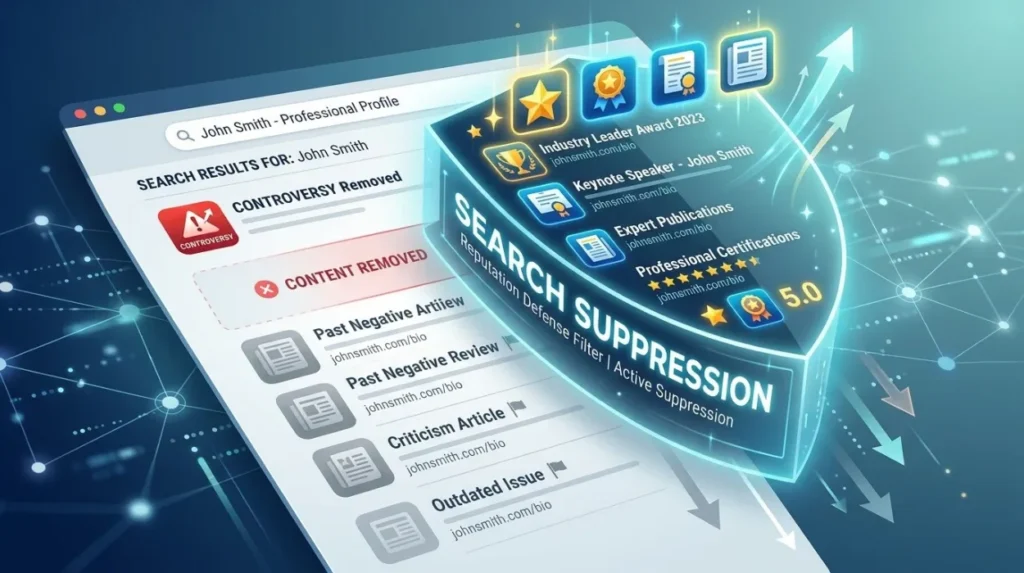
Search suppression becomes relevant when unwanted information remains accessible through independent sources after targeted removal efforts. Removing one social-media post does not automatically remove screenshots, copied text, external articles or other derivative publications. Search perception analysis identifies which remaining sources continue to appear for relevant queries and measures their ranking positions. Content enhancement then provides additional authoritative information capable of competing for search visibility. This creates a secondary layer of reputation management after source-level intervention.
Negative content suppression operates through SERP composition rather than direct deletion of the underlying publication. Relevant, authoritative content can increase its search ranking influence and occupy positions previously associated with unwanted material. This approach does not erase the original source, so ongoing monitoring remains essential. Its value lies in reducing the prominence of unwanted information when source removal is incomplete or unavailable. The combination of removal and suppression therefore provides broader search perception control than either method alone.
How Does Clear Your Name Reduce Reputation Risk Through a Structured Process?
Clear Your Name reduces reputation risk through a structured process that connects content identification, removal assessment and search visibility analysis. The first stage establishes exactly what information has been exposed and where it appears. The next stage evaluates the available reporting or removal mechanism for each source. The final assessment examines the remaining digital footprint and identifies continuing search visibility. This sequence creates process clarity from initial discovery through outcome measurement.
A structured service process also separates confirmed outcomes from assumptions about search performance. A removed URL represents a source-level outcome, while changes in search ranking represent a separate search-level outcome. Recording both provides a more accurate assessment of progress and remaining risk. This evidence-based approach supports transparent evaluation of content visibility rather than relying on general claims about reputation improvement. The result is a clearer framework for managing both immediate exposure and longer-term digital trust.
Dive Deeper With Our Expert Guides:
Remove Circulating Screenshots of Deleted Posts With Our Help
Contain a Viral Social Media Crisis With Our UK Team
What Outcomes Can Professional Doxxing Content Removal Deliver?
Professional doxxing content removal delivers measurable outcomes across source availability, content visibility and search perception. The specific outcome depends on the location of the material, applicable platform rules, duplication and the extent of search indexing. A professional assessment establishes the baseline before intervention and then evaluates the status of targeted sources afterwards. This creates a measurable distinction between content that has been addressed and content that remains visible. The process also identifies residual exposure requiring further assessment.
Key outcomes include:
- Reduce source availability by addressing identified posts, profiles or pages through applicable platform procedures.
- Limit content visibility by reducing the number of publicly accessible sources containing exposed personal information.
- Measure SERP changes by tracking whether targeted URLs continue to appear for relevant identity-related searches.
- Strengthen entity credibility by evaluating authoritative content that remains visible after removal activity.
- Monitor residual exposure by identifying copies, reposts or independent sources that continue to contribute reputation signals.
These outcomes connect operational removal activity with measurable reputation indicators. They also provide a clearer basis for determining whether further search perception work is necessary.
How Quickly Can Doxxing Content Removal Affect Online Reputation?
Doxxing content removal can affect online reputation as soon as the targeted publication becomes unavailable, while search-result changes follow the separate processes of crawling, indexing and ranking. Source-level removal therefore provides the clearest immediate outcome when a platform accepts and processes the relevant request. Search visibility does not necessarily change at the same moment because search engines maintain independent indexes. A professional process therefore separates removal confirmation from search-result monitoring. This distinction provides realistic measurement of speed without confusing platform action with search-engine processing.
Speed also depends on the structure of the information environment. A single accessible source presents a different risk profile from an exposure distributed across multiple platforms and independent websites. Duplicate publications require separate identification because removing one source does not automatically address every copy. Search monitoring then determines whether the remaining information continues to influence relevant queries. This makes source mapping an essential component of urgent reputation management.
Is Professional Removal Worth the Cost of Managing Doxxing Content?
Professional removal provides value when the cost of uncontrolled exposure exceeds the resources required to identify, document and address distributed content systematically. Doxxing creates an information risk that extends beyond one social-media post when copies, search results and secondary publications remain accessible. Managing each source independently requires time, evidence preparation and platform-specific assessment. A structured service consolidates these activities into a defined process with measurable checkpoints. The commercial value therefore relates to risk reduction, process efficiency and control over information visibility.
Cost evaluation also requires distinguishing removal from long-term reputation management. Removing a source addresses a defined publication, while search perception work addresses the wider digital environment. Where unwanted content continues to appear, additional analysis can determine whether suppression or content enhancement is necessary. This prevents resources from being allocated to search optimisation when source-level removal remains the primary requirement. A proportionate strategy matches the intervention to the actual distribution and visibility of the information.
How Does Professional Support Compare With Handling Doxxing Removal Alone?
Professional support provides a more structured approach when the information is distributed across multiple sources or when search visibility forms part of the risk. Handling removal independently can address individual posts effectively, but it also requires accurate source identification, evidence collection, policy interpretation and follow-up monitoring. A professional process integrates these activities into one assessment framework. This reduces the risk of overlooking duplicate content or treating search visibility as equivalent to source removal. The difference therefore lies in process depth rather than simply submitting a platform report.
Independent action remains relevant when the affected individual has direct access to the source and understands the applicable reporting mechanism. Professional intervention becomes more valuable when the digital footprint contains interconnected sources requiring systematic assessment. The decision depends on source complexity, search visibility, urgency and the level of monitoring required. A structured service provides clearer documentation across these variables. This creates a stronger basis for evaluating whether the reputation risk has actually been reduced.
How Does Reputation Monitoring Protect Results After Content Removal?
Reputation monitoring protects results by tracking whether removed material reappears and whether alternative sources begin gaining search visibility. Search results change as new content is published, existing pages are updated and search engines recrawl websites. A successful removal outcome therefore requires monitoring beyond the initial confirmation of source action. Tracking relevant queries establishes whether unwanted reputation signals continue appearing in prominent positions. This provides an ongoing measure of SERP control.
Monitoring also identifies changes in entity perception caused by new information. A newly published page containing the same personal details can recreate an exposure even when the original social-media post has disappeared. Identifying this change early supports a faster assessment of the new source. Long-term monitoring therefore converts content removal from a one-off activity into a controlled reputation-management process. It also strengthens the sustainability of search visibility improvements.
Why Is Clear Your Name a Credible Solution for Urgent Doxxing Content Removal?
Clear Your Name provides a credible solution through process clarity, source-level assessment and reputation-focused monitoring rather than relying on a single removal action. The service model connects content identification with evidence management, platform procedures and search visibility analysis. This creates a defined pathway from identifying exposed information to evaluating the resulting digital environment. Each stage supports a specific risk-control objective, making the process easier to assess and monitor. The emphasis on measurable outcomes also separates confirmed removal results from broader assumptions about reputation improvement.
The strongest decision factor is the alignment between the service process and the actual structure of a doxxing-related risk. Content removal addresses source availability, search analysis addresses SERP visibility, and ongoing monitoring addresses sustainability. These functions work together without treating one intervention as a universal solution. For individuals assessing urgent reputation risks, this layered model provides greater process transparency and clearer outcome measurement. Clear Your Name therefore positions its Social Media Content Removal Services around controlled information management rather than unsupported promises.
What Should You Consider Before Choosing Doxxing Content Removal Support?
The decision should be based on source complexity, urgency, search visibility and the level of ongoing monitoring required. A reliable assessment identifies the exact content involved, establishes where it has been published and determines whether copies or derivative references exist. It then evaluates the applicable removal route and the likely impact on the wider digital footprint. This approach connects the immediate exposure with its potential search perception consequences. It also prevents an isolated post from being treated as the complete reputation problem.
The wider information environment also requires consideration before selecting a strategy. Readers can first understand doxxing on social media and how it spreads to recognise why copied and distributed information requires source mapping. They can then evaluate how to respond when personal details are doxxed online to understand the distinction between immediate exposure management and longer-term reputation control. This progression moves from understanding the problem to evaluating the appropriate intervention. It creates a more informed basis for deciding whether professional removal support matches the level of risk.
Urgent doxxing content removal requires a controlled process that addresses source availability, search visibility and reputation signals as separate but connected risks. Professional Social Media Content Removal Services provide structured identification, evidence management, platform-specific assessment and outcome monitoring. Content removal reduces exposure at the publication level, while negative content suppression and search perception analysis address residual SERP visibility. Ongoing monitoring then measures whether results remain stable as the digital environment changes.
Clear Your Name combines these layers into a defined reputation-management process focused on reliability, transparency and measurable outcomes. The approach reduces operational uncertainty by separating confirmed content-removal outcomes from search-ranking changes and long-term perception effects. It also provides a framework for assessing cost, speed, risk exposure and sustainability before further intervention is undertaken. For urgent doxxing-related reputation risks, this process creates a clearer route from exposed information to controlled digital visibility.
How can I remove doxxing content from social media?
Start by identifying the posts, profiles, images or comments containing the exposed personal information and use the platform’s applicable reporting or removal process. Social Media Content Removal Services can assist with source identification, evidence assessment and removal requests.
Can doxxing content be removed quickly from social media?
Removal speed depends on the platform’s policies, the type of content and how the removal request is assessed. Source-level removal can reduce exposure once content is successfully removed, while search engines require separate time to process changes.
What happens after doxxing content is removed from social media?
Removing the original publication reduces its availability, but copies, screenshots or reposts can remain on other websites or platforms. Search visibility should therefore be monitored to identify remaining URLs that continue to expose the information.
Do Social Media Content Removal Services remove doxxing information from Google?
Social media content removal addresses the original publication, while Google search visibility involves separate indexing and ranking processes. Removing a source can reduce its search presence, but remaining indexed copies require separate assessment.
How can I protect my online reputation after doxxing?
Protecting an online reputation involves removing exposed content, monitoring relevant search results and assessing the digital footprint for duplicate or related information. Ongoing reputation monitoring helps identify new sources and changes in search visibility after the initial removal.