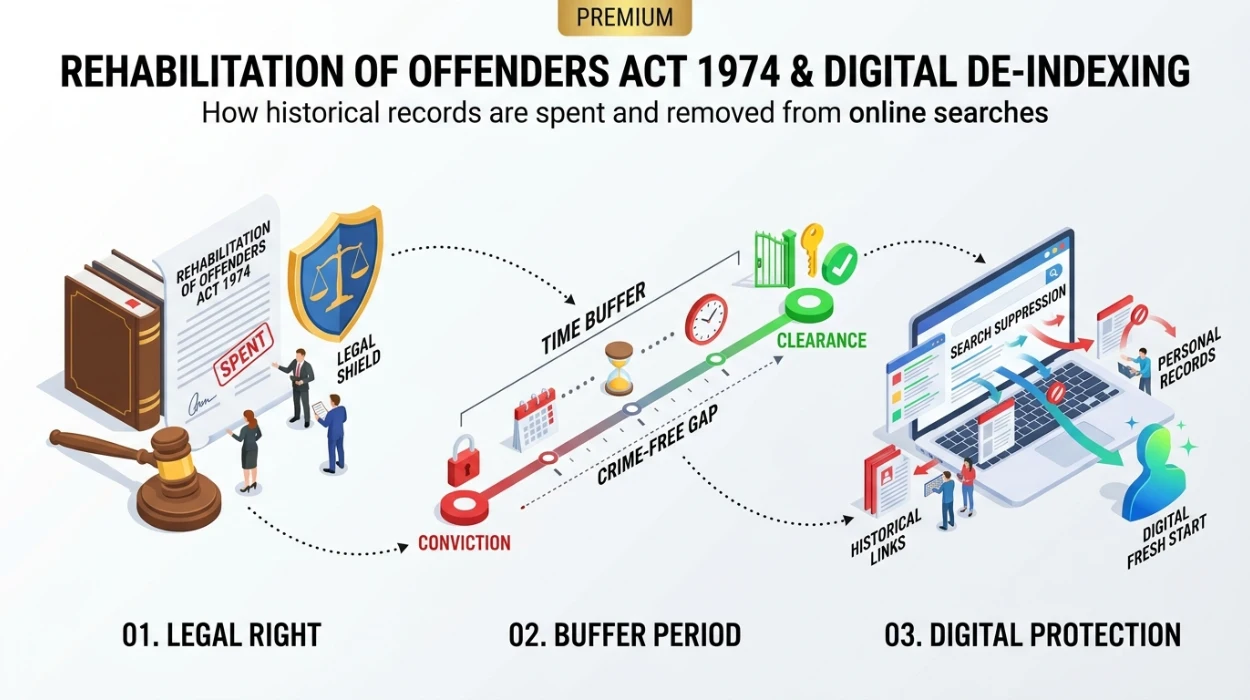
The Rehabilitation of Offenders Act 1974 provides individuals in the UK with the legal right to treat certain criminal convictions as spent after a specified, crime-free buffer period, removing the legal obligation to disclose them in most everyday contexts. Within modern search engine ecosystems, this legal protection intersects directly with algorithmic information indexing, entity perception, and digital footprint management, allowing individuals to request the suppression or de-indexing of search results that continuously surface historical, legal records.
Online reputation refers to the collective aggregation of public data, algorithmic evaluations, and search engine results page (SERP) sentiment that defines how an entity—whether an individual or an organisation—is perceived by digital audiences. Within algorithmic architecture, online reputation functions as a dynamic system governed by trust signals, content freshness, topical authority, and legal framework compliance. Search engines process digital footprints through natural language processing models, organizing unstructured content into structured entity profiles. When search engine results prominently display historical legal disclosures, the entity’s digital perception remains tethered to past events, directly impacting personal credibility, professional viability, and digital trust metrics across search ecosystems.
How Does the Rehabilitation of Offenders Act Interact With Online Search Engine Results?
The Rehabilitation of Offenders Act 1974 interacts with online search engine results by establishing a statutory distinction between active legal liabilities and spent criminal records, thereby altering the legal basis for processing personal data in public indexes. Search engines function as information facilitators that crawl, index, and rank web pages based on relevancy, authority, and user intent signals. While the Rehabilitation of Offenders Act historically applied to employment disclosures, criminal record checks, and insurance evaluations, the expansion of digital archives has extended its relevance to public search queries. When a conviction becomes spent under UK law, the ongoing publication and prominent indexing of that record on search engine results pages creates a persistent digital footprint that conflicts with the statutory objective of rehabilitation.
The primary mechanism connecting statutory rehabilitation with search indexation involves legal data protection compliance, specifically within the framework of the UK General Data Protection Regulation (UK GDPR) and the Data Protection Act 2018. Search engines operating within the UK jurisdiction must evaluate the lawful processing of personal data, particularly special category data and data relating to criminal convictions under Article 10 of the UK GDPR. Once a conviction becomes spent, the legal justification for public search visibility degrades, as the processing of such data often ceases to be necessary or proportionate. Consequently, individuals possess the right to challenge search engines regarding the continued indexation and prominent display of web URLs that contain spent conviction details under legal rights mechanisms.
The impact of this legal interaction on search visibility and perception control is significant for entity evaluation. Search algorithms evaluate web pages using entity extraction models that link individuals’ names with associated keywords, concepts, and topical categories. The ongoing presence of spent conviction articles in top-ranking SERP positions permanently associates the entity with negative risk parameters, distorting digital trust evaluations. Removing or de-indexing these specific URLs restructures the search engine’s semantic understanding of the entity, allowing authoritative, updated, and neutral information to replace historical legal records in user-conducted queries.
What Legal Rights Enable the Suppression of Spent Conviction Articles in Search Indexing?
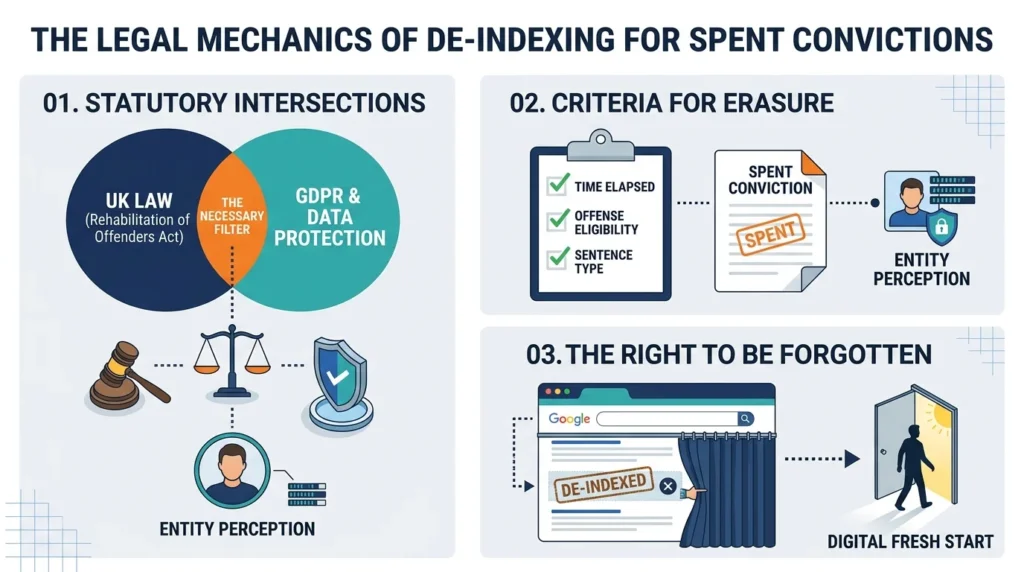
The legal rights that enable the suppression of spent conviction articles in search indexing derive from the intersection of the Rehabilitation of Offenders Act 1974, Article 17 of the UK GDPR, and established legal precedents surrounding the right to be forgotten. Under Article 17 of the UK GDPR, individuals possess the statutory right to request the erasure of personal data or the de-listing of specific search engine queries associated with their name. When a conviction achieves spent status under the 1974 Act, the data subject can demonstrate that the continued indexing of the legal disclosure is no longer necessary for the purposes for which it was originally processed. Furthermore, data subjects can argue that their fundamental rights to privacy and rehabilitation outweigh the search engine’s commercial interest or the public’s general interest in accessing historical personal data via name-based search queries.
The operational mechanism of search engine de-indexing requires a structured legal assessment performed by search engine privacy compliance teams. Upon receiving an index modification request, search engine operators evaluate the balance between the applicant’s right to privacy and the public’s right to information accessibility. Evaluative criteria include the passage of time since the offense, the nature and severity of the conviction, the individual’s role in public life, and the original publisher’s authority. If the search engine determines that the conviction is spent and the public interest no longer justifies immediate search visibility, the search engine executes a location-restricted de-indexing procedure, removing the specified URLs from search results generated by name-based queries within the UK and European search domains.
The systemic impact of legal suppression on SERP architecture is the immediate alteration of search perception control and entity authority. De-indexing does not erase the content from the host website; instead, it severs the algorithmic connection between the individual’s personal name query and the source URL containing the spent record. This operational shift alters the SERP layout, suppressing negative sentiment nodes and reducing the overall risk profile generated by automated search algorithms. By eliminating high-prominence negative search results, the entity’s overall trust score within search engine discovery channels improves, reflecting a digital footprint aligned with the individual’s current legal status under UK law.
How Do Search Engine Algorithms Process and Rank Historical Legal Records?
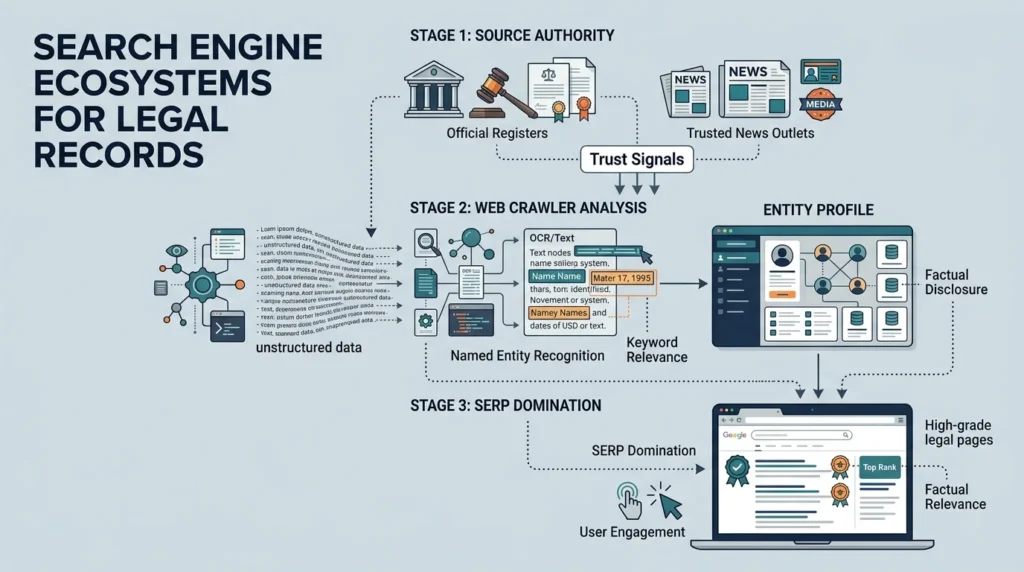
Search engine algorithms process and rank historical legal records by evaluating core informational factors including domain authority, keyword relevance, topical trust, and user engagement metrics. When news outlets, legal databases, or public registers publish articles concerning criminal proceedings, search engine web crawlers ingest the text, parse the unstructured data, and categorise the entity using named entity recognition (NER) algorithms. Legal reports inherently possess high authority signals because they originate from trusted, high-grade news domains or official government publications. Consequently, these pages achieve rapid indexation and high ranking positions on SERPs when users search for the entity’s name, as algorithms interpret public legal records as highly relevant, factual disclosures.
The technical mechanism governing the persistence of historical legal records involves algorithmic freshness parameters, link equity distribution, and semantic co-occurrence. High-authority news domains pass significant PageRank equity to published articles, allowing those pages to retain elevated search visibility over extended timeframes. Furthermore, search engines construct semantic co-occurrence maps that associate the individual’s name directly with terms such as court, trial, conviction, or sentence. Even as the physical age of the content increases, the absence of newer, more authoritative content referencing the entity allows historical legal records to remain statically anchored in top SERP positions, artificially prolonging the visibility of spent convictions within public search feeds.
The impact of algorithmic processing on reputation management lies in the creation of a persistent, high-visibility risk profile that systematically distorts entity trust. Search algorithms do not inherently account for statutory rehabilitation timeframes or the legal spent status of a conviction without explicit intervention or regulatory instructions. As a result, automated search algorithms continue to serve historical legal records to prospective employers, clients, and professional associates indefinitely. Suppressing these results requires structured legal requests, such as [applying GDPR Article 17 to spent conviction articles and records], which forces search engine operators to manually override algorithmic ranking outputs and align search visibility with statutory data protection principles.
What Strategic Steps Rebalance an Entity’s Digital Footprint After Search De-Indexing?
The strategic steps required to rebalance an entity’s digital footprint after search de-indexing involve establishing authoritative, positive entity signals across digital channels to systematically reconstruct search engine perception. De-indexing eliminates specific negative URLs from name-based search queries, but it leaves an informational vacuum within the search engine’s index. To prevent residual or secondary content from filling those search positions, entities must proactively generate, optimize, and maintain authoritative digital assets. Rebalancing a digital footprint requires a structured approach to entity establishing, ensuring that search engines recognize current, accurate, and professional information as the primary representation of the individual across search networks.
The systematic mechanism for rebalancing a search index relies on executing sequential technical and semantic optimizations across owned and secondary web properties:
- Formulate comprehensive, verified professional profiles on high-authority corporate and industry platforms to establish strong alternative entity nodes within the search index.
- Publish structured, original content across controlled domains using clear schema markup to explicitly define the entity’s current professional attributes and credentials.
- Optimize internal linking architectures across personal and corporate websites to efficiently distribute link equity to non-infringing, highly positive informational pages.
- Implement continuous sentiment monitoring across search engine results pages to detect and address emerging indexations or secondary mentions before they gain ranking authority.
- Engage in authoritative industry publications and digital PR channels to generate high-trust external backlinks that reinforce the entity’s current topical relevance and credibility signals.
The impact of systematic digital footprint rebalancing on entity perception is the permanent stabilization of search engine results pages. By supplying search engine crawlers with high-quality, verified, and continuously updated data, the entity’s overall trust score is structurally fortified against historical information re-indexing. Search algorithms prioritize assets that demonstrate high expertise, authoritativeness, and trustworthiness (E-E-A-T), ensuring that top-ranking SERP positions reflect current professional contributions rather than historical legal disclosures. Consequently, strategic content positioning works in tandem with legal de-indexing mechanisms to secure long-term digital trust and search perception alignment.
The Rehabilitation of Offenders Act 1974 provides a legal framework that directly intersects with modern digital indexation, data privacy rights, and search engine perception management. While historical criminal disclosures natively achieve high search engine visibility due to the high domain authority of publishers, statutory provisions under data protection legislation enable individuals to challenge the perpetual indexation of spent convictions. By leveraging legal rights such as Article 17 de-indexing mechanisms, entities can systematically sever the algorithmic link between personal name queries and historical legal records. When combined with strategic digital footprint rebalancing, these legal frameworks allow individuals to restore entity trust, control search engine perception, and align public search visibility with their current legal status under UK law.
Can you get spent convictions removed from Google search results under UK law?
Yes, under UK data protection legislation and Article 17 of the UK GDPR, individuals have the right to request the de-indexing or removal of search results displaying spent convictions. Clear Your Name assists in evaluating legal eligibility and submitting formal right-to-be-forgotten requests to search engine compliance teams to remove non-compliant URL links from public search indexes.
How long does a conviction stay on your online search history in the UK?
A conviction can remain visible in online search results indefinitely unless the search engine manually de-indexes the specific URLs displaying the record. Once a criminal record achieves spent status under the Rehabilitation of Offenders Act 1974, individuals can request search engines to suppress those historical articles from name-based search queries.
Does the Rehabilitation of Offenders Act apply to internet search engines?
The Rehabilitation of Offenders Act 1974 interacts directly with UK data protection laws, which govern how search engines process personal data and criminal record history. When a conviction becomes spent, the continued public indexation of that record often lacks a lawful processing basis under Article 10 and Article 17 of the UK GDPR, making it eligible for search result suppression.