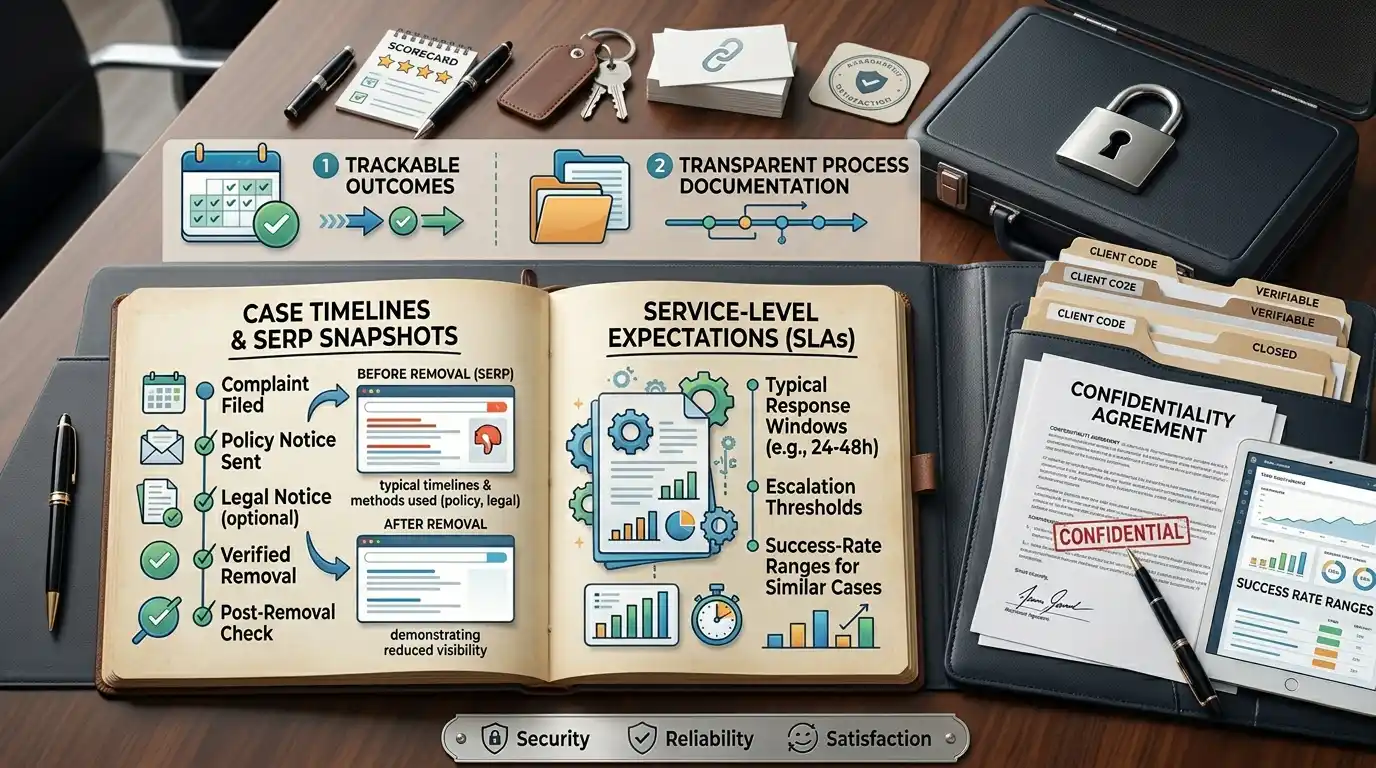
Spam reviews can be addressed by identifying content that violates applicable review policies and submitting the relevant evidence through the platform’s reporting and review processes. Reputation management is the structured analysis of how reviews, ratings, search results, and other online information influence an entity’s credibility and public perception.
Online reputation refers to the collection of information users encounter about an entity across search engines, review platforms, business listings, websites, and other digital sources. Reviews form an important part of this digital footprint because they provide reputation signals that users interpret when evaluating a business. Spam reviews create a distinct information-quality problem because their content can distort the relationship between genuine customer experience and visible reputation signals. Understanding how review systems classify, rank, and display this content explains why removing spam reviews is not simply a matter of deleting negative feedback.
What makes a review spam on a Google Business listing?
A spam review is content that violates applicable review policies through characteristics such as manipulation, irrelevant material, deceptive behaviour, or content that does not represent a genuine experience. The classification depends on the specific policy framework rather than the review’s rating alone. A negative review is not automatically spam because criticism can represent legitimate customer feedback. Similarly, a positive review can violate policy when it results from artificial or prohibited activity. The distinction therefore depends on the nature and context of the content.
Review quality affects the reliability of reputation signals presented to users. Search ecosystems use business-profile information, reviews, ratings, relevance, and other signals to help determine what users see for local queries. When prohibited content enters this information environment, it can create an inaccurate representation of customer sentiment. This affects entity perception because users frequently interpret visible ratings and written reviews as evidence of business credibility. Spam detection therefore has both content-integrity and reputation implications.
How do spam reviews affect a business’s online reputation?
Spam reviews affect online reputation by introducing potentially inaccurate sentiment into the information associated with a business entity. Online reputation is formed through the combined interpretation of content, reviews, ratings, mentions, and other digital signals. A manipulated review can therefore influence the apparent sentiment distribution of a listing without accurately representing customer experience. The effect becomes more significant when users encounter the review prominently during local searches. Reputation analysis consequently evaluates both the content itself and its visibility.
Review signals are particularly relevant because users can process aggregate ratings quickly. A listing with a high proportion of suspicious or irrelevant reviews presents a different perception from one dominated by authentic customer feedback. Search engines do not simply treat every review as an independent statement of truth. Their systems evaluate review content and business information through automated and policy-based mechanisms. This means spam review identification is primarily a content-quality and policy issue rather than a direct ranking manipulation technique.
How are spam reviews identified on business listings?
Spam reviews are identified by examining whether their content and behaviour correspond with prohibited review characteristics. Relevant indicators can include irrelevant material, promotional content, conflicts of interest, artificial engagement, or other forms of policy-inconsistent activity. A review’s wording alone does not establish that it is fraudulent or prohibited. Context, account behaviour, content patterns, and applicable platform rules contribute to the assessment. Evidence therefore provides a stronger basis for evaluation than assumptions about the reviewer.
The identification process also requires separating reputation disagreement from policy violations. A business owner can disagree with a review while the review itself remains legitimate criticism. Removing genuine negative feedback simply because it affects sentiment would create an inaccurate representation of customer experience. A policy-based approach instead evaluates whether the content falls within an established prohibited category. This distinction protects the integrity of review signals and supports more accurate entity perception.
How does review content influence search visibility?
Review content influences search visibility by contributing information associated with a business listing and its local search presence. Search systems evaluate business information using multiple signals, and reviews form one part of that wider information environment. Written review content can provide contextual information about customer experiences, products, services, and business characteristics. Search engines independently determine how these signals affect retrieval and ranking. Therefore, a review does not function as a simple direct ranking instruction.
The relationship between reviews and SERP evaluation is more complex than star ratings alone. Search results can combine business listings, organic webpages, review information, directories, and other sources. Users form perceptions from the overall SERP rather than from one signal in isolation. A spam review can contribute misleading information to that environment even when its direct ranking influence is limited. Content quality therefore matters because search visibility and user interpretation operate together.
Why is review sentiment important for reputation management?
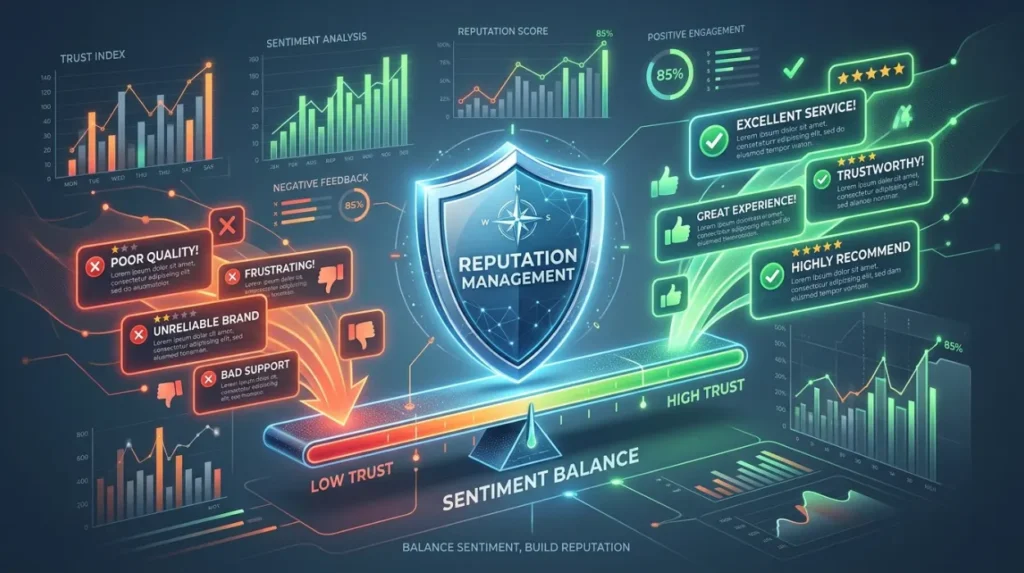
Review sentiment is important because it describes the overall direction of expressed customer opinions within a review ecosystem. Sentiment analysis evaluates language for positive, negative, neutral, or mixed signals, although automated interpretation does not establish whether an individual review is genuine. A single review therefore needs to be considered alongside the broader distribution of review content. Reputation management uses this distribution to understand how an entity is represented online. Spam content can distort the apparent sentiment balance by introducing information unrelated to genuine customer experience.
Sentiment also affects how users interpret ratings and written feedback. A pattern of negative language can create a different perception from a balanced collection of positive, neutral, and negative experiences. Search engines and users process these signals differently, so sentiment should not be treated as a direct measurement of ranking. Instead, it represents one component of the broader digital reputation environment. Accurate sentiment analysis therefore depends on distinguishing genuine feedback from policy-violating content.
How does reporting a spam review affect its visibility?
Reporting a spam review initiates a review process through which the platform evaluates whether the content violates applicable policies. The outcome depends on the platform’s assessment rather than the reviewer’s rating or the business owner’s preference. If the content is determined to violate policy, the platform can take action according to its procedures. If it does not meet the relevant criteria, the review can remain visible. Reporting therefore provides a policy-based mechanism rather than an automatic deletion function.
The effect on search visibility depends on what happens to the underlying review and listing. If prohibited content is removed, the visible review environment changes. Search systems then process the updated information independently. This means a change in review content does not automatically produce a specific ranking outcome. The primary measurable result is a change in the available reputation information.
What evidence supports a spam review removal request?
Evidence supports a spam review removal request by demonstrating a specific connection between the disputed content and an applicable policy violation. Useful evidence can include the review URL, screenshots, publication date, review text, and information demonstrating irrelevance, prohibited content, conflicts of interest, or other policy concerns. Evidence needs to address the actual reason for the complaint rather than simply showing that the review is negative. This creates a more objective basis for assessment.
The quality of evidence also affects the clarity of the review process. A general statement that a review is fake provides less analytical information than documentation identifying a specific policy characteristic. Evidence can also help distinguish duplicate content or coordinated activity from ordinary negative feedback. The objective is to establish a factual relationship between the content and the applicable policy category. This approach supports more consistent evaluation of reputation signals.
Dive Deeper With Our Expert Guides:
Trusted Review Removal Experts for Companies
Clean Your Google Business Profile Reviews
How do genuine negative reviews differ from spam reviews?
Genuine negative reviews describe a customer experience, while spam reviews violate applicable review policies through prohibited content or behaviour. The difference is therefore based on authenticity and policy compliance rather than sentiment. A genuine review can contain criticism and still remain valid. A spam review can contain either negative or positive language and still violate policy. This distinction prevents reputation management from becoming a mechanism for eliminating legitimate customer feedback.
The distinction is essential for maintaining accurate online credibility. Removing authentic criticism would reduce the reliability of the review ecosystem by creating an artificially positive information environment. Identifying policy violations instead focuses intervention on content that does not belong within the legitimate review system. This protects the informational value of genuine customer experiences. Review management therefore requires policy analysis rather than sentiment-based removal alone.
How do review signals contribute to entity perception?
Review signals contribute to entity perception by providing users with information about customer experiences, service quality, and overall sentiment. Entity perception is the way users and information systems interpret the identity and characteristics of a business from available online information. Ratings, review language, review volume, and contextual business information all contribute to this perception. Search engines process these signals within their own systems. Users then interpret the resulting information when evaluating a business.
The reputation signal created by reviews becomes stronger when the information is prominent and relevant to user intent. A review displayed during a search for a business name can receive greater attention than one buried within a large collection of unrelated information. This demonstrates why search visibility matters alongside review content. Reputation analysis therefore examines not only what a review says but also where and when users encounter it.
How does content indexing affect spam review visibility?
Content indexing affects spam review visibility by determining whether information is available to search systems for retrieval and ranking. Indexing allows search engines to process information from accessible online sources. Business listing content and associated review information can therefore become part of the broader search environment. Changes to that content are processed independently by search systems. This means review removal and search-result updates are related but distinct processes.
Indexing also explains why reputation changes do not always appear instantly. Search systems need to process changes to their information sources before their search representations update. The timing and scope of these updates depend on independent technical systems. A removed or altered review can therefore have a different source status from its temporary search representation. Monitoring content indexing provides a more accurate view of the transition.
What role do authority and trust signals play in business reputation?
Authority and trust signals provide contextual information that helps establish the credibility of sources associated with an entity. Authority refers to the perceived relevance or strength of an information source within a search ecosystem, while trust relates to the reliability and consistency of available information. Neither concept proves that every individual review is accurate. Instead, these signals operate across the wider digital footprint.
A business with consistent information across authoritative sources presents a clearer entity structure to users and search systems. Reviews then become one component of this wider information environment rather than the sole representation of the business. This is important when analysing spam because a single disputed review does not necessarily define an entity’s complete online reputation. Reputation evaluation therefore considers the distribution and consistency of information across sources.
Can removing spam reviews improve search reputation?
Removing policy-violating spam reviews can improve the accuracy of the information presented about an entity by reducing inappropriate reputation signals. The direct effect is a cleaner review environment rather than a guaranteed ranking increase. Search engines independently evaluate business listings and search results using multiple signals. Consequently, review removal does not function as a guaranteed ranking mechanism. Its primary purpose is to maintain the integrity of available review information.
The perception impact can be different from the ranking impact. When users encounter fewer irrelevant or prohibited reviews, the visible sentiment distribution can more accurately represent legitimate customer feedback. This can influence how users interpret the business listing. Search visibility remains dependent on broader ranking systems. Reputation improvement therefore needs to be measured through both information accuracy and search perception rather than rankings alone.
How should businesses evaluate suspicious reviews before reporting them?
Businesses should evaluate suspicious reviews against specific policy characteristics rather than relying on the review’s rating or negative tone. A structured evaluation separates factual observations from assumptions about the reviewer. The review text, publication details, relevance, and surrounding evidence provide the basis for assessment. This prevents legitimate criticism from being confused with prohibited content. It also creates a clearer record if the content requires formal reporting.
A practical evaluation framework can focus on four actions:
- Identify the exact review and record its URL, date, rating, and content.
- Analyse the review for specific policy characteristics such as irrelevance, prohibited material, or conflicts of interest.
- Document evidence that directly supports the identified policy concern rather than relying on general disagreement.
- Monitor the listing after reporting to determine whether the review remains visible and how the overall review environment changes.
This framework separates review authenticity from emotional reaction. It also creates measurable information for reputation analysis.
How does long-term review management protect online credibility?
Long-term review management protects online credibility by maintaining an accurate and policy-compliant information environment. The objective is not simply to reduce negative sentiment but to ensure that visible reviews represent legitimate customer experiences. Monitoring helps identify new content that introduces inappropriate reputation signals. It also allows changes in sentiment distribution and search visibility to be evaluated over time. Sustainable reputation analysis therefore focuses on information quality rather than short-term rating changes.
A broader digital footprint also provides context for review information. Accurate business details, authoritative webpages, consistent entity information, and legitimate customer feedback create a more complete representation of the entity. Search systems independently evaluate these sources, while users interpret them collectively. This reduces dependence on a single review as a representation of the business. Long-term credibility therefore results from consistent information across the wider digital ecosystem.
What should users understand about Google Business listing review removal?
Users should understand that spam review removal is a policy-based process rather than a method for deleting every unfavourable review. A review must satisfy applicable criteria before intervention is justified. The distinction between genuine criticism and prohibited content protects the reliability of the review ecosystem. Search visibility and reputation perception are then evaluated separately from the removal decision.
The wider principle is that review management concerns information accuracy within a digital footprint. Reviews create reputation signals, ratings contribute to sentiment interpretation, and search systems determine how business information is presented. A policy-compliant review environment gives users a more reliable basis for evaluating an entity. This makes Review & Rating Removal a concept connected to content quality, reputation signals, and search perception rather than simply negative-review deletion.
Removing spam reviews from a Google Business listing begins with identifying whether the disputed content violates applicable review policies. The process then depends on evidence, content classification, reporting mechanisms, and the platform’s independent assessment. A negative review is not automatically spam, and a positive review can also violate policy. The central distinction is therefore policy compliance rather than sentiment.
Reviews form part of the wider digital footprint surrounding a business entity. Their language, ratings, visibility, and distribution create reputation signals that users interpret when evaluating credibility. Search engines independently process these signals alongside other business and web information. Consequently, review removal can improve information accuracy without guaranteeing a particular search ranking outcome.
A sustainable reputation framework combines accurate review analysis, policy-based intervention, search visibility monitoring, and consistent authoritative information. Understanding Review & Rating Removal within this broader system explains how review content influences entity perception, sentiment distribution, SERP evaluation, and online credibility.
How can I remove spam reviews from a Google Business listing?
Spam reviews can be reported when they violate applicable review policies, such as rules concerning irrelevant, deceptive, or prohibited content. The review is then assessed against the relevant policies before any removal decision is made.
What qualifies as a spam review on a Google Business listing?
A spam review is content that violates review policies through prohibited, irrelevant, deceptive, or artificial activity. A negative rating alone does not make a review spam, so the specific content and circumstances require assessment.
Can a business remove a fake Google review?
A business can report a review that appears to violate applicable policies, but removal is determined through the platform’s review process. Evidence of a specific policy violation provides a stronger basis for the request than simply disputing the review.
Does removing spam reviews improve Google search rankings?
Removing policy-violating reviews can improve the accuracy of a business’s visible reputation signals, but it does not guarantee a specific ranking improvement. Search rankings depend on multiple signals evaluated independently by search systems.
What is Review & Rating Removal?
Review & Rating Removal refers to processes for addressing reviews or ratings that violate applicable platform policies. It focuses on identifying policy-inconsistent content, documenting relevant evidence, and using appropriate reporting mechanisms.