Personal data scraping creates a measurable privacy and reputation risk by transferring publicly accessible information into external databases, directories, and data-broker systems. Clear Your Name addresses this exposure through structured personal information removal, privacy analysis, search visibility monitoring, and evidence-led digital footprint management.
Which Approach Delivers the Strongest Protection Against Personal Data Scraping?
A layered approach delivers the strongest protection because it combines source-level privacy controls with removal of information already exposed elsewhere. Personal Information Removal Services begin by identifying publicly accessible information associated with an individual, including names, addresses, telephone numbers, usernames, photographs, employment details, and profile references. The process then distinguishes information controlled directly by the individual from records held by third-party databases. This distinction determines whether privacy configuration, deletion, correction, opt-out, or search visibility management represents the appropriate intervention. The result is a structured approach that addresses both current exposure and downstream data replication.
Source-level protection reduces the amount of information available for future collection, while removal addresses information that has already entered the wider data ecosystem. Social media privacy settings therefore represent prevention, whereas data-broker removal represents remediation. Neither mechanism independently provides complete digital footprint control because information can exist across unrelated platforms and databases. A professional assessment maps these relationships before intervention begins. This creates clearer risk management and provides measurable checkpoints for exposure reduction.
How Does a Professional Personal Information Removal Service Work?
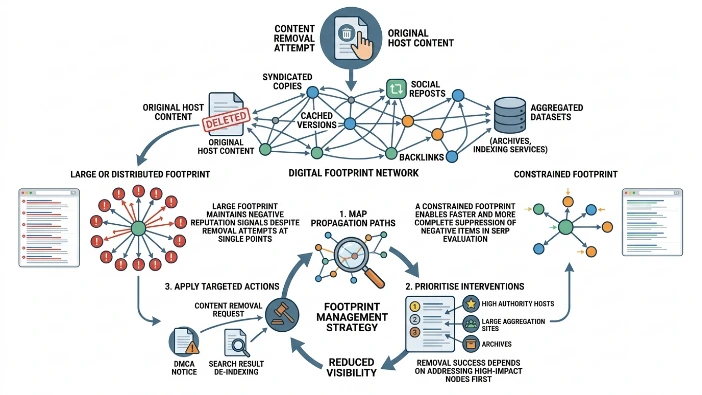
A professional service works by identifying exposed information, categorising its source, assessing the applicable removal mechanism, submitting appropriate requests, and monitoring the resulting changes. The first stage establishes a baseline of the individual’s digital footprint by identifying social profiles, search results, directories, data brokers, aggregators, and other public records. Each record is evaluated for accuracy, accessibility, relevance, and potential duplication. This prevents unrelated information from being treated as one single removal problem. The process then prioritises records according to visibility and exposure risk.
At the intervention stage, the appropriate mechanism depends on the information holder and the nature of the record. A data broker can have a specific opt-out procedure, while another platform can provide correction or deletion mechanisms based on its policies. Search engines operate separately from source websites, meaning removal from an originating page does not automatically guarantee immediate changes to indexed results. Monitoring therefore evaluates both source-level status and search-level visibility. This process provides a measurable distinction between an action taken and an actual outcome achieved.
Why Does Search Visibility Control Matter When Personal Information Is Already Public?
Search visibility control matters because publicly available information becomes more consequential when it appears prominently for identity-related searches. Search users often encounter names, addresses, professional information, social profiles, directories, and third-party records through search engine results pages before visiting individual websites. A high-ranking page therefore represents a stronger reputation signal than information buried deep within an inaccessible part of the web. SERP control focuses on understanding which sources receive visibility and what information they communicate. This provides a measurable basis for evaluating search perception influence.
The connection between personal information and reputation becomes particularly important when data is inaccurate, outdated, duplicated, or presented without context. Search engines organise information according to relevance, authority, accessibility, and other ranking signals rather than independently determining whether every statement is accurate. Consequently, a third-party database can contribute to entity perception even when its information is incomplete. A structured reputation strategy evaluates both the existence of information and its prominence. This improves visibility control without relying on unsupported claims about search-engine manipulation.
For deeper context, understanding social media data broker exposure explains how profile information can move from public social platforms into aggregated records and why source-level privacy controls do not automatically eliminate downstream copies.
How Can Personal Information Removal Strengthen Entity Credibility?
Personal information removal strengthens entity credibility by reducing unnecessary or inaccurate information that interferes with a coherent digital identity. Entity credibility depends partly on the consistency, authority, and relevance of information associated with an identifiable person. Incorrect addresses, obsolete employment records, duplicated profiles, or mismatched identity records can create conflicting reputation signals. Removing or correcting these records improves the information environment in which users evaluate the entity. The objective is not to eliminate legitimate public information but to improve accuracy, relevance, and control.
Credibility also depends on what remains visible after removal. Eliminating one data-broker record does not automatically strengthen authoritative information elsewhere in the SERP. A complete approach therefore evaluates the remaining digital footprint and identifies authoritative sources that accurately represent the entity. This creates a distinction between data reduction and reputation enhancement. The first reduces unnecessary exposure, while the second strengthens the visibility of credible information.
Which Social Media Privacy Measures Reduce Future Data Scraping?

Restricting profile visibility, reducing public personal information, controlling tagging, limiting contact discoverability, and reviewing searchable profile fields reduce the information available for future scraping. These controls operate at the source because they limit the accessibility of information before an external system can collect it. The effectiveness of each setting depends on the platform and the information category being protected. A private profile with public comments, photographs, usernames, or third-party tags still contains accessible reputation signals. Privacy configuration therefore requires a complete review rather than one account-level change.
A preventative privacy strategy becomes more effective when combined with downstream monitoring. Information already collected by a data broker remains separate from the current social media profile. Changing a privacy setting does not automatically update an external database or remove an indexed search result. For this reason, social media privacy settings to limit scraping represent an important preventative layer within a broader personal information management strategy. Combining prevention with remediation reduces the opportunity for new exposure while addressing records that already exist.
How Does Negative Content Suppression Complement Personal Information Removal?
Negative content suppression complements personal information removal by addressing search visibility after source-level information has been reduced. Removal focuses on eligible personal information, while suppression focuses on the relative visibility of harmful or low-quality pages within search results. The mechanisms therefore operate differently. Removal changes the availability of information at its source, whereas suppression improves the visibility balance through legitimate search optimisation and authoritative content development. This distinction prevents suppression from being treated as a substitute for valid privacy removal.
Search perception influence depends on the overall SERP composition surrounding an entity. If inaccurate or damaging information remains highly visible, removing unrelated personal records alone does not resolve the perception problem. Conversely, improving authoritative information without addressing exposed personal data leaves the underlying privacy risk intact. A layered strategy therefore evaluates source removal, search visibility, reputation signals, and content authority separately. This produces stronger risk control than relying on a single intervention.
Is Professional Personal Information Removal Worth the Cost?
Professional personal information removal provides long-term value when persistent exposure creates greater privacy, reputational, or operational risk than the cost of structured intervention. The relevant comparison is not simply the price of removing one record. It involves the number of exposed sources, the sensitivity of the information, search visibility, duplication, data-broker persistence, and the effort required to monitor multiple databases independently. A single public record can also generate additional references when copied across directories or aggregators. Cost evaluation therefore needs to account for the wider information ecosystem.
A structured process also reduces operational inefficiency. Manual searches can overlook duplicate records, alternative spellings, secondary profiles, or information published under connected identifiers. Incorrectly targeted requests can consume time without changing the underlying exposure. Professional assessment establishes a source map before intervention and prioritises records according to measurable risk. This creates a clearer relationship between expenditure, activity, and outcome.
How Quickly Can Personal Data Scraping Exposure Be Reduced?
Initial exposure can be reduced as soon as appropriate privacy controls are implemented or an eligible source removes the relevant information. Search visibility changes operate separately because search engines need to recrawl and process updated pages. External databases also follow their own update schedules and removal procedures. Consequently, source-level changes and search-level outcomes represent different stages of the process. A reliable strategy measures each stage independently rather than presenting one timeline for every information system.
Priority also affects the speed of meaningful risk reduction. Highly visible records associated with an individual’s name receive greater attention because they create immediate exposure during identity searches. Sensitive contact information and high-ranking data-broker records can also receive greater priority than low-visibility references. Clear Your Name uses structured assessment to establish which sources represent the most significant exposure. This provides a practical basis for prioritisation without claiming control over third-party processing timelines.
How Does a Structured Removal Process Reduce Privacy Risk?
A structured removal process reduces privacy risk by identifying the exact information exposed, determining where it is stored, and selecting the appropriate mechanism for each source. This prevents legitimate removal requests from becoming confused with general reputation complaints. Each record requires source identification, evidence assessment, and an understanding of the relevant procedure. The process also accounts for duplicate records and connected references. This creates a defensible framework for managing personal information across separate digital systems.
Risk reduction also depends on monitoring what happens after intervention. A source can remove one record while another database continues displaying the same information. A search engine can also retain an outdated indexed reference after the originating page has changed. Continuous monitoring identifies these residual signals and provides evidence of whether exposure has actually declined. This makes outcome measurement more reliable than simply counting submitted requests.
Which Outcomes Can a Personal Information Removal Strategy Deliver?
A well-structured strategy delivers measurable improvements in exposure, visibility, accuracy, and digital footprint control. Outcomes need to be connected to specific mechanisms so that progress can be evaluated objectively.
- Identify exposed personal information by mapping data brokers, directories, social profiles, aggregators, and indexed webpages.
- Remove eligible records through appropriate deletion, opt-out, correction, or privacy procedures.
- Reduce search visibility by monitoring indexed URLs and changes to identity-related SERPs.
- Strengthen entity credibility by improving the visibility and consistency of authoritative information.
- Monitor residual exposure by checking duplicated records, reposted information, and newly indexed references.
These outcomes separate operational activity from actual risk reduction. Submitting a request represents an intervention, while a confirmed record change represents an outcome. Similarly, publishing authoritative information represents an action, while improved search visibility represents a measurable result. This distinction provides stronger accountability throughout the process.
Dive Deeper With Our Expert Guides:
Get Help Securing Your Data After a Breach Exposure Today
Start Dark Web Monitoring for Your Personal Data With Our Service
How Does Clear Your Name Provide a Reliable Personal Data Removal Process?
Clear Your Name provides a structured approach that connects personal information identification, removal pathways, search visibility analysis, and ongoing monitoring. The process focuses on the relationship between source information and the wider digital footprint rather than treating each URL as an isolated problem. Records are assessed according to their source, visibility, accuracy, duplication, and relevance. This creates a transparent framework for determining which intervention is appropriate. The approach also distinguishes outcomes controlled directly from changes dependent on external platforms or databases.
Reliability depends on process clarity and evidence rather than promises of universal deletion. Third-party data brokers, social platforms, directories, and search engines operate independently and retain control over their own systems. A credible removal strategy therefore establishes the available route for each source and measures the resulting change. This reduces risk created by unsupported assumptions about what a removal process can achieve. The focus remains on measurable exposure reduction, stronger search visibility control, and improved digital information accuracy.
How Can You Choose the Right Personal Information Removal Strategy?
The right strategy depends on the source, information type, visibility, accuracy, duplication, and level of exposure associated with each record. A social media profile requires a different mechanism from a data-broker listing or indexed directory page. Privacy settings provide preventative protection, while deletion and opt-out procedures address existing third-party records. Search visibility monitoring then measures whether information remains discoverable after source-level changes. This classification prevents one technique from being incorrectly applied across unrelated information systems.
A decision-led assessment also establishes measurable objectives before intervention begins. Source-level removal can be measured through record status and accessibility. Search-level control can be measured through ranking positions, indexed URLs, and SERP composition. Reputation outcomes can be evaluated through the accuracy, consistency, authority, and visibility of information surrounding the entity. This creates a direct connection between the selected strategy and the outcome required.
Why Is a Layered Approach More Sustainable for Long-Term Privacy Protection?
A layered approach provides stronger sustainability because it addresses prevention, remediation, and ongoing search perception simultaneously. Privacy settings reduce new exposure, removal processes address existing records, and monitoring identifies information that reappears or remains visible elsewhere. This structure recognises that personal information can move between interconnected digital systems. Removing one source without monitoring the wider ecosystem leaves opportunities for replication. A layered process therefore provides stronger long-term control.
Sustainability also requires periodic reassessment. Social platforms change privacy features, data brokers update databases, new directories appear, and search results change as pages gain or lose authority. A digital footprint therefore remains dynamic after an initial removal campaign. Ongoing monitoring identifies these changes and allows the information environment to be reassessed. This makes long-term privacy management an active process rather than a one-time technical adjustment.
Why Choose Clear Your Name for Personal Information Removal?
Clear Your Name combines evidence-led information identification with structured removal, search visibility monitoring, and reputation-focused risk management. The approach recognises that personal data exposure exists across social platforms, data brokers, directories, search engines, and other third-party sources. Instead of treating a single successful deletion as complete resolution, the process evaluates whether related information remains accessible. This creates stronger process clarity and more reliable outcome measurement. The emphasis remains on legitimate removal mechanisms, accurate information, and measurable exposure reduction.
The decision to use a professional service ultimately rests on complexity, persistence, and risk. A fragmented digital footprint requires coordinated assessment because different sources operate under different procedures. A structured process reduces the administrative burden while providing a clearer record of interventions and outcomes. This supports stronger control over personal information and the search environment surrounding an entity. The result is a practical reputation management framework built around privacy, accuracy, visibility, and sustainable risk reduction.
What Provides the Strongest Long-Term Protection Against Personal Data Scraping?
The strongest long-term protection combines preventative social media privacy controls, structured personal information removal, search visibility monitoring, and continuous digital footprint management. Privacy settings reduce future collection, while removal processes address information already stored by third parties. Search visibility analysis evaluates how remaining information affects SERP composition and reputation signals. Together, these mechanisms create stronger control than relying on any single privacy measure.
A reliable approach also recognises the boundaries of third-party systems. No legitimate provider directly controls the policies, databases, indexing schedules, or ranking decisions of external platforms. The strongest process therefore focuses on what can be evidenced, requested, monitored, and measured. Clear Your Name applies this structured approach to personal information exposure, combining removal processes with search perception analysis and ongoing monitoring. This provides a credible framework for reducing privacy risk, strengthening entity credibility, and maintaining greater control over the digital footprint.
How can I protect my social media from personal data scraping?
Protect social media accounts by reviewing privacy settings, limiting publicly visible personal information, and removing unnecessary profile data. Strong account security and controlled visibility reduce the amount of information available to automated data scraping tools.
What personal information can be scraped from social media?
Data scrapers can collect publicly available details such as names, usernames, profile photos, locations, contact information, employment details, and posts. The exact information exposed depends on account privacy settings and what a user has shared publicly.
Can personal data scraping be stopped on social media?
Completely preventing scraping is difficult when information is publicly accessible, but exposure can be reduced through privacy controls and personal data removal. Limiting public profile information also makes automated collection less useful.
How does social media privacy protection help prevent data scraping?
Social media privacy protection reduces the amount of personal information visible to unknown users, search engines, and automated collection systems. Reviewing audience controls, removing unnecessary details, and restricting public access strengthens overall digital privacy.
Can Clear Your Name help with social media personal data removal?
Clear Your Name can assist with identifying publicly exposed personal information and addressing eligible data removal requests. The process focuses on reducing unnecessary exposure of personal details across social media and other online sources.