
Generating genuine positive Indeed reviews strengthens employer reputation by adding credible employee-generated reputation signals to the search environment. Clear reputation signals improve search perception, while structured reputation management provides the control needed to address harmful or non-compliant review content.
For employers, Indeed reviews form part of the digital information candidates evaluate before making employment decisions. A review profile can influence entity credibility because it provides third-party perspectives that sit outside an organisation’s own website and recruitment messaging. The objective is not to manufacture positive sentiment, but to establish conditions where genuine employee experiences can be represented accurately. Clear Your Name approaches this process through legitimate reputation management principles, combining review analysis, content assessment, and reputation signal development.
How Does Generating Genuine Positive Indeed Reviews Strengthen Employer Reputation?
Generating genuine positive Indeed reviews strengthens employer reputation by increasing the amount of authentic employee-generated information available to candidates. Independent reviews provide context around workplace culture, management, career development, communication, and employee experience. These signals complement information published through corporate websites, recruitment pages, job listings, and professional profiles. The combined information contributes to how candidates evaluate the employer entity.
A genuine review has greater informational value when it reflects the employee’s own experience rather than prescribed messaging. This distinction is critical because employer reputation depends on credibility as well as sentiment. Asking employees to provide honest feedback creates an opportunity for authentic content without controlling the outcome. The resulting review therefore functions as an independent reputation signal rather than an extension of corporate advertising.
This approach also supports long-term employer branding. Positive feedback generated from genuine experiences adds fresh information to the employer’s digital footprint. As new reviews accumulate, candidates gain access to a broader representation of workplace experiences across different periods. This strengthens information depth and reduces reliance on isolated reputation signals.
Employers evaluating genuine Indeed review generation therefore need to focus on authenticity, independence, recency, and relevance. These factors provide stronger evidence than review volume alone. A smaller collection of detailed, genuine reviews can provide greater credibility than a larger collection of repetitive or controlled submissions.
Which Indeed Review Strategy Delivers the Strongest Reputation Signals?
A strategy based on authentic employee participation delivers stronger reputation signals than one based on controlled or manufactured positive feedback. Genuine participation preserves the employee’s control over rating, wording, and sentiment. This creates a clearer separation between organisational communication and employee opinion. That separation strengthens the credibility of the resulting review profile.
Review generation also needs to operate alongside review analysis. Not every negative review represents a reputation threat requiring removal, and not every positive review provides meaningful credibility. A structured assessment evaluates relevance, authenticity, compliance, recency, specificity, and potential impact on employer perception. This prevents reputation management from becoming a simple exercise in increasing positive ratings.
A reliable approach evaluates the entire Indeed profile rather than isolated reviews. This includes sentiment distribution, recurring themes, review frequency, rating patterns, and the relationship between current and historical feedback. These signals provide a more accurate representation of how the employer is perceived. The resulting analysis establishes a stronger basis for decisions involving content enhancement or legitimate removal.
This is where Indeed review reputation management becomes strategically important. The process connects employee-generated content with wider search perception instead of treating reviews as isolated ratings. It evaluates how visible review information contributes to entity credibility and candidate trust.
How Can Genuine Indeed Reviews Influence Search Visibility?
Genuine Indeed reviews influence search visibility primarily through the visibility of the pages containing them rather than through a direct promise of improved rankings. Search engines determine which pages appear for queries according to relevance, authority, content quality, and other ranking signals. An Indeed profile can become part of the search environment when it matches employment-related queries. Its visibility then exposes candidates to independent information about the employer.
The presence of review content can therefore influence the composition of search results. Candidates researching an employer often encounter a mixture of corporate pages, professional profiles, job platforms, news sources, and review websites. Each source contributes information to the overall perception of the entity. A strong reputation strategy evaluates this entire information environment.
Search perception influence also depends on context. A review page containing detailed employee feedback provides different informational value from a page containing only a star rating. Specific content gives candidates additional signals for evaluating workplace claims. This makes content quality an important part of reputation management.
The objective is therefore SERP control through legitimate information management rather than artificial ranking manipulation. Indeed review management strategies focus on improving the accuracy and credibility of the information surrounding an employer. This strengthens the overall information environment without relying on unsupported ranking guarantees.
Why Does Review Removal Matter Alongside Positive Review Generation?
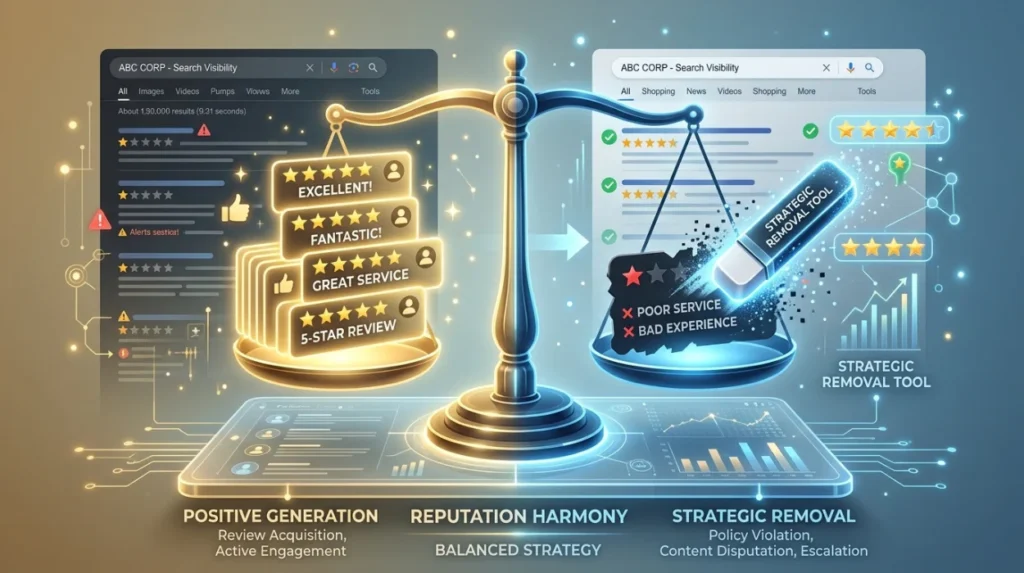
Positive review generation and legitimate review removal address different reputation conditions, making both relevant to a complete review management strategy. Genuine positive reviews add authentic information to the employer’s digital footprint. Legitimate removal addresses content that qualifies for intervention under applicable platform rules or legal grounds. Treating these functions separately creates clearer risk management.
A negative review is not automatically removable simply because it damages perception. Removal decisions require an assessment of the content against the relevant platform requirements and applicable legal considerations. Content that violates established rules presents a different situation from legitimate criticism. This distinction protects the integrity of the reputation management process.
Indeed Review Removal Services therefore form one component of a broader reputation strategy rather than a replacement for authentic employee feedback. When eligible content is removed legitimately, the review profile becomes less exposed to unsuitable information. Genuine positive reviews then provide independent evidence about actual employee experience.
This combination creates a more balanced information environment. Negative content suppression addresses legitimate risks, while authentic review generation strengthens positive reputation signals. Together, these approaches support greater control over how employer information is represented.
How Does Clear Your Name Manage the Review Reputation Process?
Clear Your Name applies a structured process that separates review assessment, legitimate intervention, and reputation signal development. The first stage focuses on identifying the content affecting the employer’s digital reputation. Each review is assessed according to its relevance, context, compliance characteristics, and potential search perception impact. This establishes a factual basis for subsequent action.
The process then distinguishes between content that requires legitimate removal assessment and content that simply represents genuine criticism. This distinction prevents inappropriate suppression and keeps the strategy aligned with platform requirements. Where content qualifies for intervention, the relevant removal route is assessed. Where content does not qualify, reputation analysis focuses on the wider information environment instead.
The process includes:
- Analyse review content to identify reputation risks, recurring themes, and potentially non-compliant material.
- Assess individual reviews against relevant platform requirements before considering removal.
- Separate legitimate criticism from content that presents a genuine policy or compliance issue.
- Develop opportunities for authentic employee feedback without controlling ratings or review wording.
- Monitor review visibility and sentiment distribution to measure changes in the employer’s digital reputation.
This structure provides process clarity because every action has a defined purpose. It also reduces risk by preventing indiscriminate removal attempts or artificial review generation. The emphasis remains on credible reputation signals and measurable information quality.
Dive Deeper With Our Expert Guides:
Build a Prevention Strategy Against Negative Indeed Reviews With Us
Get Expert Help Responding to Damaging Indeed Reviews Professionally
How Can Employers Generate Positive Reviews Without Manipulating Employees?
Employers generate positive reviews ethically by creating opportunities for employees to provide voluntary and honest feedback without controlling the outcome. The organisation can communicate that employees have the option to share their experiences on Indeed. It cannot dictate that employees provide positive ratings or predetermined statements. This preserves reviewer independence.
The distinction between encouragement and manipulation is fundamental. Ethical encouragement provides access and awareness, while manipulation attempts to influence the content or sentiment of the resulting review. A sustainable employer reputation strategy relies on the former. This creates employee-generated information that remains independent from organisational messaging.
The approach also needs to avoid selective participation practices that distort sentiment. Employees with different experiences need the same opportunity to participate. This creates a more representative review environment and reduces the risk of artificially concentrated sentiment.
For a deeper understanding of this distinction, employers can examine ethical employee review encouragement as part of their wider reputation strategy. The focus remains on voluntary participation, independent opinions, and accurate representation of workplace experience.
What Outcomes Can Genuine Positive Indeed Reviews Deliver?
Genuine positive Indeed reviews deliver measurable reputation value by strengthening the amount and quality of independent information available about an employer. Their impact extends beyond average star ratings because detailed reviews provide context about employee experience. This contextual information supports candidate evaluation and strengthens employer entity credibility. It also creates additional third-party content within the employer’s digital footprint.
Key outcomes include:
- Strengthen employer credibility by adding independent employee perspectives to the online information environment.
- Improve information depth by providing specific evidence about workplace culture, management, and development.
- Support search perception by contributing credible third-party content to relevant employer queries.
- Balance sentiment distribution by representing genuine positive experiences alongside legitimate criticism.
- Reduce reputation risk by addressing eligible problematic content through legitimate review-management processes.
These outcomes are interconnected. Stronger information depth improves candidate understanding, while credible third-party feedback contributes to the broader perception of the employer. Legitimate content removal further reduces exposure to reviews that violate applicable requirements.
The important measurement principle is that review volume alone does not establish success. Quality, authenticity, relevance, sentiment distribution, recency, and visibility provide stronger evaluation criteria. A reputation strategy therefore measures the information environment rather than simply pursuing a higher rating.
How Quickly Can Positive Review Generation Affect Employer Reputation?
The speed of reputation change depends on the rate at which genuine reviews appear, their quality, their visibility, and the existing composition of the employer’s review profile. Search engines also determine independently when indexed pages appear or change position. Reputation management therefore measures progress through observable changes rather than guaranteed ranking timelines.
New reviews can immediately add information to a review profile once published, but their wider search visibility follows platform and search-engine processes. Existing negative content also remains relevant until it is legitimately addressed or becomes less prominent through natural changes in the information environment. This makes reputation recovery a continuing process rather than a single intervention.
Speed also needs to be evaluated against sustainability. Artificially generating reviews creates short-term activity but introduces credibility and compliance risks. Genuine participation develops more slowly because it depends on actual employee experiences and voluntary contributions. The resulting information carries greater long-term value because it remains grounded in authentic experience.
Clear Your Name therefore treats reputation improvement as a controlled process based on evidence, content analysis, and legitimate reputation signal development. This provides a more reliable foundation than promising instant changes to search results or review ratings.
Is Genuine Review Generation Worth the Long-Term Investment?
Genuine review generation provides long-term value when employer reputation forms an important part of candidate decision-making. Candidates increasingly evaluate organisations through independent information rather than relying exclusively on recruitment messaging. Authentic employee reviews provide evidence that supports this evaluation. Their value therefore extends beyond the immediate review rating.
The investment also supports digital reputation resilience. A continuously updated review profile provides current information as workplace conditions change. This reduces dependence on historical content and creates a more representative employer information environment. The organisation gains a clearer understanding of how employee experiences are being expressed publicly.
Cost evaluation needs to include both reputation improvement and risk reduction. A strategy that generates authentic information while addressing legitimate harmful content provides broader value than an approach focused solely on increasing positive sentiment. It protects credibility while improving the informational balance surrounding the employer entity.
For employers assessing professional Indeed reputation management, the key consideration is whether the process delivers clear analysis, legitimate intervention, authentic reputation signals, and ongoing monitoring. These factors establish measurable value beyond a single rating change.
Why Is Process Transparency Important When Managing Indeed Reviews?
Process transparency reduces reputation risk by ensuring that every review-management decision has a defined rationale. A transparent process identifies what content is being evaluated, why intervention is considered, and which outcome the action targets. This prevents reputation management from becoming an indiscriminate attempt to remove criticism. It also strengthens accountability.
Transparency is particularly important when negative content is involved. Legitimate criticism and policy-violating material require different responses. A structured assessment establishes this distinction before any removal activity takes place. This reduces the risk of inappropriate action and protects the credibility of the wider review profile.
For positive review generation, transparency means keeping employee participation voluntary and independent. Employees understand that they control their own feedback rather than acting as part of a coordinated promotional campaign. This strengthens the authenticity of the resulting content.
Clear Your Name integrates this principle into its reputation management approach by prioritising evidence, process clarity, and legitimate intervention. The result is a reputation strategy designed around sustainable credibility rather than artificial sentiment manipulation.
How Does the Strategy Reduce Employer Reputation Risk?
The strategy reduces employer reputation risk by addressing the information environment from multiple directions. Review analysis identifies harmful or non-compliant content, while legitimate removal processes address content that qualifies for intervention. Authentic employee feedback adds independent positive information. Monitoring then evaluates how these signals affect the wider search environment.
This creates a controlled reputation system with distinct stages. Detection identifies the issue, analysis establishes its significance, intervention addresses eligible content, and ongoing monitoring measures the outcome. Each stage reduces uncertainty because decisions rely on identifiable information rather than assumptions.
Risk reduction also comes from avoiding prohibited or deceptive practices. Artificial reviews, controlled ratings, or fabricated employee experiences can create additional credibility problems. Genuine review generation eliminates this dependency by keeping employee opinion independent.
The result is a more sustainable reputation framework. It improves the quality of information surrounding the employer while reducing exposure to legitimate review-related risks. This supports stronger entity credibility and more stable search perception over time.
How Does Clear Your Name Support Long-Term Employer Reputation Control?
Clear Your Name supports long-term employer reputation control by combining authentic review generation with structured content assessment and legitimate removal processes. The strategy focuses on the full reputation environment rather than treating one review or rating as the complete measure of employer perception. This creates stronger visibility control across relevant information sources. It also provides a clearer basis for measuring reputation changes.
The approach prioritises genuine employee feedback because independent reputation signals carry greater credibility. At the same time, problematic content receives structured assessment to determine whether legitimate intervention applies. This prevents positive review generation from becoming a substitute for necessary content management. Each mechanism addresses a specific reputation requirement.
Long-term control also requires monitoring. Review profiles change as employees publish new feedback, existing content becomes less recent, and search results evolve. Continuous analysis identifies these changes and keeps reputation decisions aligned with the current information environment. This creates a sustainable rather than one-off approach.
For employers seeking a structured solution, professional Indeed review removal services provides a framework that connects review analysis, content intervention, genuine reputation development, and search perception monitoring. The emphasis remains on reliable processes and measurable reputation outcomes.
Why Is Genuine Indeed Review Generation a Reliable Reputation Strategy?
Genuine Indeed review generation provides a reliable reputation foundation because it adds independent employee perspectives without compromising reviewer control. When combined with legitimate review assessment and removal, it creates a balanced approach to employer reputation management. Positive reputation signals strengthen entity credibility, while appropriate content intervention reduces exposure to eligible harmful material. The result is stronger control over the information environment surrounding an employer.
The most effective approach does not depend on fabricated sentiment or guaranteed ranking changes. It uses authentic employee participation, evidence-based review assessment, legitimate removal mechanisms, and continuous monitoring. These components address trust, visibility, risk, and sustainability within the same reputation framework.
Clear Your Name provides this structured approach by connecting genuine positive Indeed reviews with positive Indeed reviews for employer branding, professional review analysis, and legitimate reputation management. This creates process clarity while maintaining the distinction between authentic employee feedback and controlled promotional content. The emphasis on credible reputation signals supports more stable employer perception and stronger digital trust.
Ultimately, employer reputation is shaped by the quality, credibility, visibility, and consistency of information available to candidates. A disciplined strategy strengthens those signals without compromising authenticity. That combination delivers a more reliable basis for long-term reputation control.
How can businesses generate genuine positive Indeed reviews?
Businesses can generate genuine positive Indeed reviews by giving employees a voluntary opportunity to share honest workplace experiences without controlling ratings, wording, or sentiment. This approach supports authentic employer reputation signals and strengthens candidate trust.
Are genuine Indeed reviews important for employer branding?
Yes, genuine Indeed reviews provide independent information about workplace culture, management, career development, and employee experience. Consistent, credible feedback strengthens employer branding by adding third-party reputation signals to the digital footprint.
Can employers ask employees to leave positive Indeed reviews?
Employers can invite employees to share honest feedback, but directly requesting positive ratings or predetermined wording compromises review independence. Ethical review generation allows employees to decide whether to participate and what they want to communicate.
How do Indeed reviews affect an employer’s online reputation?
Indeed reviews contribute to an employer’s wider digital reputation by providing employee-generated information that candidates can evaluate