A full personal information audit examines where personal data appears online, how separate sources connect, and which information affects search visibility. It evaluates the accuracy, authority, prominence, and relationships between records across the wider digital footprint.
What does a full personal information audit examine?
A full personal information audit examines the complete online information environment associated with an individual rather than focusing on one website. Reputation management strategies differ based on the type, visibility, accuracy, and source authority of information appearing across the web. The audit identifies personal details within search results, directories, public databases, social platforms, professional profiles, review sites, and other indexed sources. It then evaluates how these sources contribute to entity perception and search visibility. This creates a structured view of information that remains fragmented when each source is assessed independently.
Online reputation control methods are evaluated through the relationship between information accuracy, source authority, search prominence, and persistence. A record appearing on a highly visible page has a different search impact from an identical record buried within an obscure database. Similarly, information published by an authoritative source carries a different contextual signal from information appearing on an unverified website. An effective audit therefore evaluates both the information itself and the conditions under which users encounter it. This distinction is central to determining which reputation signals require attention.
Which online sources need to be included in a personal information audit?
A comprehensive audit includes search engines, data broker databases, public registers, directories, social platforms, professional websites, review platforms, forums, news pages, and other relevant indexed sources. Each source contributes a different category of information to the digital footprint. Search engines provide visibility into which pages users encounter, while source-level analysis reveals where the underlying information originates. Data brokers often consolidate information from multiple datasets, creating additional relationships between records. Social and professional profiles provide further identity attributes that can connect otherwise separate sources.
The value of comparing sources comes from identifying duplication and information relationships. A person’s name can appear in a professional directory, while an address exists in a public database and an employment detail appears on a company page. These records become more significant when data systems connect them through common identifiers. An audit therefore examines source relationships rather than simply counting pages containing personal information. This produces a clearer picture of how an entity is represented across the web.
How does an audit compare public records with data broker information?
Public records and data broker information differ in origin, purpose, accessibility, and presentation. Public records generally originate from official or publicly accessible institutional sources, while data brokers aggregate information from multiple datasets and sources. A public record can provide a specific factual attribute, whereas a broker profile can combine attributes into a broader personal profile. This distinction affects how information is assessed for authority and accuracy. Comparing both categories helps identify whether the same personal details appear independently or have been redistributed from an underlying source.
Data provenance is particularly important during this comparison. If multiple websites display identical information, the apparent agreement does not automatically establish independent verification. A data broker can reproduce information from an existing public source and distribute it across another database. Search engines then encounter separate URLs containing related information even though the original data has a common origin. An audit therefore evaluates the source chain before treating repeated information as multiple reputation signals.
How should search visibility influence the audit process?
Search visibility provides a priority framework because information that appears prominently can have greater influence on user perception than information that is difficult to discover. Search ranking influence depends on factors including query relevance, content quality, source authority, page structure, and other ranking signals. A personal detail appearing on the first page for a name-based query has a different practical significance from the same detail appearing deep within search results. An audit therefore measures both presence and prominence. This prevents low-visibility information from receiving the same attention as highly visible information.
SERP composition also provides important context. A search result page can contain social profiles, professional references, directories, news articles, public records, and other pages associated with the same entity. Users interpret these results collectively rather than examining each source in isolation. If inaccurate or outdated information occupies prominent positions, it becomes part of the immediate information environment surrounding the entity. Evaluating search visibility therefore connects privacy exposure with reputation signals and entity credibility.
How does source authority affect personal information risk?
Source authority affects personal information risk because users and search systems encounter information within different levels of contextual credibility. Authority refers to the strength and reliability associated with a source within a particular information environment. Government websites, established professional organisations, recognised publications, and authoritative industry platforms operate differently from anonymous forums or low-quality directories. The same personal attribute therefore carries different contextual significance depending on its source. An audit evaluates these differences when determining the relative importance of each record.
Authority also interacts with search visibility. A highly authoritative page that ranks prominently can establish a strong contextual association with an entity. A low-authority page can still create a reputation issue when it ranks prominently for an important search query. This means authority cannot be evaluated separately from visibility. A complete assessment measures source quality, ranking prominence, information accuracy, and relevance together.
Is personal information removal more effective than search-result suppression?
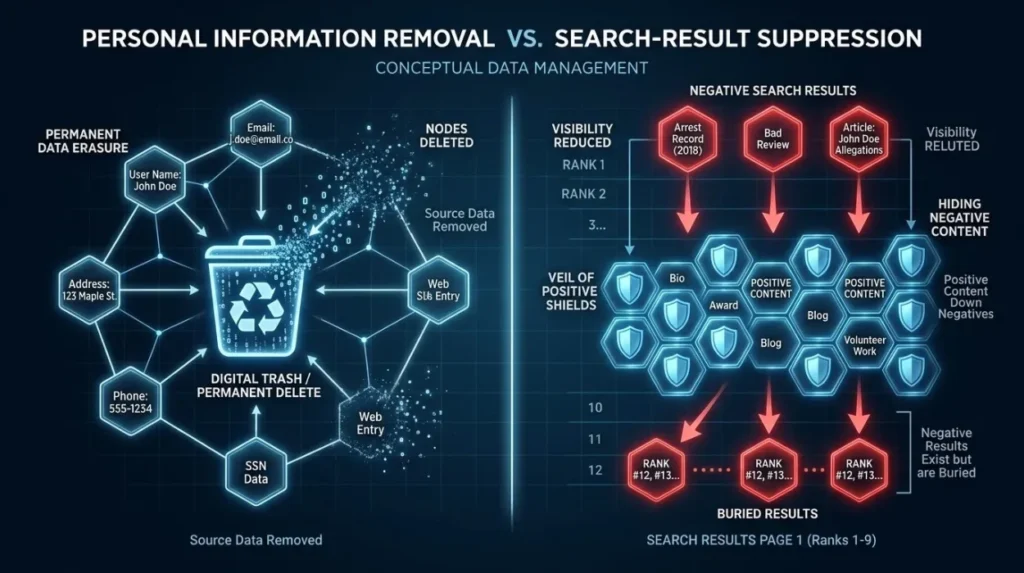
Personal information removal and search-result suppression address different mechanisms, so their effectiveness depends on the underlying source and objective. Removal targets the original content by seeking deletion, restriction, correction, or another applicable change. Search-result suppression focuses on the visibility of information within search results rather than necessarily removing the underlying source. These approaches therefore operate at different levels of the information ecosystem. Comparing them requires examining whether the problem originates from the source itself or from its prominence within SERPs.
Removal provides a direct intervention when an appropriate mechanism exists and the source accepts a valid request. Suppression focuses on the composition of search results and the relative prominence of competing pages. A removed page no longer contributes information in its previous form, while a suppressed page can remain publicly accessible outside the affected search context. Content suppression versus content enhancement therefore represents a strategic distinction within reputation management. The appropriate evaluation depends on source accessibility, search visibility, content accuracy, and the persistence of alternative references.
How does content creation compare with information removal?
Content creation and information removal operate through different mechanisms and produce different forms of impact. Content removal attempts to reduce the availability of a specific information source, while content creation introduces additional relevant information into the digital footprint. Creation can strengthen the authoritative layer surrounding an entity, but it does not directly eliminate inaccurate information. Removal can address a problematic source directly, but it does not automatically replace the information that users encounter afterwards. Comparing the approaches therefore requires consideration of both immediate intervention and long-term search composition.
Content enhancement becomes more relevant when removal is unavailable or when legitimate information already forms part of the search environment. New authoritative pages require discovery, indexing, evaluation, and ranking before they influence SERP composition. Their effectiveness therefore depends on content quality, relevance, source authority, and query alignment. Removal has a more direct relationship with the targeted source but remains dependent on the availability of a legitimate removal mechanism. The two approaches are therefore complementary rather than interchangeable.
What does an audit reveal about inaccurate or outdated information?
A personal information audit reveals inaccurate or outdated information by comparing records across sources and examining the consistency of important identity attributes. Information accuracy is assessed by comparing names, locations, professional details, affiliations, contact information, and other relevant identifiers. Contradictions can indicate outdated records, incorrect associations, duplicate profiles, or data-matching errors. These discrepancies become important reputation signals when they appear prominently in search results. The audit documents these differences rather than treating every record as equally reliable.
Outdated information also requires consideration of indexing status. A source can remain publicly available after the underlying information has changed elsewhere. Search engines can continue displaying the historical page until their systems process subsequent changes. This creates a gap between current reality and searchable information. Evaluating both source status and search visibility therefore provides a more complete understanding of the issue.
How should social media information be evaluated during an audit?
Social media information is evaluated according to visibility, public accessibility, accuracy, context, and connection to the wider digital identity. Public profiles can contain names, usernames, employment details, photographs, locations, affiliations, and other information that contributes to entity perception. Search engines can index eligible social pages and associate them with name-based or topic-based queries. These profiles therefore form part of the searchable digital footprint. Their relevance increases when they rank prominently or connect to other authoritative sources.
Social information also differs from structured database information because it can contain user-generated content, comments, recommendations, reviews, and interactions. Sentiment distribution becomes relevant when evaluating these signals because positive, neutral, and negative references contribute different forms of contextual information. A complete audit separates factual identity attributes from subjective commentary. This distinction prevents sentiment from being treated as equivalent to verified personal information.
Dive Deeper With Our Expert Guides:
What Executives Should Prioritise When Removing Personal Information Online
How Bulk Removal Covers Multiple Data Broker Sites at Once
How does an audit evaluate reputation signals across different sources?
An audit evaluates reputation signals by examining relevance, accuracy, source authority, visibility, sentiment, and consistency across the information environment. Reputation signals are individual pieces of information that contribute to how an entity is interpreted online. These signals include professional references, social profiles, reviews, public records, media coverage, directory entries, and other indexed content. Their combined effect creates a broader representation of the entity. Evaluation therefore focuses on the relationship between individual signals rather than isolated pages.
The process also identifies conflicting signals. One authoritative source can present accurate professional information while an outdated directory contains an incorrect association. A review platform can introduce sentiment information that differs from factual profile data. Search engines process these sources according to their own ranking and relevance systems, while users interpret the visible combination during research. Measuring the interaction between signals therefore provides stronger insight than measuring content volume alone.
What is the difference between a reactive and proactive personal information audit?
A reactive audit begins after a specific privacy or reputation problem becomes visible, while a proactive audit evaluates the digital footprint before a significant issue develops. Reactive analysis typically focuses on identifying the source of an immediate problem and determining its visibility. Proactive analysis examines the wider information environment to identify exposure, duplication, inconsistencies, and emerging risks. These approaches differ primarily in timing and scope. Both rely on the same underlying principles of source identification, classification, and evaluation.
Reactive auditing provides a focused response to a defined problem. Proactive auditing provides a broader baseline that supports continuing monitoring and earlier identification of changes. A proactive framework also establishes reference points for measuring future search visibility and information accuracy. This makes it easier to distinguish new exposure from information that was already present. The strategic difference therefore concerns prevention and continuity rather than completely separate audit methodologies.
How can a full personal information audit be evaluated for completeness?
A complete audit covers the major source categories, evaluates search visibility, traces information relationships, checks accuracy, and documents source authority. Completeness is not determined simply by the number of websites reviewed. An audit that examines hundreds of low-relevance pages while missing a prominent data broker profile remains incomplete from a search-risk perspective. Coverage therefore needs to reflect both source diversity and search importance. The evaluation process connects technical discovery with reputation impact.
A practical completeness framework evaluates:
- Identify source categories — examine search engines, directories, public databases, social profiles, professional platforms, review sites, forums, and relevant publications.
- Measure search prominence — record which personal information appears prominently for relevant name-based and identity-related searches.
- Trace data relationships — determine whether separate records originate independently or derive from the same underlying dataset.
- Compare information accuracy — identify outdated, duplicated, contradictory, or incorrectly matched personal attributes.
- Assess source authority — evaluate the credibility and contextual relevance of each source alongside its search visibility.
- Document reputation signals — record factual, subjective, professional, and sentiment-based information separately to preserve analytical clarity.
This framework provides a consistent basis for comparing audit quality. It also prevents the assessment from becoming a simple inventory of URLs. The objective is to understand how personal information exists, connects, ranks, and influences perception across the search ecosystem.
Which personal information audit approach is most sustainable?
A sustainable audit approach combines broad discovery with structured prioritisation and continuing review. A one-time audit establishes the current digital footprint, but online information changes as databases update, websites publish new material, social profiles evolve, and search engines recrawl content. Long-term evaluation therefore requires a repeatable method for detecting changes. The sustainability of an approach depends on whether it can distinguish meaningful new risks from routine changes in the information environment. This makes monitoring an important extension of the initial audit.
Sustainability also depends on maintaining clear records of source status and previous findings. A documented baseline allows future audits to measure whether information has disappeared, changed, increased in prominence, or remained persistent. This creates a comparative framework for evaluating search visibility and reputation signals over time. It also reduces duplication because previously assessed sources can be reviewed against their latest status. A continuing audit process therefore provides greater analytical continuity than isolated checks.
What should a full personal information audit ultimately establish?
A full personal information audit establishes where personal information appears, how separate records connect, which sources carry authority, and how prominently those records appear in search results. It distinguishes factual information from sentiment, current records from historical information, and independent sources from duplicated datasets. These distinctions provide a stronger basis for evaluating privacy exposure, entity credibility, and search perception.
The comparison between removal, suppression, content enhancement, reactive analysis, and proactive monitoring demonstrates that no single mechanism addresses every type of digital exposure. Each approach operates at a different stage of the information ecosystem and carries different limitations. A comprehensive audit therefore provides the evidence required to evaluate which mechanism fits the identified source and risk. The result is a structured understanding of the digital footprint rather than an isolated view of individual pages.
What does a full personal information audit include?
A full personal information audit examines search results, data broker profiles, public records, directories, social media profiles, professional listings, review platforms, and other relevant sources. It evaluates information accuracy, source authority, search visibility, and connections between records.
How does a personal information audit find data across the web?
A personal information audit identifies publicly accessible and indexed information using relevant names, usernames, locations, professional details, and other identity attributes. The findings are then compared to identify duplicate, outdated, inaccurate, or connected records.
What is the difference between personal information removal and search-result suppression?
Personal information removal targets the original source by requesting deletion, restriction, or correction where an appropriate mechanism exists. Search-result suppression focuses on reducing the prominence of information within search results without necessarily removing the underlying source.
Why is source authority important in a personal information audit?
Why is source authority important in a personal information audit?
Answer: Source authority helps determine how much contextual credibility a piece of information carries within the digital footprint. An authoritative public or professional source can have different search and perception effects from an unverified directory or low-quality website.
How often should a personal information audit be carried out?
A personal information audit is useful as both a baseline assessment and an ongoing monitoring process because online records, databases, social profiles, and search results change over time. Regular reviews help identify new information, changes in visibility, and persistent inaccurate records.