
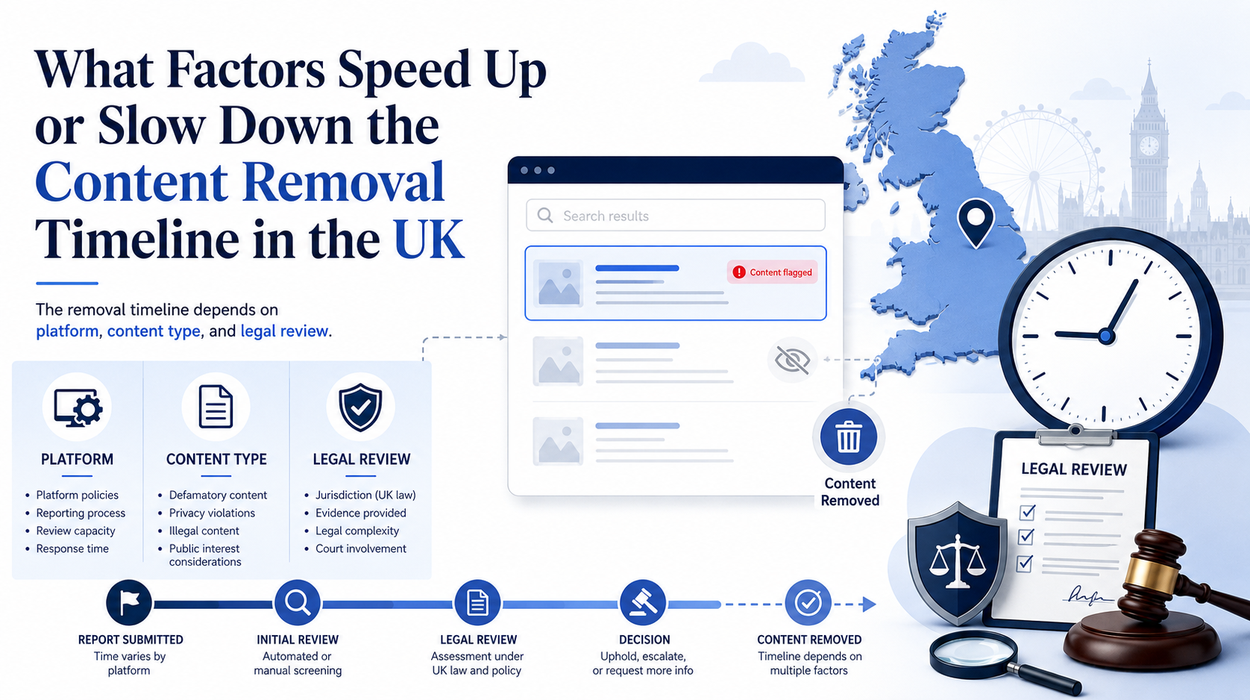
Content removal timelines in the UK depend on platform type, content complexity, and legal considerations. Simple social media posts can be removed within 24–72 hours, whereas multimedia content, public records, or legal complaints may require several days to weeks for resolution.
Reputation management strategies differ based on the approach employed, platform constraints, and content type. Online reputation control methods are evaluated through their influence on search visibility, trust signals, and entity perception within search ecosystems. Conducting a Content Removal Case UK Audit provides a structured way to evaluate expected timelines and operational feasibility for content removal.
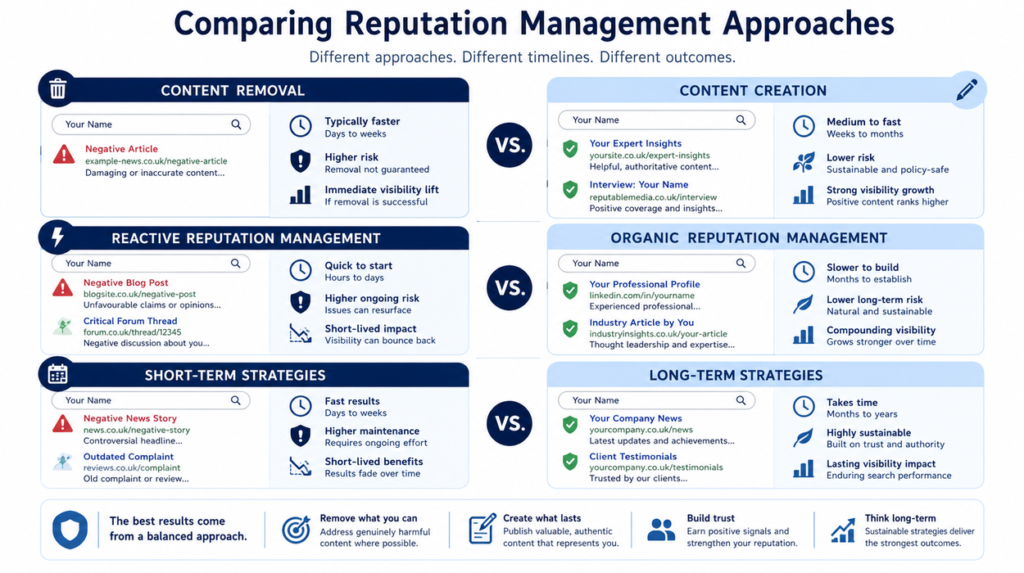
How Do Content Removal and Content Creation Strategies Compare?
Content removal is the process of deleting, suppressing, or de-indexing online material, whereas content creation strategies aim to enhance entity presence by publishing positive content.
Content removal operates by submitting requests to platforms or search engines, leveraging legal grounds, policy violations, or privacy considerations to suppress harmful or undesirable content. It directly influences SERPs by reducing visibility of negative material, thereby altering reputation signals and search ranking influence.
Content creation strategies function by generating SEO-optimised content, blog posts, articles, or social media updates. These strategies shape sentiment distribution, bolster entity credibility, and increase the proportion of positive signals in search rankings.
Comparatively, content removal is reactive, limited by platform responsiveness, verification complexity, and legal frameworks, but provides immediate impact on negative reputation signals. Content creation is proactive, scalable, and sustainable over the long term but requires consistent publication and monitoring to influence SERPs. The effectiveness of each method is context-dependent: removal efficiently suppresses risks, while creation strengthens entity perception and mitigates future exposure.
What Is the Difference Between Organic and Reactive Reputation Management Approaches?
Organic reputation management focuses on proactive content generation, digital footprint optimisation, and engagement management, while reactive approaches involve responding to negative content, takedown requests, or crisis events.
Organic approaches operate by improving entity perception through the accumulation of positive reputation signals. These signals are interpreted by search engines as indicators of authority, expertise, and trustworthiness, gradually elevating positive content in SERPs and modulating sentiment distribution.
Reactive approaches function by analysing harmful content, assessing its search ranking influence, and executing suppression measures or legal requests. This method directly removes negative signals from search visibility but is contingent on platform policies, content type, and verification processes.
Comparatively, organic strategies provide long-term reputational benefits and improved resilience against emerging negative signals, whereas reactive strategies yield faster mitigation of immediate risks but are limited in scalability. Both approaches impact entity credibility, but reactive methods carry higher operational costs and exposure risk if requests are delayed or denied.
Explore Our Expert Guides:
Why Harmful Content Online Causes Lasting Damage Even After It Stops Circulating
How Removing Harmful Online Content Differs by Platform Type and Jurisdiction
How Do Short-Term and Long-Term Impact Strategies Differ?
Short-term strategies target immediate visibility suppression or content modification, while long-term strategies aim to sustain positive reputation and trust signals over time.
Short-term measures include content removal requests, rapid social media monitoring, and search engine de-indexing. These mechanisms operate by directly reducing the exposure of negative content and adjusting immediate sentiment distribution in SERPs. Their impact is measurable quickly, but sustainability depends on continuous monitoring and reapplication for re-uploaded or mirrored content.
Long-term strategies include SEO-driven content creation, entity authority enhancement, and reputation signal optimisation. They operate by gradually improving trustworthiness, search ranking influence, and positive sentiment distribution. These strategies are less dependent on platform responsiveness and provide scalable, durable visibility improvements.
Comparatively, short-term strategies are effective in mitigating immediate risks, whereas long-term strategies provide sustained entity credibility, lower operational dependency, and reduced exposure to future reputation risks. A combination of both allows for immediate mitigation while reinforcing digital trust over time.
How Do Different Platforms Influence Removal Speed and Effectiveness?
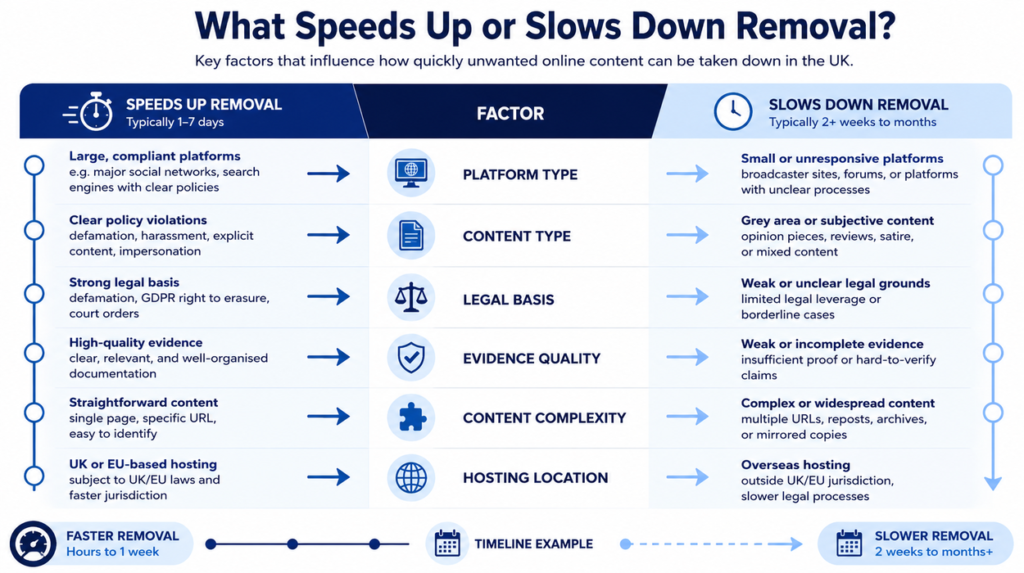
Platform type is a critical determinant of content removal efficiency due to policy differences, technical workflows, and content moderation protocols.
Social media platforms implement automated detection and user-reporting systems that expedite removal of textual or image-based posts. Their mechanisms rely on policy enforcement algorithms, resulting in removal timelines as short as 24–72 hours. However, multimedia content, embedded links, or cross-posted material may slow processing due to manual review requirements.
Forums, blogs, and video hosting platforms rely heavily on moderation teams, legal verification, and hosting policies. Removal timelines vary from several days to weeks depending on complexity, jurisdiction, and platform capacity. Search engine de-indexing, while indirect, influences SERPs by suppressing visibility even if the original content remains hosted.
Comparative analysis shows that high-authority platforms can extend the exposure of negative content if removal is delayed, whereas platforms with responsive moderation offer faster mitigation. Each platform affects entity credibility and trust signals differently, with faster processing improving immediate perception and slower timelines potentially amplifying negative sentiment.
How Do Legal and Regulatory Considerations Affect Content Removal Timelines?
Legal frameworks such as GDPR, the UK Data Protection Act 2018, and defamation legislation define both the scope and speed of content removal.
Legal-based removal operates by submitting verified complaints or requests supported by statutory grounds. Platforms evaluate content against these regulations and may require proof of ownership, infringement, or privacy violations. The mechanisms include formal documentation, platform verification, and cross-jurisdictional compliance checks.
Platforms prioritise content backed by legal authority, resulting in faster removal compared with standard policy-based requests. However, legal disputes, cross-border hosting, and multi-platform replication can extend timelines significantly.
Comparatively, legal considerations increase procedural rigour, reduce risk exposure, and enhance legitimacy, but may limit speed and scalability. Effective evaluation of these constraints is critical for realistic expectations of removal timelines and their influence on search ranking and reputation signals.
Get More Insights:
Remove Harmful Online Content Through Our UK Privacy and Removal Experts
What Operational and Technical Factors Modulate Removal Efficiency?
Content format, duplication, engagement, and verification complexity directly modulate removal timelines.
Operational mechanisms include manual review workloads, content moderation queues, and verification of evidence. Platforms evaluate whether content violates policy, legal rights, or technical terms, affecting prioritisation and speed.
Technical factors include content type (text, video, document), hosting replication, caching, and search engine indexing. Multimedia or documents require additional verification steps, while reuploads and mirrored content prolong suppression. Content that is highly linked or engaged amplifies search ranking influence and delays effective de-indexing.
Analysis shows that operational efficiency and technical constraints create a spectrum of timeline variability. Strategies must consider these variables to balance immediate mitigation with long-term reputation maintenance.
How Do Combined Strategies Affect Overall Reputation Control?
Integrated approaches that combine removal, creation, organic growth, and legal intervention provide the most comprehensive influence on search visibility.
Removal strategies operate by suppressing negative signals, whereas creation strategies enhance positive reputation signals. Organic growth sustains long-term entity credibility, and legal intervention ensures compliance and enforceability. Each mechanism interacts within search ecosystems to modulate trust signals, sentiment distribution, and SERP composition.
Comparatively, combined strategies balance speed, sustainability, and scalability. Removal alone offers immediate mitigation but limited long-term resilience. Creation alone requires time and is subject to search ranking dynamics. The integrated approach maximises control over reputation signals while minimising exposure risk and operational inefficiencies.
Conclusion
Analysis of UK content removal strategies demonstrates that timelines are influenced by platform type, content complexity, legal requirements, and operational capacity. Removal strategies provide rapid mitigation but are limited by verification and procedural delays. Content creation and organic approaches provide long-term reputation sustainability, enhancing trust signals and entity credibility.
Strategic evaluation suggests combining reactive removal with proactive content optimisation maximises control over search visibility and sentiment distribution. Legal and regulatory frameworks improve legitimacy but can extend timelines, while platform responsiveness and content type modulate operational efficiency. Evaluating these factors allows informed consideration of the most effective reputation management mechanisms.
FAQs
1. How long does content removal take in the UK with Clear Your Name?
The timeline for content removal depends on the platform, content type, and legal factors. Social media posts may be removed within 24–72 hours, while multimedia files or legal complaints can take several days to weeks.
2. Which content types can Clear Your Name help remove?
Clear Your Name assists with social media posts, forum threads, blog articles, online reviews, and public documents. Each request is evaluated for policy compliance, platform rules, and technical feasibility.
3. Can content removal affect search engine results?
Yes, content removal often includes search engine de-indexing. This reduces the visibility of unwanted content in SERPs, though the original content may still exist on the host platform until removal is completed.
4. How do legal requirements influence content removal speed in the UK?
Legal frameworks such as GDPR, the UK Data Protection Act 2018, and defamation laws determine processing priority. Requests supported by statutory rights, like privacy violations or unlawful content, are handled faster and follow regulatory timelines.
5. Why does content type affect removal time?
Simple text posts are generally removed faster than videos, PDFs, or complex multimedia. Factors like content complexity, cross-platform replication, and platform moderation policies can extend the removal timeline.