
The GDPR Right to Erasure allows individuals to request the deletion of personal data when specific legal grounds under UK GDPR or the EU GDPR apply. The right does not guarantee automatic removal because organisations evaluate each request against legal obligations, public interest considerations and applicable exemptions.
Reputation management is the process of understanding how digital information affects search visibility, public trust and long-term entity perception across search ecosystems. Online reputation refers to the collection of indexed content, personal information, media references and user-generated material that search engines interpret when evaluating credibility and authority.
Personal information published online contributes to an individual’s digital footprint because search engines index and organise publicly available content across search engine results pages (SERPs). Information that remains accessible for extended periods influences reputation signals, search visibility and public perception. The GDPR Right to Erasure establishes a legal framework governing when personal data qualifies for deletion, balancing privacy rights with freedom of expression and legitimate public interest. Understanding this framework explains how search ecosystems interact with data protection law rather than simply removing information from public access.
What is the GDPR Right to Erasure?
The GDPR Right to Erasure is a legal right allowing individuals to request the deletion of personal data under specific conditions defined by data protection legislation.
The right, frequently referred to as the “right to be forgotten”, applies where organisations process personal information without a continuing lawful basis or where other legal grounds require deletion. It operates through data protection legislation rather than search engine ranking systems, making it distinct from search visibility management alone. Organisations receiving erasure requests evaluate whether the request satisfies the legal requirements before determining whether personal data must be removed. This legal assessment supports both privacy rights and the integrity of information governance.
Within search ecosystems, personal data forms part of an individual’s digital footprint because indexed information contributes to entity perception. Erasure decisions therefore influence the availability of personal information without automatically determining how search engines rank unrelated content.
Dive Deeper With Our Expert Guides:
What the Right to Be Forgotten Means for UK Residents Under Post-Brexit Law
What a Personal Information Removal Service Can Access That You Cannot Do Alone
When does the Right to Erasure apply?
The Right to Erasure applies when one or more legal grounds defined by data protection law are satisfied.
Data protection legislation establishes specific circumstances in which organisations are required to delete personal information. These circumstances include situations where personal data is no longer necessary for its original purpose, consent has been withdrawn where consent formed the legal basis for processing, or processing has become unlawful. Each request undergoes legal evaluation because the existence of qualifying grounds determines whether erasure becomes mandatory. The process therefore depends on statutory requirements rather than personal preference.
Search visibility changes only after personal information is removed from its original source or otherwise becomes unavailable through lawful data management processes. The legal basis for erasure therefore precedes any effect on search engine indexing.
Which legal grounds support an erasure request?
The GDPR identifies defined legal grounds that establish eligibility for erasure.
Each ground reflects a different legal basis for removing personal data while balancing privacy rights against competing legal interests. Organisations analyse the purpose of processing, the applicable lawful basis and statutory obligations before determining whether personal information qualifies for deletion. This structured assessment maintains consistency across data protection decisions while preserving information required for legal, regulatory or public interest purposes.
Specific legal conditions establish when erasure requests become valid.
- Demonstrate unnecessary processing by showing that personal data no longer serves the purpose for which it was originally collected.
- Withdraw valid consent where consent represents the legal basis supporting continued processing of personal information.
- Identify unlawful processing by demonstrating that personal data has been processed without a lawful basis recognised under data protection legislation.
- Establish legal obligation where applicable legislation requires the deletion of personal information following a valid request.
Each circumstance focuses on lawful data processing rather than search ranking or online reputation alone.
Why is the Right to Erasure not an automatic removal right?
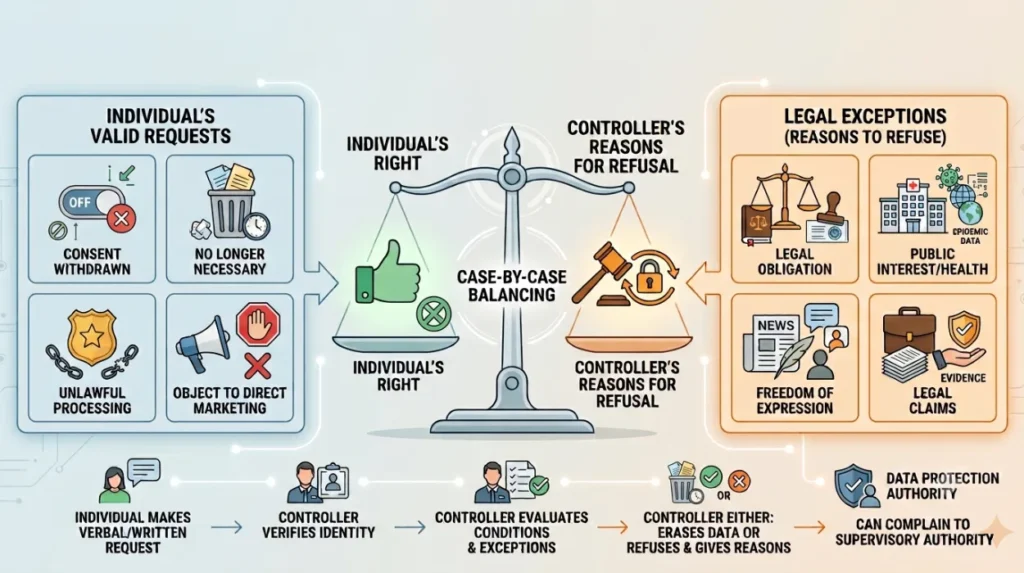
The Right to Erasure is not an automatic removal right because organisations evaluate every request against statutory exemptions and competing legal obligations.
Data protection law protects privacy while also recognising rights relating to freedom of expression, legal compliance, public health, scientific research and the administration of justice. These legal considerations create circumstances where organisations retain personal information despite receiving an erasure request. Decision-makers therefore balance individual privacy rights against wider legal responsibilities before determining the appropriate outcome. This structured approach preserves fairness across the data protection framework.
From a search ecosystem perspective, retained information continues contributing to publicly available reputation signals where lawful publication remains justified. Erasure rights therefore operate within a legal framework rather than functioning as unrestricted reputation management tools.
How does online content affect search visibility?
Online content affects search visibility because search engines discover, index and organise publicly available information before presenting it within search results.
Search algorithms evaluate indexed content using relevance, authority, freshness and contextual relationships to determine visibility across search engine results pages. Personal information published on websites, news platforms, blogs and public records contributes to digital identity because search engines associate this information with identifiable individuals. Indexed content therefore influences entity perception regardless of whether the information remains current or outdated.
Content indexing also affects long-term reputation because information continues appearing in search results while it remains publicly accessible. Changes in source content influence search visibility only after search engines reassess and update indexed information.
How do search engines interpret reputation signals?
Search engines interpret reputation signals by evaluating the quality, consistency and authority of publicly available information associated with an identifiable entity.
Reputation signals include published articles, official records, verified profiles, structured data and other authoritative references contributing to entity credibility. Search systems compare these signals to understand relationships between people, organisations and publicly available information. Accurate and trustworthy information strengthens online credibility, whereas inconsistent or outdated content affects search perception over time. Search engines therefore evaluate reputation through information quality instead of personal opinion.
Understanding how to submit a GDPR Right to Erasure request that Google is likely to accept provides additional context because successful requests depend upon satisfying legal criteria, presenting appropriate evidence and following structured submission procedures rather than relying solely on the existence of personal information.
How does content indexing influence digital reputation?
Content indexing influences digital reputation because indexed information becomes accessible through search engine results and contributes to long-term online visibility.
Search engines continuously discover, organise and store publicly available content within searchable indexes. Once indexed, personal information becomes associated with an identifiable individual and contributes to digital footprint development. Even older information continues influencing entity perception while it remains indexed and publicly accessible. Search visibility therefore depends not only on publication but also on how search systems process and present information across search engine results pages. Content indexing acts as the connection between published information and ongoing online reputation.
What is the relationship between the Right to Erasure and search engine indexing?
The Right to Erasure regulates personal data processing, while search engine indexing determines how publicly available information is organised and displayed.
An approved erasure request generally concerns the deletion of personal information held by a data controller rather than directly changing search engine rankings. When information is removed from its original source, search engines eventually reassess the indexed content through normal crawling and indexing processes. This sequence demonstrates that data protection law and search engine operations function through separate but related mechanisms. Erasure affects the availability of source information, whereas indexing reflects the current state of publicly accessible content.
The interaction between legal data protection and search indexing follows a structured process.
- Remove source data by deleting qualifying personal information where legal grounds for erasure apply.
- Update indexed records as search engines revisit the original source during subsequent crawling cycles.
- Reassess search visibility by evaluating the revised information available within the updated index.
- Reflect current information across search engine results pages as indexing systems incorporate the latest content.
Each stage demonstrates that search visibility changes after lawful data management actions rather than through immediate ranking adjustments.
Why do authority and trust signals remain important?
Authority and trust signals remain important because search engines evaluate the reliability and credibility of publicly available information before determining visibility.
Authority signals originate from recognised publishers, official organisations, verified sources and consistently reliable information. Trust signals reflect accuracy, transparency and the ongoing credibility of indexed content. Search systems combine these indicators when evaluating entity perception across search engine results pages. Strong authority and trust signals improve the reliability of information presented to users while supporting accurate digital identities.
Data protection decisions interact with these signals by determining whether certain personal information continues forming part of an individual’s publicly accessible digital footprint. The evaluation therefore extends beyond privacy rights into broader information quality considerations.
How does the digital footprint influence online credibility?
The digital footprint influences online credibility because it represents the accumulated body of information associated with an identifiable individual across digital platforms.
Search engines interpret this information collectively rather than evaluating isolated pieces of content independently. Published articles, public records, directories, media references and personal information all contribute to the development of reputation signals. Consistent, accurate and lawfully maintained information strengthens entity credibility, while outdated or unnecessary personal information alters search perception. Digital footprint management therefore depends upon understanding both legal data protection principles and search ecosystem behaviour.
The GDPR Right to Erasure contributes to this process by defining when qualifying personal information becomes eligible for lawful deletion. Its purpose is to regulate data processing within legal boundaries instead of controlling reputation through unrestricted information removal.
The GDPR Right to Erasure establishes a legal mechanism allowing individuals to request the deletion of personal information when specific statutory conditions apply. Its application depends on defined legal grounds, balanced against exemptions relating to freedom of expression, legal obligations and the public interest. The right therefore regulates lawful data processing rather than guaranteeing automatic removal of online content.
Search engines continue evaluating indexed information according to relevance, authority and trust signals, making digital reputation closely connected to both legal data protection and search ecosystem processes. Understanding how erasure rights, content indexing and reputation signals interact provides a clearer explanation of how personal information influences online credibility and long-term search visibility.
What does the GDPR Right to Erasure cover?
The GDPR Right to Erasure covers personal data that qualifies for deletion under specific legal grounds set out in UK GDPR and EU GDPR. It applies where processing is no longer lawful or necessary, subject to legal exemptions and public interest considerations.
When can I request the removal of my personal information under GDPR?
You can request erasure when your personal data is no longer required for its original purpose, consent has been withdrawn, processing is unlawful or another legal ground under GDPR applies. Each request is assessed individually against the applicable legal criteria.
Does the GDPR Right to Erasure remove content from Google search results automatically?
No. The GDPR Right to Erasure applies to the processing of personal data by data controllers rather than automatically removing search results. Search engines update indexed content after changes occur at the original source and following their normal indexing processes.
What are Personal Information Removal Services?
Personal Information Removal Services assess whether online content qualifies for removal under applicable privacy laws, platform policies or legal procedures. Clear Your Name provides guidance on these processes, while the final decision remains with the relevant organisation or platform.
Can removing personal information improve my online reputation?
Removing qualifying personal information can reduce the visibility of outdated or unnecessary content and improve the accuracy of reputation signals over time. As search engines update their indexes, entity credibility and online perception may better reflect current and relevant information.