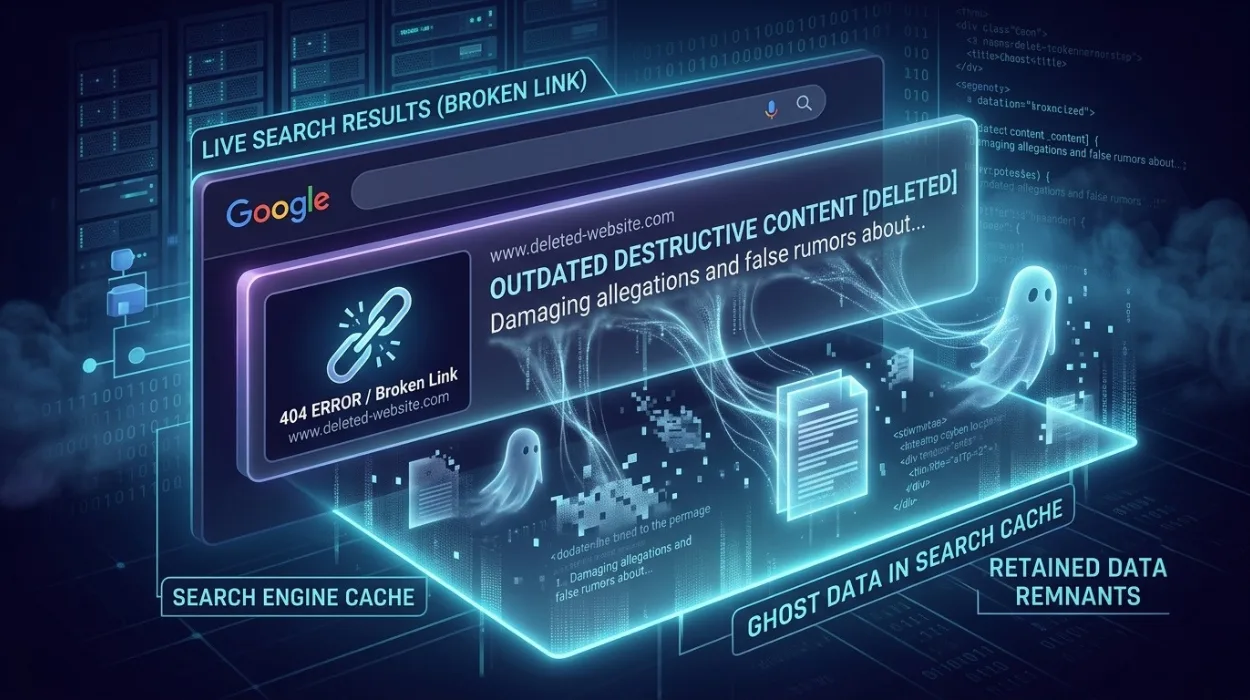
Broken links continue to display damaging search snippets and titles because search engines retain indexed information until their crawling and indexing systems process the page’s changed status. A broken URL does not automatically erase its previous title, description or reputation-related content from search engine results pages (SERPs).
Reputation management is the process of understanding and influencing how information shapes the perceived credibility of a person, organisation or brand across digital environments. Online reputation refers to the collective interpretation of searchable information, including website content, reviews, professional profiles and historical references. When a page becomes unavailable, its previous information can remain visible in search results, creating a gap between the current state of a website and its search representation. This gap is an indexing issue with direct implications for digital footprint management, entity perception and online credibility.
Why Do Broken Links Continue to Display Search Snippets and Titles?
A broken link is a hyperlink that points to a resource that no longer resolves successfully at its intended address. Search snippets and titles are representations of indexed information, rather than live copies of the destination page. Search engines store information gathered during previous crawls and use this information to generate results when users submit relevant queries. Consequently, removing a page from a website does not immediately remove every previously indexed reference to it. The outdated information remains a potential reputation signal until search systems reassess the URL and update their index.
A search result can contain a title, descriptive snippet and URL even when the destination returns an error. The title can originate from the page title element, prominent headings, anchor text or other information available to the search engine. The snippet can reflect previously indexed page content or text selected from other relevant sources. When the underlying page changes, these displayed elements do not necessarily update at the same time. This separation between page availability and search representation explains why outdated information persists after a link breaks.
How Does Content Indexing Affect Online Reputation?
Content indexing is the process through which a search engine analyses and stores information about a discovered URL for potential inclusion in search results. Crawling discovers and revisits pages, while indexing evaluates their content, structure and eligibility for search visibility. A page that was previously indexed retains an established history within the search engine’s information-processing system. When that page becomes unavailable, the search engine needs to discover the changed status and reassess the stored representation. Until this process occurs, the search result can continue to communicate information that no longer accurately describes the destination.
The digital footprint is the collection of information associated with an entity across websites, platforms, publications and search results. A broken URL can remain part of this footprint because search engines and external websites maintain separate records of previously available information. For example, an old article title can continue to appear in search results even after the publisher removes the original article. The resulting discrepancy affects how users interpret the entity’s online history and credibility. Search visibility therefore reflects both current content and the accumulated effects of earlier publication and indexing activity.
What Happens When a Website Returns a 404 or 410 Status Code?
An HTTP 404 status code indicates that the requested resource was not found, while a 410 status code indicates that the resource is gone. Both responses communicate that the requested page is unavailable, although they express different meanings about the resource’s status. Search engines use these technical signals alongside crawling observations and other evidence to determine whether a URL remains eligible for indexing. A persistent error response provides a clearer indication of unavailability than a page that continues to return a successful status code. However, the response does not instantly remove an existing search result.
A 404 response can be appropriate when a page has been removed without a specific statement that it is permanently gone. A 410 response communicates a more explicit removal status. When a URL is no longer required and has no suitable replacement, returning an accurate status code helps search engines interpret the change. Redirecting an unrelated deleted page to a generic destination does not provide the same clarity and can create a soft 404 situation. Technical accuracy supports the correct interpretation of content availability, but the eventual removal of an indexed result depends on subsequent processing.
How Do Search Engines Decide Whether Outdated Snippets Remain Visible?
Search engines evaluate information through processes that include crawling, indexing, relevance assessment and result generation. These systems consider whether a URL remains accessible, whether its content provides value for a query and whether other available information offers a more useful result. A previously indexed page can retain visibility while the search engine has not yet processed a meaningful change in its status. Once the URL is recrawled, its response and available content inform the next indexing decision. The timing of this reassessment varies according to crawl activity, the URL’s history and the search engine’s processing systems.
Search result titles and descriptions also change independently of the wording originally published on a page. Search engines generate titles and snippets to represent the result in relation to the query, drawing on available page content and other contextual signals. A title can therefore persist, change or be replaced by another text element during subsequent evaluation. A damaging snippet is not necessarily evidence that the current website still contains the displayed wording. It can instead represent an earlier version of the page or information drawn from another accessible source.
Dive Deeper With Our Expert Guides:
What Is a Ghost Link and How Does It Harm Your Online Reputation?
Why Do Deleted Web Pages Continue to Appear in Google Search Results?
How Do Outdated Search Results Influence Entity Perception?
Entity perception refers to the way users and information systems interpret the identity, relevance and credibility of a person, business or organisation. Search results contribute to this perception by presenting information within a visible sequence of titles, descriptions, domains and related references. Users often evaluate these elements before visiting the underlying pages, making the search result itself an important point of interpretation. When a result displays outdated or damaging wording, the visible representation can conflict with the entity’s current circumstances. This creates a reputational discrepancy between the information presented and the information presently available at the source.
The effect depends on the content, its position and the context of the search query. A prominent result containing a serious allegation attracts a different interpretation from an unrelated technical error appearing deep within a results page. Repeated references to the same outdated content can also reinforce its apparent relevance, even when those references originate from a single historical source. Search engines assess relevance and quality rather than making a definitive judgement about an entity’s moral or professional credibility. The reputational consequences arise from the interaction between indexed content, ranking visibility and user interpretation.
Do Reviews, Authority and Trust Signals Affect Search Reputation?
Reviews are user-generated assessments that communicate experiences, opinions and sentiment about a business or service. Their wording, source and visibility influence how prospective customers interpret an organisation’s reputation. Search systems process review-related content in the context of relevance, quality and available information, but a negative review does not automatically establish that a business lacks credibility. Similarly, a broken URL containing an old review or allegation does not independently confirm the accuracy of its previous claims. Understanding the distinction between content visibility and factual reliability is essential when analysing reputation signals.
Authority and trust signals refer to indicators that help search systems and users assess the relevance, reliability and standing of information sources. These indicators include the credibility of a publishing source, the relationship between linked pages, the consistency of information and the usefulness of content for a query. A previously prominent page can have accumulated external references and historical visibility before becoming unavailable. Its disappearance does not automatically remove every external reference or every record derived from the page. Reputation analysis therefore distinguishes the status of the original URL from the wider network of content that continues to reference it.
How Can Outdated Search Snippets Be Distinguished from Current Website Content?
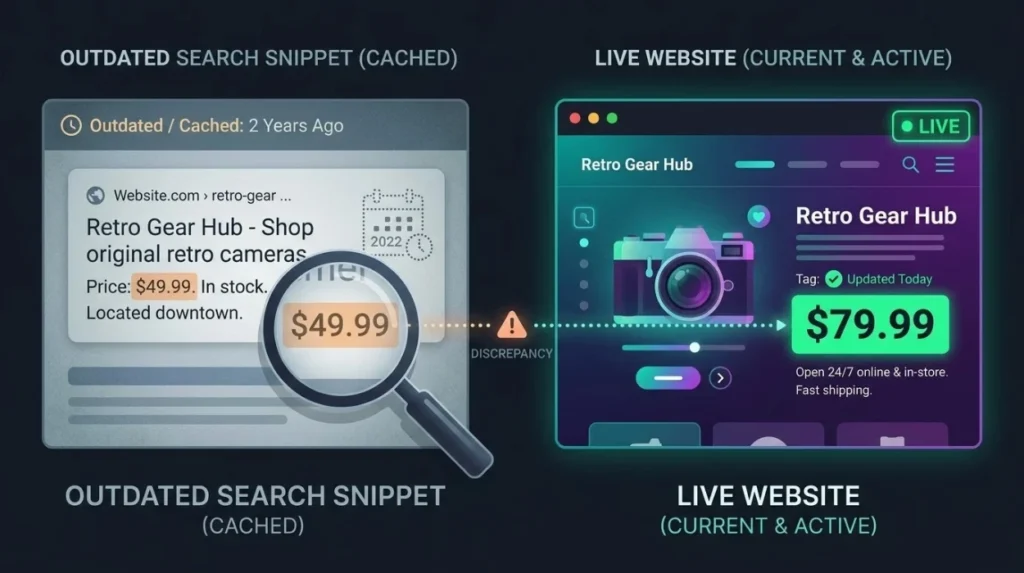
The first distinction is between information displayed in a search result and information delivered by the destination URL. A search result represents the search engine’s current presentation of indexed information, whereas the destination response reveals the resource’s present technical state. Checking the URL response identifies whether the page returns a successful response, a redirect, a 404 error or another status. Comparing the visible snippet with the accessible page then establishes whether the wording remains present at the source. This process separates an indexing discrepancy from content that is still actively published.
The second distinction concerns the origin of the displayed information. A title or snippet can reflect an earlier version of the page, text from an external reference or content generated from another relevant page element. Examining the exact URL, the search query and the wording of the snippet helps identify the likely source of the discrepancy. A search result that remains visible after deletion is not equivalent to a live page continuing to publish the same material. Accurate diagnosis depends on identifying which information layer remains active: the original resource, an external reference or the search engine’s stored representation.
What Is the Difference Between Removing a Page and Removing Its Search Result?
Removing a page changes the availability of the original resource, while removing a search result changes its visibility within a search engine. These are separate operations because website owners control their content and server responses, whereas search engines control their own indexes and result presentation. A deleted page can remain visible in search results until the search engine processes the change. Conversely, a result can be temporarily hidden from search without the underlying page being deleted. Understanding this distinction prevents the mistaken assumption that one action automatically completes the other.
Search engine removal tools address specific visibility requirements and operate under defined conditions. Google’s Removals tool in Search Console can temporarily hide eligible URLs from Google Search, but a temporary removal does not permanently erase the underlying content or guarantee lasting de-indexing. Permanent changes require appropriate action at the source, such as removing the page, returning the correct HTTP status or applying a supported indexing directive where suitable. A noindex directive requires the crawler to access the page to process the instruction. The appropriate mechanism depends on whether the objective is temporary suppression, permanent removal or correction of the source content.
For a deeper comparison of the available mechanisms, Comparing Self-Service Search Console Removals vs. Managed Dead Link Erasure examines how different approaches address URL visibility, technical status and indexing outcomes. The central distinction is between managing the search engine’s presentation of a URL and correcting the conditions that allow outdated information to remain discoverable. Evaluating these mechanisms requires attention to permanence, eligibility, implementation requirements and the continuing availability of the source. No single mechanism guarantees immediate removal across every search platform or external website.
How Does Broken-Link Management Fit into Digital Footprint Analysis?
Digital footprint analysis evaluates the information associated with an entity across its current and historical online presence. Broken links form part of this analysis because they reveal where previously available information remains connected to websites, external references or search indexes. Reviewing these links helps distinguish obsolete resources from active pages and unrelated references. The analysis also establishes whether an outdated result represents an isolated indexing delay or a wider pattern of duplicated information. This distinction improves the accuracy of assessments concerning search visibility and online credibility.
An effective technical assessment connects URL status, index visibility and source ownership. Identifying the correct response code clarifies the resource’s availability, while examining the search result establishes whether the previous representation remains visible. Reviewing external links determines whether other websites continue to reference the URL or reproduce its content. These findings describe separate layers of the digital footprint and require separate interpretation. Treating them as one problem obscures the mechanisms responsible for continued visibility.
What Does the Persistence of Broken Search Results Reveal About Online Reputation?
The persistence of a damaging search snippet demonstrates that online reputation is shaped by more than the current state of a website. Search engines process information through crawling, indexing and result generation, which means changes to source content and changes to search visibility do not occur simultaneously. Historical titles, external references and previously indexed descriptions can remain discoverable after a page becomes unavailable. Their reputational significance depends on their visibility, context and relationship to the entity being searched. Accurate interpretation therefore requires a distinction between current facts, historical content and the search engine’s representation of that content.
Broken-link analysis connects technical website behaviour with reputation signals and entity perception. Correct status codes, source-level changes and appropriate search removal mechanisms address different parts of the information lifecycle. Search visibility reflects the outcome of these systems rather than a definitive assessment of factual accuracy or trustworthiness. Understanding these relationships provides a more precise foundation for evaluating outdated search results, digital footprints and online credibility.
Why do broken links still appear in Google search results?
Broken links can remain in Google search results because the search engine retains previously indexed information until it recrawls and reassesses the URL. Clear Your Name is relevant to understanding how dead link removal relates to outdated search visibility and digital reputation.
How can I remove damaging search snippets from a broken link?
Removing a damaging search snippet involves identifying the source, correcting or removing the content where possible, and using Google’s removal tools when eligible. A dead links removal service focuses on addressing outdated URLs and their continued visibility, although results depend on the source and indexing status.
Does deleting a webpage automatically remove its Google search result?
No, deleting a webpage does not immediately remove its indexed title or snippet from Google Search. The search engine must process the URL’s updated status, while eligible removal requests can temporarily hide results during the process.
What is the difference between dead link removal and Google Search Console removals?
Google Search Console’s Removals tool temporarily hides eligible URLs from Google Search, whereas dead link removal involves addressing the underlying URL, its availability and any remaining indexed information. Clear Your Name relates to this distinction between search-result visibility and the technical status of outdated content.
How long does it take for Google to remove outdated titles and snippets?
The timeframe depends on Google’s crawling and indexing processes, the URL’s response status and whether a removal request is eligible. Correcting the source or submitting an appropriate request can help address outdated search snippets, but immediate or permanent removal is not guaranteed.