Google decides whether to remove a website from its search results by evaluating whether the page or domain violates its policies, legal rulings, or established guidelines for safety, legality, and credibility. Reputation management is the systematic oversight of how information about an entity is created, indexed, and interpreted across digital channels. Online reputation refers to how a brand or individual is perceived through the interplay of search results, reviews, content, and media coverage.
How does Google determine when a website should be de‑indexed?
Google de‑indexes a website when it judges that the page or domain no longer complies with its Webmaster Guidelines, legal requirements, or safety standards. This decision is not a simple binary; it is based on an assessment of content risk, platform rules, and user‑protection principles within search ecosystems.
Dive Deeper With Our Expert Guides and Related Blog Posts:
How a Website Removal Service Approaches Cases Where Platforms Refuse to Act
What Grounds Are Required to Get a Website Taken Down in the UK Legally
Within SERP evaluation, removal begins with content indexing analysis. Google’s crawlers and quality‑control systems flag content that exhibits patterns such as spam, malware, deceptive practices, or policy violations. When these signals accumulate, automated systems or human reviewers may trigger a reduction in ranking, containment in search, or full de‑indexing. The severity of the violation and the scope of the affected URLs determine the level of suppression.
Google also responds to formal removal requests. When a rights holder, regulator, or court issues a notice asserting legal grounds—such as copyright infringement, defamation, or privacy violations—Google evaluates the claim against its own policy criteria. If the notice is valid and correctly scoped, the search engine may remove or demote specific URLs from search results, even if they remain live on the web.
From a reputation perspective, these mechanisms mean that search visibility is not absolute. A website can retain its hosting and domain while disappearing from Google’s SERPs, which alters how users and algorithms interpret its presence and credibility. The de‑indexing decision effectively recalibrates the entity’s visibility footprint without necessarily altering the underlying content on the server.
What legal and policy reasons can force a website’s removal from Google?
A website can be removed or de‑listed from Google when it breaches legal obligations or platform policies that govern search visibility, safety, and legitimacy. These reasons are not arbitrary; they are structured around specific categories of non‑compliance, each with defined criteria and enforcement pathways.
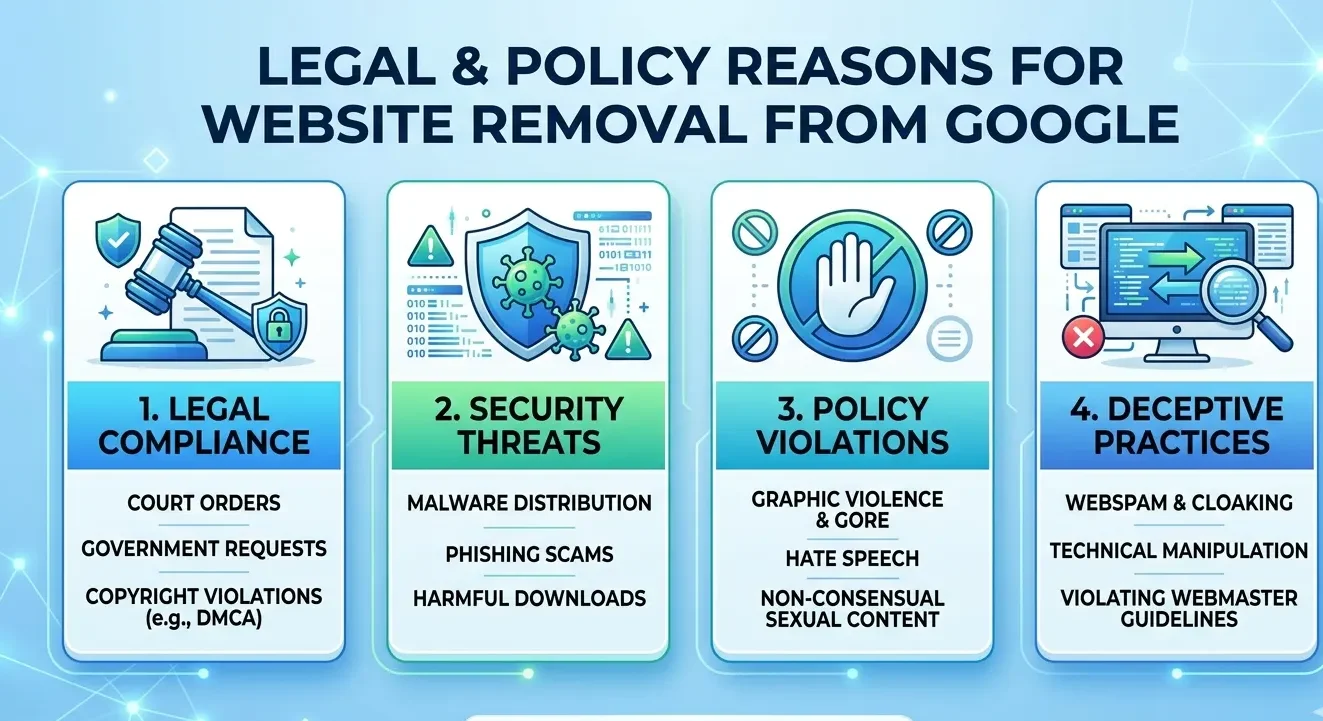
Within search ecosystems, illegal content is a primary trigger for removal. Google may de‑index pages that host child sexual abuse material, promote terrorism, or facilitate other criminal activity. These categories are aligned with international norms and national laws, and they are treated as high‑risk violations that justify rapid removal or containment in search results.
Policy‑based reasons include spam, cloaking, and deceptive techniques designed to manipulate rankings. A website that systematically generates low‑quality content, re‑links forbidden phrases, or hides content from search engines may be penalised with reduced visibility or complete removal. Google evaluates such sites through spam‑detection systems and manual review workflows, applying consistent thresholds to determine the degree of suppression.
Legal‑based removals occur when third‑party rights intersect with search visibility. Copyright takedown notices, defamation claims, and certain privacy‑based requests can prompt Google to delink or de‑index specific URLs. The platform does not automatically assume guilt; it validates the notice format, jurisdiction, and factual basis before acting. This process reflects how legal frameworks and platform rules jointly shape what appears in search.
How do search engines distinguish between removal and ranking demotion?
Search engines distinguish between removal and ranking demotion by applying different technical and policy mechanisms to how content is indexed and positioned. Both reduce visibility, but they operate at different levels and carry distinct implications for reputation and entity perception.
Removal, in search terms, means that a URL is no longer included in Google’s index or is actively blocked from appearing in SERPs. This is typically applied to content that violates clear safety, legal, or policy thresholds. Once removed, the page will not surface in standard organic results, even if it remains accessible on the web through direct links or other platforms.
Ranking demotion is less absolute; it leaves the page indexed but pushes it down the results or out of prominent positions. This often occurs when content is low‑quality, untrustworthy, or manipulative, but not illegal. Search engines use algorithmic signals—such as user‑engagement data, spam likelihood, and trust metrics—to determine how far to demote a page without fully removing it.
From a reputation perspective, removal has a stronger signal than demotion. A page that disappears from search sends a clear message that it was judged non‑compliant with core standards. A demoted page, by contrast, signals weakened credibility; users may still encounter it if they navigate beyond the first page of results. Both mechanisms therefore influence how observers interpret the legitimacy and reliability of the website.
How do takedown requests influence which websites Google removes?
Takedown requests influence which websites Google removes by triggering a formal review process that combines legal eligibility, policy alignment, and technical scope. These requests do not automatically erase content; they initiate a structured evaluation that determines whether removal or suppression is justified.
Within search ecosystems, takedown requests are typically submitted under specific frameworks and effective routes such as copyright law, data‑protection regulations, or defamation statutes. Each request must meet defined criteria, including accurate identification of the URL, explanation of the legal or policy basis, and proof of rights where applicable. Google’s systems validate these elements before acting.
The impact on search visibility depends on the request’s validity and coverage. When a compliant notice is accepted, Google may de‑index the named URLs or issue regional delisting if the legal basis is jurisdiction‑specific. This means that the same page can disappear from search results in one country while remaining visible in another. The process highlights how legal boundaries and platform rules jointly shape global SERP composition.
From a reputation management standpoint, takedown requests are one of several signals that search engines monitor. A sudden influx of legitimate notices can prompt closer scrutiny of the affected domain, which may lead to broader ranking adjustments or content‑quality reassessments. However, Google does not use requests alone as a primary ranking signal; they modify what is visible, rather than recalibrate the entire reputation footprint.
What does a website’s removal from search mean for its online reputation?
A website’s removal from search has a significant but not absolute effect on its online reputation because it alters how and how often that content appears in search results. Online reputation refers to the composite perception formed from search visibility, content signals, and external references, and de‑indexing shifts that balance.

Within SERP evaluation, removal reduces the likelihood that users will encounter the website through organic queries. This can lower the apparent prominence of any negative or controversial content hosted on the site, which in turn reduces its gravitational pull on entity perception. However, removal does not erase the content from the web; it persists on the server and can still be shared via social channels, forums, or direct links.
Search engines interpret removal as a signal of non‑compliance or risk. When a domain is repeatedly associated with takedowns, policy violations, or safety issues, its broader reputation signals may be downgraded. Algorithms may treat future pages from the same host as higher‑risk, which can reduce indexing depth and ranking potential. In this way, repeated removal‑related events contribute to a weakened overall credibility assessment.
For the entity associated with the website removal can stabilise reputation in search but does not resolve underlying reputational issues. If the reasons for removal relate to factual inaccuracy, legal dispute, or policy breach, observers may still form judgements based on off‑search discourse. Reputation management therefore extends beyond de‑indexing to include how narratives are contested, clarified, and contextualised across the wider digital footprint.