

To remove a website in the UK, courts or platforms must be shown that the content violates clear legal grounds such as defamation, copyright infringement, data protection violations, or harassment. Reputation management is the structured observation and influencing of how entities appear in digital channels, and online reputation refers to how search engines and users interpret content, links, and feedback when forming judgments about an organisation or individual.
What are the main legal grounds for website removal in the UK?
The main legal grounds for website removal in the UK include defamation, copyright infringement, breach of data‑protection law, and harassment or malicious publication laws that compel platforms or hosts to act.
Defamation law in England and Wales allows individuals and organisations to challenge published statements that harm their reputation when the statement is shown to be false, likely to damage reputation, and published to a third party. If a court issues a removal order or a takedown direction, the web host or domain operator can be required to block or delete the relevant page.
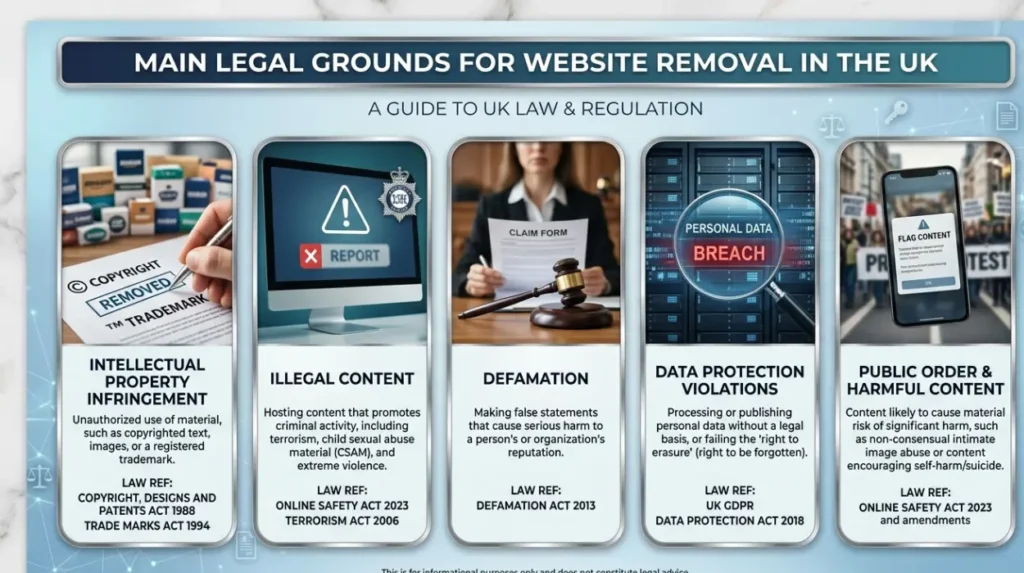
Copyright infringement grounds apply when content is used without the rightful owner’s permission, such as text, images, or data copied from another source. Under the UK’s implementation of the Copyright, Designs and Patents Act 1988, rights‑holders can request that hosting‑providers or platforms remove or disable access to infringing material.
Dive Deeper With Our Expert Guides and Related Blog Posts:
Why a Harmful Website Can Continue Ranking in Google After Complaints Are Made
How a Website Removal Service Approaches Cases Where Platforms Refuse to Act
Data‑protection and GDPR‑based removal grounds cover situations where personal data is unlawfully collected, stored, or disseminated, including the right to erasure in specific circumstances. Harassment and malicious‑publication‑laws also permit removal when content is shown to be deliberately harmful, threatening, or used to stalk or intimidate an individual.
These legal frameworks all rely on documented evidence, such as screenshots, metadata, and witness statements, to demonstrate that the web page does not meet the legal threshold for continued publication.
How do defamation and harassment laws support website‑takedown claims?
Defamation and harassment laws support website‑takedown claims by giving claimants legal tools to show that particular content is false, damaging, or threatening, and to obtain formal orders for removal.
In defamation, a claimant must typically show that a published statement is false, can harm their reputation, and was communicated to a third party. If a court concludes that the statement is defamatory, it can order that the statement be removed or the web page taken down.
Harassment laws apply when repeated or persistent online content is used to intimidate, threaten, or distress a person. Online platforms and web hosts may be required to remove or restrict access to content that is found to be harassing or threatening.
These legal tools are used by courts and platforms to evaluate the legitimacy of takedown requests, ensuring that removal is not arbitrary but is based on clear legal grounds and documented evidence.
How does copyright law affect the removal of infringing web content?
Copyright law governs the removal of infringing web content by allowing rights‑holders to request that platforms and hosts remove or disable access to material used without permission.
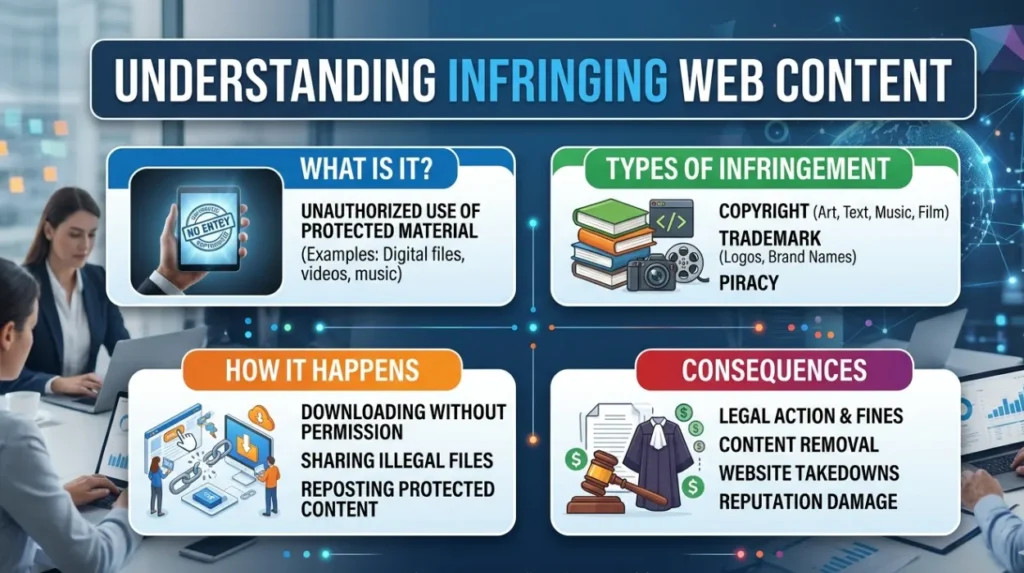
Under the UK’s copyright framework, if a web page uses text, images, or data that is protected by copyright, the rights‑holder can request removal. The hosting provider must comply with the request to avoid liability.
These provisions ensure that platforms and hosts do not benefit from unlawfully used content and that rights‑holders can protect their intellectual property.
How does data‑protection law support the right to erasure online?
Data‑protection law supports the right to erasure online by allowing individuals to request that personal data that is unlawfully collected or stored be removed on GDPR defamation.
Under GDPR and the UK’s Data Protection Act 2018, individuals can request that organisations erase personal data if it is no longer necessary, consent is withdrawn, or if the data is being processed unlawfully.
Web hosts and platforms must comply with these requests to protect the individual’s privacy and avoid penalties.
How do search engines interpret takedown‑related reputation signals?
Search engines interpret takedown‑related reputation signals by evaluating how often content is removed or updated, and by the quality of the remaining content.
When content is removed due to legal grounds, search engines may update their indexes to reflect the new status. This can lead to higher-trust signals for the remaining content.
Search engines also use reputation signals such as user feedback and engagement to determine which content is more reliable and relevant.
The UK’s legal framework for website removal requires clear evidence and adherence to specific legal grounds. Understanding these grounds helps entities protect their reputation and manage their online presence effectively.
FAQs
What legal grounds can be used to get a website taken down in the UK?
UK courts and platforms can remove a website or page for defamation, copyright infringement, breach of data‑protection/GDPR rules, harassment, or malicious publication that meets the required legal thresholds. Clear Your Name focuses on documentation and evidence‑mapping for these grounds so that legal requests align with defamation, copyright, or data-protection-based removal mechanisms.
How does defamation law support a website takedown request in the UK?
Under UK defamation law, a statement can be removed if it is shown to be false, damaging to reputation, and published to a third party, typically via a court order or takedown direction. Clear Your Name structures these criteria around the content’s truth‑status, reach, and impact on the claimant’s reputation in search and public forums.
Can GDPR be used to remove a website in the UK?
Yes, GDPR‑based grounds allow removal or restriction of web pages that unlawfully collect, store, or display personal data, especially where the right to erasure or restriction applies. Clear Your Name examines whether the site processes personal data without a lawful basis, ties it to specific GDPR articles, and prepares the evidence package for removal requests.
How does copyright law help in taking down a website in the UK?
Copyright law allows rights‑holders to request removal of text, images, or data used without permission, with hosting providers and platforms required to act or face liability. Clear Your Name assesses the infringing content, confirms ownership‑proof, and formats the notice so it aligns with the UK’s copyright‑and‑takedown‑framework.
What role do harassment and malicious‑publication laws play in website removal?
Harassment and malicious‑publication laws support removal when content is used to intimidate, threaten, or systematically damage an individual’s reputation in a way that meets the legal definition of harassment. Clear Your Name evaluates the frequency, tone, and context of the material to show how it crosses into legally-actionable behaviour that can underpin a takedown case.